
Chinese banks extended just CNY 60 billion in new loans in August 2026, against a median economist forecast of roughly CNY 400 billion. That is less than one-sixth of what the market expected, and it is not a rounding error inside a healthy system.
It is a visible signal that something structural is shifting inside the world’s second-largest economy. What makes it stranger is Beijing’s response, which runs directly against what a finance-educated reader would expect: when credit weakens this sharply, central banks usually ease. The People’s Bank of China (PBoC) has done the opposite.
This is not a one-month wobble. Outstanding yuan loan growth has slowed from roughly 12% three years ago to approximately 5% year-on-year in August 2026, a record low. PBoC Governor Pan Gongsheng has publicly endorsed that deceleration as consistent with high-quality growth, and rather than reach for the monetary toolkit, Beijing has pivoted toward trade diplomacy as its main near-term growth lever, most visibly through the May 2026 Xi-Trump summit.
Here is the framework for reading these signals together, rather than in isolation: why the PBoC’s inaction is itself a policy statement, how the diplomacy pivot connects to the domestic credit picture, and what the combination means for China-exposed assets in the months ahead.
What China’s August credit collapse actually tells you
Start with the headline number and let its scale land. New yuan loans of CNY 60 billion in August 2026 came in against a median forecast of CNY 400-404 billion, according to Reuters and Bloomberg calculations from PBoC data released on 14 September 2026. A miss of that magnitude is rare even in a slowing economy.
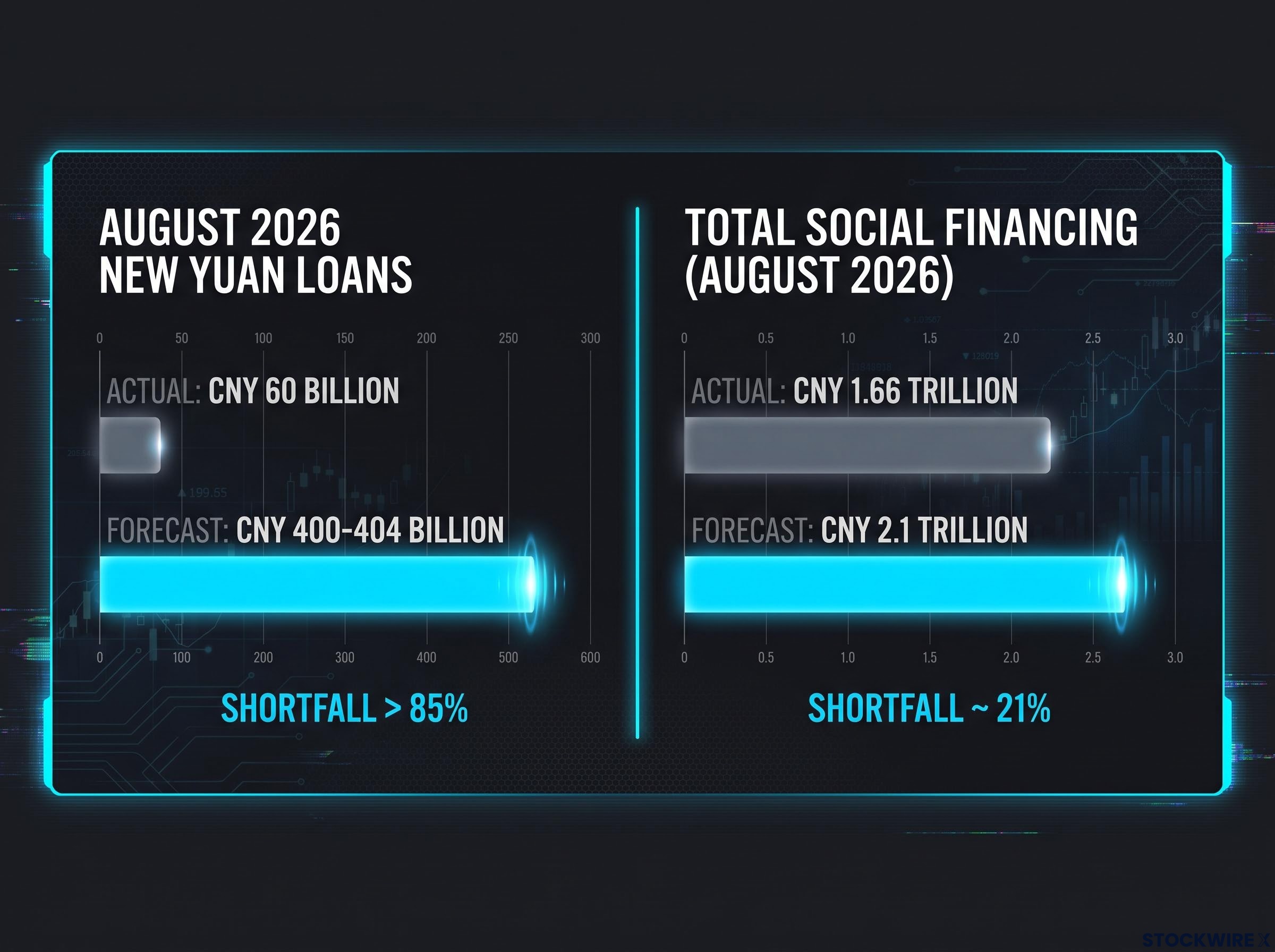
The broader credit measure told the same story. Total Social Financing (TSF), which captures the full flow of credit into the economy including bank loans, bonds, and off-balance-sheet lending, rose about CNY 1.66 trillion in August against a CNY 2.1 trillion forecast. M2 money supply growth also came in below consensus.
The August figures did not appear out of nowhere. They followed the most severe month on record.
In July 2026, borrowers in China’s real economy net-repaid approximately CNY 590 billion in local-currency loans, the largest net repayment in data going back to 2002. Including inter-bank lending, overall loans shrank by roughly CNY 340 billion.
Here is the composition detail that matters most before anyone declares a bottom. Government bond issuance contributed around CNY 1 trillion of August’s TSF total. Strip that fiscal support out, and the private-sector picture is far weaker than the headline financing figure suggests, with household loans alone contracting by about CNY 203 billion.
| Indicator | August 2026 Actual | Median Forecast | Year-on-Year Change |
|---|---|---|---|
| New yuan loans | CNY 60 billion | CNY 400-404 billion | Not disclosed |
| Total Social Financing | CNY 1.66 trillion | CNY 2.1 trillion | +7.2% (down from +7.4%) |
| Outstanding yuan loans | Qualitative | Qualitative | +4.9-5% (record low) |
| M2 money supply | Below consensus | Not disclosed | Not disclosed |
The single monthly miss is dramatic, but it is the year-on-year trend that carries the real signal. A deceleration from 12% to 5% in outstanding loan growth over three years is not cyclical noise; it is a multi-year shift reaching its final stage of confirmation. If you track aggregate TSF as a leading indicator of recovery, the fiscal-versus-private split is the distinction that separates a floor from a foundation.
The same August data release that produced the loan miss also confirmed the two-speed economy dynamic at full stretch: exports accelerated 25.0% year-on-year while retail sales grew just 0.4%, with Nomura estimating that integrated-circuit and data-processing exports alone accounted for roughly 45% of total export growth, concentrating China’s trade performance in a single AI-driven demand cycle.
When big ASX news breaks, our subscribers know first
How the PBoC turned a credit miss into a policy statement
Two days after the data landed, the PBoC’s response arrived, and it was not what a weak print usually produces. Governor Pan Gongsheng published an article in Qiushi, the Communist Party’s theoretical journal, around 16 September 2026.
The venue tells you this was deliberate policy communication, not routine statistical commentary. Qiushi is where the Party sets out ideological and strategic direction, so placing an argument there signals intent from the top of the system, not a technocratic footnote.
PBoC liquidity signals from earlier in August told a more nuanced story: the 10-year Chinese government bond yield broke below 1.70% while the yuan simultaneously hit its strongest level since February 2023, a configuration that indicated the central bank faced no immediate trade-off between domestic stimulus and currency stability even before the credit miss data was published.
Pan’s argument reframes the slowdown entirely. Declining loan growth, in his telling, reflects a quality-over-quantity transition in Chinese finance, a feature of economic modernisation rather than a symptom of demand failure. Read that way, weak credit is not a problem to be solved with easing; it is progress to be tolerated.
Pan Gongsheng’s quality-over-quantity framing, reported by Reuters and published in the Economic Times on 16 September 2026, makes explicit that the PBoC regards slower loan growth as the new normal rather than a temporary shortfall requiring a policy response.
For markets, this is the important read. Pan’s public endorsement of slower credit is not reassurance. It is a signal that the PBoC is not preparing an easing cycle, and if you hold Chinese credit or rate-sensitive assets, you should price in the absence of stimulus rather than wait for a pivot that is not being telegraphed.
The demand-failure case the official narrative sidesteps
The competing interpretation, drawn from Bloomberg and Reuters coverage of the data, reads the same numbers very differently. Record net repayments and household deleveraging look less like a designed structural shift and more like a demand-side collapse rooted in property-sector stress and eroded confidence.
The property sector transmits into credit weakness through four reinforcing channels:
- Mortgage contraction: As property values stall or fall, households repay housing debt rather than take on new loans. August’s CNY 203 billion household loan contraction reflects this directly.
- Confidence destruction: Falling home values and developer stress dent household wealth perceptions, pushing families toward repayment and cash preservation over borrowing.
- Corporate deleveraging: Firms facing weaker demand and property-linked uncertainty repay debt or avoid fresh borrowing, suppressing business credit.
- Bank risk aversion: Lenders perceive higher credit risk from property-exposed borrowers and lend less aggressively even to those who qualify.
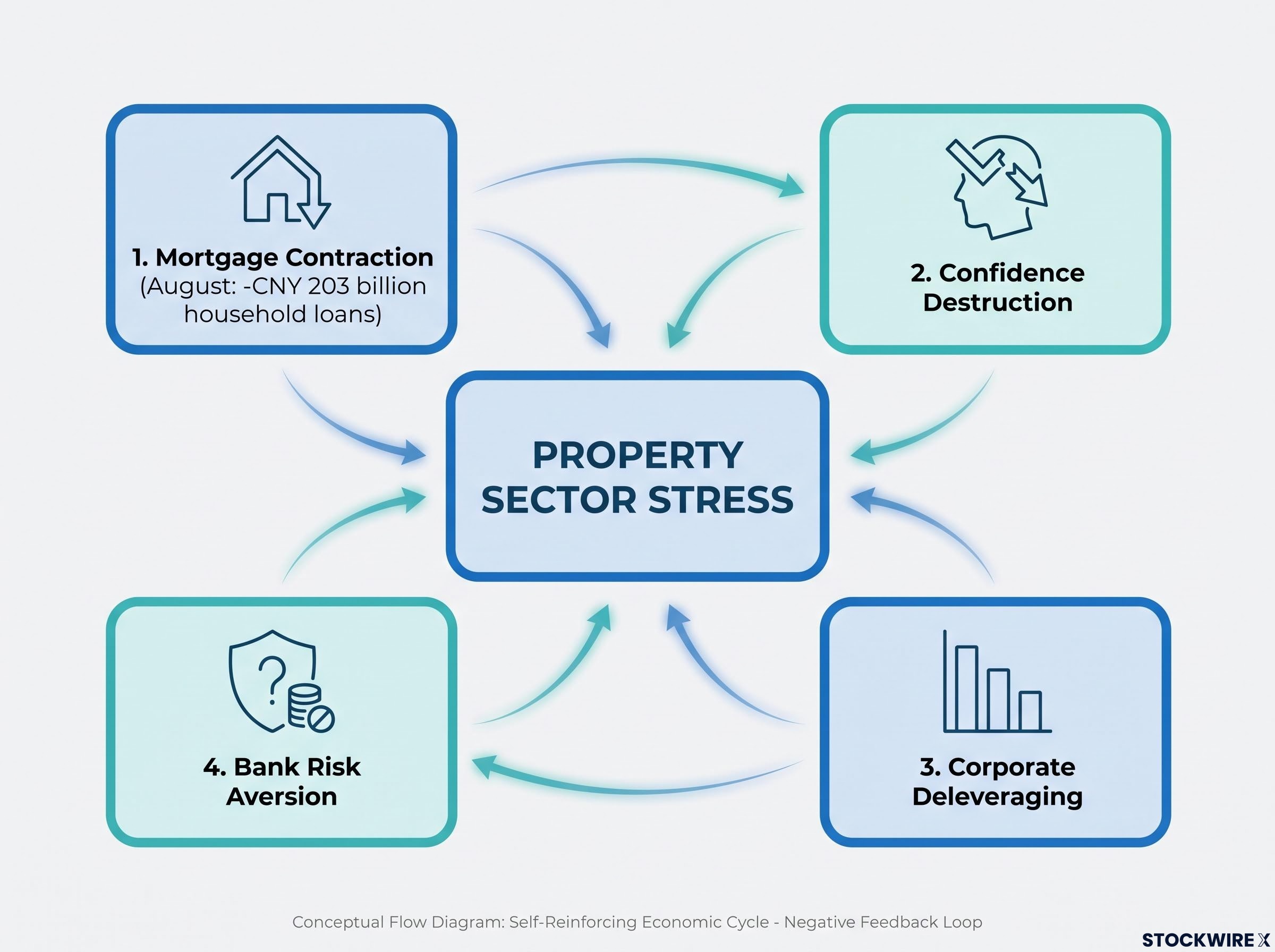
This pattern, net repayment and muted new lending even with credit available, mirrors the framework economists call a balance-sheet recession, most associated with Japan after 1990. No named analyst in the current coverage explicitly confirms the China-Japan parallel, so treat it as the established analytical lens rather than a settled verdict.
Materials sector deterioration provides the clearest on-the-ground confirmation of the property-credit feedback loop described above: cement output collapsed 11.6% year-on-year in July, cement sector profits fell 84% in H1 2026, and flat glass producers were permanently pulling capacity offline, all property-linked readings that the 4.5% aggregate industrial output headline actively concealed.
The mechanism is what matters here. It explains why credit is weak regardless of how Beijing chooses to frame it, and it leaves the reader holding two interpretations, each with its own internal logic, that the official narrative does not fully reconcile.
Why Beijing is betting on diplomacy where it will not deploy stimulus
Follow the logic of the constraints Beijing has set for itself. If the PBoC has framed monetary easing as inconsistent with its structural narrative, and fiscal channels are already doing the heavy lifting through government bond issuance, then the remaining lever is external: stabilise the trade environment.
That is the rational read on the diplomatic pivot. The most visible expression of it was the Xi-Trump summit in Beijing on 14-15 May 2026, which produced a set of concrete, if modest, commitments.
- China agreed to purchase at least US$17 billion of U.S. agricultural products per year through 2028.
- An initial order of 200 Boeing aircraft was placed.
- A Board of Trade and a Board of Investment were established under a reciprocal tariff-reduction framework.
- The tariff truce was extended through November 2026.
- Certain rare-earth export controls were suspended as part of the de-escalation.
Then the limiting case arrives. Both sides called the talks very successful, but the deal flow was thinner than the optics suggested.
Reuters described Trump leaving Beijing “with few wins but warm words for Xi.”
The BBC reported “very successful” talks but “few deals,” and the New York Times noted it was “not immediately clear what trade deals had been signed, if any” by the summit’s conclusion. Commerzbank’s FX Research has referenced an anticipated follow-on engagement around 24 September 2026 as a potential sentiment catalyst, though the broader press confirms only the May summit as a completed event. Treat that follow-on as pending rather than banked.
The IBA analysis of the Xi-Trump summit outcomes, published in July 2026, characterises the bilateral framing as one of constructive strategic stability while noting that tangible breakthroughs remained limited, a read that reinforces the tail-risk-reduction interpretation over a growth-catalyst one.
The structural mismatch is where the scepticism concentrates. Trade diplomacy does not touch weak household demand, property-sector balance-sheet stress, or subdued private investment, which are the actual drivers of the credit weakness laid out above.
For your read on China’s near-term trajectory, separate the sentiment value from the material impact. The gap between the diplomatic warmth and the concrete deals tells you the summit primarily reduced tail risk rather than injected growth, and a truce that expires in November 2026 buys time without resolving the underlying demand problem.
What the credit-diplomacy combination signals for China-exposed assets
Pull the threads together and the policy mix becomes legible. No near-term monetary easing, per Pan’s Qiushi framing. Fiscal support effectively capped at government bond issuance. External stabilisation resting on diplomacy that markets are treating as tail-risk reduction, not a growth catalyst.
That combination points to a backdrop of managed deceleration, not recovery and not crisis. Commerzbank’s FX Research frames a favourable summit outcome as capable of delivering a modest positive sentiment effect, which is a meaningful distinction: a sentiment lift is not the same as a durable fundamental re-rating of China-exposed assets.
The credit miss reinforces a K-shaped divergence that institutional research teams at Citi and Bloomberg Economics classified as structural rather than transitional from early 2026: semiconductor exports surging over 70% year-on-year while property investment collapses and consumer spending turns negative, a split that makes broad China exposure a fundamentally different risk profile from a GDP-growth proxy.
The external environment tightens the room to manoeuvre further. Commerzbank identifies a renewed U.S. Federal Reserve tightening cycle and concurrent EU trade pressure as additional headwinds, though those specific linkages come from the Commerzbank research layer rather than broad independent press confirmation.
The read for positioning is this: the setup rewards a calibrated view over a binary one. Diplomatic progress can lift China-exposed equities and the renminbi at the margin, but the structural weakness in household credit and property demand means the fundamental case for a broad China rally is not yet in place.
Three variables that will determine whether the outlook shifts
Rather than predict, watch. Three data points will confirm or challenge this reading in the months ahead.
- The September follow-on summit. A confirmed, substantive meeting with durable trade liberalisation would signal genuine diplomatic momentum, in contrast to the May summit’s limited deal flow. Warm words without binding outcomes would confirm the tail-risk-reduction read.
- The property-sector trajectory. Stabilisation here is the necessary condition for private credit to recover, regardless of any monetary or diplomatic action. Until household confidence in property turns, mortgage demand stays suppressed.
- The composition of TSF. The monthly split between government bond issuance and private credit is the cleanest test of Beijing’s structural narrative. If fiscal issuance keeps carrying the headline while private borrowing stays weak, the demand-failure interpretation gains ground.
Watch whether government issuance can keep substituting for private demand without diminishing returns. That is the pressure point where the managed-deceleration thesis either holds or breaks.
This article is for informational purposes only and should not be considered financial advice. Investors should conduct their own research and consult with financial professionals before making investment decisions. Past performance does not guarantee future results, and forward-looking statements are speculative and subject to change based on market and policy developments.
Managed deceleration, not crisis, but not recovery either
Three threads run through the mid-to-late 2026 picture. The credit data confirms a structural deceleration. Pan Gongsheng’s Qiushi framing converts that deceleration into policy cover for inaction. And the trade diplomacy pivot is what happens when the conventional domestic levers are deliberately withheld.
The weight of commentary from Reuters, Bloomberg, the New York Times, and the BBC is sceptical that diplomacy can substitute for domestic easing, and that scepticism is earned. It does not dismiss the real value of reduced tail risk; it simply distinguishes that from a growth engine.
For anyone assessing China exposure now, the decision-point is clear: separate sentiment-level catalysts, which is what the diplomacy offers, from fundamental-level drivers, which is what a credit-demand recovery would provide. The August data argues those two are not yet pointing in the same direction.
What would change the analysis is equally clear: a substantive follow-on summit with durable liberalisation, visible stabilisation in property-sector credit demand, or a reversal of Pan’s framing toward explicit easing guidance. Until one of those arrives, this is deliberate complexity, not a clean directional signal.