For three decades, the yen functioned as the global economy’s cheapest, most reliable funding source. That structural reality has now changed. The Bank of Japan’s (BoJ) policy rate sits at 1.0% as of August 2026, markets are pricing further hikes, and the era of near-zero Japanese rates is not winding down; for practical purposes, it has already ended.
The timing matters. BoJ normalisation intersects with Japanese gross government debt exceeding 250% of GDP, a yen carry trade whose notional exposure ranges from several hundred billion to over a trillion dollars, and a September 2026 meeting where another hike is actively priced. This is no longer a Japan-specific monetary story. BoJ decisions now sit at the centre of global macro analysis, with transmission channels that reach US Treasuries, European sovereigns, and emerging-market funding conditions in real time.
Here is a clear analytical map of how the normalisation path works, where the pressure points sit, and what global investors should be tracking as this transition continues through 2027-2028. Consider it a working framework for portfolio thinking, not a headline summary.
Japan’s deflation exit is real, and the data confirms it
July 2026 industrial data tells a quiet but structurally important story:
- Industrial output: +0.1% month-on-month (seasonally adjusted), effectively flat
- Shipments: +2.2% month-on-month, a meaningful acceleration
- Inventory levels: +0.5% month-on-month
- Inventory ratio: -1.7% month-on-month, signalling leaner supply conditions
These are not stimulus-driven surges. Shipments expanding while the inventory ratio declines points to an economy running under its own momentum, absorbing what it produces, with lean supply conditions rather than stockpiling. That pattern, sustained over multiple quarters, is what a post-deflation economy looks like when the exit is genuine rather than policy-dependent.
Ahead of the September 17-18 BoJ meeting, Wee Khoon Chong at BNY offered a view consistent with the data: robust Japanese macroeconomic conditions continue to underpin the normalisation argument. The weight of that assessment lies partly in its institutional source, a major global custodian whose clients have real capital at risk if the normalisation thesis proves fragile.
Then there is the geopolitical validation. US Treasury Secretary Scott Bessent indicated that the Abenomics era belongs to history, pointing to “Takaichi-nomics” as the framework now taking shape. Rather than dictating a particular rate path, Bessent expressed broad confidence in the direction of Governor Kazuo Ueda’s policy choices, and a bilateral meeting between the two was planned for the G20 summit in Asheville around that same period.
Bessent’s signal matters beyond the bilateral relationship. A senior US official publicly endorsing Japan’s departure from its deflationary era and ultra-loose monetary framework materially reduces the tail risk that normalisation stalls and the yen reverts to its old funding-currency role. For investors, this shifts the analytical frame from “will the BoJ normalise?” to the more useful question: how fast, and how far?
When big ASX news breaks, our subscribers know first
How the BoJ is engineering the normalisation path
Since March 2024, the BoJ has removed negative interest rates, formally ended yield-curve control (YCC), a framework that capped long-term government bond yields to keep borrowing costs artificially low, and signalled a return to conventional monetary policy anchored on a positive short-term rate. The pace has been deliberate and sequential, and understanding the mechanics tells you something important about how far and how fast this can go.
The July 2026 hold decision is the immediate precursor to the September meeting: an 8-1 vote that left rates unchanged while a named dissenter explicitly pressed for a move to 1.25%, compressing the perceived distance to the next hike and anchoring market expectations ahead of the September 17-18 deliberation.
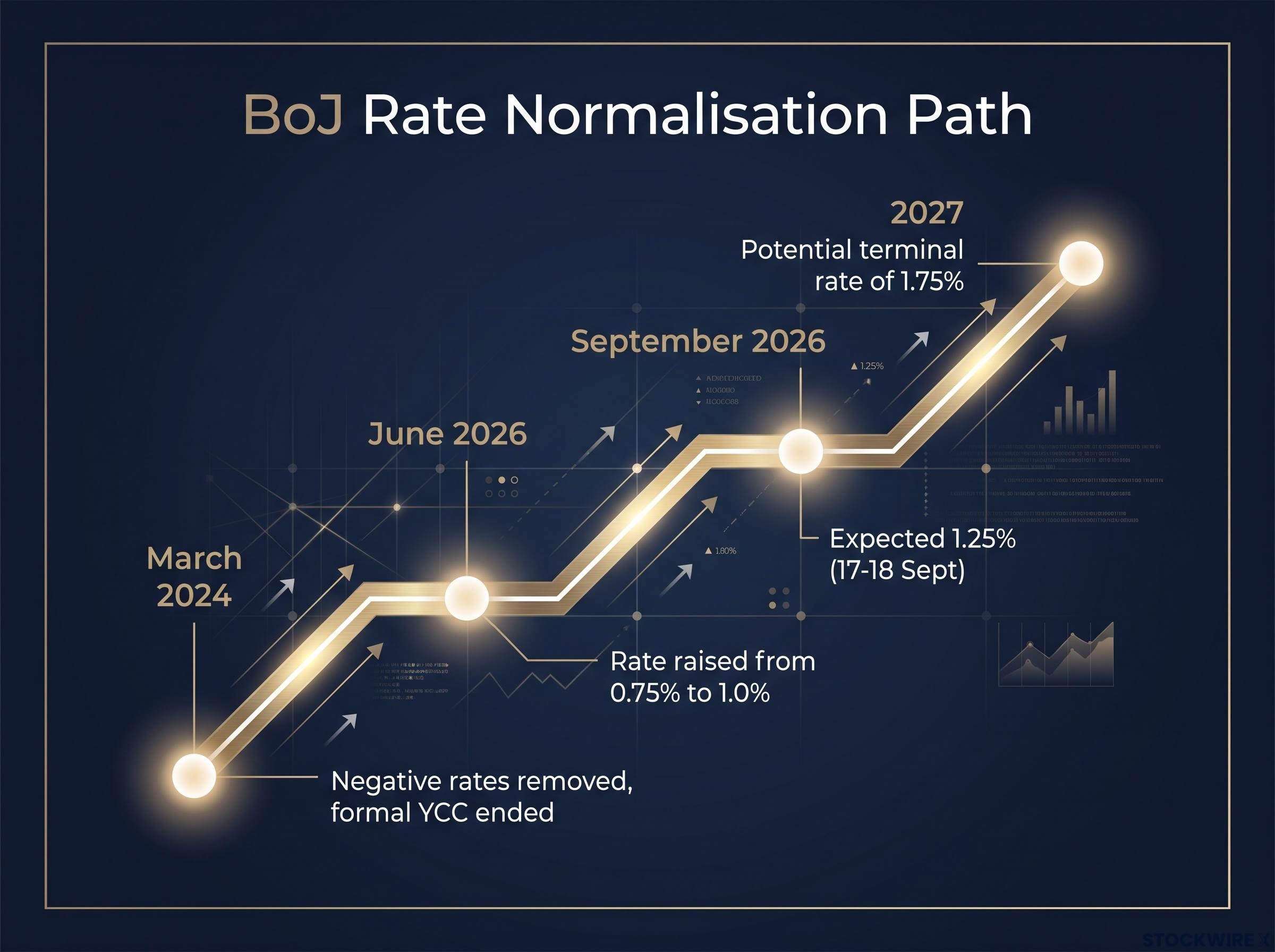
Normalisation rests on two pillars. The first is rate normalisation: raising the policy rate toward a neutral level consistent with 2% inflation. The second is quantitative tightening: reducing the pace of Japanese Government Bond (JGB) purchases to shrink the BoJ’s enormous footprint in the bond market.
| Date | Policy Action | Market-Implied Next Step |
|---|---|---|
| March 2024 | Negative rates removed; formal YCC ended | Gradual hikes expected through 2025 |
| June 2026 | Policy rate raised from 0.75% to 1.0% | Hike to 1.25% priced for September 2026 |
| September 2026 | Meeting scheduled 17-18 September | 1.25% widely expected |
| 2027 (terminal scenario) | Potential rate of 1.75% | Dependent on wage growth and inflation persistence |
JGB purchase reduction and the backstop
On the quantitative tightening side, the BoJ is reducing JGB purchases from approximately 6 trillion yen per month (before the 2024 reductions began) toward a target of roughly 2 trillion yen monthly by March 2027. Officials have stressed there is “no rush” and have retained the option of fixed-rate purchase operations if long-term yields spike disruptively.
That backstop language is analytically significant. Oxford Economics argues that additional near-term hikes, potentially front-loaded, should be manageable given high household savings in an ageing society, decades of corporate deleveraging that reduce investment sensitivity to modest rate rises, and a correction of yen weakness. But the BoJ’s primary fear is clearly a bond-market dislocation, not inflation overshooting. That asymmetry tells you the normalisation path will slow or pause before it risks a JGB crisis, and you should price in that sequencing when thinking about rate trajectory.
The yen carry trade: from cheap funding to global risk switch
The yen carry trade is one of the largest leveraged positions in global finance, and it exists because of a simple arithmetic that held for three decades: borrow in yen at near-zero rates, invest in higher-yielding assets elsewhere, and pocket the difference. A carry trade, in its simplest form, is borrowing cheaply in one currency to invest in another currency or asset offering higher returns. The strategy works as long as the funding currency stays cheap and stable. When that assumption breaks, the unwind can be violent.
The scale is substantial. Notional estimates of yen-linked carry exposure range from several hundred billion to over one trillion dollars when derivatives and forwards are included. Normalisation has already forced hundreds of billions of dollars of positions to close.
Carry spread persistence is the central reason the yen carry trade has not unwound despite the BoJ’s most aggressive tightening cycle in three decades: a 250-275 basis point gap between Japanese and US policy rates still makes yen-funded dollar positions structurally attractive, capping how much normalisation alone can compress positioning.
The risk runs in both directions, which is what makes the yen a genuine risk switch rather than a one-directional bet:
- Strong-yen risk (carry unwind): When the yen appreciates abruptly, whether from a BoJ surprise or shifting expectations for Federal Reserve policy, leveraged traders are forced to close positions simultaneously. The August 2024 episode demonstrated this dynamic, when rapid yen strength triggered cascading deleveraging across FX, credit, and equity markets far beyond Japan.
- Weak-yen risk (imported inflation): A persistently weak yen raises import costs and household pressure inside Japan, creating political and social constraints on how long authorities can tolerate depreciation. This limits the BoJ’s own tolerance for currency weakness and can eventually force intervention or faster tightening.
The BIS bulletin on the August 2024 carry trade unwind documents how rapidly yen appreciation forced cascading deleveraging across FX, credit, and equity markets, providing quantitative evidence that yen carry exposure functions as a systemic risk channel rather than a contained bilateral currency position.
The yen is no longer a passive background variable in portfolio construction. It is an active risk switch that can transmit Japanese policy surprises into forced deleveraging across FX, credit, and equity markets simultaneously. Yen volatility should appear explicitly in cross-portfolio stress tests, not just in FX hedging books.
Bessent described recent yen moves as well contained and not disorderly ahead of the September meeting, adding that while the 160 JPY per USD level had drawn market attention, he viewed the overall situation as manageable. A joint US-Japan intervention in late July 2026 had temporarily strengthened the yen but did not eliminate the underlying carry incentive. The signal from authorities is clear: they want to avoid disorderly moves but accept that normalisation inherently raises currency volatility.
For investors who understand these mechanics, the framework provides something more valuable than a forecast. It provides a way to read when yen moves are likely to become contagion events rather than contained FX adjustments, and to position accordingly.
What BoJ normalisation means for global bond markets, capital flows, and equity investors
Bond markets and capital flows
As the BoJ reduces JGB purchases and allows yields to trade more freely, Japanese institutional investors face a rational case to reallocate capital domestically. For decades, Japanese insurance companies, pension funds, and banks were significant buyers of US Treasuries and European sovereign debt because domestic yields offered almost nothing. That calculus is changing.
If Japanese institutions trim foreign bond purchases, demand for these securities weakens at the margin, keeping global yields structurally higher than they would otherwise be. This is not a theoretical channel. Japan’s JGB market is the world’s largest by outstanding stock, and the reallocation of even a fraction of Japanese institutional capital away from foreign bonds has a measurable impact on global funding costs.
The fiscal constraint tightens the analysis further. With central government debt reaching a record 1,346 trillion yen by end-June 2026 and gross government debt exceeding 250% of GDP, even modest rate increases translate into substantial additional interest costs. This is precisely why the BoJ cannot afford a credibility shock and will communicate carefully.
But it is also why the “triple-red” scenario, where JGBs, equities, and the yen all decline simultaneously, is the tail risk worth stress-testing. Scenario analysis from market researchers shows that in a credibility-stress case, Japanese bonds could post significant losses, and USD-based investors could fare even worse if yen weakness compounds local-currency declines.
Equity market dynamics
The equity implications split along clear sectoral lines:
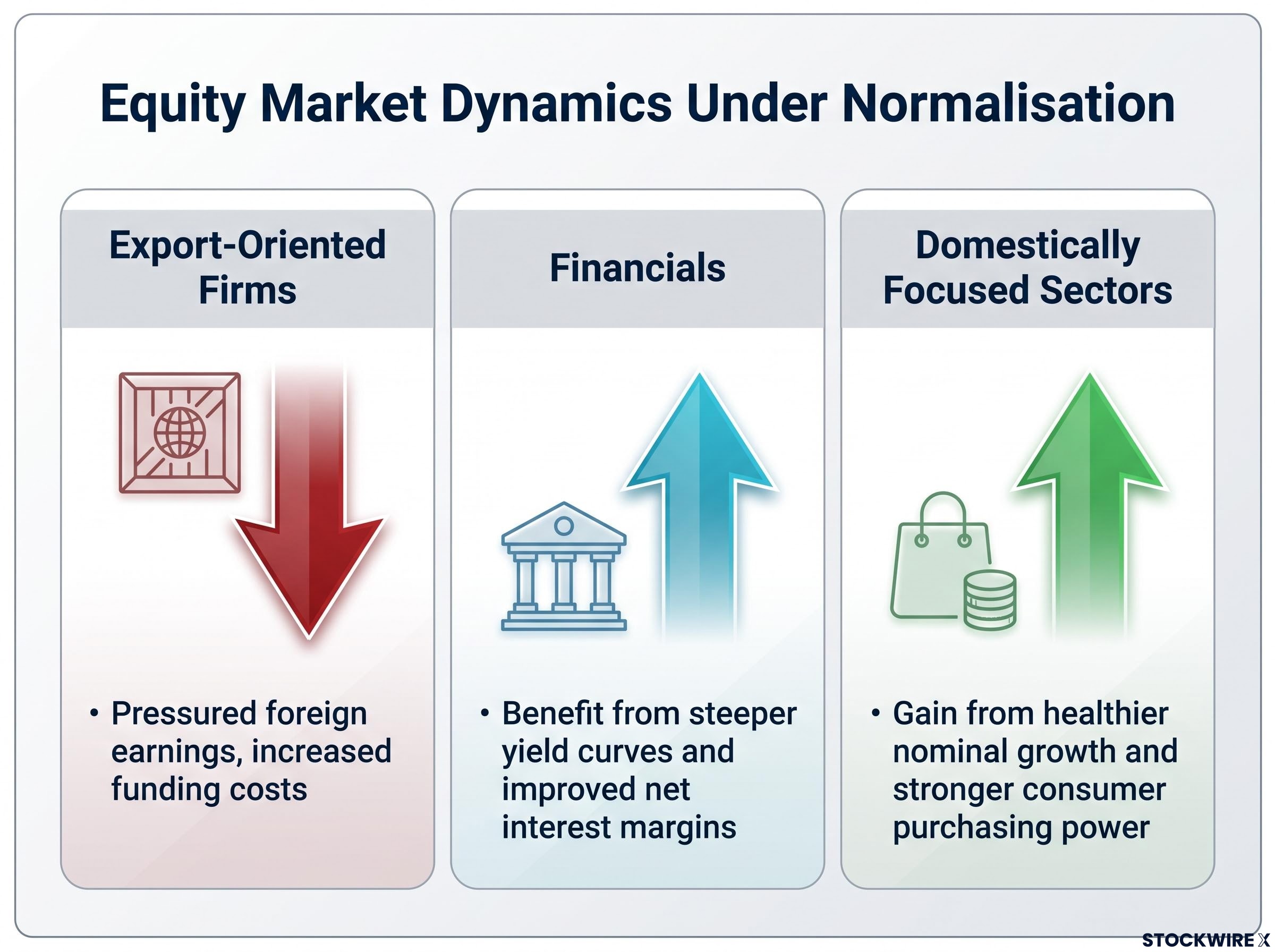
- Export-oriented firms: A firmer yen and rising rates pressure foreign earnings (worth less in yen terms) and increase funding costs
- Financials: Benefit from steeper yield curves and improved net interest margins in a positive-rate environment
- Domestically focused sectors: Gain from healthier nominal growth and stronger consumer purchasing power as import costs stabilise
Empirical work on Japan indicates that in a positive interest-rate environment, changes in rates transmit monetary shocks more effectively via stock prices, making equities a primary channel through which normalisation affects the broader economy. This is a shift from the zero-rate era, when bond yields carried most of the transmission.
Ongoing corporate governance reforms add a structural tailwind that partially offsets the rate headwind, supporting equity valuations even as funding costs rise. These dynamics are expected to play out through 2026-2028.
What this means at the portfolio level is straightforward: BoJ meeting dates now warrant the same macro attention as FOMC and ECB decisions. A BoJ surprise has a plausible transmission path into US Treasury yields, European spreads, and emerging-market funding conditions within the same trading session.
What the structural shift demands of investors through 2027
The analytical framework above converts into a practical monitoring checklist. Five variables will determine the pace and smoothness of normalisation, and they are listed here in priority order, from the foundation to the systemic amplifier:
- Wage growth and core inflation: The entire normalisation case rests on sustained wage increases and core inflation near the 2% target. A reversal in wages or a slide in core inflation would slow or pause the tightening path. This is the single most important variable.
- BoJ communication cadence and meeting surprises: The September 2026 meeting (1.25% priced) and the trajectory toward a potential 1.75% terminal rate by 2027 are the near-term tests. Surprises in either direction, too fast or too slow, are what markets fear most.
- Yen levels and volatility thresholds: The 160 JPY per USD level has already attracted official attention. Large, rapid moves in either direction act as a global risk switch, tightening or loosening financial conditions far beyond Japan.
- Interaction between BoJ tightening and Fed or ECB easing: The speed of interest-rate convergence between Japan and Western central banks determines the medium-term yen path. Faster US and European easing amplifies the impact of modest BoJ hikes on FX and global funding conditions.
- Carry-trade positioning and Japanese capital-flow data: Estimates of yen carry exposure and the scale of recent unwinds suggest that positioning itself can be a source of systemic risk. Any clear shift toward domestic assets by Japanese institutions has direct implications for US Treasuries, European sovereigns, and emerging-market debt.
September hike probability has risen sharply on the back of two consecutive above-forecast inflation prints, with overnight-indexed swap markets moving from roughly 23% immediately after the July hold to 78-85% by late August, compressing the US-Japan yield differential and reinforcing the structural yen strengthening thesis the article’s carry risk framework depends on.
The BoJ has moved from liquidity provider to potential shock source. This is the single most important investment thesis shift for global portfolios. Frameworks that treat Japan as a background variable in macro analysis should be updated to treat it as a core input alongside the Fed and the ECB.
The September 2026 meeting is the immediate test. The trajectory through 2027 is the structural one. Investors who continue to treat BoJ decisions as secondary to Fed and ECB deliberations are carrying an unmodelled source of macro risk, because the yen carry unwind dynamic means a BoJ surprise can reach global portfolios faster and with less warning than a comparable surprise from either Western central bank.
This article is for informational purposes only and should not be considered financial advice. Investors should conduct their own research and consult with financial professionals before making investment decisions. Forward-looking statements regarding interest rate paths and terminal rates are subject to change based on evolving economic conditions and central bank decisions.