
Bank of England Governor Andrew Bailey told a Zurich audience on 4 November 2026 that artificial intelligence could lift UK growth. In the same lecture, he called an AI asset price bubble a clear threat to financial stability. He spoke at the Swiss Institute of International Studies lecture series at the University of Zurich, and the two messages sat side by side.
The timing gives the warning weight. The next day, the Bank raised Bank Rate to 4.00%, with consumer price inflation (CPI) at 3.5% in September. An AI shock would land on an economy where inflation is already well above target.
Here is what Bailey said, why the Bank is worried about valuations rather than the technology itself, and how decisions on rates, quantitative easing (QE) and quantitative tightening (QT) reach the pound.
What did Bailey actually say about AI, growth and the bubble risk?
Bailey started with the good news. He pointed to “growing signs of beginnings of positive supply shock from AI, investment”, meaning AI could let the economy produce more without pushing up prices. UK activity has held up better than expected, and he linked part of that to AI-related investment in business services.
Then he added his caveat.
“The returns may be good, and they may match expectations, but they take longer to be realised than predicted.”
The worry is about timing, not about whether AI works. The official UK evidence supports a modest gain.
Part of the timing problem is a productivity paradox: task-level gains of up to 55% have not yet shown up in economy-wide productivity, which one major bank puts at roughly 0.1% a year.
| Source | Timeframe | AI productivity position |
|---|---|---|
| Office for Budget Responsibility (OBR) | October 2026 | About 0.2pp a year in the central case; scenarios run from under 0.1pp to 0.8pp |
| IMF, UK Article IV | November 2026 | A small boost of about 0.2pp |
The Bank’s Financial Policy Committee (FPC) has flagged four risks:
- Stretched valuations: AI company prices have risen faster than broader indices.
- Concentration: a few AI firms make up a growing share of global indices.
- Momentum and leverage: crowded positions and borrowing could make a sell-off bigger.
- Rising debt: the September FPC record warned about opaque “circular arrangements” in AI financing.
Bailey also said frontier AI has raised cyberattack risk and that advanced models need more testing.
He is not calling AI a failure. His point is that a profitable technology can still sit inside an overpriced market. If the returns arrive late, prices could fall even though the technology works.
Why does the Bank worry about AI valuations if UK stocks have little direct exposure?
The reassuring part first: according to the Bank, UK-listed companies have relatively little direct exposure to AI. The worry is how a global fall could still spread to the UK.
The Bank sees five main channels:
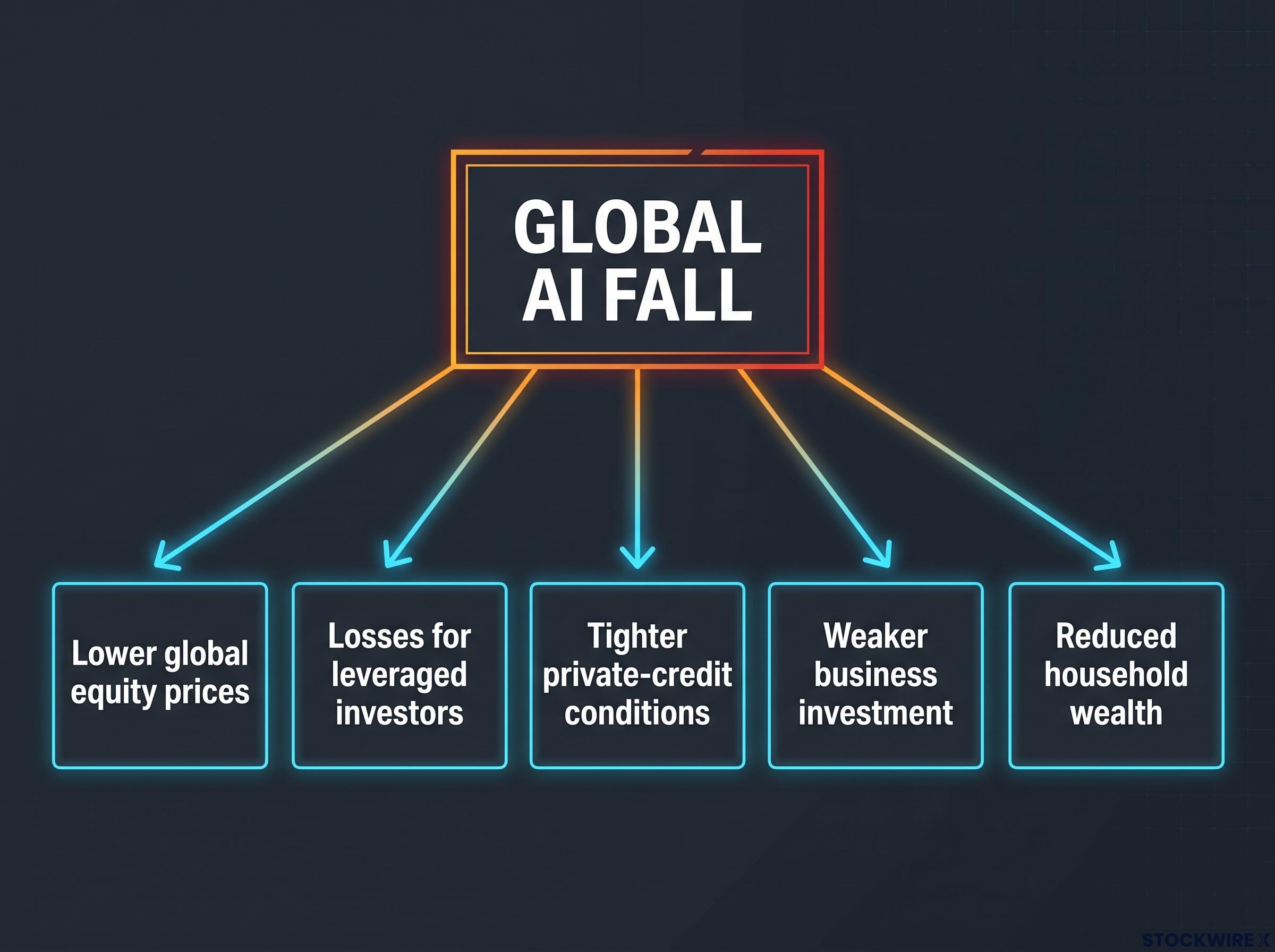
The Bank outlines channels for a Global AI Fall: Lower global equity prices, Losses for leveraged investors, and Tighter private-credit conditions.
- Lower global equity prices
- Losses for leveraged investors
- Tighter private-credit conditions
- Weaker business investment
- Reduced household wealth
The shift in how AI is funded raises the stakes. Infrastructure was first paid for mainly from the cash flows of profitable tech firms and from equity. Debt financing is now growing quickly, including through private markets. Borrowed money turns a price fall into losses for lenders.
History offers some comparisons. The dot-com era showed that investors can overpay for a technology that really does change the economy. The 2008 crisis and the 2022 gilt crisis linked to liability-driven investment (LDI) pension strategies showed how leveraged, correlated positions can force rapid asset sales. The Bank has not said an AI correction would repeat any of these episodes.
The dot-com era comparison is instructive on index concentration: Cisco investors were right about the internet yet waited more than 25 years to recover their peak, while today’s Magnificent Seven weight in the S&P 500 sits near 32%.
For you, the risk to your pension, savings or mortgage rate runs through global markets and leverage. It does not depend on how many AI shares UK companies own.
The case against a bubble
The defence case is real. Much of the spending has been funded by large, profitable firms rather than heavy bank lending. The OBR and IMF both expect a positive productivity effect, although the OBR says the pre-2008 information and communications technology (ICT) revolution had a larger near-term impact. Traditional valuation ratios may also say less about firms whose earnings depend on large future markets.
The open question is valuation and timing, not whether AI has value.
How do rate changes, QE and QT reach Sterling, and where does AI fit?
| Tool | How it works | Usual Sterling effect | Caveat |
|---|---|---|---|
| Bank Rate | Sets the Bank’s main interest rate | A rise tends to support the pound | Depends on why rates rise and what was expected |
| QE | The Bank creates money to buy bonds, lowering long-term yields | Bank research finds sterling has generally fallen after QE announcements | Used as a last resort |
| QT | The Bank lets gilts mature and sells them | Usually supportive | Less direct than a rate change |
The 5 November hike shows how expectations shape the result. The vote was 8-1, and GBP/USD briefly rose just above 1.3500 before settling near 1.3450, because markets had largely priced the move in.
Sterling traders weigh MPC dissent and forward guidance alongside the headline rate, since a split vote can signal where the committee’s balance of risks is heading before the next decision arrives.
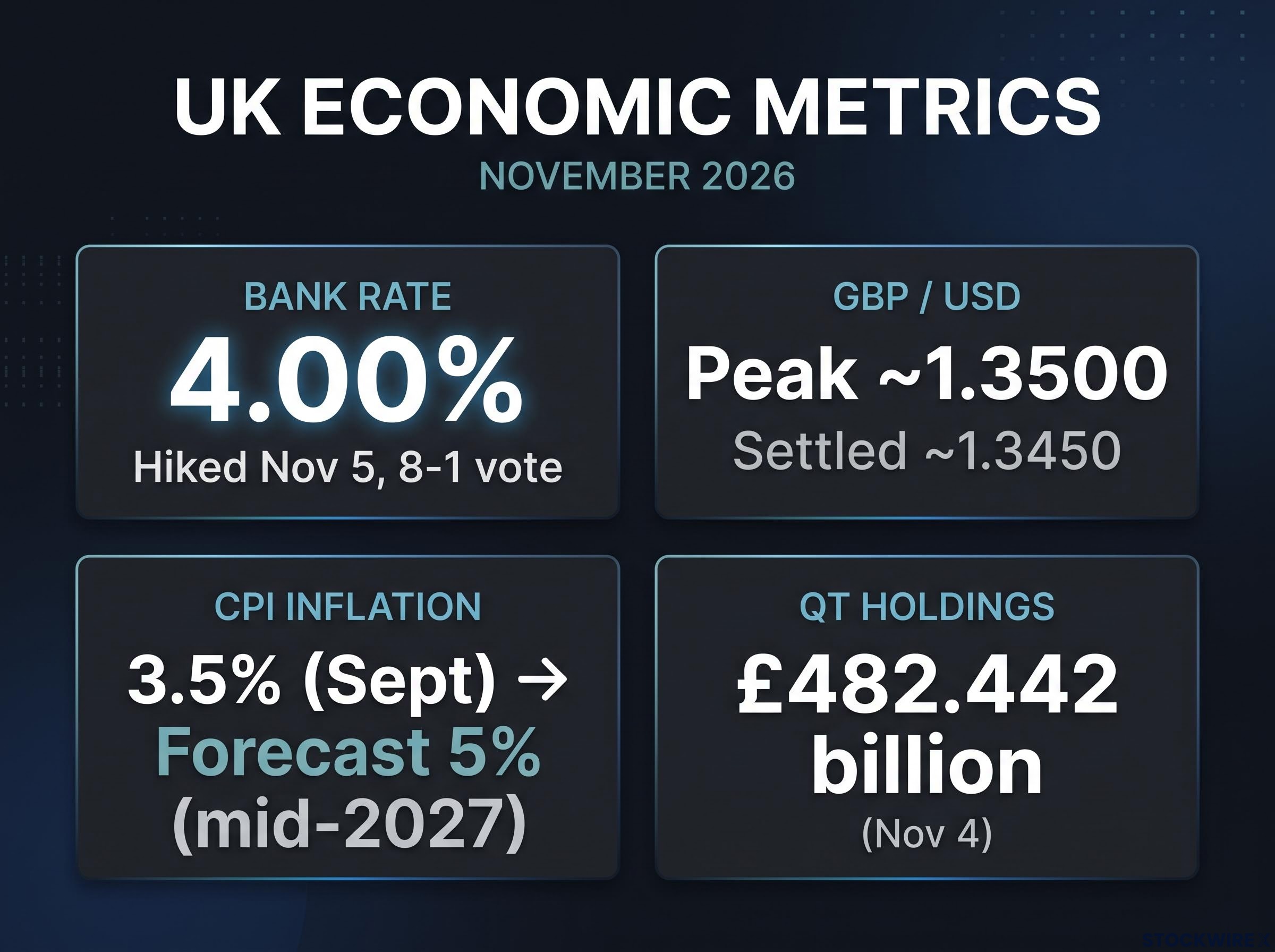
In November 2026, the Bank Rate was hiked to 4.00% with an 8-1 vote, while CPI Inflation stood at 3.5% and QT Holdings were £482.442 billion.
QT can behave unexpectedly too. The Bank plans 20 billion pounds of active sales a year, within an average annual reduction of 46 billion pounds through 2034. Its gilt holdings stood at 482.442 billion pounds on 4 November. Even so, when the Bank confirmed in September that it would keep shrinking its holdings, 30-year gilt yields fell by about 10bp.
Inflation is the main pressure. CPI rose to 3.5% in September from 3.1%, and the Bank’s forecast puts inflation near 5% by mid-2027.
Two AI scenarios for the pound
- Productivity boom: more supply could support investment and possibly Sterling, but the Monetary Policy Committee (MPC) says the net effect on inflation is uncertain.
- Sharp correction: investors moving into safe-haven currencies could weigh on Sterling, and weaker UK demand could eventually bring rate cuts.
The pound reacts to why rates move and to what markets expected. An AI shock could push it either way, depending on whether it hits inflation or investors’ appetite for risk.
These statements are speculative and subject to change based on market developments. Past performance does not guarantee future results.
What to watch after Bailey’s Zurich warning
Bailey sees genuine productivity upside and a separate valuation risk. That risk hinges on how long AI returns take to arrive.
Three markers matter next:
- The October CPI release on 18 November 2026
- Any further Bank findings on AI-related financial stability risks
- Signs that debt financing in AI infrastructure keeps rising
Rate, QE and QT decisions only move Sterling through inflation and expectations. Those two forces will decide how much an AI correction or boom matters for your money.
For readers wanting the wider picture, our full explainer on what moves the British Pound covers rate pricing, inflation data and political risk premiums.
This article is for informational purposes only and should not be considered financial advice. Investors should conduct their own research and consult with financial professionals before making investment decisions.