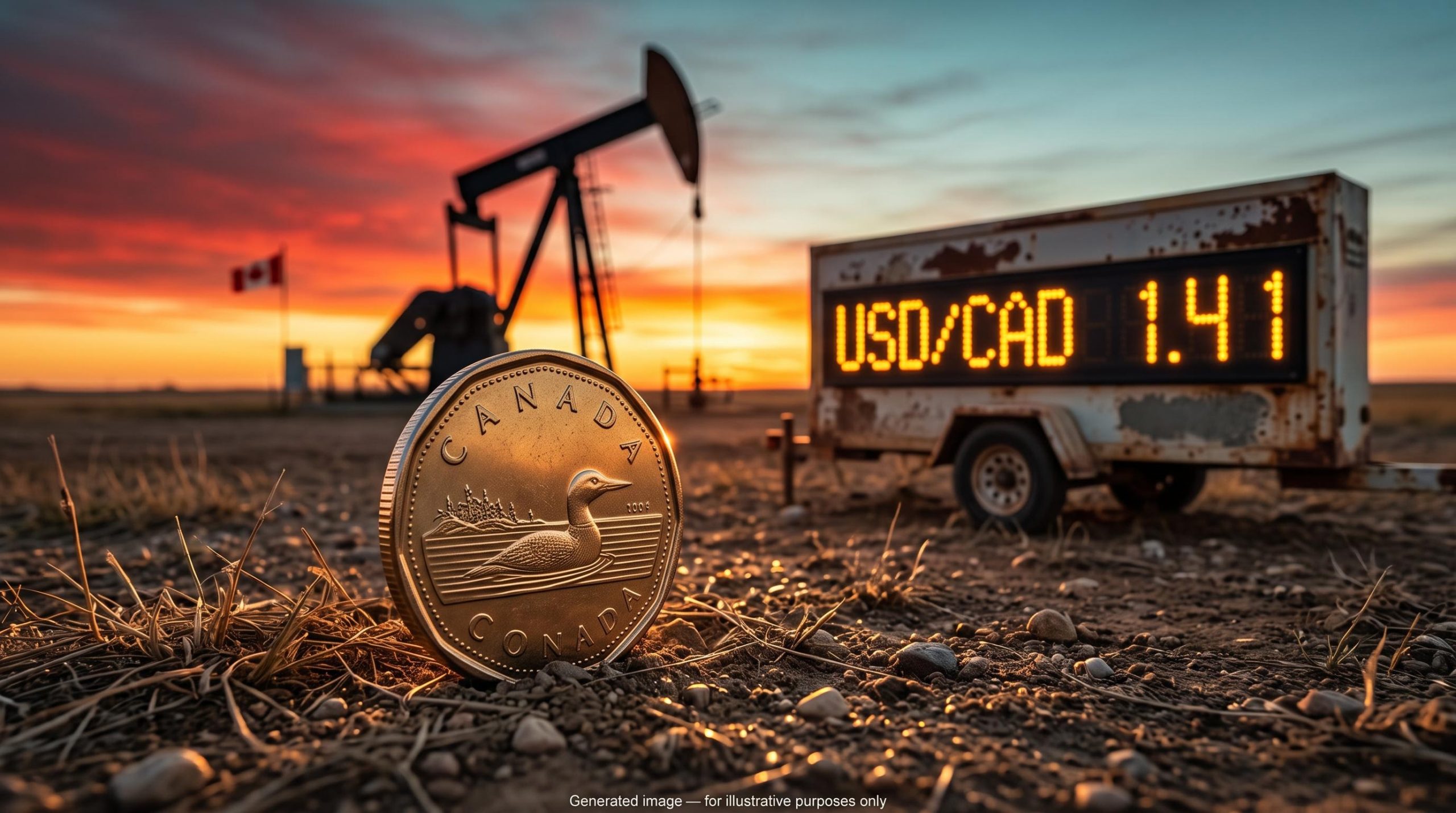
The Canadian dollar slipped against the greenback on Monday even as the broader US dollar weakened. USD/CAD climbed back toward 1.41 in the US session, trading between a low of about 1.4077 and a high near 1.4132, while the US Dollar Index (DXY) fell roughly 0.45% to around 101.84. That divergence sets up the USD/CAD forecast ahead of Tuesday’s US inflation data.
Three pressures sit on the Loonie, the market’s nickname for the Canadian dollar. Crude is sliding as Iran diplomacy gathers pace. Canada has just recorded its third straight monthly job loss. Meanwhile, markets still price the Federal Reserve as likely to raise rates in December.
The next test arrives quickly. US October consumer price index (CPI) figures land on Tuesday, 10 November.
Here is which driver is winning for the Loonie right now, and what could flip it when that number prints.
Why is USD/CAD rising when the dollar index is falling?
The pair should have fallen. When the dollar loses ground against a basket of six major currencies, USD/CAD usually follows it lower.
Oil explains why it did not. Crude shed roughly 3% on Monday as President Trump downplayed the prospect of fresh strikes while negotiations carry on. Qatar’s prime minister travelled to Washington to meet Trump and Vice President JD Vance about bringing the conflict to a close.
Monday’s slide extended a heavy week for crude. After the Democratic midterm victories, traders wagered that Congress would lean on the White House to wrap up the war with Iran.
Quota decisions matter less than the physical supply crisis around the Strait of Hormuz, where commercial transits have collapsed and a credible ceasefire could restore flows faster than usual.
- Prior close: West Texas Intermediate (WTI), the US benchmark crude, settled near US$90.83 on 6 November
- Weekly move: WTI finished last week about 12% lower
- Monday: intraday trade roughly in the US$86-$89 range, with reported levels varying between sources
Canada is a major crude exporter, so cheaper oil means lower export receipts and weaker energy-sector cash flow. On Monday that commodity link overpowered the risk-on mood that hurt the US dollar. The heat map below shows how the Loonie fared across the majors.
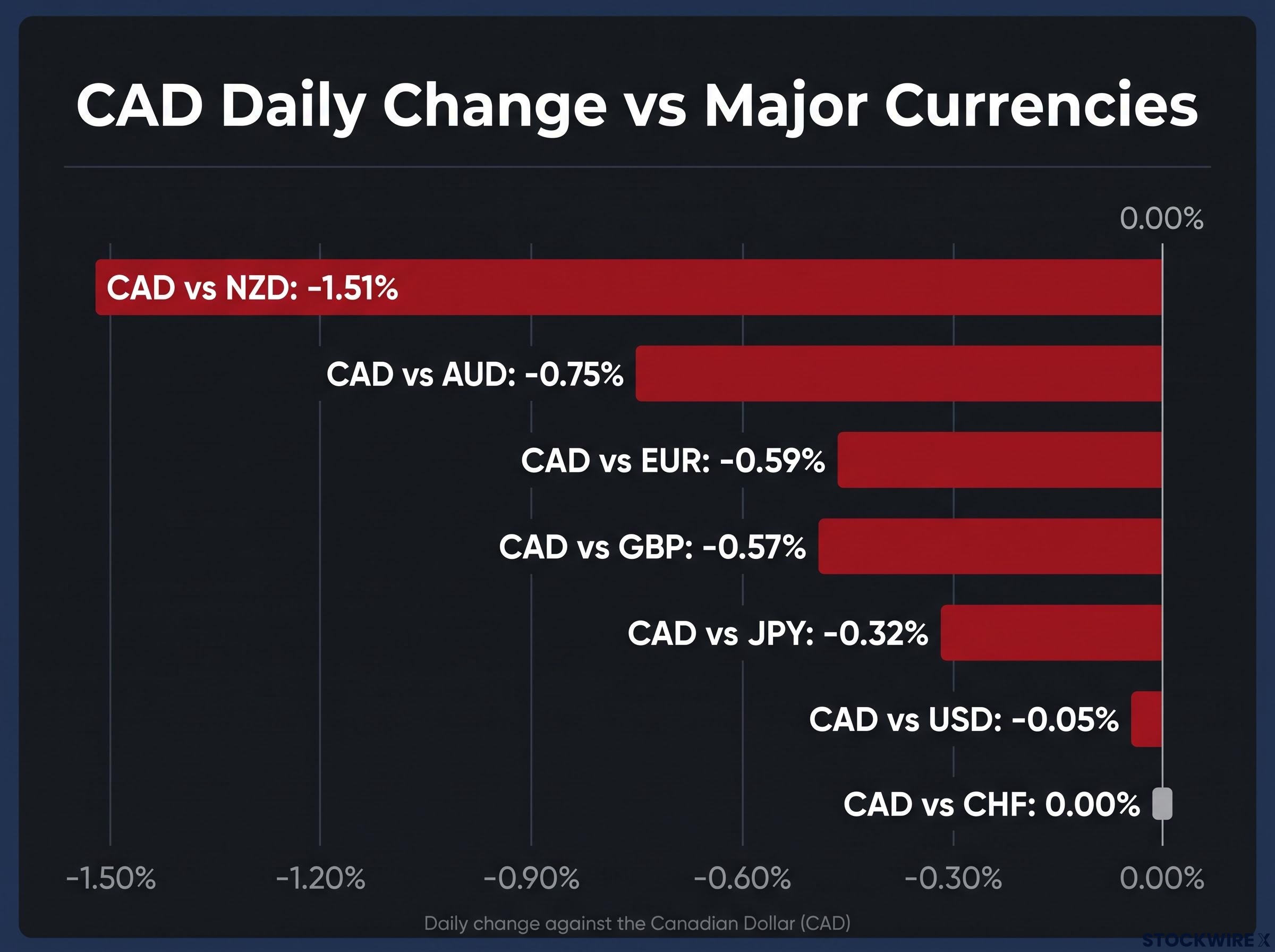
The Canadian dollar weakened broadly against major currencies, dropping most significantly against the New Zealand dollar at -1.51%.
| Pair | CAD change on day | Approximate cross level |
|---|---|---|
| CAD vs USD | -0.05% | 1.4103-1.4132 (USD/CAD) |
| CAD vs EUR | -0.59% | 1.5785 (EUR/CAD) |
| CAD vs GBP | -0.57% | 1.8920 (GBP/CAD) |
| CAD vs JPY | -0.32% | Not available |
| CAD vs AUD | -0.75% | Not available |
| CAD vs NZD | -1.51% | Not available |
| CAD vs CHF | 0.00% | Not available |
The read is simple. USD/CAD is trading as an oil story first and a dollar story second, so watching the DXY alone would have misled you on Monday. Crude still sits above pre-war levels, which means that upside risk returns if talks stall.
Can the Bank of Canada keep hiking while jobs are disappearing?
Friday’s jobs report gave the Loonie no help. Statistics Canada reported October employment fell by 4,700, against a consensus forecast of a 13,600 gain. Unemployment rose to 6.7% from 6.5%.
This was the third consecutive decline, following losses of 68,300 in September and 41,700 in August. The mix was weaker than the headline suggests: private-sector jobs fell 53,000, while public-sector hiring added 50,000.
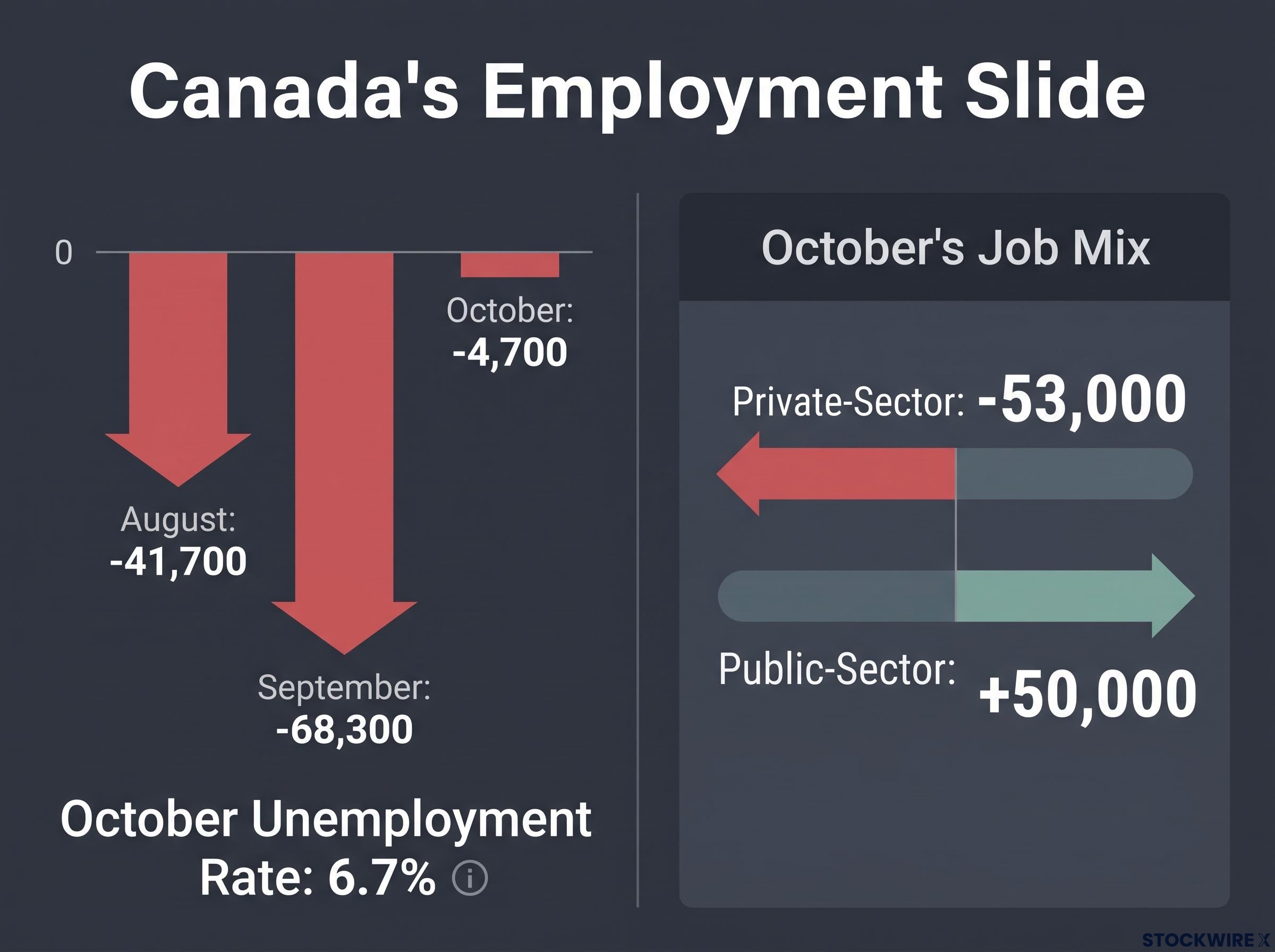
Canada lost jobs for the third consecutive month, and October’s headline decline of -4,700 masked a stark drop of -53,000 private-sector roles.
That leaves the Bank of Canada (BoC) in a genuine bind. It raised its policy rate by 25 basis points to 2.50% on 28 October. A basis point is one-hundredth of a percentage point.
The Bank of Canada rate hike was contested, with CIBC calling an immediate move a potential policy error, and the loonie barely reacted because markets had already priced most of it.
Bank of Canada, 28 October 2026 “There could be a need to increase the policy rate further.”
The bank paired that line with a promise to “proceed carefully”. Its next decision is due on 9 December.
The case for another hike
- The BoC says CPI inflation has hovered around 3% since April and could reach about 3.5% by year-end
- Governor Tiff Macklem has pointed to higher gasoline, diesel and heating-oil prices pushing up production and transport costs
- The bank fears energy costs could spread into wages and services, and the economy has shown resilience
- Most economists surveyed by Reuters expected at least one more increase before March
The case for waiting
- Three straight monthly job losses
- Unemployment at 6.7%
- Higher borrowing and mortgage costs already weighing on households
For you as a CAD watcher, the BoC’s refusal to commit to December means domestic rate support for the Loonie is conditional. On its own, that support cannot offset a falling oil price.
What could Tuesday’s US CPI do to USD/CAD?
South of the border, the Fed’s posture looks firmer. October non-farm payrolls, the monthly count of new US jobs outside agriculture, rose 165,000 against roughly 65,000 expected. US unemployment dipped to 4.1%, and CME FedWatch put the odds of a December hike near 77-78%.
Richmond Fed President Thomas Barkin said on 5 November that further hikes would probably be needed, while calling inflation the chief risk to the Fed’s mandate. Consensus forecasts for the October CPI release are:
A December Fed hike is largely priced in, which means a hold would be the bigger surprise, and the 10-2 October vote showed two dissenters already leaning toward tightening.
- Headline: about +0.3% month on month (FactSet median +0.24%), and around 3.9-4.0% year on year
- Core (excluding food and energy): about +0.2% month on month, and around 2.8% year on year
| Scenario | Fed hike odds | US yields | Likely USD/CAD reaction |
|---|---|---|---|
| Hot CPI | Higher | Higher | USD supported, pair likely higher |
| Soft CPI | Lower | Lower | Pair could ease, especially if oil stabilises |
| Soft CPI, talks stall | Lower | Lower | Crude rebound could add CAD support |
Oil is the complication. If Iran talks stall, crude could rebound and support the Loonie even after a hot print, so the Fed signal and the energy signal compete. Longer-range views differ too: MUFG, UBS and Morgan Stanley held bearish USD/CAD targets near 1.34, compared with spot near 1.41, reflecting disagreement over oil and eventual US easing.
History argues against treating the pair as a simple oil proxy. In 2022, aggressive Fed tightening lifted USD/CAD despite high crude. For your positioning view, Tuesday’s number matters less on its own than in whether it confirms or breaks the oil-driven move already in the price. These scenarios are speculative and subject to change based on market developments.
Two signals, one pair: what to watch after the CPI print
For now, oil and central-bank repricing are pulling USD/CAD in the same direction. Cheaper crude drains support from the Loonie, while a firm Fed backs the greenback. That alignment is fragile, and three events can break it:
- The CPI outcome against consensus. A surprise in either direction will reset December Fed hike odds.
- Crude’s reaction to diplomacy headlines. Stalled talks would revive the commodity channel for CAD.
- The 9 December BoC decision. It will test whether Canadian rate support survives a weakening labour market.
This article is for informational purposes only and should not be considered financial advice. Investors should conduct their own research and consult with financial professionals before making investment decisions.