The New Zealand dollar climbed from Friday’s low of 0.5527 to a Monday high of 0.5600 against the US dollar, recovering ground even as a strong US jobs report kept the greenback well supported. The bounce looks better on a chart than it does in context, and the near-term NZD/USD forecast still depends on two questions the rally has not answered.
The election itself is not settled. The governing National-ACT-NZ First bloc is provisionally on 67 of 131 seats, one more than the majority threshold. Around 400,000 special votes (ballots cast overseas or outside a voter’s home electorate) will not be counted until 27 November 2026, according to the Electoral Commission.
Across the Pacific, a payrolls surprise has pushed traders to price a likely Federal Reserve rate hike in December. That pressure caps how far the Kiwi can climb, whatever happens in Wellington.
Here is how the political relief and the US rate pressure separate, and which dates will decide whether Monday’s move holds. All figures reflect preliminary data as of 9 November 2026.
Why did the Kiwi rally on a knife-edge election result?
Markets had braced for worse. NZD/USD fell to 0.5527 on Friday as fears of a drawn-out coalition process built. By Monday it had touched 0.5600 and was trading near 0.5590, according to FXStreet, though a separate report from the Asian session placed it nearer 0.5560.
The trigger was simple. The incumbent centre-right bloc kept a provisional path to government.
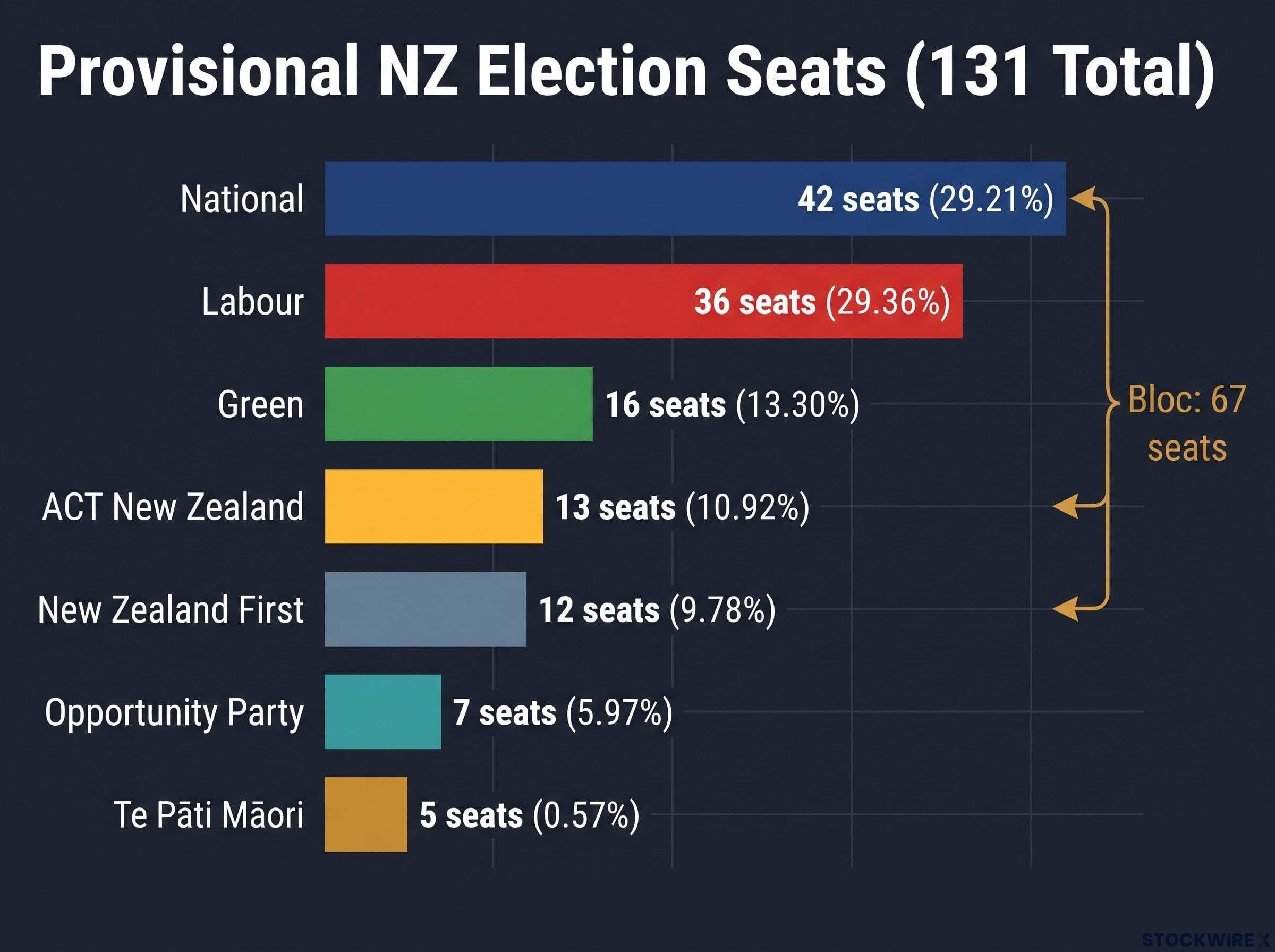
The governing bloc of National, ACT New Zealand, and New Zealand First provisionally holds 67 of the 131 total seats.
| Party | Projected party vote (preliminary) | Projected seats (preliminary) |
|---|---|---|
| National | 29.21% | 42 |
| Labour | 29.36% | 36 |
| Green | 13.30% | 16 |
| ACT New Zealand | 10.92% | 13 |
| New Zealand First | 9.78% | 12 |
| Opportunity Party | 5.97% | 7 |
| Te Pāti Māori | 0.57% | 5 |
Source: Electoral Commission projection updated 8 November 2026. Figures are preliminary.
A provisional path is not a resolved result. Party leaders have said coalition talks will not begin until the final count, and Kiwibank pointed to a sizeable “overhang” of knife-edge seats and uncounted special votes that could stretch uncertainty into late November or beyond.
The election overhang arises because a handful of knife-edge electorate seats can add extra list seats to parliament, which is why Labour can lead the party vote while National’s bloc holds the stronger path to a majority.
The uncertainty discount Imre Speizer, head of NZ strategy at Westpac, said a limited reaction was unsurprising because an “uncertainty discount” was already priced into the currency, with a larger move possible after the final result.
History supports that reading. After the inconclusive 2017 election, the NZD weakened while coalition talks dragged on, and an Interest.co.nz review of elections since 1984 found that global risk appetite and monetary policy usually mattered more than politics.
For you, Monday’s bounce signals a smaller risk premium, not a settled outlook. Treat it as a partial recovery from an extreme low rather than evidence that the Kiwi has turned.
How do strong US payrolls and Fed hike bets pull on NZD/USD?
The US Bureau of Labor Statistics reported on Friday that October nonfarm payrolls rose by 165,000, against expectations of roughly 65,000. Unemployment unexpectedly fell to 4.1% from 4.2%.
That number carries into the Kiwi through three channels:
- Rate differentials: a strong jobs market makes further Fed tightening more likely, lifting returns on US dollar assets relative to NZ ones and pulling the pair lower.
- The dollar and Treasury yields: solid jobs data tends to push up yields and the dollar. Because NZD/USD measures how many US dollars one NZ dollar buys, a stronger greenback weighs on the pair even when NZ news is neutral.
- Risk sentiment: the NZD is a liquid, high-beta currency, meaning it tends to swing more than the broader market. It suffers when equity stress sends money into the US dollar.
Risk appetite stayed fragile on Monday. Asian equities recovered from their lows with mostly small gains, while South Korea’s tech-heavy Kospi fell 0.8%.
The pull is not one-way. On Monday, reduced political risk in New Zealand outweighed dollar support, producing the rebound. But US rate expectations set the ceiling on how far that recovery can run.
The Fed voices behind the December odds
Traders lifted the probability of a 25-basis-point hike at the 8-9 December Fed meeting to roughly 77%-80%, up from about 67% before the data, according to Reuters.
Three Fed officials kept that door open, CNBC reported on 9 November. New York Fed President John Williams said inflation remained too high. St. Louis Fed President Alberto Musalem said inflation was still a leading concern among businesses in his district. San Francisco Fed President Mary Daly said further hikes might be needed despite the technology-stock sell-off.
Every future US data release can be read through the same three channels.
The Fed rate hike outlook had looked softer in October, when traders priced roughly 81% odds of a hold after weak September payrolls, which shows how quickly this week’s data reversed sentiment.
What are the NZ-side drivers and dates to watch for the NZD/USD forecast?
Beyond politics, a standing set of forces moves the Kiwi:
- RBNZ policy: higher rates from the Reserve Bank of New Zealand tend to support the NZD; cuts tend to weaken it.
- China: New Zealand’s largest trading partner. Weaker Chinese demand hurts exports and the currency.
- Dairy prices: the main export. Higher prices lift export income and support the NZD.
- Global risk sentiment: risk-on conditions help; turbulence pushes money toward safe havens.
The domestic policy backdrop leans hawkish. The Official Cash Rate (OCR), the RBNZ’s benchmark interest rate, sits at 2.75% after a 4-3 hold on 28 October, with three members reportedly favouring a hike. Annual inflation was reported at 3.7% in late October, above the RBNZ’s 1-3% target band.
The 4-3 hold caught markets leaning toward a hike, and the committee split reflected worries that fuel costs and a softer currency could push inflation expectations higher.
Dairy offers modest support. The Global Dairy Trade auction on 3 November lifted its index 3.0% to an average US$4,166 per tonne, with whole milk powder up 5.9%, according to auction results.
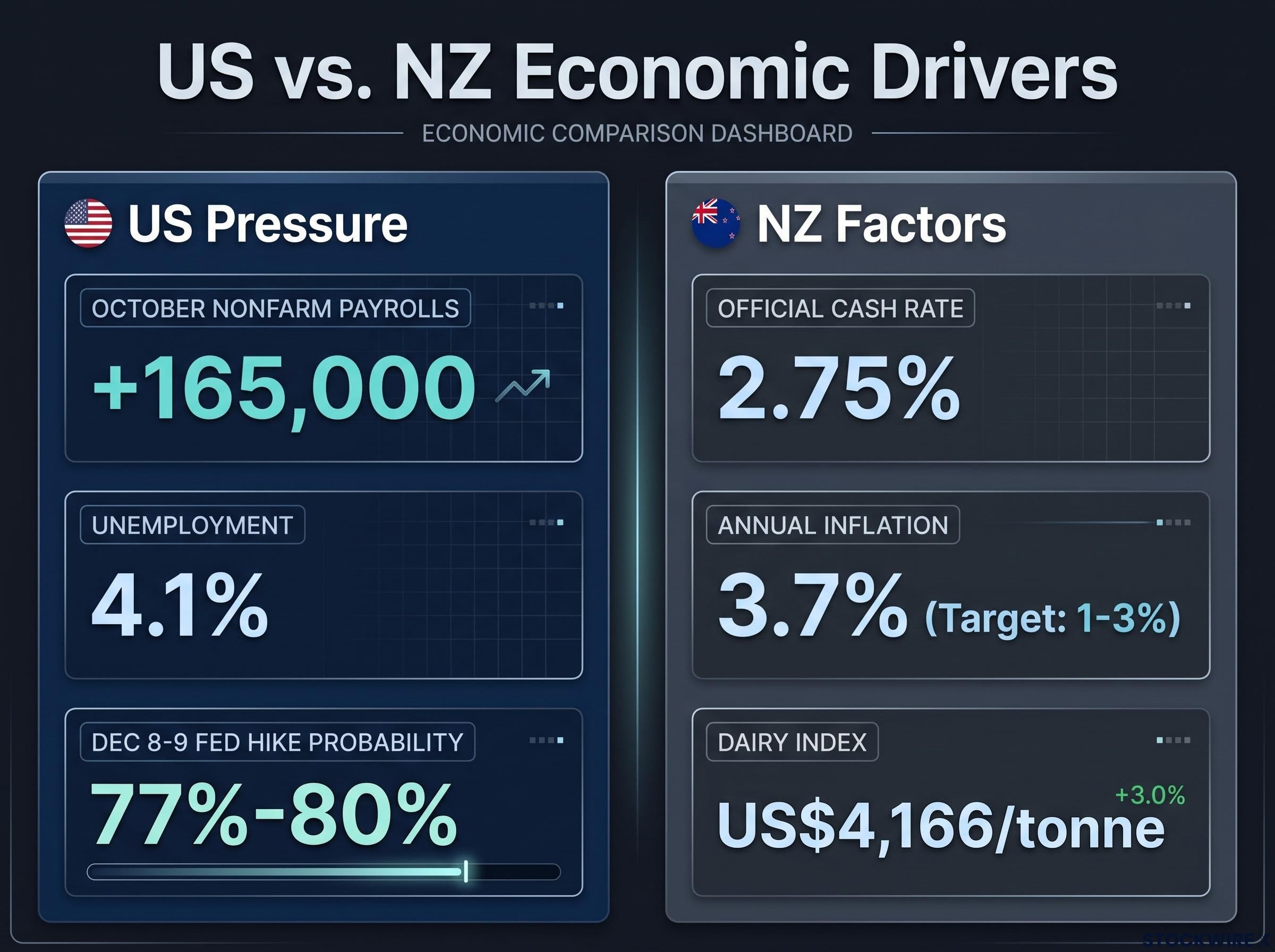
US October Nonfarm Payrolls rose +165,000, while the NZ Official Cash Rate sits at 2.75% amid 3.7% inflation.
Fiscal settings are less comforting. Westpac noted that deficits are projected to persist until 2028-29, and BNZ has kept its NZD recovery forecasts cautious.
| Event | Date | Why it matters |
|---|---|---|
| Final election count | 27 November 2026 | Special votes could confirm or erase the bloc’s one-seat margin |
| Coalition talks | After the final count | Sets government composition and fiscal priorities |
| Fed meeting | 8-9 December 2026 | A hike would reinforce US dollar strength |
| Next Global Dairy Trade auction | Next scheduled auction | Tests whether dairy price gains continue |
Two of those rows carry the most weight. The 27 November count and the December Fed decision are the events most likely to move the pair; treat the rest as context.
What the rebound settles, and the dates that will test it
Monday’s rise settled one thing: the market no longer needs to price the immediate risk of a sudden change in government. It did not settle who governs or how far US rates climb.
That leaves NZD/USD caught between political relief at home and rate pressure from Washington. If the special votes hold the bloc’s majority and talks move quickly, the relief has room to extend. If the Fed hikes in December as traders expect, the dollar side of the pair keeps the ceiling low.
Your two markers are the special-vote count on 27 November and the shifting Fed hike odds. Watch both before reading anything more into Monday’s bounce.
This article is for informational purposes only and should not be considered financial advice. Investors should conduct their own research and consult with financial professionals before making investment decisions.