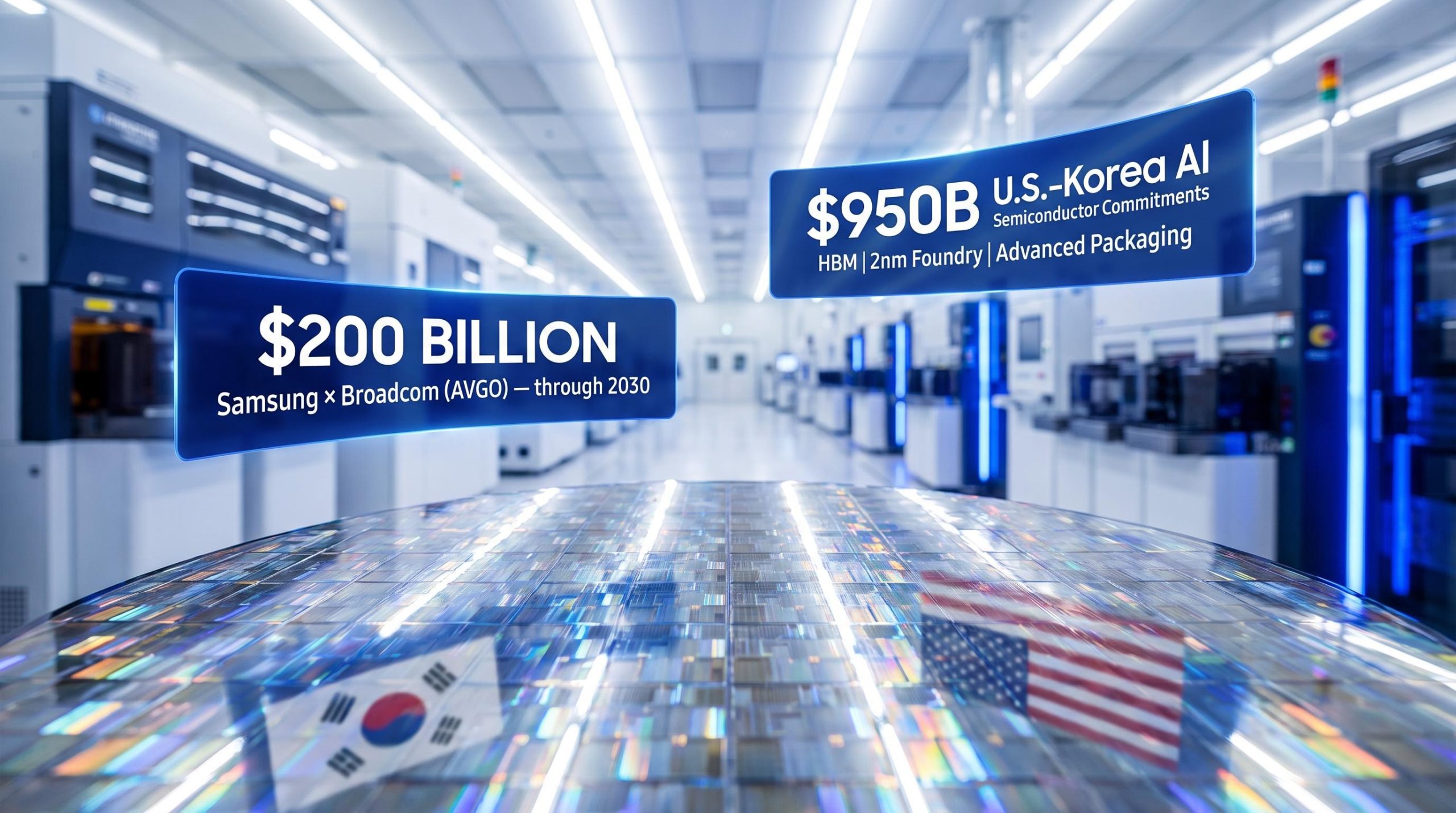
South Korean President Lee Jae Myung convened an AI summit in San Francisco on Friday 25 July 2026 and walked away with Samsung Electronics‘ signature on a $200 billion chip supply commitment to Broadcom (NASDAQ: AVGO), making it one of the largest bilateral semiconductor agreements ever announced.
The summit at The Midway brought senior leadership from Nvidia, OpenAI, Anthropic, and Broadcom to the same room as Samsung, SK Group, Hyundai Motor, and Naver, producing a combined $950 billion package of U.S.-Korea semiconductor commitments announced the same day. According to South Korean government officials, U.S. firms are responsible for somewhere between 80% and 90% of the demand that will drive South Korea’s semiconductor expansion plans.
The scale of that single statistic tells you why Seoul staged the event in San Francisco rather than Seoul. Here is what the Samsung-Broadcom agreement locks in for AVGO’s AI roadmap, and why the diplomatic architecture around it carries as much weight as the dollar figure.
What the $200 billion MOU actually covers
The headline number needs context. This is a memorandum of understanding (MOU), a formal statement of intent covering cooperation through 2030, not a single purchase order. In practice, that means Samsung and Broadcom have agreed on the scope, technologies, and estimated scale of their partnership, but individual contracts, pricing, and delivery schedules will be negotiated within the framework over its five-year life.
What gives the figure substance is the technical scope. The MOU covers three interlocking pillars:
- Advanced high-bandwidth memory (HBM): memory chips designed for the extreme data throughput AI accelerators require, supplied for Broadcom’s next-generation custom silicon.
- Leading-edge foundry capacity at 2-nanometre and below: Samsung will manufacture Broadcom’s most advanced chips, including high-speed data communication processors, on its most capable production lines.
- Advanced packaging delivered as a turnkey pipeline: Samsung will integrate design, manufacturing, and packaging into a single end-to-end service rather than handing off between separate suppliers.
The combination matters because Samsung’s structure as an integrated device manufacturer (IDM), a company that designs and fabricates its own chips across memory, logic, and packaging, makes it one of a very small number of counterparties capable of delivering all three under one roof. For Broadcom, that compresses development cycles in ways a disaggregated supplier chain cannot match. It also concentrates execution risk with a single counterparty, a trade-off that speaks to the strategic depth of the relationship.
| Parameter | Detail |
|---|---|
| Deal type | Memorandum of Understanding (MOU) |
| Parties | Samsung Electronics and Broadcom (NASDAQ: AVGO) |
| Announced | 25 July 2026, The Midway, San Francisco |
| Total value | More than $200 billion through 2030 |
| Duration | Five years, to 2030 |
| Technologies covered | HBM, 2-nm-and-below foundry, advanced packaging (turnkey) |
When big ASX news breaks, our subscribers know first
The San Francisco summit and what the AI Declaration commits both sides to
The Midway was not an accidental venue. President Lee staged the summit on American soil, in the city where OpenAI, Anthropic, and much of the Silicon Valley AI ecosystem are headquartered, and built a guest list that paired the companies building AI models with the companies building the hardware those models run on.
U.S. participants:
- Nvidia
- OpenAI
- Anthropic
- Broadcom
South Korean participants:
- Samsung Electronics
- SK Group
- Hyundai Motor
- Naver
At the summit, President Lee introduced the San Francisco AI Declaration, a policy framework designed to institutionalise technology cooperation between the two countries. Detailed provisions of the declaration have not yet appeared extensively in mainstream international coverage, but the commercial agreements signed at the event were explicitly framed as anchor commitments within it, the operational expression of a diplomatic strategy rather than standalone corporate deal-making.
South Korean officials put the share of demand from U.S. companies at somewhere between 80% and 90% of the total underpinning South Korea’s semiconductor expansion, a figure cited by presidential adviser Kim Yong-beom.
For anyone tracking AI supply chain geopolitics, the signal here is directional: U.S.-Korea semiconductor cooperation is moving from transactional, deal-by-deal procurement toward institutionalised policy alignment. That shifts the risk profile of capacity commitments made under the framework, because government-facilitated agreements historically lower the probability of unilateral supply chain reversals.
The San Francisco AI Declaration is partly a response to how quickly Korean policy signals can move markets: a single social media post from a South Korean presidential aide in May 2026 wiped more than $300 billion from chip stocks intraday, confirming the regulatory risk premium now embedded in AI semiconductor valuations.
Understanding Broadcom’s role in the AI hardware stack
If Nvidia is the name most investors associate with AI chips, Broadcom is the one hyperscale data centre operators associate with custom silicon. Broadcom designs application-specific integrated circuits (ASICs) and custom accelerators (sometimes called XPUs), processors built to a single customer’s specifications rather than sold as a general-purpose product. Alongside custom silicon, Broadcom is among the largest providers of high-speed networking hardware that connects the thousands of chips inside an AI data centre.
Broadcom’s ASIC model sits at the centre of a broader hyperscaler shift toward custom AI chips, where Google, Meta, Amazon, and Microsoft are each developing proprietary silicon programmes driven by the economics of lower per-inference costs and reduced dependence on any single external supplier.
That distinction matters here. Nvidia sells merchant GPUs off the shelf to anyone who will buy them. Broadcom co-designs custom processors with individual hyperscalers, which means each chip is engineered around a specific manufacturing process, a specific memory interface, and a specific packaging architecture.
Why custom silicon requires an integrated supply chain
Custom accelerators cannot simply be moved from one foundry to another without redesigning the chip. The co-design dependency creates three structural requirements:
- HBM supply matched to the accelerator’s memory bandwidth specifications.
- Advanced foundry capacity at the specific process node the chip was designed for.
- Advanced packaging capable of integrating memory, logic, and interconnects into a single module.
Samsung is one of the only companies on earth that can deliver all three. That is why a turnkey, multi-year MOU with a single IDM provides Broadcom with strategic supply chain insurance rather than a simple cost saving. The $200 billion cooperation envelope is consistent with Broadcom’s positioning across custom accelerators and networking; it addresses a real capability constraint, not simply a procurement efficiency.
The $950 billion framework and South Korea’s strategic calculation
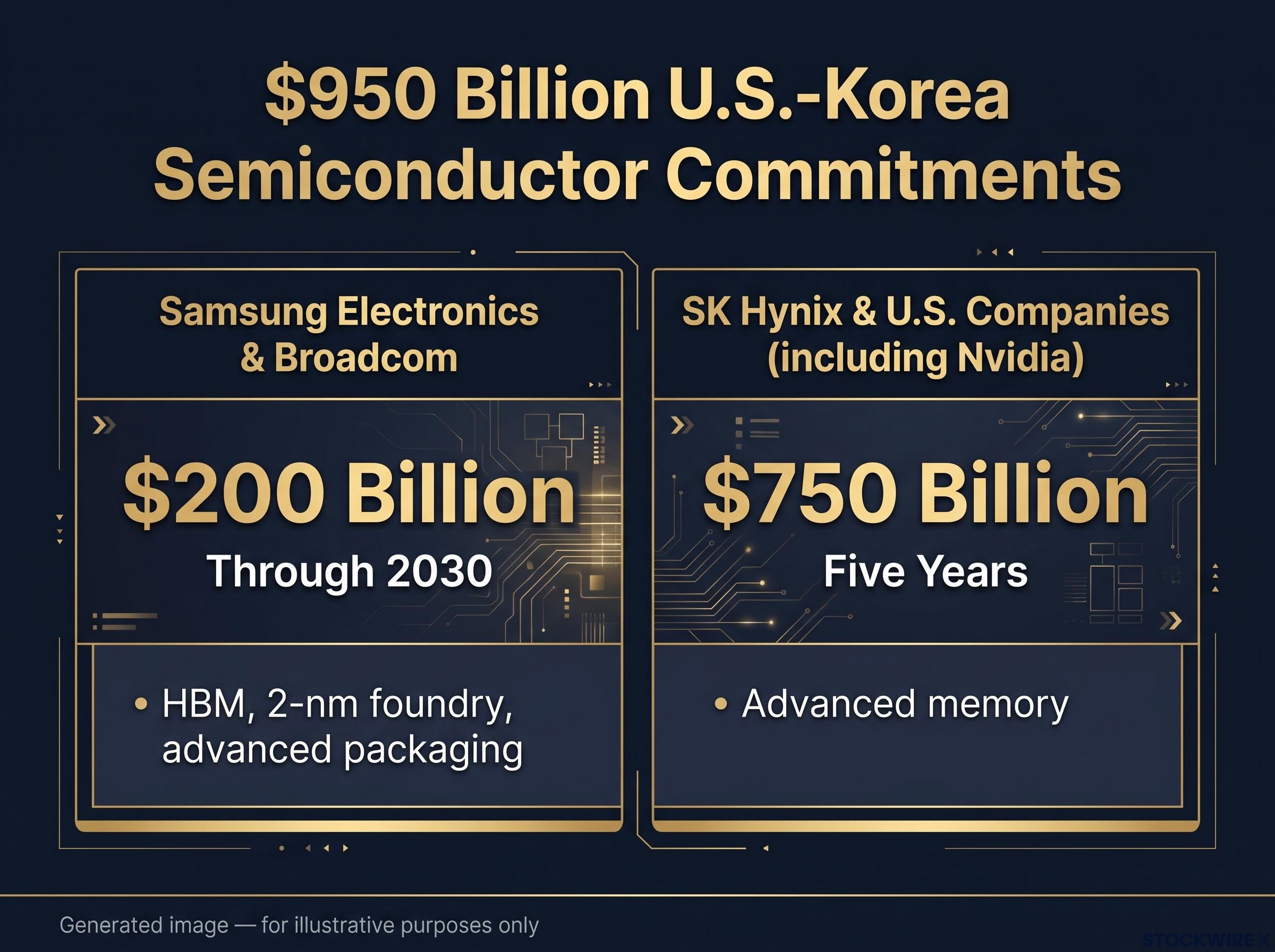
The Samsung-Broadcom MOU is one half of something larger. At the same briefing, Reuters reported, citing presidential adviser Kim Yong-beom, that the combined semiconductor supply partnerships Samsung and SK Hynix intend to pursue with U.S. technology firms will reach $950 billion in aggregate.
| Company | U.S. counterpart(s) | Value | Technologies | Duration |
|---|---|---|---|---|
| Samsung Electronics | Broadcom | $200 billion | HBM, 2-nm foundry, advanced packaging | Five years (to 2030) |
| SK Hynix | U.S. companies including Nvidia | $750 billion | Advanced memory | Five years |
The strategic logic from Seoul’s perspective is direct. If American companies generate 80-90% of the demand for South Korea’s semiconductor expansion, then locking that demand into multi-year, government-backed commitments secures the revenue visibility Korean chipmakers need to justify the capital expenditure. This is not bilateral deal-making between two companies. It is a coordinated national industrial strategy: Seoul is using supply commitments to anchor South Korea as an indispensable node in the U.S. AI hardware ecosystem before any future trade policy shifts could disadvantage Korean chipmakers.
The memory chip shortage shaping this agreement is not a temporary procurement imbalance: HBM capacity at major producers was sold out through 2026-2027 before this MOU was announced, and new fab capacity takes a minimum of 18-24 months from investment decision to volume production.
What the deal changes for Broadcom’s AI revenue outlook
For AVGO shareholders, the significance of this MOU is less about the $200 billion headline and more about what it de-risks. Three specific categories of uncertainty shrink when a supply agreement of this scale carries diplomatic backing:
- Execution risk on custom AI chip contracts: A turnkey manufacturing pipeline with Samsung reduces the chance that Broadcom’s hyperscaler commitments are delayed by foundry or packaging bottlenecks.
- Supply chain disruption risk: The San Francisco AI Declaration creates a government-level framework around the commercial relationship, making unilateral supply reversals less likely than in more politically exposed supply chains.
- Capacity availability risk: As AI data centre build-outs accelerate globally, a five-year, pre-committed envelope of advanced foundry, HBM, and packaging capacity gives Broadcom priority access.
Reuters attributed the $200 billion figure to South Korean presidential adviser Kim Yong-beom, giving the commitment a level of reputational and diplomatic visibility that goes well beyond what a standard commercial MOU would carry.
The net effect is that AI-driven revenue visibility for Broadcom is being reinforced not only by commercial contracts but by state-level industrial policy. That combination is worth a meaningful premium in how analysts model AVGO’s AI segment growth, because it reduces the execution uncertainty that typically attaches to large custom silicon programmes over multi-year horizons.
This article is for informational purposes only and should not be considered financial advice. Investors should conduct their own research and consult with financial professionals before making investment decisions.
What comes next for the U.S.-Korea AI supply chain
The commercial MOU is currently ahead of the policy architecture it is supposed to sit within. The San Francisco AI Declaration has been introduced as a framework, but its detailed provisions have not yet appeared extensively in international coverage. That gap will need to close for the institutional backing to carry full weight.
Three variables will determine whether the five-year commitments translate into the stated revenue and capacity outcomes:
- Samsung’s 2-nm yield maturity: Whether Samsung can achieve commercially viable yields at the 2-nanometre node on the timeline Broadcom’s product roadmap requires.
- HBM supply ramp: Whether Samsung’s HBM production scales fast enough to match the accelerating demand from Broadcom’s hyperscaler contracts.
- Hyperscaler AI capital expenditure trajectory: Whether the data centre operators underwriting Broadcom’s custom silicon programmes maintain their current pace of infrastructure spending through 2030.
The institutionalisation of U.S.-Korea AI cooperation, via the declaration and summit structure, is a durable development regardless of any individual deal’s execution. Both governments now treat semiconductor supply chain alignment as a strategic priority. But diplomacy sets the conditions; the commercial outcomes will depend on whether Samsung can deliver the technology those conditions were designed to support.
For readers wanting to map where the $630-725 billion in hyperscaler AI infrastructure spending is actually concentrating across semiconductors, foundries, and memory producers, our deep-dive into AI supply chain capex flows examines which layers of the stack retain the most structural pricing leverage as the build-out accelerates.
These statements are speculative and subject to change based on market developments and company performance.