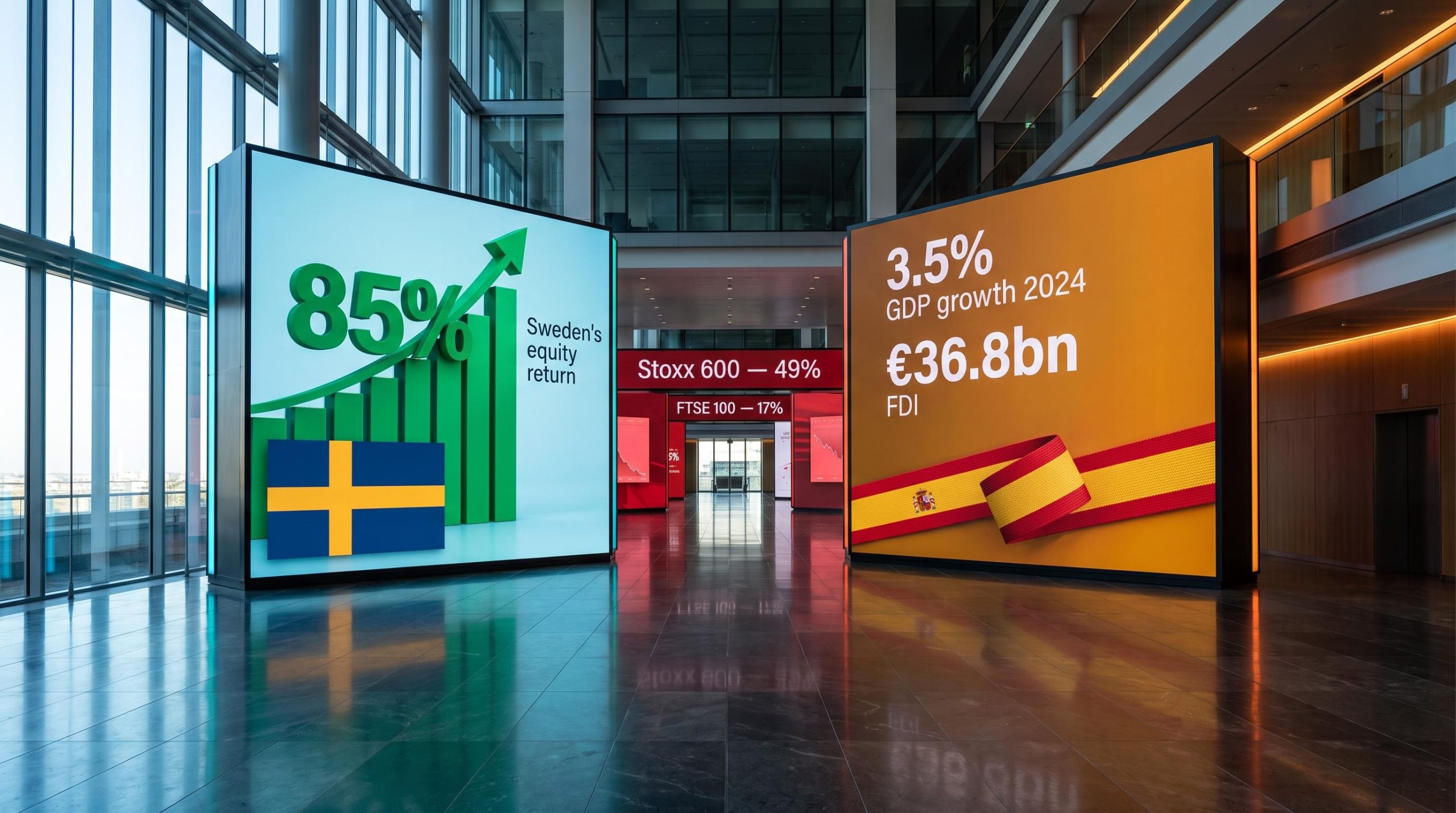
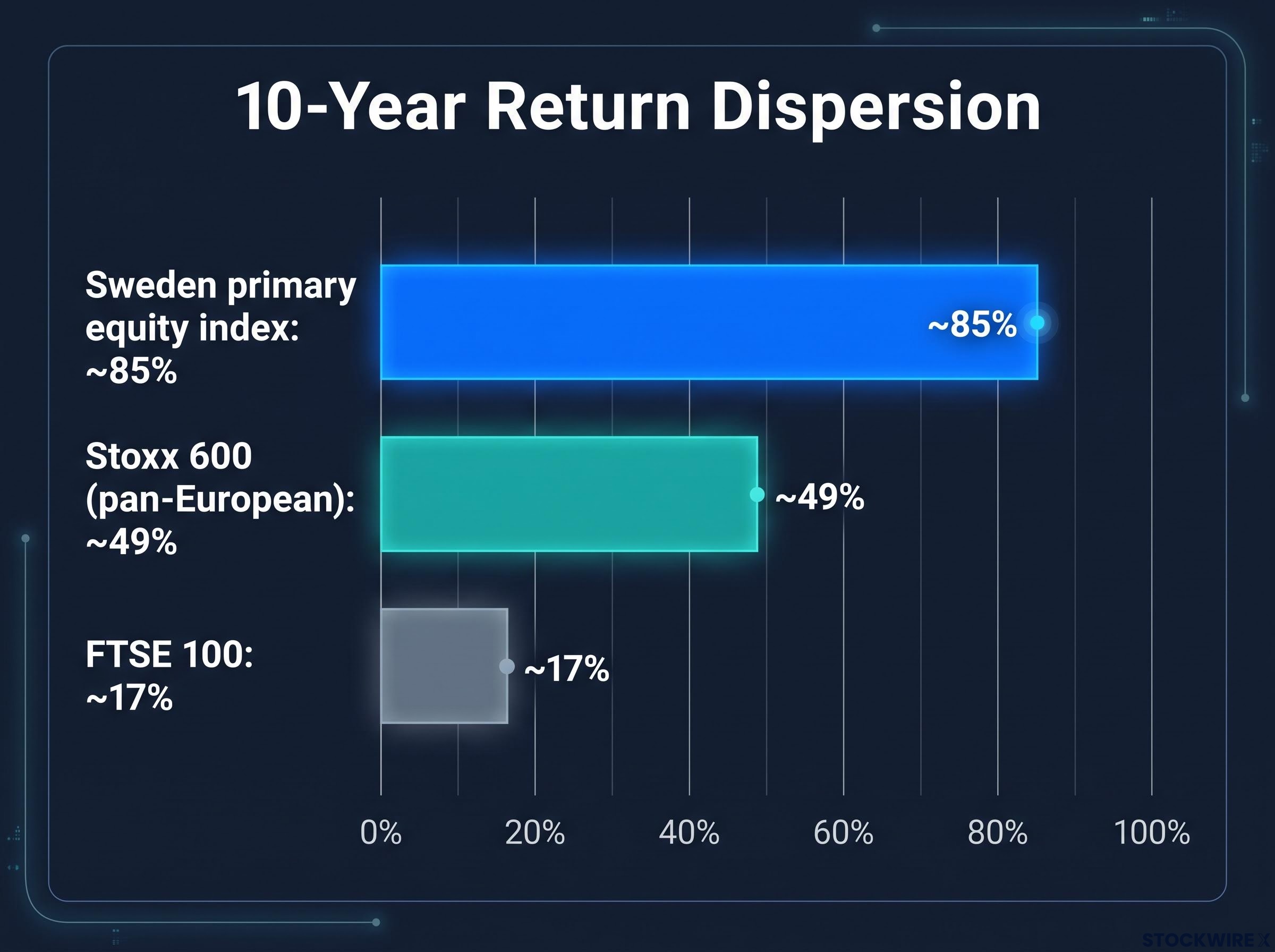
Europe is one of the world’s largest economic blocs, accounting for roughly 25% of global GDP. Most investors who bought it as a single allocation over the past decade bought underperformance. The pan-European Stoxx 600 returned approximately 49% over ten years, according to available market data. Sweden’s primary equity index returned approximately 85% over the same period. The FTSE 100 managed roughly 17%.
The problem is not Europe itself. The problem is treating it as a monolith. Broad regional indices systematically overweight the continent’s slowest reformers, France, Germany, and Italy, while diluting exposure to the countries where reform, policy design, or institutional depth have produced genuinely different outcomes.
Here is the framework for identifying which parts of European equity markets deserve capital and why, built around Spain and Sweden as the two clearest current examples. The logic is structural, not cyclical, and it applies whether or not the broader continent finds its footing by the end of the decade.
Why treating Europe as a single investment is the core mistake
The return dispersion within European equities over the past decade is wider than most investors assume. Sweden’s approximate 85% gain against the Stoxx 600’s roughly 49% is not a rounding error. It is a structural outcome of very different policy frameworks, corporate ecosystems, and capital market architectures operating under the same continental umbrella. At the other end, the FTSE 100’s approximate 17% decade return tells you what happens when an index is dominated by legacy sectors with limited growth reinvestment.
The FTSE 100 decade return of roughly 17% is not an outlier anomaly but a structural outcome: domestic institutional ownership of UK equities has collapsed from around 80% in the early 1990s to approximately 42% today, removing the stabilising bid that once prevented drawdowns from overshooting fundamentals.
Broad European indices overweight the large, slower-reforming economies by design. France, Germany, and Italy carry disproportionate index weight because of their market capitalisation, not because of their reform momentum. That construction means buying “Europe” has historically meant paying for the drag of the continent’s weakest structural performers, while the genuine outperformers are diluted to near-irrelevance in the portfolio.
The continental squeeze is real: Chinese manufacturing dominance on one side, US technological leadership on the other, and European capital markets carrying their own structural limitations:
- Limited household participation in equities across most of the continent
- Conservative institutional portfolios weighted heavily toward fixed income and deposits
- Political resistance to structural reform in labour markets, energy policy, and capital market integration
Disaggregating by country is not a sophisticated overlay. It is a basic analytical prerequisite for anyone investing in European markets with the intention of capturing genuine outperformance rather than continental mediocrity.
When big ASX news breaks, our subscribers know first
Spain’s second act: how post-crisis discipline became a durable investment case
Spain’s investment thesis begins in 2012, at the worst possible moment. Sovereign bond spreads were priced near default levels. The eurozone crisis had stripped the country’s institutional credibility. What followed was not cosmetic fiscal adjustment but a sustained, painful reform cycle across labour markets, banking regulation, and fiscal discipline that has now run for more than a decade.
The most legible evidence of this transformation appears in sovereign bond markets. Spreads that once reflected imminent default risk have since contracted to levels broadly in line with those of core eurozone issuers, including German bunds and French OATs. That move is not incidental. It represents a fundamental reassessment of Spain’s creditworthiness by the market, and the relative outperformance of Spanish equities against continental peers is a direct consequence of that reassessment.
Spain’s 2024 GDP growth reached 3.5%, versus 0.9% for the eurozone as a whole, a gap wide enough to suggest structural drivers rather than a cyclical blip.
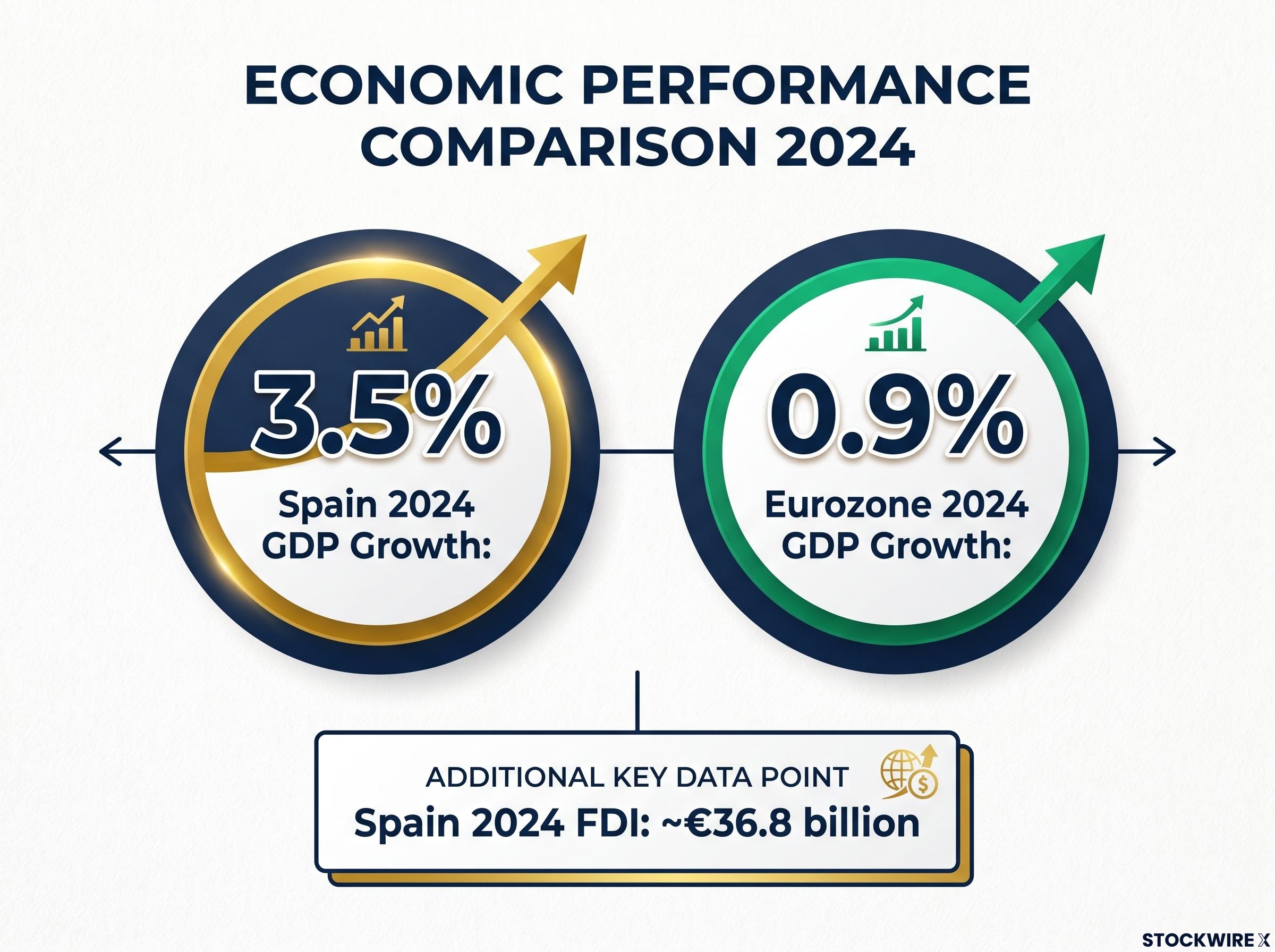
The growth differential has real underpinnings. Spain attracted approximately €36.8 billion in foreign direct investment in 2024, with the US as the second-largest source, according to available data. The country’s legal framework is described as highly favourable to foreign investors, with clear property rights and non-discriminatory treatment.
Structural labour and infrastructure advantages
Spain redesigned its immigration framework in a way that brought skilled workers into the economy and absorbed them productively, an achievement that distinguishes it from most other eurozone members. The country possesses the largest high-speed rail network in Europe, modern ports, and advanced telecommunications infrastructure, all of which support its role as a gateway connecting Europe, Latin America, and North Africa.
For investors, the causal chain matters: crisis forced reform, reform rebuilt credibility, credibility attracted capital, capital supported growth. That chain is what makes Spain’s case repeatable rather than lucky.
What Spain actually invests in, and where the gaps create opportunity
Spain’s equity market was among Europe’s best-performing in the year prior to mid-2026. That outperformance occurred despite a remarkably conservative domestic institutional base, which creates a paradox worth understanding.
OECD analysis of pension fund allocations reveals a striking contrast. Spanish occupational pension funds invest less than 6% of assets directly in equities, compared with approximately 43% in Sweden and 25% in Italy, according to available data. The fact that Spanish equities have outperformed despite this conservative domestic base suggests the gains reflect genuine structural improvement, not domestic capital rotation.
The OECD pension fund allocation data underpinning these figures draws from the organisation’s Institutional Investors Statistics, which tracks equity, bond, and deposit weightings across member-country occupational schemes, making the Spain-Sweden contrast reproducible against primary source figures.
| Country | Pension fund equity allocation | Capital market depth |
|---|---|---|
| Spain | Less than 6% | Moderate; conservative institutional base |
| Sweden | Approximately 43% | Among the deepest in the EU |
| Italy | Approximately 25% | Moderate; growing but fragmented |
Note: Pension fund allocation figures are based on OECD analysis and have not been independently verified against primary filings.
The pension fund allocation gap between Spain and Sweden is not a curiosity. It is a potential source of multi-year capital inflows into Spanish equities if domestic savings policy shifts even modestly toward equities. Sweden’s experience demonstrates precisely what happens when policy design channels household and institutional savings into equity markets over time.
For investors looking at where the specific opportunities sit, Spain’s structural tailwinds concentrate in several areas:
- Banks that generate significant revenues internationally, with particular exposure to Latin American and Middle Eastern markets
- Infrastructure companies benefiting from the country’s physical connectivity advantages
- Consumer services and tourism, supported by a large domestic market and geographic position
- Companies with cultural and trade connectivity to Latin America and North Africa, generating earnings beyond the eurozone
Sweden’s equity market: why one of Europe’s smallest economies built one of its deepest capital markets
Sweden’s capital market depth did not happen by accident. It was built through specific, deliberate policy choices that created a self-reinforcing cycle of household participation, institutional equity investment, and corporate listing quality.
Two policy mechanisms did the structural work:
- Allemansspar savings accounts (1980s): These government-backed accounts initiated broad public participation in equity markets for the first time, creating a generation of retail equity investors where none had existed before.
- Investment savings accounts, known as ISK (introduced in 2012): These made equity ownership tax-advantaged and administratively simple for ordinary citizens, removing the friction that keeps household savings trapped in bank deposits across most of the continent.
The result is measurable. Swedish households hold a larger proportion of their assets in listed equities and maintain lower levels of bank deposits than households in most other European countries. Financial literacy in Sweden exceeds levels in Germany, France, and Spain, supporting an embedded culture of equity ownership rather than deposit accumulation.
Sweden’s primary equity index returned approximately 85% over the past decade, versus roughly 49% for the Stoxx 600. Since 1900, Sweden’s average real equity return is approximately 5.9% per year, ranking among the top five globally, according to available long-run data.
For a global investor, Sweden’s capital market depth tells you that the quality of corporate governance, the patience of the capital base, and the liquidity of the market are all structurally higher than the Swedish economy’s size alone would suggest. That has historically translated into persistently superior risk-adjusted returns.
Corporate quality and the defence tailwind
Sweden’s equity market hosts a disproportionate number of globally competitive industrial and technology firms operating in specialised niches: telecoms infrastructure, industrial automation, and precision engineering. The domestic pension fund system, with its approximate 43% equity allocation, and high retail participation supply the long-term patient capital that enables these firms to remain listed domestically rather than migrating to US exchanges in search of deeper pools.
Defence is the most visible current tailwind. Saab, Sweden’s largest defence contractor, is positioned directly in the path of rising European defence budgets following Russia’s invasion of Ukraine and ongoing NATO spending pressure. That demand driver is multi-year in nature, though the precise timing and scale of budget commitments remain subject to political negotiation across the alliance.
The investment read is not a single-sector bet on defence, but recognition that Sweden’s industrial corporate base, patient capital structure, and policy-designed equity depth combine to produce a market whose quality consistently exceeds what its economy’s size would predict.
For investors wanting to move from the structural case to specific Swedish names, our deep-dive into Swedish industrial holding companies examines how Latour’s proprietary subsidiaries in precision engineering and niche industrials deliver consistent earnings growth that the listed portfolio drag obscures at the headline level.
Currency, politics, and the risks that actually matter
Every investment case has a failure condition. The specific variables to monitor differ by country.
Spain risks:
- Political fragmentation and regional tensions represent the clearest threat. Spain’s entire investment thesis rests on fifteen years of post-crisis credibility, and the continuation of fiscal discipline depends on governing coalition stability. If the bond spread compression that anchored the case earlier in this analysis were to reverse, the equity thesis would weaken in tandem.
- Cyclical exposure to tourism and external demand means global shocks, whether energy price spikes, security concerns, or eurozone recession, can transmit quickly to growth.
Sweden risks:
- SEK currency volatility is a persistent consideration for non-SEK investors. Because Sweden is fundamentally sound but relatively small, the Swedish krona (SEK, Sweden’s national currency) can overshoot during risk-off periods, creating both drawdown risk and, for patient investors, advantageous entry points when fundamentals reassert.
- High household and pension fund equity participation amplifies market cycles. While it has supported strong long-run returns, it also magnifies drawdowns during global downturns.
Pan-European risks:
- A renewed euro-area crisis or major geopolitical fragmentation could compress country-level outperformance by raising regional risk premia across the board. Even structurally sound markets like Spain and Sweden would be constrained if the continent-wide risk premium spikes.
For an investor building a position in either market, the monitoring framework is specific: in Spain, watch the political stability of the governing coalition and the continuity of fiscal targets. In Sweden, the EUR/SEK rate at entry is a material determinant of total return.
2027, reform momentum, and where Spain and Sweden fit in either scenario
The year 2027 is flagged by Rosenberg Research analysts as a potentially decisive juncture for European economic reform momentum. This is an analyst scenario, not market consensus, and it deserves to be assessed on both sides.
| Scenario | Continental reform momentum | Spain positioning | Sweden positioning |
|---|---|---|---|
| Reform | France and Germany stabilise politically; energy, capital market, and industrial strategy reform lifts broader European equities | Already through reform cycle; benefits from rising continental tide | Capital market architecture operates independently; participates in upside without depending on it |
| Stagnation | Continued dysfunction; no meaningful reform implementation | Post-reform credibility insulates from worst continental drag | Structural market depth and corporate quality sustain outperformance regardless |
Source: Scenario framework adapted from Rosenberg Research analysis. Presented as analyst scenario, not consensus forecast.
Whether 2027 delivers reform momentum or continued stagnation, the allocation logic converges on the same conclusion: country-level selectivity is not a tactical tilt but a structural necessity in European equities.
The contrarian European equity thesis, built on the gap between entrenched consensus pessimism and the reality that institutional positioning was at its most underweight since December 2024 as of mid-2026, provides a complementary demand-side lens to the structural supply-side reform story that anchors the Spain and Sweden cases.
The allocation imperative: disaggregate Europe by country. Allocate to those already through their reform cycles or with structurally deep capital markets. Spain and Sweden are the clearest current examples.
The pension fund allocation contrast between Spain (less than 6% in equities) and Sweden (approximately 43%) is not just a comparison. It is structural evidence that policy design determines capital market outcomes over time, and that those outcomes compound across decades.
The case for selectivity over breadth in European equity allocation
Within European equities, two structural variables are the most predictive of long-run outperformance: where a country sits in its reform cycle, and how deep its capital market institutions run. Spain offers domestically headquartered banks with substantial international revenue exposure, infrastructure supported by world-class physical connectivity, and consumer and corporate reach into Latin America and North Africa. Sweden offers industrials, technology, and defence names backed by one of the deepest domestic capital bases in the developed world, with a currency entry point that rewards patience.
If France and Germany demonstrate genuine reform momentum by the latter part of this decade, the European allocation case broadens materially. Until then, precision targeting of already-proven markets remains the more defensible strategy.
The variable to monitor is not whether Europe “recovers” as a bloc. It is whether the specific structural conditions that produced outperformance in Spain and Sweden, post-crisis reform credibility in one case, policy-designed capital market depth in the other, begin appearing in other European markets. That is when the allocation widens.
This article is for informational purposes only and should not be considered financial advice. Investors should conduct their own research and consult with financial professionals before making investment decisions. Past performance does not guarantee future results. Financial projections and scenario analyses are subject to market conditions and various risk factors.