
The Federal Court found on 22 July 2026 that Rory Macleod, former managing director and CEO of Noumi Limited, breached his duties under the Corporations Act by failing to ensure the company’s financial statements gave a true and fair view. The ruling is the last major liability determination in a civil penalty case that has now produced sanctions against Noumi, its former CFO, and its most senior executive.
The judgment, ASIC v Noumi Ltd & Ors (No 7) [2026] FCA 958, caps more than three years of coordinated enforcement by ASIC against parties responsible for financial reporting failures at the company formerly known as Freedom Foods Group. Noumi has already been ordered to pay a $5 million corporate penalty. Former CFO Campbell Nicholas received a $100,000 penalty and was barred from managing corporations for four years. Macleod’s penalty and any disqualification orders are still to be determined.
The case establishes, in concrete terms, the standard that courts and ASIC now apply to CEOs who delegate financial oversight. For any director or executive of an ASX-listed company, the ruling draws a line between acceptable reliance on a finance team and the active engagement the law actually requires.
What the Federal Court found against Rory Macleod
The Court determined that Macleod breached two specific provisions of the Corporations Act across Noumi’s financial reports covering the year ended 30 June 2019 (on a limited basis) and the half-year ended 31 December 2019:
- Section 180(1), the duty of care and diligence: Officers must act with the degree of care and diligence that a reasonable person in the same position would exercise. The Court found Macleod fell short of this standard.
- Section 344(1), financial reporting compliance: Officers must take reasonable steps to ensure the company complies with its financial reporting obligations. This is a personal duty, not a collective corporate one.
The critical finding was that Macleod’s position on the financial reports was one where he knew, or ought to have known, that the figures did not properly capture the company’s actual inventory and revenue situation. Passive reliance on finance teams is not a shield under this standard. The Court was asking whether the CEO asked the right questions, not just whether he received reports.
Claims ASIC did not establish against Macleod
The judgment was not a clean sweep for the regulator. The Court dismissed both the continuous disclosure allegations against Macleod and the claim brought under s 1309 of the Corporations Act that he had provided false or misleading information. Those outcomes give a balanced picture of the ruling’s scope: liability was established on the financial reporting duties, but not on every front ASIC pursued.
When big ASX news breaks, our subscribers know first
The accounting failures that drove the breach findings
Two specific problems inside Noumi’s accounts drove the Court’s conclusions:
- Premature revenue recognition on lactoferrin sales: Revenue was recorded against sales where the goods had not yet reached customers and the contractual thresholds required for recognition remained unmet.
- Unsaleable inventory not properly reflected: The financial statements failed to account for inventory that could not be sold, distorting the company’s reported financial position.
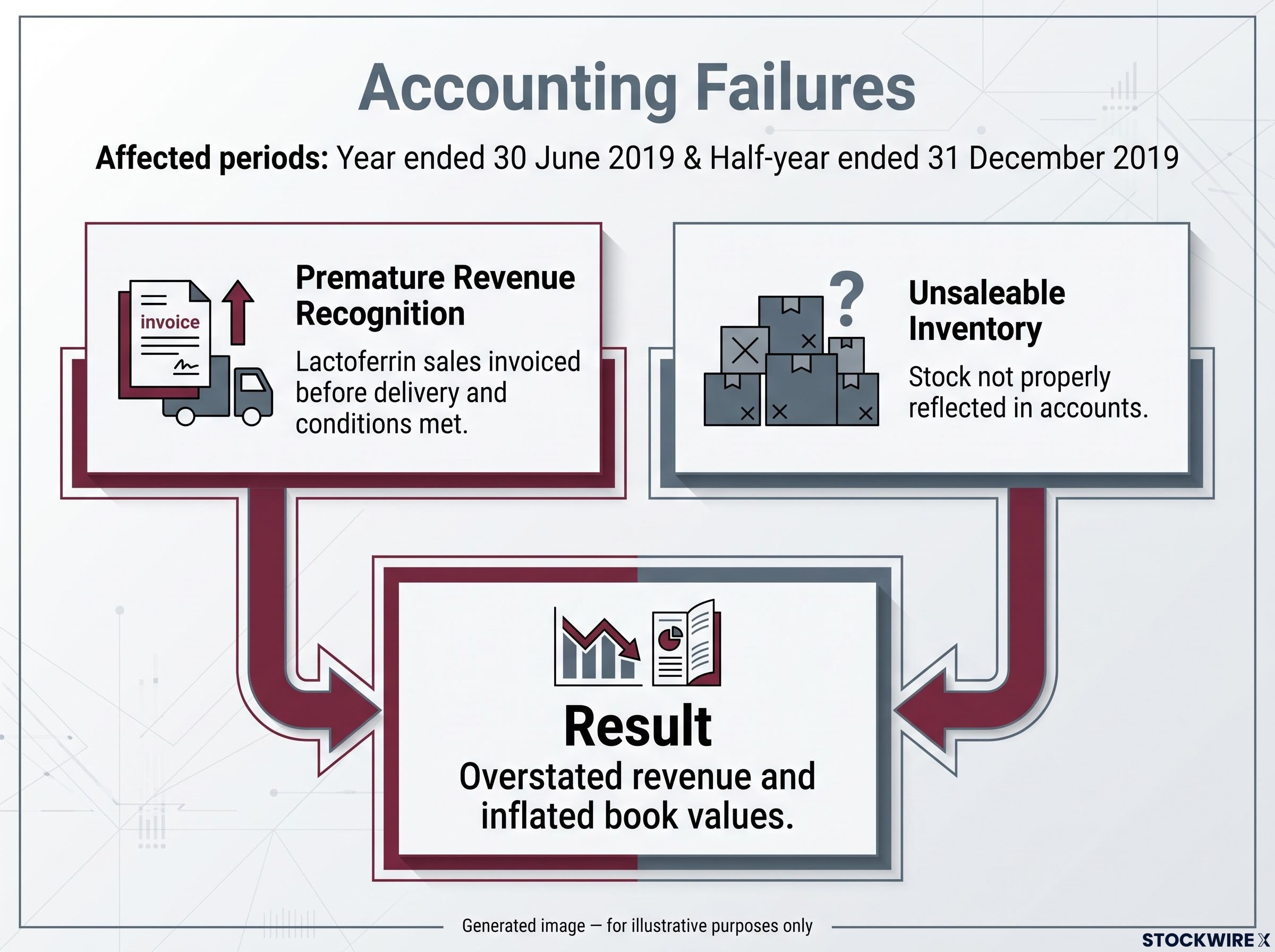
The lactoferrin issue is straightforward in principle. Noumi invoiced customers before delivery and before the conditions that would legitimately allow it to count that money as earned revenue had been met. The effect was to inflate reported revenue at the relevant reporting dates, giving investors a picture of business performance that did not match reality.
The Noumi financial scandal, which also produced a $43 million class action settlement in which Deloitte contributed approximately $31.4 million, illustrates how a single set of reporting failures can generate simultaneous regulatory, civil, and auditor liability across multiple proceedings running years apart.
The inventory issue compounded the problem. When a company holds stock it cannot sell, the accounts need to reflect that. Noumi’s did not, at least not adequately. Taken together, these failures meant the market was working with financial statements that overstated both revenue and the value of what the company held on its books.
ASIC characterised the effect as depriving “investors and the market” of “an accurate view of Noumi’s underlying business performance” in the relevant reporting periods (ASIC media release 26-166MR).
For any executive overseeing a business with complex revenue arrangements or material inventory, these two failures are a map of the questions that should be asked at every reporting cycle.
How liability was allocated across the company, the CFO, and the CEO
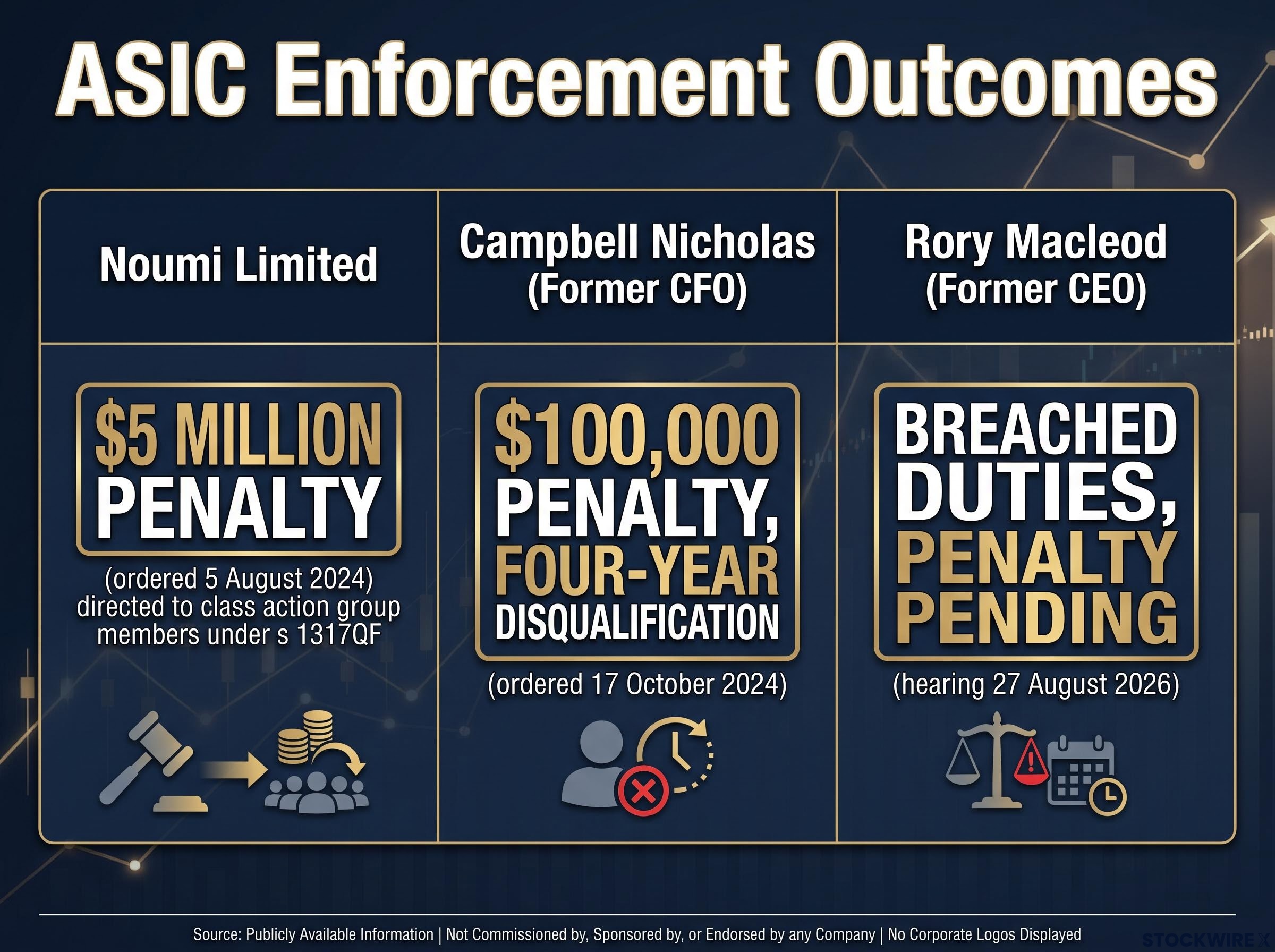
ASIC’s proceedings against the three respondents produced three distinct outcomes, each calibrated to the individual party’s role, knowledge, and conduct. The progression tells you something about how the regulator builds and runs a coordinated enforcement action.
| Party | Role | Key findings | Outcome |
|---|---|---|---|
| Noumi Limited | The company | Continuous disclosure breaches | $5M civil penalty (ordered 5 August 2024); penalty directed to class action group members under s 1317QF |
| Campbell Nicholas | Former CFO and company secretary | Continuous disclosure breaches, officer duty breaches, false or misleading information to directors and auditors | $100,000 penalty; four-year disqualification (ordered 17 October 2024) |
| Rory Macleod | Former Managing Director and CEO | Breach of duty of care and diligence (s 180(1)); failure to secure financial reporting compliance (s 344(1)) | Pending (case management hearing 27 August 2026) |
The s 1317QF mechanism applied to Noumi’s penalty is worth noting. Rather than paying the $5 million to the Commonwealth, the Court directed the penalty be applied for the benefit of class action group members, a relatively uncommon order that connects the enforcement outcome directly to affected investors.
The differentiation across the three parties is the point. ASIC’s enforcement model does not treat corporate failure as a single shared liability. What each individual knew and did determines their personal exposure, and the Noumi case is now a practical illustration of that principle.
The dual enforcement model ASIC applies in cases like Noumi and EOS means that a company penalty paid by shareholders does not resolve the personal exposure of the executives who made the decisions, a design principle the Corporations Act embeds specifically to place deterrence where conduct is controlled.
What the Corporations Act requires of company officers on financial reporting
The two statutory provisions at the centre of the Macleod judgment set the legal baseline for every officer of an ASX-listed company. Understanding what they require in practice, not just in principle, is what separates adequate governance from exposure.
- Section 180(1), duty of care and diligence. This requires an officer to act with the degree of care and diligence that a reasonable person in the same position would exercise. In the context of financial reporting, it means actively engaging with the substance of what the numbers show, not simply receiving reports and assuming they are correct. The standard is one of active inquiry.
- Section 344(1), financial reporting compliance. This requires an officer to take all reasonable steps to ensure the company complies with its financial reporting obligations. It is a personal duty on each officer individually, not a collective corporate obligation that can be discharged by pointing to someone else’s role.
The Court’s “knew, or ought to have known” finding against Macleod brings these provisions to life. Your personal exposure as a director begins at the point where you stopped asking questions, not at the point where you actively signed off on something false.
ASIC Chair Sarah Court stated, in remarks issued alongside the judgment, that directors must “actively engage” with financial reporting and cannot assume that finance teams or auditors have everything in hand. She described reliable financial reporting as the bedrock on which investor confidence and the integrity of Australian capital markets depend.
This article is for informational purposes only and should not be considered financial advice. Investors should conduct their own research and consult with financial professionals before making investment decisions.
What comes next for Macleod, and what the case signals for ASX governance
The proceeding against Macleod is now in the relief and penalty phase. A case management hearing is listed for 27 August 2026, where the Court will begin addressing the quantum of any financial penalty and whether a disqualification order should be imposed.
With Macleod’s penalty and any director disqualification still to be determined at the August case management hearing, the mechanics of how courts and ASIC calibrate disqualification orders, including the distinction between administrative bans under s 206F and court-ordered prohibitions, become directly relevant to assessing his residual exposure.
ASIC has framed the outcome as significant despite the dismissal of some claims. The regulator’s public messaging makes clear it views partial success as meaningful enforcement and is willing to pursue CEOs and CFOs directly, not just non-executive directors.
For ASX boards, audit committees, and senior executives, the aggregate case leaves several concrete governance takeaways:
- Revenue recognition on complex arrangements requires direct executive engagement at every reporting cycle, particularly where delivery conditions and contractual triggers are incomplete.
- Material inventory positions demand scrutiny of write-down assessments and obsolescence, especially in restructured or diversified businesses.
- Active engagement with financial reporting is a personal statutory obligation that delegation does not discharge.
- Personal liability is differentiated by role and conduct, not shared equally across a board or management team. What you knew and what you did determines your exposure individually.
When the quantum of Macleod’s sanction is determined, it will set a further data point on the personal financial cost of failing these obligations.
What the Noumi ruling establishes for directors who delegate financial oversight
The principle the Noumi case leaves behind is direct: delegation does not discharge a CEO’s personal obligation to ensure the financial statements give a true and fair view. The Court found that insufficient engagement with the substance of the numbers is itself the breach, not a mitigating factor.
The Noumi findings sit within a broader judicial pattern: the Star Entertainment proceedings extended executive liability under section 180 into non-financial compliance domains, confirming that the active engagement standard the Court applied to Macleod is not confined to accounting contexts but reaches any risk that executives control and fail to escalate.
The penalty phase remains ahead. The 27 August 2026 case management hearing is the next public milestone, and the final sanction against Macleod will complete an enforcement action that has already reached the company, its former CFO, and now its former CEO. ASIC has demonstrated willingness to run coordinated multi-party proceedings to their conclusion, and the Noumi case confirms that the most senior executives in an ASX-listed company sit squarely within its enforcement perimeter.