The October 2026 distribution window is closing right now, and if you hold any of Australia’s largest exchange traded funds, the clock is already running on decisions you cannot undo later.
Today is 1 October 2026, and the end of the September quarter has triggered a synchronised wave of income distributions across the four biggest providers on the ASX. Betashares, Vanguard, BlackRock iShares, and Global X have all hit their ex-dividend dates within days of each other, which forces every unitholder into the same narrow window for registry decisions.
This is not a quiet administrative event. The timing of these payouts determines how much cash lands in your account in mid-October, whether your distributions get reinvested or paid out, and what your tax position looks like at year-end.
Here is what you need: the confirmed cents per unit figures for the major funds, a plain explanation of why your unit prices are dropping this week, and the strict deadlines you have to meet if you want to control where your income goes.
Confirmed October 2026 payouts and critical deadlines
Start with the numbers, because that is almost certainly what brought you here. The major providers have finalised or estimated their figures, and the pattern across all of them is the same: extremely tight clustering driven by quarter-end accounting.
Vanguard’s Australian Shares Index ETF (VAS) carries a final estimate of 129.0661 cents per unit, published on 30 September 2026 and superseding an earlier estimate of 129.2582 CPU from 24 September. Its ex-date is 1 October with payment on 16 October.
BlackRock’s iShares S&P 500 ETF (IVV) is paying 17.330483 CPU, with an earlier ex-date of 29 September and payment arriving on 9 October.
Global X’s Australia 300 ETF (A300) carries an estimated 44.319691 CPU for the distribution period ending 30 September 2026, with payment landing latest of the group on 19 October.
Betashares confirmed its own round across a long list of funds, all sharing an ex-date of 1 October 2026 and a payment date of 16 October 2026. Here are eight of its most widely held ETFs.
| Fund Code | Fund Name | Distribution (CPU) |
|---|---|---|
| A200 | Betashares Australia 200 ETF | 167.0 |
| DHHF | Betashares Diversified All Growth ETF | 19.6 |
| WBND | Betashares Global Aggregate Bond Currency Hedged ETF | 57.2 |
| DVBA | Betashares Diversified Balanced ETF | 14.6 |
| DVGR | Betashares Diversified Growth ETF | 14.3 |
| INCM | Betashares S&P Global High Dividend Aristocrats ETF | 15.1 |
| US10 | Betashares U.S. Treasury Bond 7-10 Year Currency Hedged ETF | 53.6 |
| UTIP | Betashares Inflation-Protected U.S. Treasury Bond Currency Hedged ETF | 27.8 |
Notice the gap between the ex-date and when cash actually arrives. The two Vanguard and BlackRock timelines make this explicit.
- Vanguard VAS: Ex-date 1 October 2026, record date 2 October 2026, payment date 16 October 2026.
- BlackRock IVV: Ex-date 29 September 2026, record date 30 September 2026, payment date 9 October 2026.
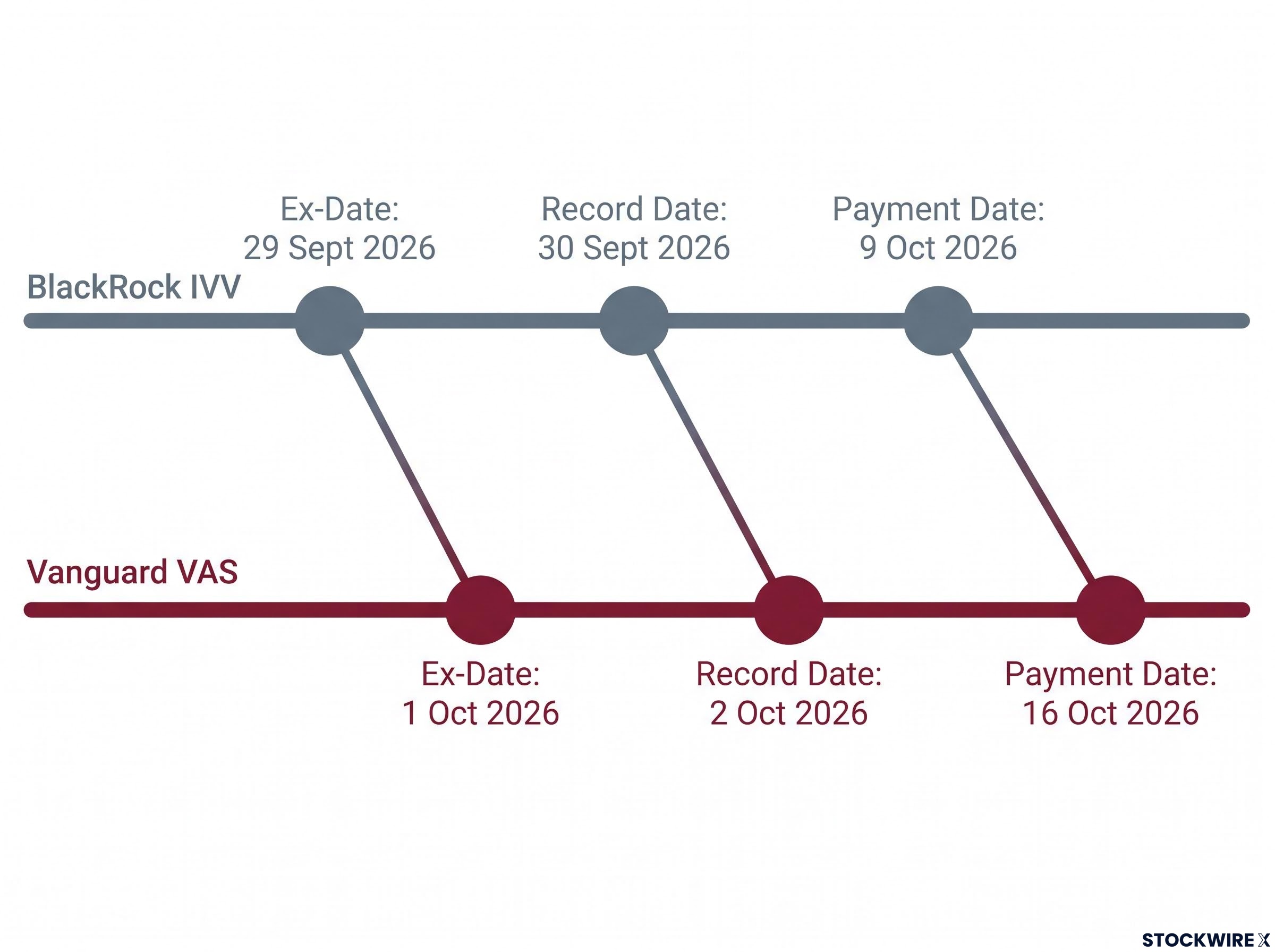
Seeing these clustered dates tells you exactly how tight your window for action is. If you hold any of these funds, you need to verify your registry settings now rather than later, because the entitlement is locked at the record date regardless of when the money shows up. You also need this data to project your mid-October cash flow and to confirm whether any last-minute purchases actually qualified for this round.
For investors who have just encountered VAS, A200, or DHHF for the first time through this distribution cycle, our comprehensive walkthrough of building a core ASX ETF portfolio covers how to combine these funds with international exposure, what fee compounding costs over decades, and the AMIT tax obligations that apply from year one.
When big ASX news breaks, our subscribers know first
Why your ETF price will drop on the ex-dividend date
Here is the part that catches new investors off guard. On the ex-dividend date, your ETF’s unit price falls by roughly the amount of the distribution, and that drop is not a market move, a sell-off, or anything going wrong.
An ETF’s price tracks its net asset value (NAV), which is the total value of everything the fund holds divided by the number of units on issue. When the fund sets aside cash to pay your distribution, that cash physically leaves the fund’s assets. The NAV drops by the same amount, and so does the unit price.
This matters because of the sequence. The ex-dividend date is the day the price adjusts downward. The record date, usually the very next day, is when the registry confirms exactly who was on the books and therefore entitled to the payout. The payment date, often weeks later, is when the cash finally lands.
The free money myth
A common misunderstanding is that you can buy an ETF the day before the ex-date, collect the distribution, and come out ahead. The maths does not work that way.
Say you buy a unit for $100 the day before the ex-date, and the fund pays a $2 distribution. On the ex-date, the unit price falls to roughly $98 because that $2 has detached from the fund. You now hold a $98 unit plus a $2 distribution coming your way. Your total value is unchanged at $100, and you may owe tax on that $2 as well.
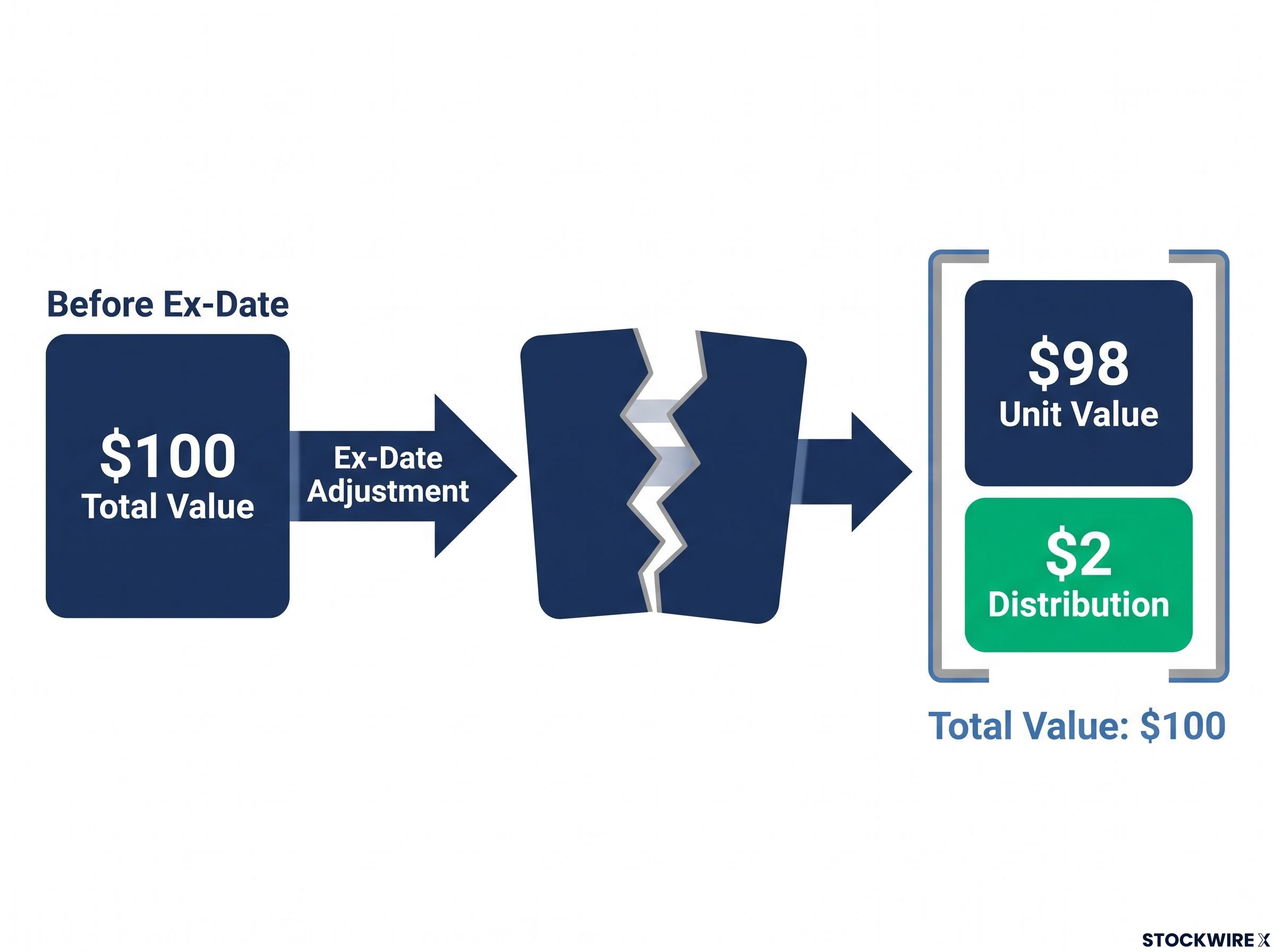
So there is no windfall in timing a purchase around the ex-date. The distribution simply converts a slice of your capital value into an income payment.
The same logic that explains the ex-date price drop also explains why dividend capture does not work: because the distribution converts a slice of your capital into income rather than adding new value, buying in just before the record date produces no gain and may add a tax liability on top.
Understanding this mechanism keeps you calm when your portfolio balance dips this week. The money has not vanished. It is moving from the fund’s unit price into your pending payout, and your total position is intact. That knowledge is what stops you from reacting to a screen that looks alarming but is behaving exactly as designed, and from making a poorly timed trade off the back of a misread.
Navigating DRP elections before the cut-off
Now the decision shifts from watching to acting. A Distribution Reinvestment Plan (DRP) lets you automatically convert your cash distribution into additional units of the same fund, rather than receiving the money in your bank account. For investors focused on compounding, it is a way to keep money working without paying brokerage on each top-up.
The catch is timing, and the deadlines are strict.
Vanguard requires your DRP election to be lodged by 5pm on the record date of 2 October 2026. Betashares sets its cut-off at 5pm AEDT on 5 October 2026. Global X’s A300 deadline has already passed, as its election closed on 1 October 2026.
There is a second trap. These elections are made at the registry level, not through your broker. Betashares uses MUFG Corporate Markets as its registrar, and an instruction sitting in your broking account does nothing if the registry has not recorded your preference. If you want to change your DRP status, here is the sequence.
- Identify which registry administers the specific fund you hold, as providers do not all use the same one.
- Locate your holder number, either your Holder Identification Number (HIN) or Securityholder Reference Number (SRN), which links you to the holding.
- Submit your DRP instruction directly to that registry before the stated cut-off time.
Missing these deadlines strips you of the choice for this quarter. You are then locked into whatever default position applies, whether that is cash or reinvestment, and it may not match the compounding strategy you actually want. Getting this right is how you take full control of your money: knowing exactly where, when, and how to instruct the registry leaves nothing to chance.
The hidden tax reality of your quarterly distributions
Step back from the cash for a moment, because the tax character of these payments is where investors make their biggest errors. An ETF distribution is not a simple company dividend. It is a bundle of different income types packaged together.
A single distribution can contain franked dividends from Australian companies, unfranked income, realised capital gains generated when the fund rebalances its holdings internally, and foreign income from overseas assets. Each component is taxed differently, and the full breakdown does not arrive until your annual tax statement is issued after the financial year ends.
The DRP trap is particularly costly. Even if you reinvest every cent and receive no physical cash, the Australian Taxation Office still treats the distribution as assessable income. You can be taxed on money you never saw land in your account.
This is why the embedded capital gains matter so much. Index funds that sell down positions during rebalancing pass those gains straight through to you, so you should prepare for a more complex year-end outcome rather than assuming the whole payout is clean dividend income.
The full complexity of ETF tax obligations extends well beyond what any single quarterly distribution reveals: mandatory annual cost base adjustments, foreign income gross-up requirements, and the treatment of return-of-capital amounts all interact with the components bundled inside these October payouts.
Evidence-based advisers, including Stockspot’s Chris Brycki, have consistently argued that high headline yields can mask capital erosion or tax-inefficient distribution profiles. Morningstar Australia research similarly stresses that distributions are inherently variable, depending on underlying dividends, bond coupons, and realised gains. The consistent message across the mid-2020s: plan for variability and prioritise long-term total return over chasing the highest quarterly yield.
Morningstar Australia research on income ETF variability reinforces this point, showing that headline yield figures can shift substantially quarter to quarter depending on the mix of dividends, bond coupons, and realised gains passing through the fund in any given period.
Recognising this protects you from treating a high CPU figure as a reason to buy, and helps you judge the true after-tax value of your ETF income.
This article is for informational purposes only and should not be considered financial advice. Investors should conduct their own research and consult with financial professionals before making investment decisions. Past performance does not guarantee future results, and distribution figures described as estimates are subject to confirmation in annual tax statements.
Positioning your portfolio for the next quarter
So where does this leave you this week? You now have the confirmed figures, you understand why your unit prices are dipping on the ex-date, and you know the registry deadlines that control your DRP choice.
The action item is immediate. If you want to change your reinvestment status for any payment still in play, log in to the correct registry and lodge your instruction before the cut-off, because your broker cannot do it for you.
Beyond the logistics, keep perspective. These quarterly distributions are a normal part of owning an ETF, not isolated windfalls to chase. Your real measure of success is total return, the combination of income and capital growth over time, not the size of any single CPU figure. Treat this cycle as routine portfolio housekeeping, and you stay in control of both your cash flow and your tax outcome.
Quarterly distributions are also a useful prompt for ETF due diligence more broadly: whether a fund’s distribution profile reflects genuine income or returned capital, how its tracking difference compares to peers, and whether your current holdings still match your target allocation are all worth reviewing while the registry deadlines focus your attention.