The Federal Reserve’s preferred inflation gauge just printed below every major forecast, and the US Dollar did not fall apart. That gap between what the data suggested and what markets actually did is where today’s most useful trading insight sits.
The August Personal Consumption Expenditures (PCE) figures, released on 30 September 2026, came in softer than economists at Dow Jones, PNC Economics, and the Cleveland Fed had projected, trimming expectations for further Federal Reserve tightening. Yet the US Dollar Index held its ground and partially recovered, Treasury yields rose, and four of the world’s most-traded currency pairs each moved for entirely different reasons.
Making sense of it means separating the PCE data story from the Dollar story. Here is what the numbers actually showed, how the Dollar responded despite the inflation miss, and what each major currency pair’s reaction reveals about the forces now competing for control of the FX market. After reading, you will have a framework for interpreting the next macro release rather than reacting to the headline.
What the August PCE data actually showed, and what it did not
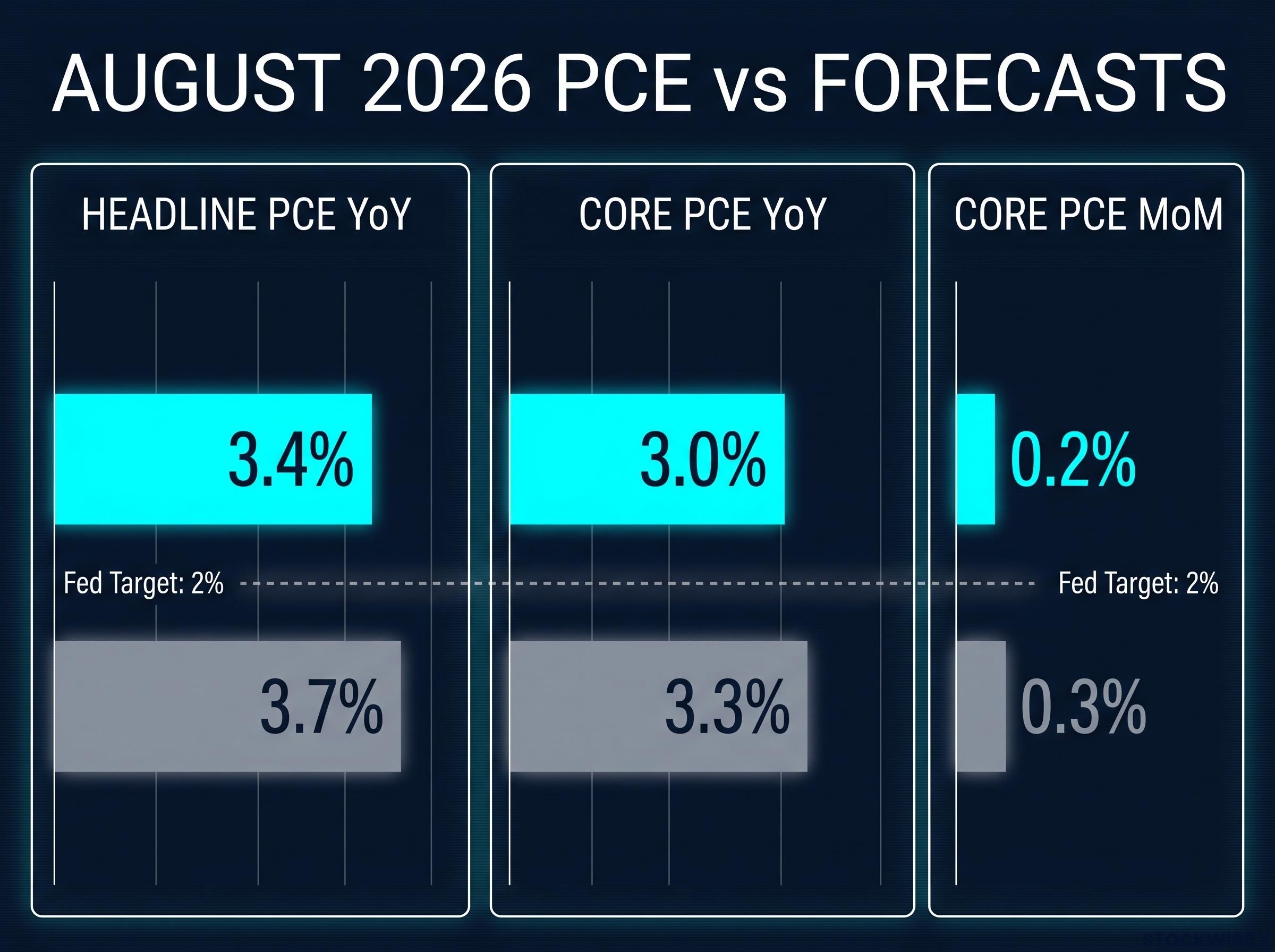
Start with the print itself. The Bureau of Economic Analysis reported headline PCE rising 0.3% month-on-month and 3.4% year-on-year for August 2026. Core PCE, which strips out volatile food and energy prices, rose 0.2% month-on-month and 3.0% year-on-year.
The BEA Personal Income and Outlays release confirmed headline PCE at 3.4% year-on-year and core at 3.0%, both landing below the consensus range that sophisticated macro desks had anchored to heading into the print.
Every one of those four measures landed below what forecasters had penned in. The Dow Jones survey had headline PCE at 3.7% year-on-year. Market consensus put core at 3.3% year-on-year, headline at 0.4% month-on-month, and core at 0.3% month-on-month.
| Measure | Actual (BEA) | Forecast | Cleveland Fed Nowcast |
|---|---|---|---|
| Headline PCE YoY | 3.4% | 3.7% | N/A |
| Core PCE YoY | 3.0% | 3.3% | N/A |
| Headline PCE MoM | 0.3% | 0.4% | 0.34% |
| Core PCE MoM | 0.2% | 0.3% | 0.27% |
The Cleveland Fed’s own nowcast, updated on 29 September 2026, had estimated monthly PCE at 0.34% and core at 0.27%, both above the final published figures.
The Cleveland Fed’s model pointed to monthly PCE of 0.34%. The BEA delivered core at 0.2%. When a central bank’s own inflation nowcast overshoots the actual print, the market’s repricing is not noise.
The distance between what forecasters expected and what arrived tells you something important. Even sophisticated macro models were caught leaning too hawkish, which means the market’s downward revision of Fed expectations is legitimate rather than a knee-jerk reaction to one soft number.
One caveat anchors everything that follows. Core inflation at 3.0% year-on-year remains a full 100 basis points above the Fed’s 2% target, and the PCE index has sat above that target continuously since 2021. This is a recalibration story, not a pivot story.
The August softening makes more sense when read against July PCE trends, where core held at 3.3% year-over-year for a second consecutive month and real personal spending went flat, establishing the deceleration sequence that August has now extended rather than originated.
How pre-release positioning made the miss land harder
The setup mattered as much as the number. Reuters coverage on 11 September 2026, following the CPI release, described inflation as accelerating and pushing the Fed closer to a hike, with economists at that point pencilling in core PCE of 0.3% month-on-month.
PNC Economics went further in mid-September, raising its own August core forecast to 0.3% month-on-month and arguing the data “seals a Fed hike in September,” with further increases projected for December and March.
When consensus is that firmly braced for more tightening, a downside miss carries extra weight. The gap between expectation and reality is what moves prices, and here that gap was unusually wide, which is precisely why the repricing in rate expectations and the Dollar was as sharp as it was.
When big ASX news breaks, our subscribers know first
Why the Dollar held despite the inflation miss
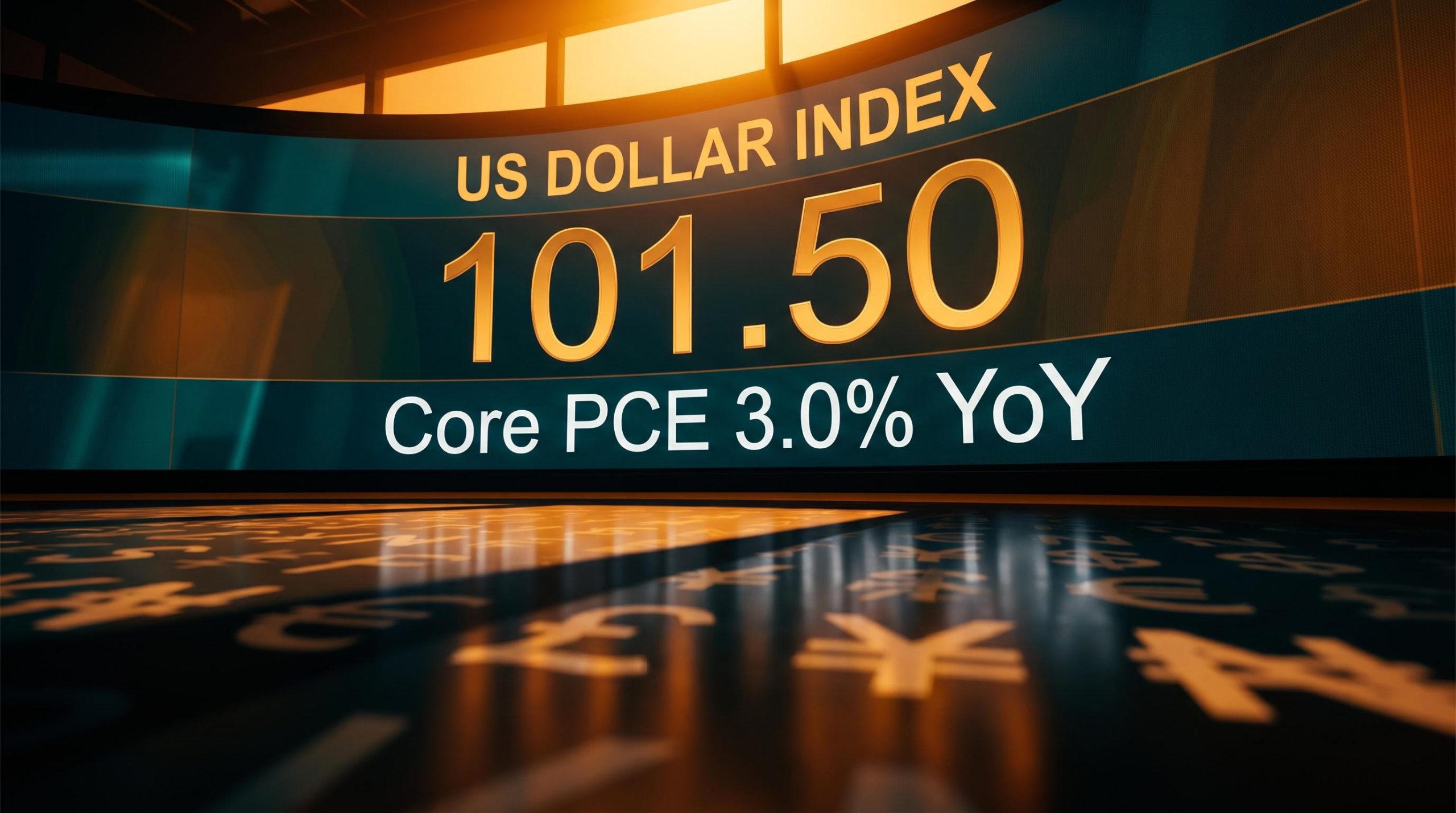
Here is the puzzle. Softer inflation reduces the case for rate hikes, and fewer expected hikes would ordinarily weaken a currency. Yet the US Dollar Index revisited the 101.50 area on 1 October 2026, building on a partial weekly rebound.
So what kept the Dollar upright when the logic pointed down?
The answer is that three forces were pulling at once, not one:
- Downward pressure from the softer inflation data, which prompted market participants to trim their bets on further tightening
- Upward support from rising US Treasury yields, which drew capital toward the Dollar even as the rate-hike case eased
- A structural floor from inflation remaining above the Fed’s target, keeping policy restrictive by default
The second force did much of the heavy lifting. Rising yields made Dollar-denominated assets more attractive, offsetting the drag from reduced tightening expectations and delivering the greenback’s partial recovery.
The third force is the one that gets overlooked. With core inflation still at 3.0% and consumer spending described as robust, the Fed has no reason to abandon its restrictive stance on the strength of a single softer month. The data moderated the pressure; it did not remove it.
The Fed’s September rate projections placed core PCE at 3.4% for full-year 2026 and pencilled in no return to the 2% target until 2029, which frames the August softening as a welcome but structurally inconsequential data point against a multi-year disinflation baseline.
The read to take from this is simple: the market is not pricing a pivot, it is pricing a pause. Those two scenarios have very different implications for how long Dollar strength can last.
That distinction matters directly for anyone with cross-border exposure or open currency positions. A market that has abandoned the tightening cycle calls for strategic repositioning. A market that has merely deferred it calls for a tactical hedge. Reading the Dollar’s resilience as the former when it is actually the latter is where positioning goes wrong.
Several Fed officials, including Neel Kashkari, Thomas Barkin, Susan Collins, Jeffrey Schmid, and John Williams, were scheduled to speak around the release. Their specific remarks on the August PCE print were not available at the time of writing, which leaves the “pause, not pivot” reading resting on the price action rather than on official guidance.
How EUR/USD, GBP/USD, USD/JPY, and AUD/USD each responded differently
A single US data point does not hit every currency the same way. It travels through each pair filtered by that currency’s own domestic dynamics, which is why the four majors behaved like four separate stories on 1 October 2026 rather than one unified Dollar move.
Think of the PCE release as an external impulse. Whether it amplifies or fades depends on what is already happening at home in the eurozone, the UK, Japan, and Australia.
| Pair | Level / Range | Direction | Primary domestic driver |
|---|---|---|---|
| EUR/USD | 1.1330-1.1340 | Lower | Accumulated Dollar strength, energy exposure |
| GBP/USD | ~1.3260 | Modestly lower | Limited domestic catalyst |
| USD/JPY | Low 157.00 | Range-bound | Intervention risk vs weak data |
| AUD/USD | ~0.6950 | Sharply lower | CPI miss, China PMI, Dollar recovery |
EUR/USD: the weight of a long decline from 1.2082
The Euro briefly pushed toward 1.1380 before pulling back into the 1.1330-1.1340 range and holding its downward bias. Wednesday’s low of 1.1312 was the pair’s weakest since May 2025.
That level carries context. EUR/USD has fallen a long way from its January 2025 peak of 1.2082, so this is not a fresh crack but the continuation of an established slide, driven by Dollar strength and lingering concerns over European energy price exposure.
The next tests come from Germany’s and the eurozone’s final S&P Global Manufacturing PMI readings and the broader eurozone Unemployment Rate.
GBP/USD: limited domestic catalyst, limited move
The Pound recouped some ground, briefly crossing above 1.3300 before surrendering most of it and easing back toward 1.3260.
The muted move reflects an empty domestic calendar. The final S&P Global Manufacturing PMI was the only significant UK release scheduled for the day, leaving Sterling without a homegrown catalyst to lean against the Dollar impulse. This is close to a “pure” PCE reaction: what a pair does when nothing local is competing for attention.
USD/JPY: intervention risk keeps the pair in check
The Yen pair stayed range-bound in the low 157.00 area, having traded below 157.00 during Wednesday’s Asian session amid intervention concerns.
Here the forces genuinely cancel out. Hawkish Bank of Japan expectations and the risk of Japanese currency intervention support the Yen, while weak domestic factory output and retail sales pull the other way. That standoff is why the pair went nowhere.
Upcoming catalysts include the BoJ Summary of Opinions, the final S&P Global Manufacturing PMI, weekly Foreign Bond Investment data, and the Tankan survey.
AUD/USD: three headwinds hit at once
The Australian Dollar took the sharpest hit, sliding to roughly 0.6950, a fresh two-month low. Three pressures landed together:
- August Australian underlying CPI came in below expectations, dampening the case for further Reserve Bank of Australia rate hikes
- Chinese PMI figures failed to offer meaningful support
- The Dollar’s partial recovery after the PCE release added external weight
That compounding is the lesson. AUD/USD’s sharper move relative to EUR/USD and GBP/USD shows that when domestic fundamentals line up with the external Dollar impulse, the effects stack rather than offset. That stacking is exactly the signal to watch in your own currency exposures. Australian traders now look ahead to the final S&P Global Manufacturing PMI, trade balance, and commodity price data.
What comes next, and which data releases will matter most
The PCE print raised a question it cannot answer alone: was August a genuine cooling, or a single soft month? The 1 October 2026 US data slate is the first real test.
Weight the releases by how much they inform the Dollar outlook, not by the order they arrive:
- ISM Manufacturing carries the most signal on whether activity is genuinely slowing
- Weekly Initial Jobless Claims provide the freshest read on the labour market
- Challenger Job Cuts add a second labour-market angle
- Final S&P Global Manufacturing PMI confirms or contests the ISM read
- Construction Spending rounds out the activity picture
The analytical logic is straightforward. If ISM Manufacturing disappoints and jobless claims rise alongside the PCE miss, the case for a pause strengthens materially and Dollar weakness could extend. If those readings hold firm, the softer inflation number starts to look like an outlier, and the “pause, not pivot” interpretation becomes harder to defend.
If ISM Manufacturing and jobless claims both soften with the PCE miss, you have the start of a corroborated cooling picture. If they diverge, the safe assumption is that the Dollar’s resilience continues.
The Fed speaker calendar is a secondary layer. With Kashkari, Barkin, Collins, Schmid, and Williams all scheduled, apply three questions to each appearance:
- Do they reference the PCE miss explicitly?
- Do they keep emphasising inflation persistence above target?
- Do they signal any change in the balance of risks?
Knowing which releases to weight most heavily lets you filter noise from signal in the days ahead, rather than treating every data point as if it carries equal force.
The current ambiguity around Fed speaker signals reflects a deeper structural shift: the Fed communication regime under Kevin Warsh has deliberately removed the forward-guidance scaffolding that previously allowed investors to interpret individual speeches within a clearly telegraphed rate path.
Reading the Dollar in a recalibration, not a reversal
Pull the four threads together and one picture emerges. The August PCE miss was real and meaningful against consensus, with core at 3.0% year-on-year versus the 3.3% expected. But it did not change the structural picture of above-target inflation and a still-restrictive Fed, which is exactly why the Dollar held at the 101.50 area rather than selling off.
The framework to carry forward: this is a recalibration, not a reversal. The market repriced how much tightening is coming, not whether the tightening cycle still exists.
That leaves two possible regimes. Either this is the start of a genuine softening cycle where Dollar weakness becomes durable, or it is a temporary repricing where the Dollar consolidates before resuming strength once incoming data reaffirms the inflation story. The currency pairs offer early evidence for the second reading: AUD/USD at a two-month low of 0.6950 and EUR/USD’s Wednesday low of 1.1312, its weakest since May 2025, show how much accumulated Dollar strength already existed before the PCE release even landed.
The Dollar Index breakout above 100 in mid-September, driven by a unanimous Fed hike to 3.75-4.00% and a 30-basis-point dot-plot revision, is the proximate origin of the accumulated Dollar strength that was already in place before the August PCE data even landed.
The variables to watch are not the next PCE print in isolation. They are whether labour and activity data corroborate or contradict the August softness over the next four to six weeks. Three developments would tip the balance toward a genuine reversal:
- Corroborated labour-market softening across claims and job-cut data
- An ISM Manufacturing contraction confirming slower activity
- Fed speaker language that explicitly de-emphasises the inflation-above-target narrative
Until those appear, the structural case for Dollar resilience remains intact, and positioning against it carries meaningful risk.
This article is for informational purposes only and should not be considered financial advice. Investors should conduct their own research and consult with financial professionals before making investment decisions. Past performance does not guarantee future results, and financial projections are subject to market conditions and various risk factors.