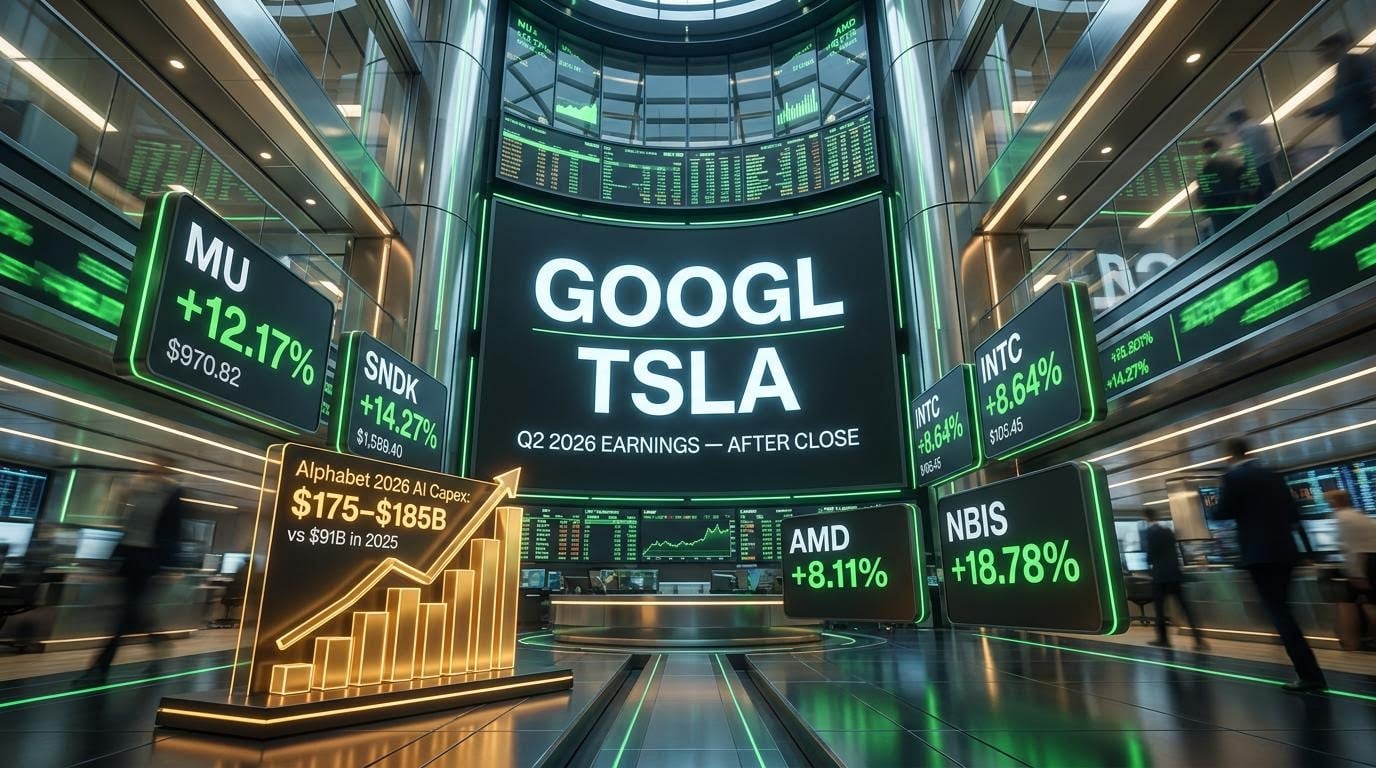
Both Alphabet and Tesla report Q2 2026 earnings after today’s market close, and the stakes extend well beyond two stock prices.
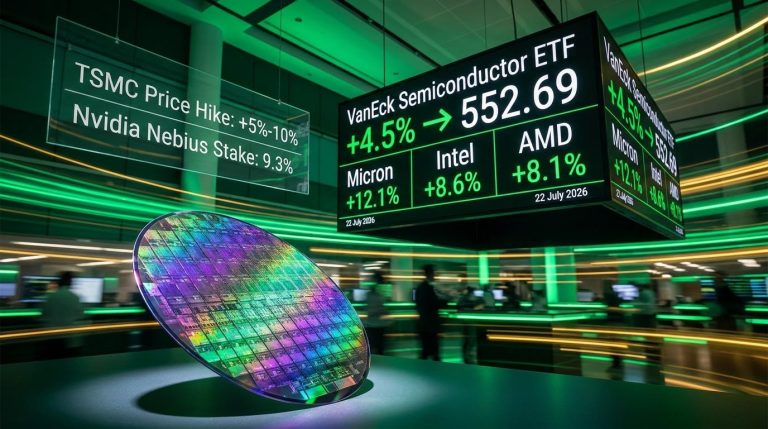
The session leading into tonight’s prints told its own story. Micron surged 12.17%, SanDisk jumped 14.27%, and Intel climbed nearly 9%. The market has placed its bet in plain sight: AI infrastructure demand is accelerating, and tonight’s results need to confirm it. The question is whether Alphabet’s capex commentary and Tesla’s delivery recovery can validate what semiconductor names have already priced in.
Here is what each print could tell you about the durability of the AI trade, and which numbers to watch before the results land.
What Alphabet needs to show tonight on AI spending
The single most consequential number Alphabet will deliver tonight is not earnings per share. It is capex guidance.
Alphabet guided 2026 AI capital expenditure of roughly $175-$185 billion, up from approximately $91 billion in 2025. Whether management reaffirms that range, pulls spending forward, or softens the language even slightly will set the tone for every AI infrastructure name in the market.
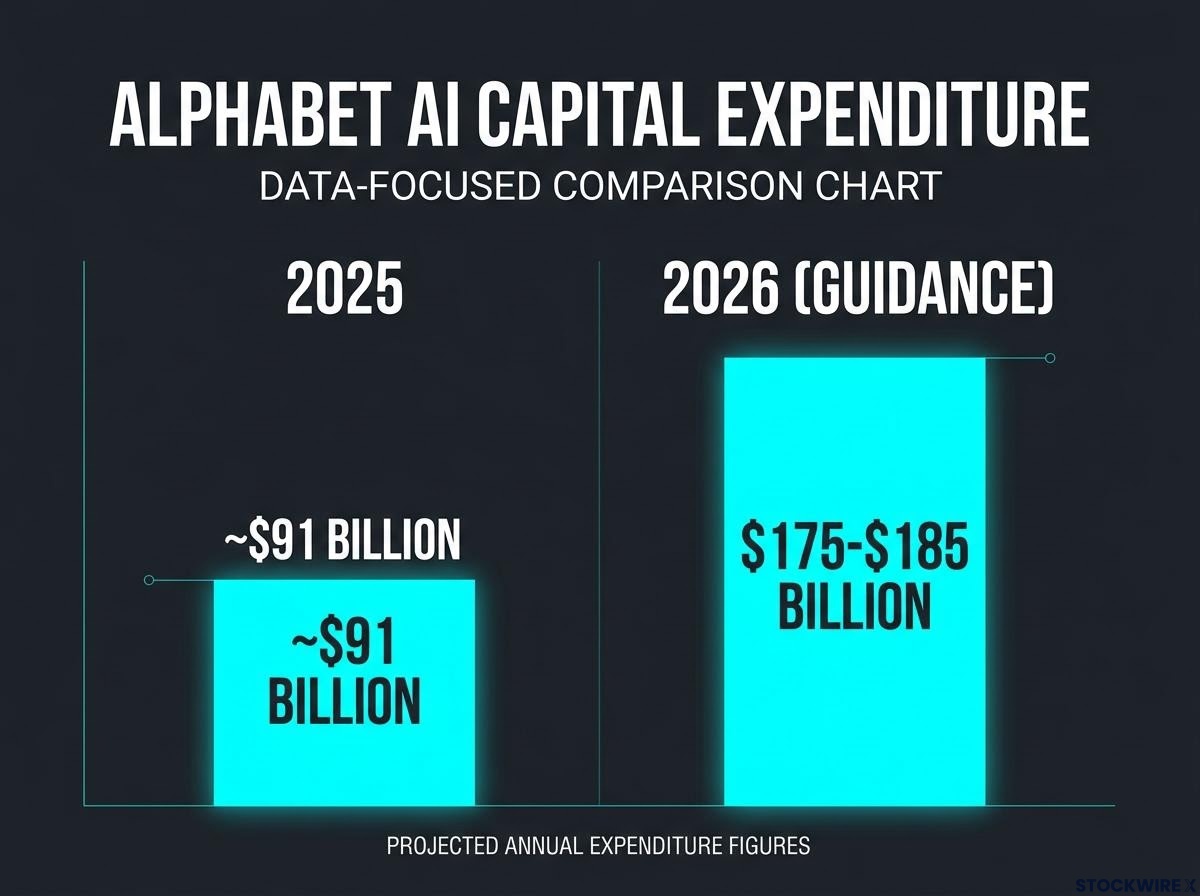
Key figure: Alphabet’s 2026 capex guidance of $175-$185 billion represents a near-doubling of its 2025 spend, the largest single-company AI infrastructure commitment on record.
That figure is not just an Alphabet line item. It is the demand anchor for NVIDIA, AMD, Micron, and the entire data centre networking supply chain. A reaffirmation extends the demand runway. Any moderation, even in tone rather than dollars, could unwind the day’s semiconductor gains quickly.
Alphabet enters tonight with momentum. Q1 2026 earnings per share came in at $5.11, representing 82% year-over-year growth. Consensus estimates for Q2 2026 revenue sit at approximately $120.2 billion, with EPS expected in the range of $2.86-$2.95 (estimates sourced via aggregator data and not independently confirmed).
Here is what to watch on the call:
- Capex confirmation or revision against the $175-$185 billion framework
- Google Cloud margin direction
- Search monetisation signals, particularly any AI cannibalisation risk
- Gemini enterprise adoption and pricing commentary
When big ASX news breaks, our subscribers know first
Google Cloud and Search: the two numbers that determine the stock reaction
The capex figure tells you what Alphabet is spending. Cloud and Search tell you whether the spending is working.
Google Cloud is the primary swing factor tonight. The Street is modelling 25-30% year-over-year revenue growth for Q2 2026. That sounds strong until you consider the comparison bar: in Q1 2026, Cloud revenue grew approximately 48% year over year, and Cloud operating income more than doubled.
The Google Cloud backlog entering Q2 stood at $460 billion, with more than $230 billion expected to convert to recognised revenue within 24 months, giving Alphabet a near-term revenue schedule that makes tonight’s Cloud margin print far more consequential than a typical quarterly update.
| Metric | Q1 2026 (Actual) | Q2 2026 (Consensus) |
|---|---|---|
| Cloud revenue growth (YoY) | ~48% | 25-30% |
| Search revenue growth (YoY) | Strong (mid-teens range) | Mid-teens |
| Total revenue | Beat consensus | ~$120.2B |
Search remains the near-term profit engine, historically representing 55-60% of total Alphabet revenue. Analysts expect mid-teens Search revenue growth in Q2 2026, but the more sensitive question is whether AI overviews or new ad formats are starting to cannibalise ad monetisation.
If Cloud margins expand while Search holds, the AI infrastructure bet is monetising. If Search shows any cracks from AI cannibalisation, the story about converting capex into returns becomes significantly harder for management to tell.
Why the AI hyperscaler category matters beyond Alphabet alone
A hyperscaler, in the AI context, refers to a company operating computing infrastructure at enormous scale, spending tens of billions of dollars annually on data centres, chips, and networking equipment to train and deploy artificial intelligence models.
Four companies dominate this category:
- Alphabet (Google Cloud, Gemini, custom TPU silicon)
- Microsoft (Azure, OpenAI partnership, Copilot infrastructure)
- Amazon (AWS, custom Trainium and Inferentia chips)
- Meta (Llama models, internal AI infrastructure)
Their collective spending runs into hundreds of billions of dollars in aggregate. These procurement decisions set capacity cycles that ripple downstream to chipmakers and suppliers, often 12-18 months ahead of revenue recognition. When a hyperscaler accelerates spending, it creates a demand signal that chipmakers use to plan production. When one pauses, the entire supply chain feels it.
SanDisk gained 14.27% and NBIS surged 18.78% in today’s session alone, both pricing in continued hyperscaler commitment before a single Q2 number has been reported.
Tonight is not just an Alphabet earnings event. It is a referendum on whether the infrastructure build-out that drove today’s semiconductor rally has a confirmed second half.
Tesla’s delivery recovery: what a real rebound looks like versus a discounted one
Tesla enters tonight’s report needing to demonstrate that a two-year stretch of declining deliveries is reversing. The headline delivery number will get the first reaction. The number underneath it determines whether the reaction holds.
Automotive gross margin excluding regulatory credits is the metric that separates a genuine demand recovery from a discount-driven one. Tesla’s prior price cuts boosted volumes but compressed margins, and professional investors learned to look past the delivery headline to the quality of each unit sold.
Product mix adds another layer. A higher share of premium models and Full Self-Driving (FSD) software subscriptions supports margin recovery. A volume rebound built primarily on lower-priced vehicles tells a different story, one where growth comes at the expense of earnings quality.
Here is the Tesla investor watchlist for tonight:
- Q2 deliveries versus consensus and any updated full-year volume guidance
- Automotive gross margin excluding regulatory credits
- Full-year guidance update or revision
- FSD attach rate commentary and recurring software revenue
A delivery recovery that compresses margins is not the recovery the bull thesis requires. Investors need to see whether tonight’s numbers reflect genuine demand or bought volume.
FSD, Optimus, and whether Tesla’s AI story gets a tangible update tonight
The part of Tesla’s valuation that carries the highest premium is also the part with the least operational evidence. The bull case rests significantly on the view that FSD and the Optimus humanoid robot position Tesla as an AI platform, not just an automaker. That premium requires ongoing proof.
The Tesla valuation framework entering tonight’s report rests on a 188x forward price-to-earnings ratio, a multiple that the automotive beat alone cannot justify and that requires FSD and Optimus milestones to materialise on the timeline the stock already prices in.
There is a meaningful difference between what would count as genuine progress and what would count as narrative maintenance:
- Genuine progress: regulatory approvals for expanded FSD deployment, verifiable FSD attach rate data, Optimus pilot deployments in Tesla factories with measurable output, or concrete commercialisation timelines with milestones attached
- Narrative maintenance: updated roadmap slides without new deployment data, vague timelines repeated from prior quarters, or aspirational language about Optimus capabilities without factory evidence
The core investor question tonight: is Tesla’s AI valuation premium being earned through operational milestones, or deferred through forward promises?
FSD remains the key software revenue and recurring monetisation angle for Tesla’s margin structure. Optimus factory deployment pilots represent the nearest-term operational milestone that could shift sentiment. Vague timelines or a repeat of prior quarter language could disappoint investors who have already priced in AI optionality.
For context, Intel reports on 23 July, providing the next AI-infrastructure read-through. The AI narrative will continue to be tested through the rest of the week.
What tonight’s prints mean for AI-exposed portfolios through the rest of the week
Alphabet and Tesla are the first two data points in a 48-hour earnings window that also includes Texas Instruments (reporting today) and Intel (reporting 23 July). Each provides a different layer of the AI demand picture.
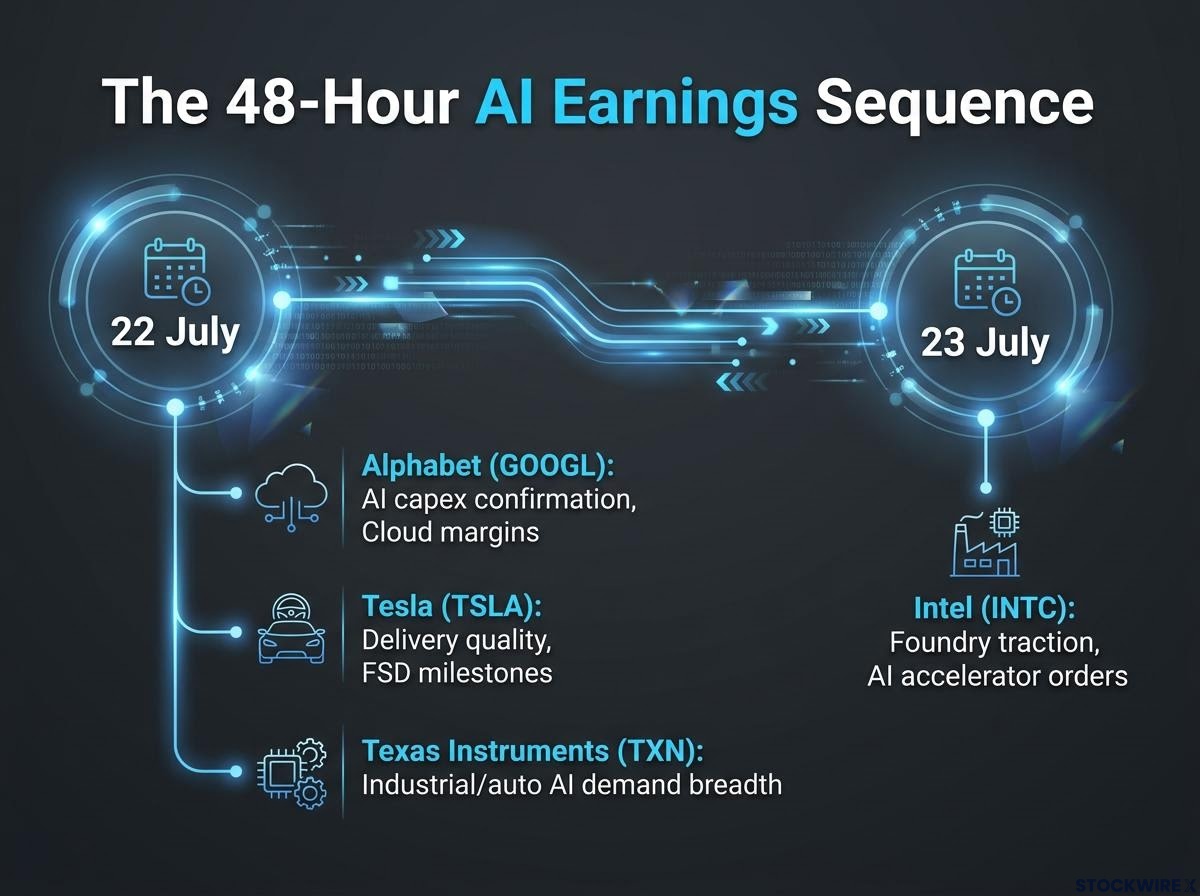
TI’s results offer a read-through on whether AI-related semiconductor demand is broadening beyond the data-centre GPU complex into industrial and automotive applications. Intel’s report tests whether the optimism already priced in (the stock climbed 8.64% in today’s session to $105.45) reflects a genuine foundry and AI accelerator turnaround or an expectations overshoot.
| Company | Ticker | Report Date | Key Watchpoint |
|---|---|---|---|
| Alphabet | GOOGL | 22 July | AI capex confirmation, Cloud margins |
| Tesla | TSLA | 22 July | Delivery quality, FSD milestones |
| Texas Instruments | TXN | 22 July | Industrial/auto AI demand breadth |
| Intel | INTC | 23 July | Foundry traction, AI accelerator orders |
The four-company, 48-hour sequence gives you a layered diagnostic: hyperscaler intent (Alphabet), physical-world AI deployment (Tesla), chip demand breadth (TI), and turnaround credibility (Intel). Each print refines the picture for the next.
Positioning before the close: what the market has already priced in
Today’s session made the market’s expectations visible before a single earnings number has been reported. The bar is already elevated.
| Name | Ticker | Change | Closing Price |
|---|---|---|---|
| NBIS | NBIS | +18.78% | $216.92 |
| SanDisk | SNDK | +14.27% | $1,589.40 |
| Western Digital | WDC | +12.51% | $548.39 |
| Micron | MU | +12.17% | $970.82 |
| Intel | INTC | +8.64% | $105.45 |
| AMD | AMD | +8.11% | $544.43 |
| NVIDIA | NVDA | +1.97% | $207.29 |
On the other side, Danaher fell 10.99%, MSCI Inc. dropped 10.14%, and Halliburton declined 5.47%. The selectivity is sharp: AI-adjacent names surged while non-AI sectors gave back ground.
AI semiconductor divergence is already visible within today’s session: NVIDIA gained less than 2% while Micron and SanDisk surged into double digits, a split that reflects different end-market exposures across the GPU, memory, and networking layers rather than uniform sector momentum.
Alphabet trades at a forward price-to-earnings ratio near 22x (estimate not independently confirmed), a discount to its historical range that implies limited tolerance for negative surprises but meaningful upside if Cloud margins and AI monetisation beat expectations.
The session’s moves tell you the bar is already elevated: a merely solid print from Alphabet or Tesla may not be enough to extend the day’s semiconductor gains, and any shortfall on the metrics that matter most could reverse them quickly.
The question tonight is not whether these are good companies. It is whether the results justify the positioning the market established today. Investors who understand where the bar sits can make more deliberate decisions about sizing and risk before results land.
For readers wanting to model the risk that today’s semiconductor gains reverse if tonight’s prints disappoint, our dedicated guide to the capex-to-revenue lag explains the 18-24 month gap between hyperscaler spending commitments and the revenue recognition that ultimately validates semiconductor valuations.
This article is for informational purposes only and should not be considered financial advice. Investors should conduct their own research and consult with financial professionals before making investment decisions. Forward-looking statements, including earnings estimates and capex guidance ranges, are subject to change based on market developments and company performance.