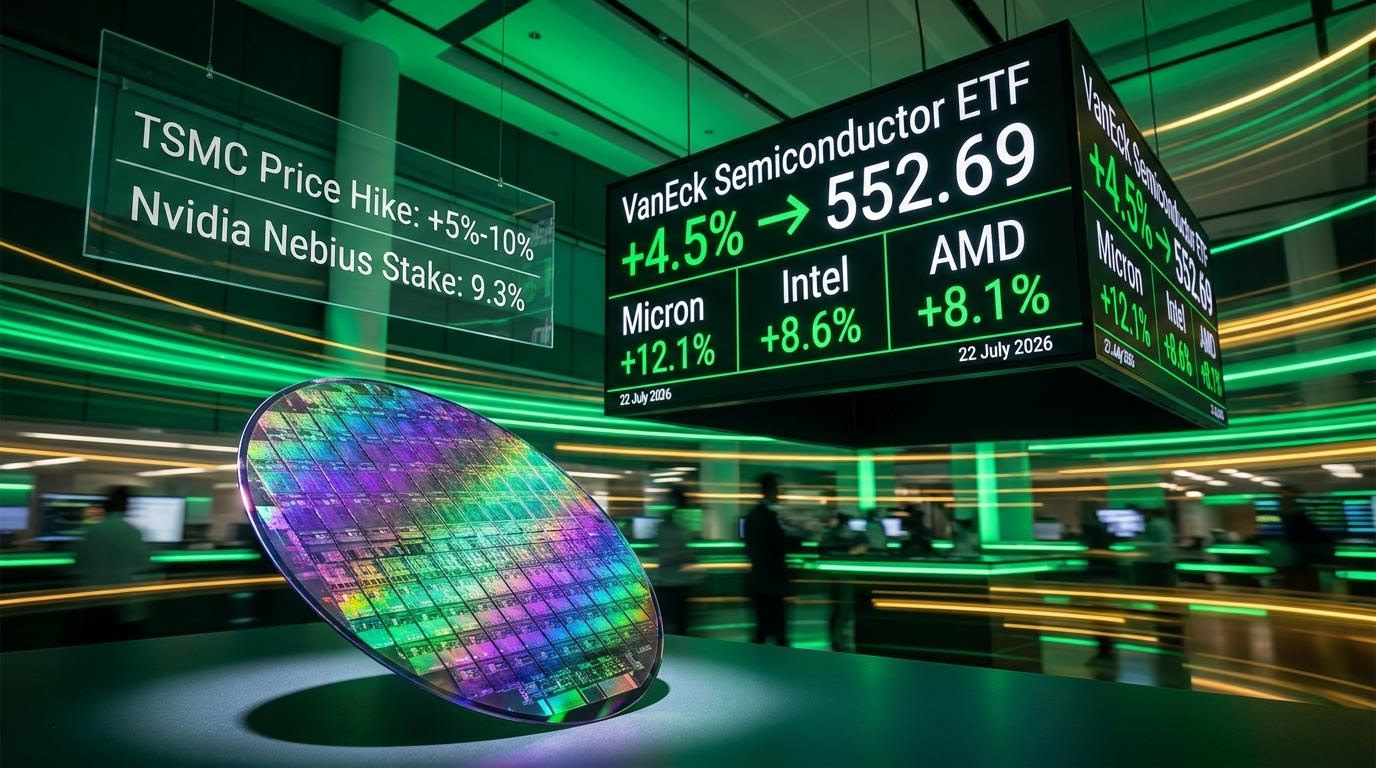
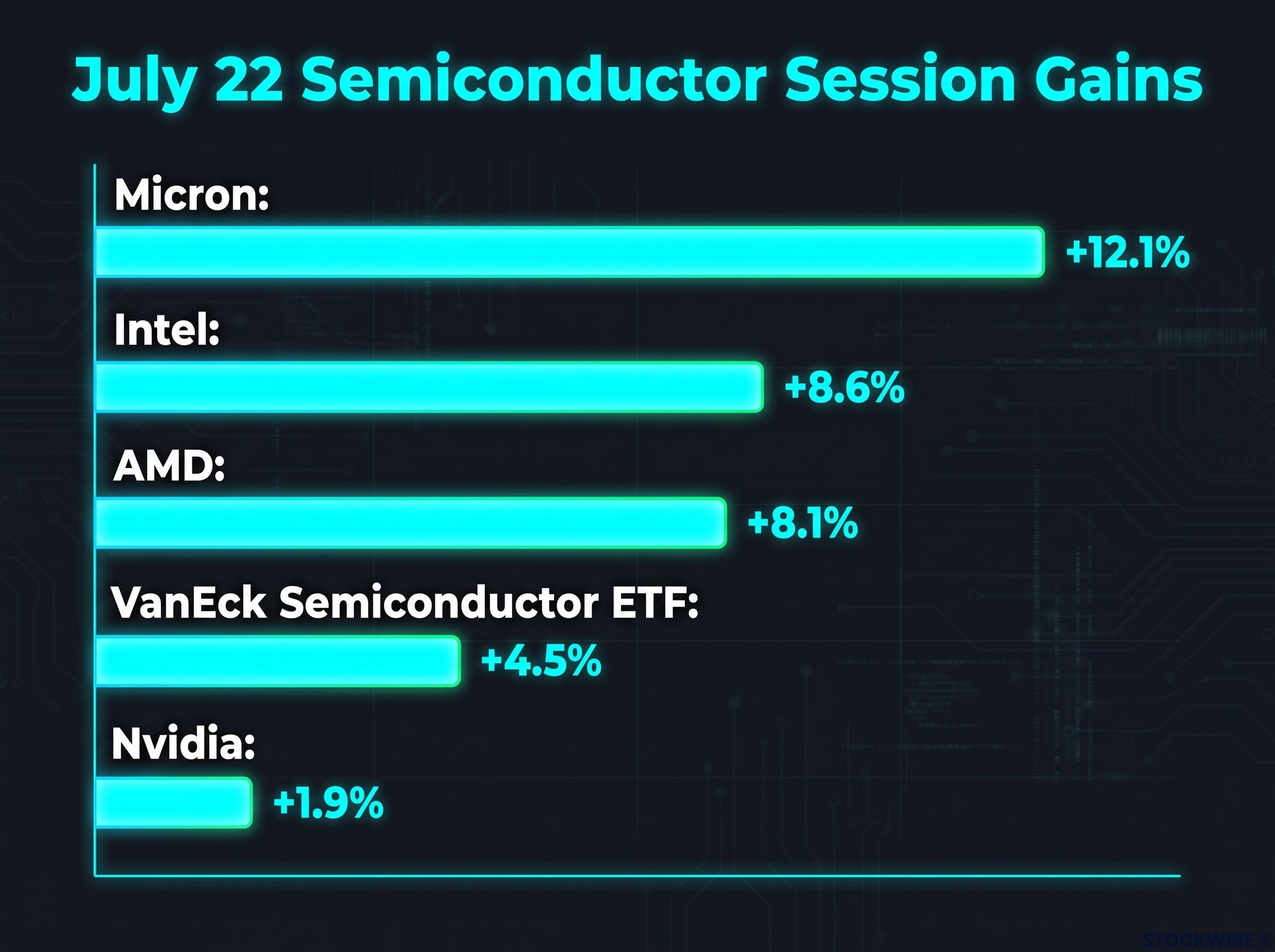
Micron surged 12.1%, Intel jumped 8.6%, AMD climbed 8.1%, and the VanEck Semiconductor ETF gained 4.5% in a single session on 22 July. Semiconductors carried the bulk of the day’s gains as major US indices ended a three-day run of losses, with chip stocks outperforming the broader market by a margin not seen in weeks.
Two catalysts gave the move its narrative spine. Nvidia revealed it had taken a 9.3% passive position in AI cloud infrastructure provider Nebius Group, while TSMC set out plans to lift its manufacturing prices by as much as 10% from 2027 onwards. Neither was a random headline. Both reinforced a structural AI infrastructure thesis that has been building across 2026, and the market responded by repricing the sector in a single afternoon.
Here is what the session’s specific catalysts, earnings backdrop, and market breadth data actually tell you about where semiconductor stocks stand right now, and whether this rally reflects durable demand or stretched positioning in a handful of mega-cap names.
What actually moved the chip market on July 22
The headline numbers looked strong across every major index. The S&P 500 closed at 7,509, up 0.89%. The NASDAQ Composite advanced 1.29% to 25,837. The Dow Jones Industrial Average added 0.74% to finish at 52,225. The Russell 2000 outperformed at +1.53%, closing at 2,987.
Within semiconductors, the moves were sharper:
- Micron: +12.1%
- Intel: +8.6%
- AMD: +8.1%
- Nvidia: +1.9%
- VanEck Semiconductor ETF: +4.5%, closing at 552.69
The VIX fell 8.58% to 17.05, confirming reduced fear after three sessions of selling pressure. Bargain hunting after that recent weakness was clearly part of the equation; these names had sold off despite still-strong structural demand for AI compute, and buyers stepped back in.
| Company / Index | Session Move | Close |
|---|---|---|
| S&P 500 | +0.89% | 7,509 |
| NASDAQ Composite | +1.29% | 25,837 |
| Micron | +12.1% | — |
| Intel | +8.6% | — |
| AMD | +8.1% | — |
| Nvidia | +1.9% | — |
| VanEck Semi ETF | +4.5% | 552.69 |
But here is the number that tells the real story. The equal-weighted S&P 500 gained just 0.16% on the session, versus the cap-weighted benchmark’s 0.89%.
The 73 basis point gap between the cap-weighted and equal-weighted S&P 500 tells you the day’s gains were almost entirely carried by a handful of large-cap names, not a broad market advance. That distinction matters when assessing whether this rally has staying power.
When big ASX news breaks, our subscribers know first
Why memory chips led the surge, and what Micron’s 12% gain signals
Micron’s 12.1% single-session gain was the day’s standout move, and it is less surprising than it looks once you understand the supply mechanics behind it.
HBM, or high-bandwidth memory, is the specialised memory that sits inside data-centre GPUs. It is a direct bottleneck for AI server performance: without enough HBM, even the most advanced processors cannot operate at full capacity. That makes Micron one of the most directly exposed names to the AI infrastructure buildout.
The supply-side constraints underpinning Micron’s positioning are not a new development: the memory chip shortage that drove more than 900% year-over-year earnings growth across Samsung, SK Hynix, and Micron simultaneously in Q1 2026 has been compounding since AI server demand began absorbing available HBM capacity faster than producers could redirect wafer output.
The supply-side picture explains the pricing power:
- Micron’s 2026 HBM production is reported as effectively sold out under long-term contracts
- Memory price increases are being driven by AI server demand and limited capacity additions
- New manufacturing capacity takes years and billions of dollars to bring online, keeping supply tight
Sold-out production schedules through year-end mean Micron’s earnings visibility is unusually high by semiconductor standards. That justifies premium positioning, but it also means any softening in AI server orders would hit the stock disproportionately hard, because the market is pricing in full utilisation.
Intel (+8.6%) and AMD (+8.1%) sit at different points in the same AI data-centre demand chain, covering accelerators, server processors, and networking silicon. All three moved together because the demand signal is the same.
The two catalysts that gave the rally its narrative spine
Two distinct signals landed on the same trading day, and together they reinforced the AI infrastructure thesis from opposite ends of the supply chain.
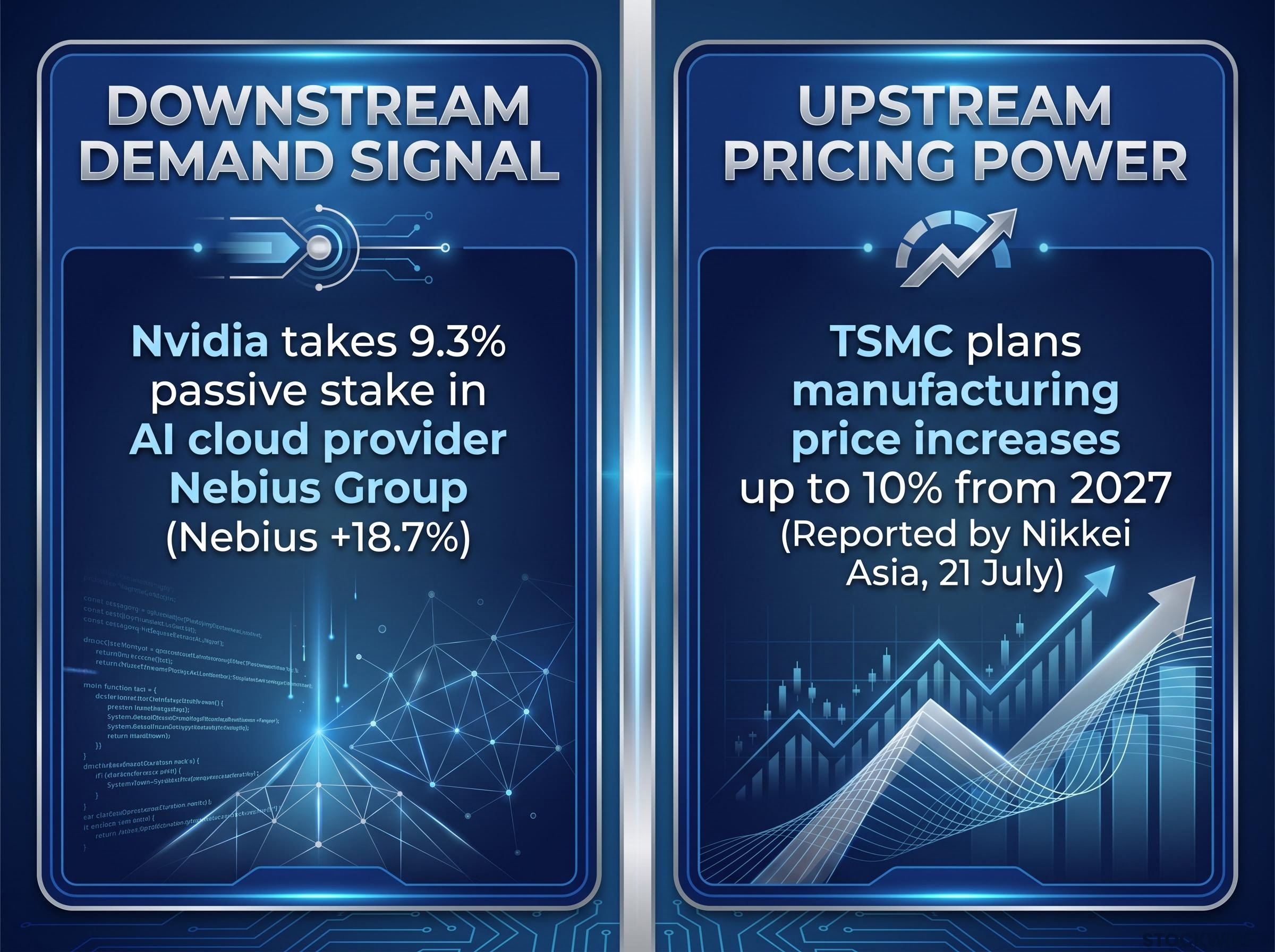
- Nvidia took a 9.3% passive equity stake in Nebius Group, an AI cloud infrastructure provider, with Nebius climbing 18.7% on the session. The stake signals that Nvidia sees durable demand for downstream AI cloud infrastructure, the layer that actually deploys its GPUs at scale, and is positioning for equity upside beyond chip sales alone.
- TSMC set out plans to raise chipmaking prices by as much as 10% from 2027, across both its advanced and mature manufacturing nodes. The announcement, reported by Nikkei Asia on 21 July, signals that order books are full enough and capacity is tight enough for the world’s dominant foundry to raise prices while expecting customers to absorb the increase without meaningful volume loss.
TSMC margin compression adds a complicating layer to the pricing power narrative: the company posted a fifth consecutive record quarter in Q2 2026 with net income up 77%, yet shares fell roughly 4% on earnings day because H2 2026 gross margin guidance landed approximately 70 basis points below analyst forecasts, driven by 2nm ramp costs and overseas fab expansion.
TSMC’s planned price increase of up to 10% from 2027 is the session’s most forward-looking data point. When a dominant foundry raises prices and expects customers to absorb them, that is a stronger real-world demand signal than analyst forecasts alone.
These catalysts matter beyond the day’s price moves because they provide forward-looking confirmation that AI infrastructure spending is still in expansion, not consolidation.
How semiconductor chips became central to the AI infrastructure buildout
The moves across Micron, Intel, AMD, and Nvidia on a single session are not coincidental. They reflect a supply chain where demand at one layer creates correlated pressure across every other layer.
AI models require massive GPU clusters for training and inference. Those clusters need:
- GPU and accelerator chips (Nvidia, AMD)
- High-bandwidth memory (Micron)
- Advanced foundry capacity to manufacture the chips (TSMC)
- Networking silicon to connect the servers
When a platform like Microsoft or Amazon commits billions to AI data-centre expansion, it creates simultaneous demand across all four layers. That is why a single positive headline, whether it is an Nvidia equity stake or a TSMC pricing move, can lift the entire complex in a single session.
Why supply constraints are the key variable
What separates this AI semiconductor cycle from prior boom-bust patterns is the supply side. Building a new semiconductor fabrication plant takes years and costs billions of dollars. Capacity cannot respond quickly to demand surges, which is what gives pricing power to TSMC and memory makers like Micron.
Long-term contracts, particularly in HBM and advanced-node logic, lock in demand visibility and insulate leading suppliers from near-term demand swings. Industry analyst forecasts suggest semiconductor revenue could rise approximately 57% cumulatively through 2026, with annual growth of roughly 22% followed by 26% (analyst-sourced, treat as directional rather than confirmed). Until new fab capacity comes online, pricing power is structurally embedded in the leaders.
This article is for informational purposes only and should not be considered financial advice. Investors should conduct their own research and consult with financial professionals before making investment decisions.
Q2 earnings add fuel, but analysts see the revision cycle approaching a peak
The chip rally did not happen in isolation. Strong Q2 earnings from names outside the semiconductor complex helped set the session’s risk-on tone.
| Company | EPS Result | vs Consensus / Prior Year | Key Development |
|---|---|---|---|
| General Motors | $3.57 (adjusted) | ~12% above consensus | Raised full-year EPS guidance to $12-$14; shares +4.9% |
| 3M | $1.78 (GAAP) | +33% year-over-year | Margins approaching 25%; raised outlook; shares +7.3% |
| MSCI | Below expectations | Q2 earnings miss | Shares fell 10.7% |
The broader S&P 500 earnings growth consensus for calendar year 2026 sits at approximately 24.5% year-over-year, according to FactSet, with technology as a primary driver.
CFRA analyst Sam Stovall has noted that the pace of upward earnings revisions may be near a peak. Once the revision cycle crests, further multiple expansion becomes harder to justify, and sensitivity to any disappointment in AI-related spending increases.
That is the tension investors need to calibrate. Earnings growth of 24.5% is strong enough to sustain current chip valuations. But if Stovall’s read is correct, the market may already be pricing in most of the good news. The next catalyst needs to be a genuine upside surprise, not just a beat-and-hold.
Upcoming mega-cap earnings from Tesla, Alphabet, Microsoft, Meta, Apple, and Amazon will test exactly that.
What the data tells investors about the sustainability of this rally
The session delivered genuine tailwinds. It also delivered data that complicates the picture. Both deserve weight.
Bull case signals:
- AI capital expenditure commitments from mega-cap platforms remain intact
- TSMC’s pricing move confirms demand absorption; customers are willing to pay more
- Memory supply constraints support earnings visibility through at least 2026
Bear case signals:
- The cap-weighted vs equal-weighted gap (0.89% vs 0.16%) shows concentration risk; the rally is narrow
- CFRA’s revision cycle concern means valuation expansion is harder to justify from here
- Oracle’s credit default risk has reached a multi-year high as bondholders question whether AI capital expenditure delivers adequate returns
Oracle’s credit default risk at a multi-year high is the most underappreciated signal in this session. Fixed-income markets, which price risk without the same optimism bias as equities, are already questioning whether AI capital expenditure delivers adequate returns. That is worth watching.
The Russell 2000’s 1.53% gain outpaced the cap-weighted S&P 500, but that outperformance was driven by small-cap-specific dynamics, not broad AI participation. Historically, this kind of concentration in leaders resolves in one of two ways: more sectors join the advance, or the leaders themselves correct as stretched valuations meet fundamental or macro headwinds.
Semiconductor cycle dynamics complicate a straightforward bull case: TSMC’s locked-in 2026 capital budget of $52-56 billion and Samsung’s estimated $70-80 billion annual outlay confirm a structural supply wave arriving in 2027-2029, with the double-hit mechanism of simultaneous earnings disappointment and multiple compression historically arriving before quarterly results make the turn visible.
What comes next depends on capex commitments, not just chip prices
The session’s two catalysts, Nvidia’s Nebius stake and TSMC’s pricing announcement, have already been priced in by the close. The next inflection point is earnings season commentary on AI spending, and that is where the rally either finds new fuel or runs into the valuation ceiling the equal-weighted data is already hinting at.
Three variables deserve close attention:
- Mega-cap tech capex announcements: Tesla, Alphabet, Microsoft, Meta, Apple, and Amazon are all reporting in coming weeks. Their capital expenditure guidance drives AI chip demand directly. SpaceX releases its first-ever earnings on 4 August.
- HBM pricing trajectory in H2 2026: If memory prices hold or rise further, the earnings visibility thesis stays intact. Any softening would challenge the premium baked into names like Micron.
- Market breadth widening: If the equal-weighted S&P 500 begins to close the gap with the cap-weighted benchmark, that signals the rally is broadening. If the gap persists, concentration risk remains the dominant concern.
This is neither a clear all-in nor a clear exit. It is a positioning checkpoint. The quality of upcoming earnings commentary will either extend or challenge the structural narrative that drove the session’s gains. For semiconductor investors, the capex numbers matter more than the chip prices right now.
For readers wanting to look beyond chip stocks to where durable value may concentrate in the broader buildout, our dedicated guide to AI infrastructure binding constraints examines why power availability, cooling density, and grid interconnection timelines may compound more durably than headline semiconductor names through 2026 and beyond.
Past performance does not guarantee future results. Financial projections are subject to market conditions and various risk factors.