Chip stocks fell for a seventh straight session on 15 October 2026, and the AI chip sell-off has now wiped more than $1tn from 20 of the world’s most valuable AI and semiconductor stocks this week, according to CNBC.
The timing makes the move look confused. On the same day, TSMC posted a record quarterly profit, while a hotter-than-expected US inflation reading revived expectations of further Federal Reserve rate rises.
Strong demand and falling prices can both be true at once. The difference lies in who is paying for the buildout, and how.
Here is how to tell signals of weak demand apart from signals of fragile financing, and which numbers to watch next.
Why is CoreWeave’s credit stress rattling the whole AI trade?
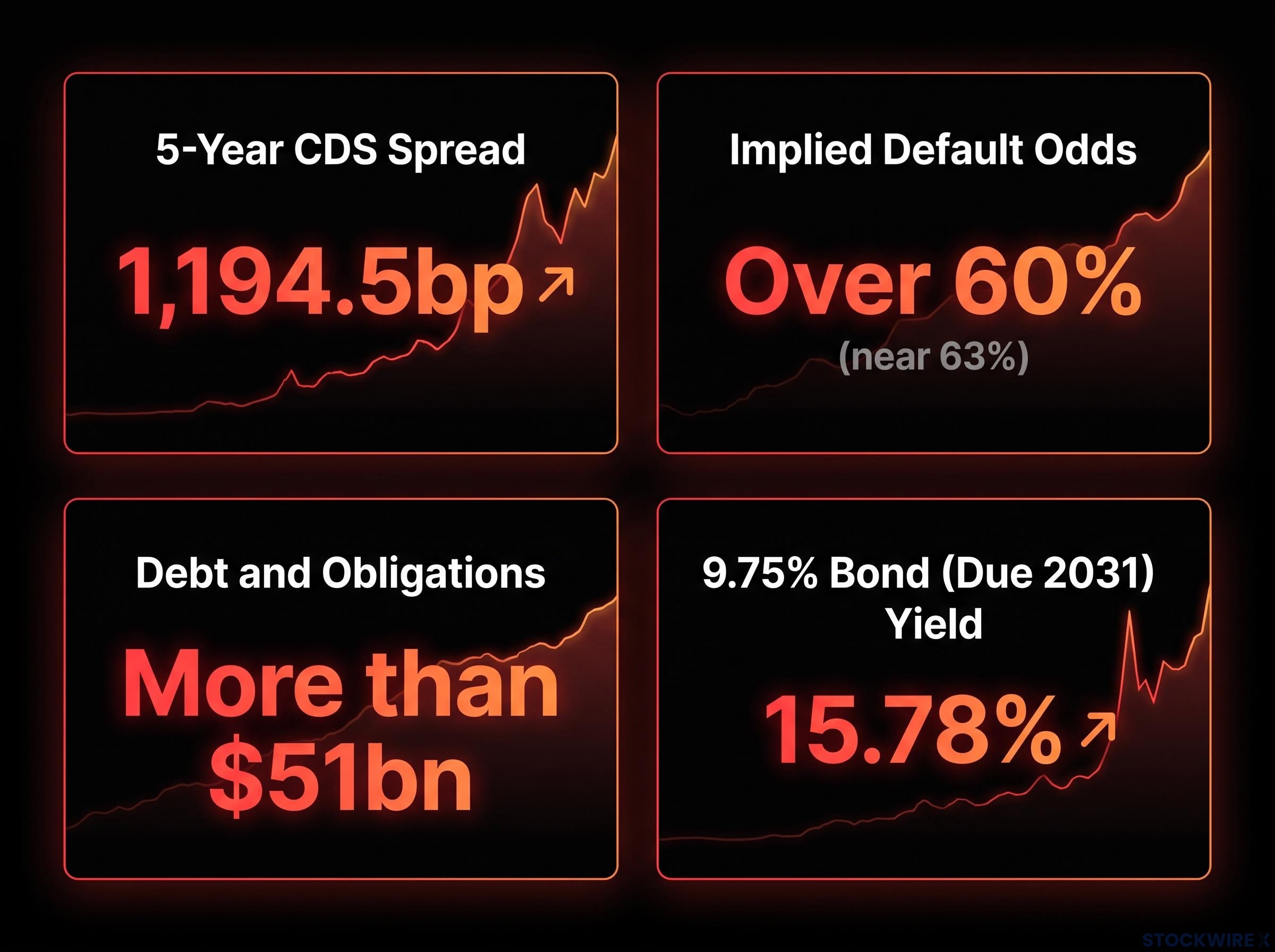
The most alarming number of the week came from the credit market. CoreWeave‘s five-year credit default swap (CDS) spread rose as much as 74.5bp to a record intraday 1,194.5bp, according to Bloomberg using ICE Data Services. A CDS is a contract that pays out if a borrower defaults, and its price is quoted in basis points (bp), where 100bp equals 1% a year.
That level implies more than 60% odds of default within five years. Reuters-related coverage put the figure near 63%, up from about 30% a year earlier. CNBC cited lower readings of around 1,088bp and 1,038bp, likely taken later or measured differently.
- CDS spread: record intraday 1,194.5bp
- Implied default odds: over 60%, near 63% in some coverage
- Debt and obligations: more than $51bn (CNBC)
- 9.75% bond due 2031: yielding about 15.78%, with some unsecured issues below 80 cents on the dollar
CoreWeave matters because it is the clearest case of debt-funded AI infrastructure built ahead of cash revenue. One leveraged borrower has become the market’s stand-in for financing risk across the sector. A reported $3bn private placement and possible insurance-sector funding have not been completed.
The bond market warnings on CoreWeave have been louder than anything visible in its share price, with the 2032 notes trading below 78 cents on the dollar and yielding close to 15%.
Management is pushing back. Jensen Huang, Chief Executive Officer of Nvidia, told Bloomberg that CoreWeave is improving, its cost of capital is falling, and Nvidia does not need to provide a backstop.
CoreWeave’s defence Chief Executive Officer Mike Intrator told employees the company’s deal backlog more than covers its debt obligations, and warned that markets could misunderstand the business.
A spread this wide tells you bond investors are pricing refinancing risk, not weak AI usage. Treat it as a gauge of borrower fragility, not of demand. Deutsche Bank analysts have urged investors to watch these credit signals as capex leans more on debt than on free cash flow.
How big is the debt, really?
Reported figures range from about $35bn to more than $51bn. The filing-based $35bn at end-June, up from $21bn at the start of the year, appears to exclude some obligations that the larger figures include. Whichever number you use, the direction is the same: sharply up.
When big ASX news breaks, our subscribers know first
What do TSMC’s record results and Anthropic’s growth say about real AI demand?
Set against that credit stress, the demand data looks exceptionally strong. TSMC’s net profit rose 68.7% to a record NT$763.1bn, its sixth straight record, and it guided fourth-quarter revenue to $52.3-54.3bn.
| Metric | Figure | Source | Note |
|---|---|---|---|
| TSMC Q3 revenue | NT$1.49tn (about $46.36bn) | TSMC | Reported results |
| TSMC operating margin | 58.7% | TSMC | Above 58% guidance |
| TSMC free cash flow | NT$476.56bn | TSMC | Versus NT$139.38bn a year earlier |
| TSMC advanced tech share | 79% of wafer revenue | TSMC | HPC was 68% of revenue |
| Anthropic Q3 revenue | $16.8bn, up nearly 50% | Axios | From $11.6bn in Q2, $4.7bn in Q1 |
| Anthropic revenue per $1 of compute | About $1.70 | Financial Times | Adjusted, investor-presented |
TSMC also expects substantially higher capex from 2026 through 2028. Further down the chain, Anthropic told investors it was cash flow positive and reached adjusted profitability for a second quarter. Its adjusted operating margin above 11% and gross margin near 85% are unaudited figures.
The financing link SemiAnalysis’s Sravan Kundojjala read the results as advanced-chip demand outrunning supply, and noted that TSMC checks whether customers have the financing to deploy the chips they order.
These results tell you end demand is real and supply-constrained. A falling chip index is not evidence that AI usage is shrinking, which leaves the obvious question of why prices fell anyway.
Where is the pressure coming from: rates, rotation and the borrowers behind the buildout?
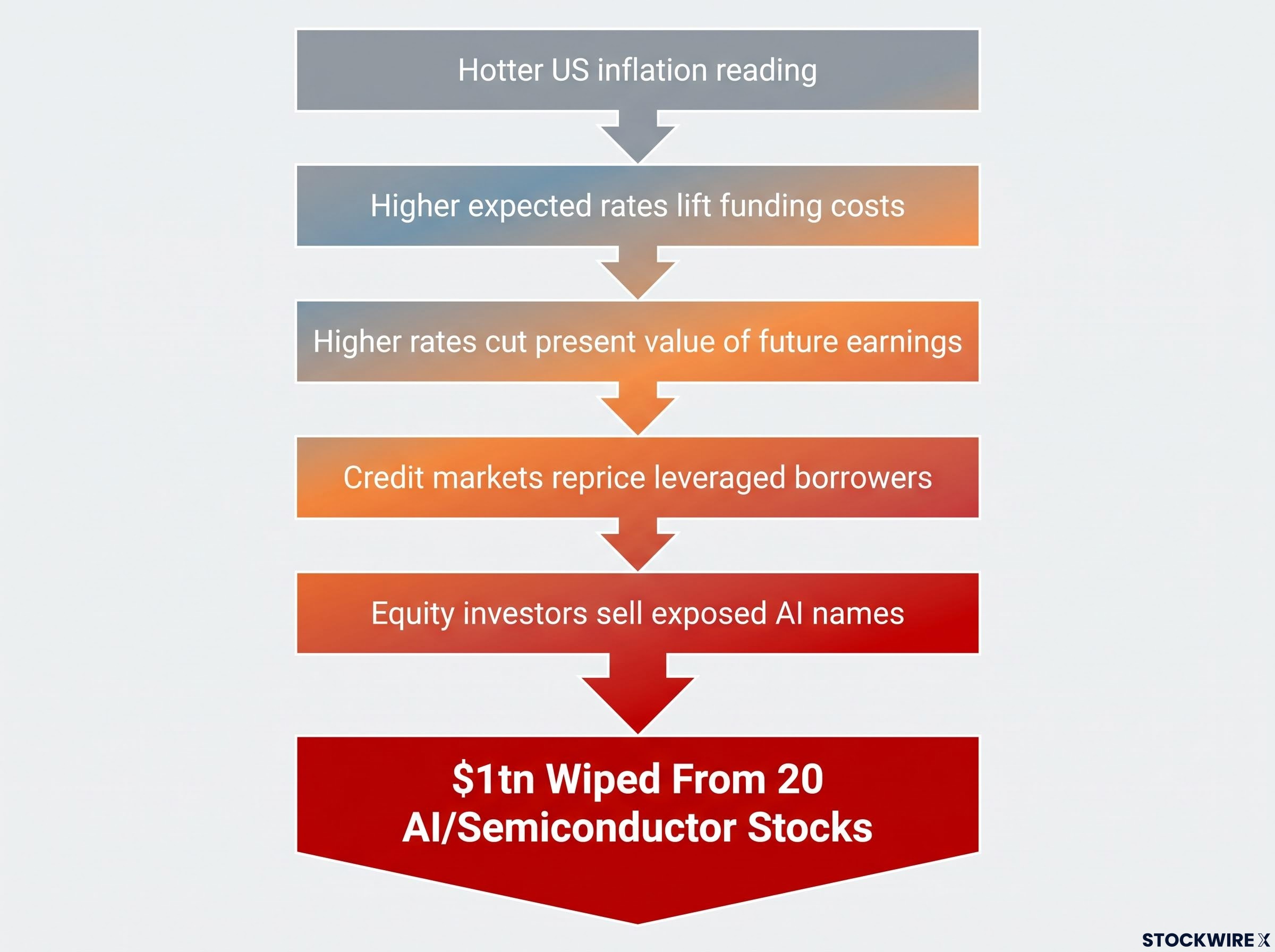
The answer runs through a chain that started with the inflation print:
- A hotter US inflation reading revived rate-rise expectations.
- Higher expected rates lifted funding costs for AI infrastructure.
- Higher rates also cut the present value of earnings expected far in the future.
- Credit markets repriced leveraged borrowers such as CoreWeave.
- Equity investors sold the most exposed chip and AI names.
Nomura‘s Takahide Kiuchi expects capex at the five largest hyperscalers to exceed their operating cash flow in 2026, making the cycle more reliant on outside money. Morningstar found the sharpest selling in companies that borrowed heavily for data centres. Concerns about circular financing, where suppliers help customers fund purchases, and competition from custom silicon added weight.
Vital Knowledge research suggests AI spending is consuming up to 90% of hyperscaler cash flows, which supports the view that the buildout increasingly depends on outside funding rather than internally generated cash.
| Market or stock | Reported move | Note on source variance |
|---|---|---|
| Philadelphia Semiconductor Index | Down about 3.6%; seventh straight loss | 12% below early-October peak, or 14% since 6 October |
| Nvidia | Down 9.2% since 6 October | One-day fall reported at about 1% to nearly 2% |
| AMD | Down nearly 4% | Single session |
| Intel | Down about 4% | Nearly 20% lower in October |
| Nikkei 225 | Down 4.7-4.9% | Varies by source |
The semiconductor index’s losing streak is its longest since May 2025. Bloomberg’s Charles Riley said the longest calm stretch in US stocks since 2020 has now ended.
Who is rotating into what?
US indices still closed higher. The S&P 500 rose 0.33% to 7,744, the Dow gained 1.08%, the Russell 2000 added 1.38% and the Nasdaq recovered from a 1.4% intraday drop to finish up 0.08%. Health care rose 1.84% to an all-time high, while information technology slipped 0.54%.
Money moved into consumer names (Nike up about 5%, Walmart about 1.5%), gold miners and government bonds. The FTSE 100, DAX and Nifty 50 rose while the Nikkei, Shanghai and Hang Seng fell. RBC cut tech to market weight in favour of health care, and Deutsche Bank’s Parag Thatte warned the rotation could broaden or become a wider sell-off.
This pattern tells you investors are repricing financing and valuation risk, not abandoning AI. Before asking whether your holdings depend on AI, ask whether they depend on cheap debt.
How can you tell genuine AI demand from balance-sheet risk?
The drivers sort into three groups. AI usage and advanced-chip demand are structural; valuations, rates, spreads and capex pace are cyclical; and leveraged providers carry company-specific risk.
Demand versus returns Manish Singh of Crossbridge Capital said businesses will not revert to pre-AI usage, but debt servicing is a present concern because future cash flows may not arrive quickly enough.
Cash-rich leaders such as TSMC and Nvidia sit on one side of that line, and leveraged builders on the other. Five signals help you place any AI-linked holding:
- Free cash flow compared with capex
- Credit spreads and bond yields
- Whether customers can finance their orders
- Upcoming refinancing needs
- Evidence of supply constraints
The bull case, per TSMC, is that supply stays tight as adoption widens into agentic AI, open-source models and enterprise use. The bear case is that strong chip demand does not guarantee returns for every data-centre operator. Reporting surfaced no direct dot-com telecom precedent; the closest parallel is construction financed ahead of proven cash returns.
Customer concentration adds another layer of risk, since one Wall Street sceptic argues roughly 70% of hyperscaler AI revenue comes from just two loss-making labs.
What this sell-off changes, and what it leaves untouched
End demand, shown in TSMC’s and Anthropic’s numbers, looks intact. What has changed is the scrutiny on leveraged builders and the sector’s sensitivity to rates.
The markers to watch are CoreWeave’s CDS and bond yields, whether the reported $3bn placement completes, shifting expectations for the next rate decision, and whether rotation broadens or deepens.
For your own exposure, the useful question is which risk you actually hold: demand risk, or funding risk.
This article is for informational purposes only and should not be considered financial advice. Investors should conduct their own research and consult with financial professionals before making investment decisions. Past performance does not guarantee future results, and forward-looking statements are speculative and subject to change.