China may be moving its US Treasuries and federally backed agency bonds to custodian banks outside the US, according to a Bloomberg report published on 14 October 2026. If true, China Treasury holdings in official data would look smaller than its actual exposure to US debt. The claim is unverified, and neither Beijing nor Ottawa has confirmed it.
The official figures show China’s reported Treasury position at $618.0 billion in July, down from $633.4 billion in June. A day after the report, the US 10-year yield fell below 5.11%, a roughly three-week low.
If you follow bonds, the dollar or gold, the gap between what these headline numbers measure and what they do not now matters. Here is what the data actually shows, where speculation begins, and how much of this week’s market move can fairly be pinned on the story.
Why a lower reported number may not mean less Chinese ownership
On paper, China’s Treasury pile is shrinking fast. The $618.0 billion figure is roughly half its 2016 peak, and China’s reported agency mortgage-bond holdings are down nearly 50% since early 2024.
| Foreign holder | Treasury holdings, July 2026 | Rank |
|---|---|---|
| Japan | $1,103.9B | 1 |
| United Kingdom | $998.3B | 2 |
| China, mainland | $618.0B | 3 |
But the table records where bonds sit, not necessarily who owns them.
How custody can change the label on a bond
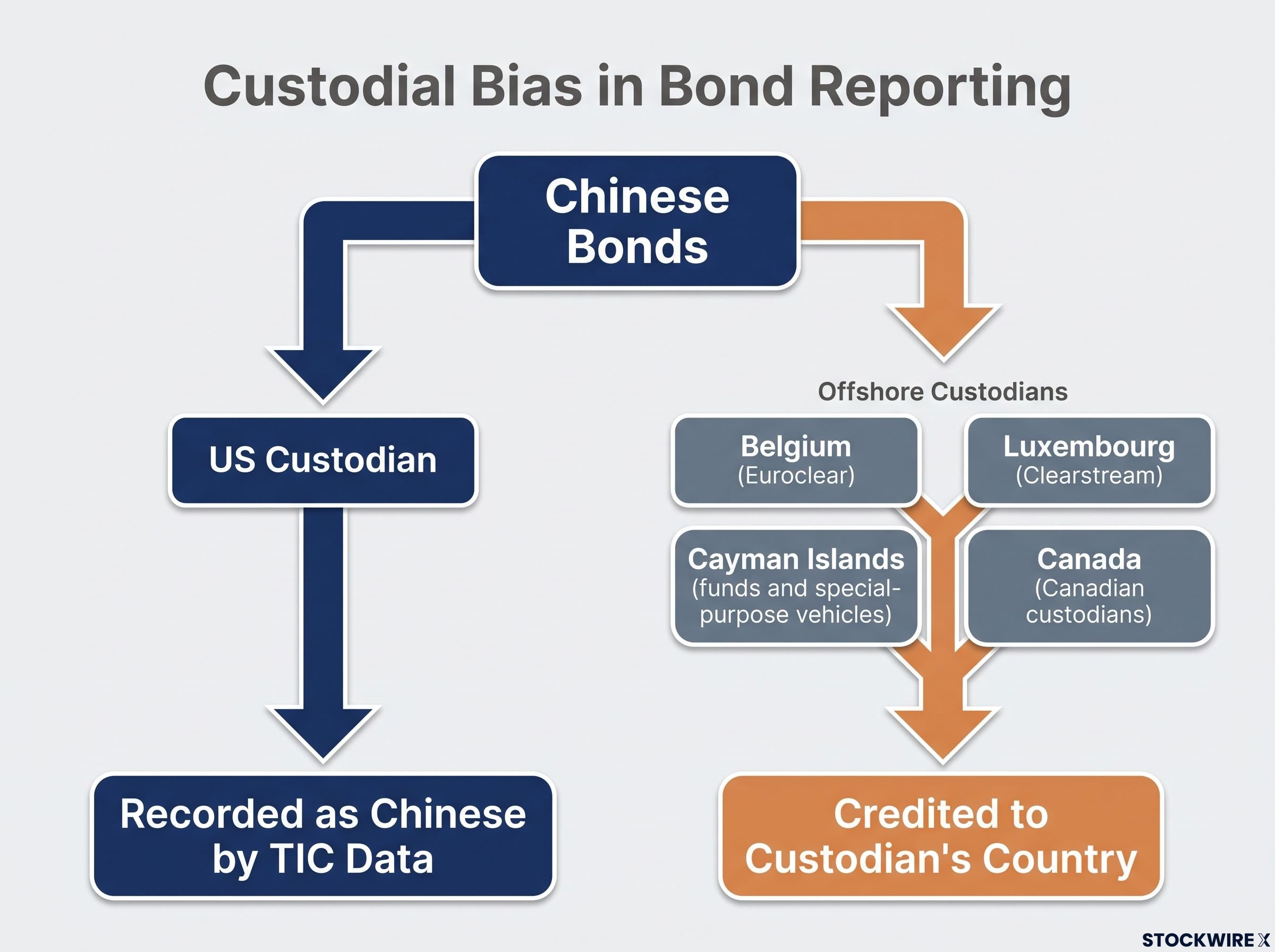
A custodian is a bank or depository that holds securities on behalf of the owner. The US Treasury’s international capital (TIC) data is built mainly from custodial information, so Chinese bonds held through a US custodian are generally recorded as Chinese. Held abroad, they can be credited to the custodian’s country instead:
- Belgium: home of Euroclear, the standard example of this “custodial bias”
- Luxembourg: home of Clearstream
- Cayman Islands: large positions held through funds and special-purpose vehicles
- Canada: Canadian custodians holding securities for clients elsewhere
Treasury’s own caveat The US Treasury warns that its data may not precisely measure ownership by individual country.
What Canada’s number does and does not show
The figure that drew attention was Canada’s combined Treasury and agency holdings of nearly $600 billion, more than quadrupled in five years. That is a Bloomberg-described combined total; Canada’s Treasury-only July figure was not identified in available reporting. Canada’s agency mortgage-backed holdings alone jumped from about $21 billion in mid-2021 to about $162 billion.
Bloomberg framed the China link as speculation from investors and analysts, with no direct evidence. For you, that means a falling China line in the TIC table tells you less than it seems: treat country rankings as a map of custody locations, not a register of owners.
Who backs the custody theory, who pushes back, and what would settle it
The theory has serious supporters. Brad Setser of the Council on Foreign Relations (CFR) says the data fits China using non-US custodians aggressively, pointing to an abrupt rise in Canadian agency holdings and further increases in Luxembourg and possibly France.
The European Central Bank (ECB) treats Chinese holdings routed through Euroclear as a real possibility, even modelling an upper-bound adjustment that assumes Belgian Treasury holdings could originate from China. That supports the mechanism, not the specific Canada claim.
| Party | Position |
|---|---|
| Brad Setser, CFR | Data consistent with heavy use of non-US custodians, especially for agency bonds |
| ECB | Chinese holdings via Euroclear plausible; upper-bound adjustment modelled |
| Investors cited by Bloomberg | Part of China’s decline may be relocation, not selling |
| Sceptics | Canadian hedge funds, securities lending, arbitrage or normal custody growth could explain Canada |
| Genuine-selling view | TIC data shows a real fall in China’s US-custodied Treasuries |
Push on the evidence and it thins. The case is strongest for agency bonds and weaker for China’s whole Treasury portfolio. Four caveats are worth holding:
- TIC data cannot identify the ultimate owner of any bond.
- The Canada-China link is unproven.
- Sanctions motives are plausible, but moving custody is no shield, since the securities remain dollar assets. Russia after 2022 showed how nominal ownership and practical control can split, though that is a sanctions precedent, not proof of misreporting.
- Diversifying custody is not the same as leaving the dollar.
The realistic read for you: China’s true dollar exposure is probably larger than $618 billion, but nobody knows by how much, so treat any precise “hidden” figure with caution.
What the bond market, dollar, gold and yen actually did
The report landed in an already crowded week.
The CPI-driven sequence
On Wednesday, September’s consumer price index (CPI), the main US inflation gauge, came in hot: headline 3.7% against a 3.6% forecast, with core at 2.6%. The 10-year yield spiked to about 5.30%, then reversed, sliding below 5.11% by Thursday’s Asian session. FXStreet described a 1.7% fall; Saxo and InvestingLive put it at more than 10 basis points (a basis point is one hundredth of a percentage point). Both land near 5.1%.
| Asset | Move | Level or reference | Likely driver |
|---|---|---|---|
| US 10-year yield | Down 10+ bps | Below 5.11% | Post-CPI reversal, short-covering |
| Dollar index | Down about 0.45% | 102.05-102.13 | Falling yields |
| Gold | Up about $40 | $4,135-$4,150 (Saxo, FXStreet) | Lower yields, safe-haven demand |
| AUD/USD | Steady | Near 0.6950 | Softer dollar |
| USD/JPY | Lower | Under 158.00 | Yields gave back CPI gains |
Attribution caveat The timing overlapped with the Bloomberg report, but the rally was not solely attributable to it. Short-covering, unwinding of post-CPI positions, safe-haven buying during a technology sell-off and Federal Reserve expectations all played a part.
What a real sell-off would look like instead
A genuine large-scale Chinese liquidation would push yields higher, could weaken the dollar if proceeds were converted, and might lift gold. Yields went the other way. Effects are not one-directional, either: a disorderly event could spark safe-haven dollar buying, and higher yields can weigh on gold short term.
So falling yields tell you the market was not pricing a Chinese fire sale. Read this move mainly as a CPI positioning reversal, not a verdict on China.
What stays unproven, and the signals to watch next
China’s reported $618 billion likely understates its total dollar-securities exposure. The claim that Canada’s nearly $600 billion combined position is substantially Chinese remains unverified; the data supports a custody distortion possibility, not an attribution.
Three signals could shift the debate: the next monthly TIC release, further moves in Canadian, Belgian and Luxembourg agency and Treasury holdings, and any confirmation or denial from Beijing or Ottawa.
Until then, treat country rankings as a custody map and wait for corroboration before acting on any headline about Chinese selling.
This article is for informational purposes only and should not be considered financial advice. Investors should conduct their own research and consult with financial professionals before making investment decisions. These statements are speculative and subject to change based on market developments.