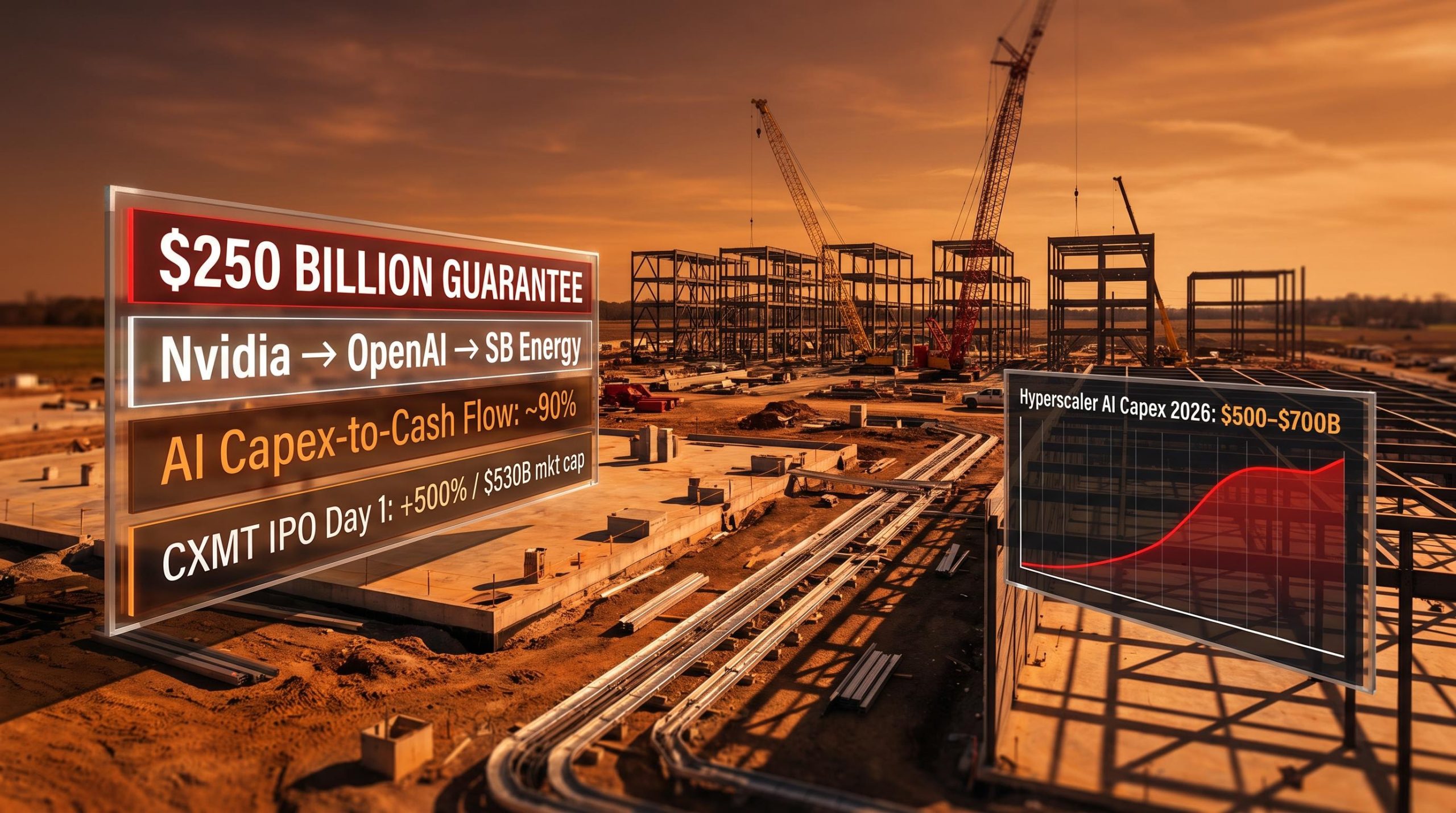
A chip supplier is reportedly preparing to guarantee a quarter-trillion dollars in lease obligations for its own customer’s data centre. A Chinese memory maker just surged 500% on its first trading day to overtake Intel’s market capitalisation. A major research firm is warning that AI capital expenditure is now outrunning the cash flows meant to support it.
All three happened on 27 July 2026.
Each of these events is individually explicable. Together, they expose something more uncomfortable: the financial architecture sustaining the AI infrastructure boom is shifting from equity and operating cash flow toward contingent liabilities, policy premiums, and complex credit structures. That shift is not a signal of imminent collapse, but it does change the risk profile for any investor with exposure to AI infrastructure, hyperscaler equities, or semiconductor names.
Here is the structure of each development, the fault lines they collectively reveal, and the conditions under which the current capex cycle becomes self-reinforcing in the wrong direction. The goal is a working analytical lens for reading the AI infrastructure story as it enters a more financially complex phase.
What Nvidia’s $250 billion guarantee actually reveals about AI’s financing model
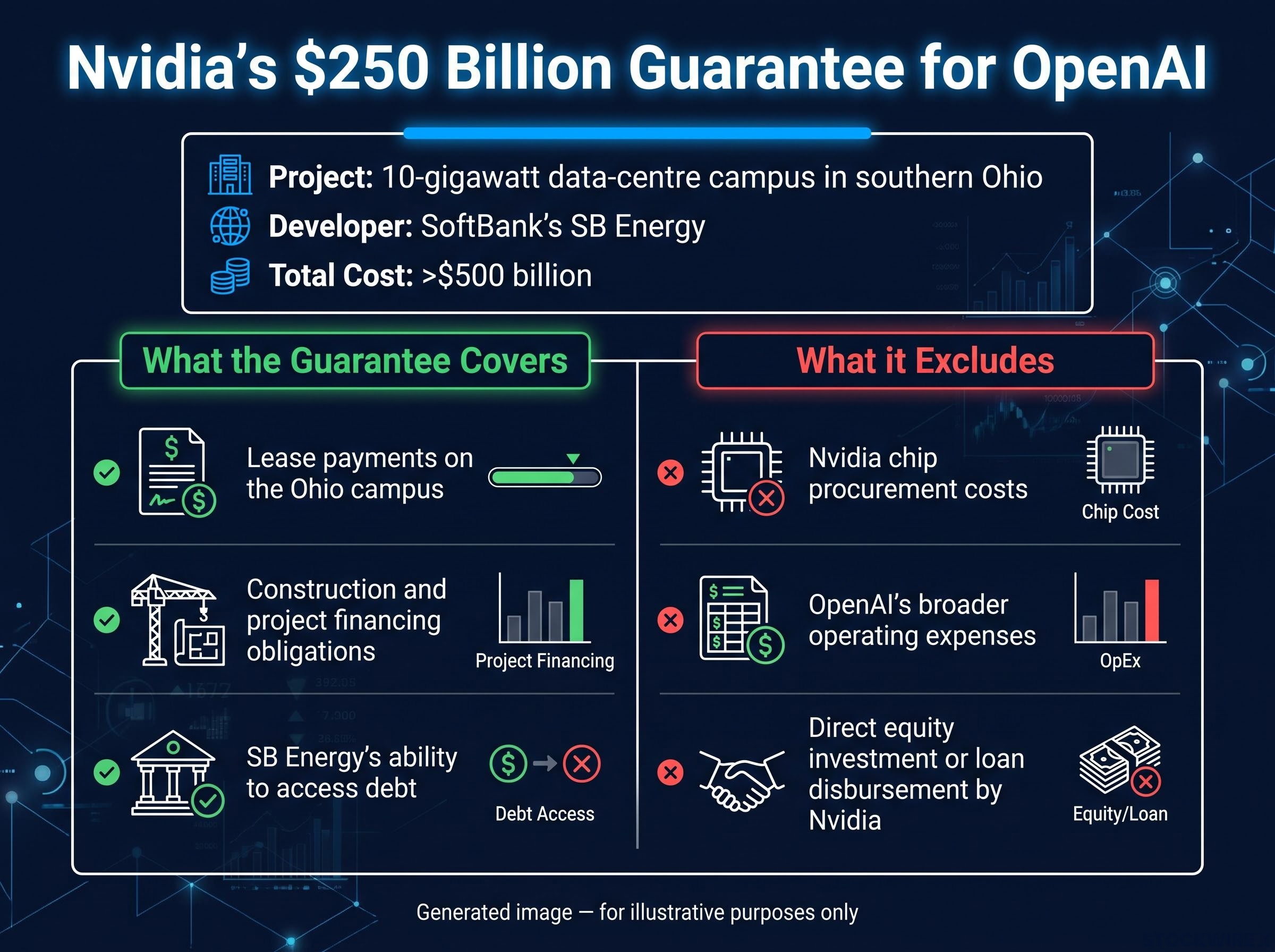
Nvidia is reported to be in advanced negotiations to backstop approximately $250 billion in leasing and financing obligations for OpenAI, tied to a proposed 10-gigawatt data-centre campus in southern Ohio. The campus is being developed by SoftBank’s energy subsidiary, SB Energy, and the broader project is estimated to carry total costs that could run beyond $500 billion.
The structural reason Nvidia’s backing is reportedly required is straightforward: OpenAI lacks an investment-grade credit rating, a designation that determines whether a borrower can access large-scale debt financing at competitive rates. Without that rating, lenders face elevated risk, and a stronger third party must step in to bridge the gap.
That is where the arrangement becomes analytically significant. The guarantee creates what commentators have explicitly called circular financing: the chip supplier underwrites the customer’s infrastructure, which sustains demand for the supplier’s own products.
The circular-financing characterisation: Nvidia’s commercial success depends on OpenAI’s operational capacity, and OpenAI’s operational capacity now depends on Nvidia’s credit exposure. The supplier and the customer are financially tethered in a closed loop.
The key structural components of the guarantee:
- Scope: Covers lease payments and construction/financing obligations for the Ohio campus
- Scale: Approximately $250 billion, large relative to any reasonable approximation of Nvidia’s annual revenue base
- Exclusions: Chip procurement is explicitly excluded and would be financed separately
- Accounting treatment: Depending on final legal structure, exposure may remain economically off-balance-sheet until triggered, with recognition limited to a fair-value provision or note disclosure at inception under applicable GAAP/IFRS standards
| What the guarantee covers | What it excludes |
|---|---|
| Lease payments on the Ohio campus | Nvidia chip procurement costs |
| Construction and project financing obligations | OpenAI’s broader operating expenses |
| SB Energy’s ability to access debt at more favourable terms | Direct equity investment or loan disbursement by Nvidia |
What this means practically: if OpenAI’s financial position deteriorates, Nvidia’s contingent liability could be triggered at the precise moment when AI chip demand is also under pressure. Risk concentrates at the supplier rather than distributing across capital markets. That is a qualitatively new category of risk in the AI supply chain, and investors assessing Nvidia’s risk profile may need to look beyond reported balance-sheet figures to whatever off-balance-sheet commitments materialise from negotiations like this.
The AI supply chain that Nvidia sits atop is itself layered across foundries, memory producers, and cloud operators, and concentration risk does not distribute evenly; TSMC and SK Hynix retain structural leverage because every custom and third-party AI chip depends on the same fabrication and HBM ecosystem regardless of who guarantees the downstream data-centre financing.
When big ASX news breaks, our subscribers know first
Why CXMT’s 500% debut is more than a headline number
CXMT Corp made its Shanghai Stock Exchange debut on 27 July 2026, with the listing recognised as the largest IPO in Asia so far this year and the biggest A-share semiconductor flotation on record. The company brought in approximately $8.6 billion in proceeds (noting that $9.8 billion has also appeared in broadcast coverage, with the final figure subject to over-allotment and source variation), according to Investing.com reporting.
Shares surged approximately 500% on the first day of trading.
After that opening-day move, CXMT’s market capitalisation came in at above 3.6 trillion yuan, a figure equivalent to roughly $530 billion that placed it ahead of Intel’s market cap, according to Investing.com reporting.
The Intel comparison in context: CXMT’s market capitalisation now exceeds Intel’s, but Intel’s revenue and operating scale remain substantially larger. The comparison reflects market conviction about CXMT’s future trajectory, not current operational parity.
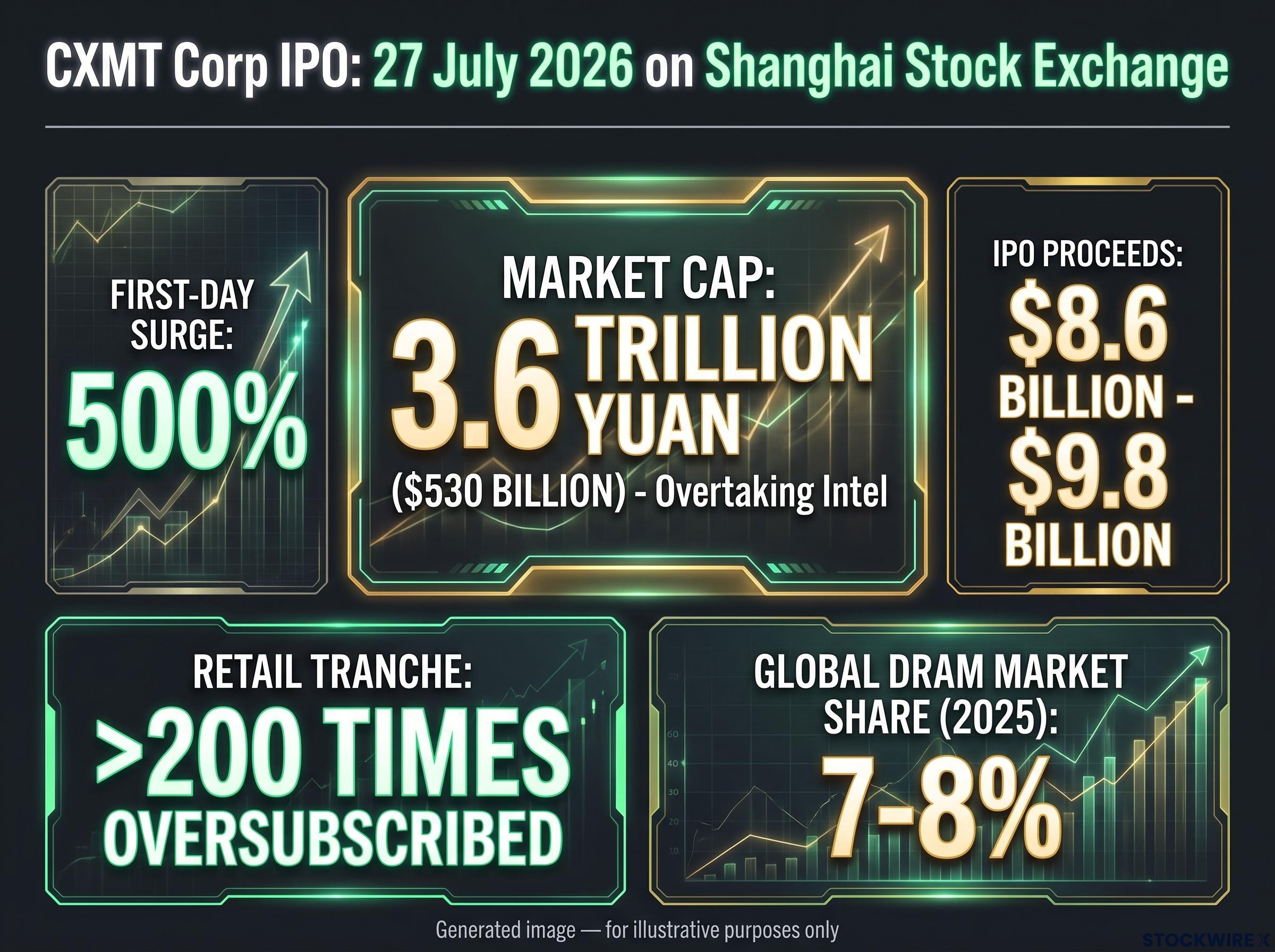
That $530 billion valuation on roughly 7-8% global DRAM market share (as of 2025) tells you the market is paying for a geopolitical outcome, not a present-day earnings stream. Three structural tailwinds are embedded in that price:
- Domestic policy support: CXMT operates in a sector designated a strategic priority for Chinese semiconductor self-reliance
- Constrained foreign competition: Export controls limiting international rivals provide a structural tailwind to CXMT’s domestic competitive position
- AI-driven memory demand: Memory-intensive AI workloads are scaling, and CXMT is positioned as a domestic beneficiary of that growth
The BIS semiconductor export licensing policy, revised in January 2026, explicitly tightened restrictions on advanced chip sales to China, providing the regulatory foundation for the constrained foreign competition that is embedded as a structural tailwind in CXMT’s valuation premium.
The pre-IPO retail tranche was reportedly oversubscribed by more than 200 times, a measure of the speculative intensity behind the listing.
The gap between market capitalisation and operating fundamentals
The valuation premium is, by its composition, the risk rather than just the reward. A $530 billion market cap built on policy tailwinds and demand assumptions offers limited margin of safety against any moderation in either.
Post-IPO corrections in heavily anticipated strategic listings are historically common. A 500% first-day move in a company with single-digit global market share prices in a great deal of future conviction, and that conviction rests on conditions that are, by nature, not guaranteed. Investors should treat CXMT’s debut as the most visible current example of AI-adjacent capital formation where policy and demand assumptions are doing the financial heavy lifting.
How AI capex outpaced cash flow, and what analysts say happens next
A research note from Vital Knowledge, circulated around 27 July 2026, identified three structural concerns about AI-related capital expenditure. These represent one analytical house’s view and should be attributed as such rather than established consensus, but broader research directionally supports the framework.
- Capex approaching or exceeding operating cash flow: AI spending among major technology firms is consuming a materially higher share of internally generated cash than in prior cycles, with estimates suggesting the ratio is approaching or exceeding 90% of cash flow from operations at major hyperscalers
- Early capital market resistance: New AI-linked debt and equity issuance is encountering growing friction from investors, with the financing environment showing signs of tightening at the margins
- SpaceX’s post-IPO performance as a warning indicator: SpaceX’s June 2026 public market debut and subsequent trading are cited as evidence that even high-profile AI-adjacent technology offerings face selective capital market reception
Hyperscaler AI capex consensus estimates for 2026 have been revised upward to the $500-$700 billion range across consensus forecasts, with JPMorgan research and Goldman Sachs estimates referenced in supporting commentary as consistent with this trajectory.
Barclays models combined hyperscaler capex consuming 85-90% of combined operating cash flow between 2026 and 2028, a structural funding shortfall that independently validates the hyperscaler capex sustainability concerns the Vital Knowledge note raises and points toward more than $200 billion in debt issuance as the gap-filler.
The financing shift: Multiple commentaries on the Nvidia-OpenAI-SoftBank arrangement explicitly cite it as evidence that the AI build-out has moved beyond what AI labs can fund from equity and operating cash flow, now requiring supplier-backed credit structures to sustain the pace.
The feedback loop is specific. If capex continues rising faster than internally generated cash and capital markets reprice AI risk (through higher yields or tougher equity issuance windows), then large AI data-centre projects face higher financing costs or delays. AI labs must temper cash burn. Chip demand growth moderates. Valuations anchored to uninterrupted AI spending become exposed.
| Signal | Current reading | What to watch |
|---|---|---|
| Capex-to-cash-flow ratio | Approaching or exceeding 90% at major hyperscalers | Capex guidance language in upcoming earnings releases |
| IPO market reception | SpaceX’s post-IPO performance signals selective appetite | Pricing and aftermarket performance of AI-linked offerings |
| Debt issuance trends | Early signs of resistance to AI-linked issuance | Spread compression or widening on hyperscaler and AI-lab debt |
When capex consistently runs above internally generated cash and capital markets begin repricing AI risk, the financing structures that look innovative in a benign environment can become the transmission mechanism for a broader slowdown. The Vital Knowledge framework gives investors a specific set of variables to monitor rather than a vague sense of unease.
What AI infrastructure financing looks like at scale
The Nvidia-OpenAI arrangement introduces a financing structure that may recur as the AI build-out continues, making the underlying mechanics worth understanding clearly.
An investment-grade credit rating is a designation assigned by rating agencies (such as Moody’s, S&P, or Fitch) that signals a borrower’s ability to meet its debt obligations. Borrowers with this rating access larger pools of capital at lower interest rates. Borrowers without it, including OpenAI, face either higher borrowing costs or difficulty accessing large-scale project finance at all.
A financial guarantee solves this problem by substituting a stronger party’s creditworthiness for the borrower’s. The guarantor does not lend money or take an equity stake. Instead, it promises to cover the borrower’s obligations if the borrower cannot. Three distinct instruments are worth distinguishing:
- Financial guarantee: The guarantor’s creditworthiness enables the borrower to access debt on better terms. The guarantor’s exposure is contingent, triggered only if the borrower defaults.
- Direct loan: The lender provides capital directly and carries immediate on-balance-sheet exposure from day one.
- Equity stake: The investor takes ownership, sharing in both upside and downside, with the investment reflected directly on the balance sheet.
Where the accounting risk sits
Under applicable GAAP/IFRS standards, a financial guarantee is typically recognised at inception through a fair-value provision or note disclosure. A fair-value provision is the estimated cost of the guarantee obligation recorded as a liability at the time the commitment is made. The key distinction: the full contingent exposure may not appear on the face of the balance sheet until triggered, meaning it can remain largely invisible to investors who rely solely on reported financial statements.
Categorical assertions about the balance-sheet impact of Nvidia’s arrangement are premature until the final legal structure is disclosed. What is clear is that investors should watch for disclosure language in future Nvidia filings, because the accounting treatment distinction matters practically. Those who rely only on Nvidia’s reported balance sheet may not see the full scale of contingent exposure until the legal structure is finalised and disclosed.
Private credit spillover risk adds a cross-border dimension to the financing stress the current AI capital cycle is generating: ECB analysis of approximately $425 billion in opaque European private credit exposure identifies the same pattern visible in the Nvidia-OpenAI structure, where contingent obligations remain structurally invisible to investors until a trigger event forces recognition.
Big Tech earnings as the stress test for the capex thesis
Amazon, Meta Platforms, Microsoft, and Apple are all scheduled to report quarterly financial results during the week of 27 July 2026. These firms represent the primary funders of AI infrastructure and the most direct validators of its commercial returns.
Earnings week as a stress test: This is not routine results season for AI-exposed investors. It is the first cycle where the capex-sustainability question has specific structural evidence behind it, and where management guidance will either corroborate or challenge the fault lines identified across this analysis.
Four focal variables deserve attention:
- Capex guidance language: Whether management signals acceleration, moderation, or plateau in AI infrastructure investment matters more than the historical spending figures. The sustainability question is forward-looking.
- Debt issuance and balance-sheet leverage trends: Whether the shift toward external financing visible in the Nvidia-OpenAI context is also appearing in hyperscaler balance sheets.
- AI-specific revenue attribution: Whether companies can demonstrate concrete revenue streams that justify current infrastructure investment levels, or whether the gap between capex and monetisation is widening.
- Commentary on Chinese technology competition: Given CXMT’s debut and the broader Chinese semiconductor push, any management commentary on competitive dynamics carries elevated significance this cycle.
If multiple hyperscalers signal capex acceleration alongside limited AI-specific revenue attribution, the gap between infrastructure investment and demonstrated commercial return narrows the margin of safety the current cycle assumes. These earnings releases are the nearest-term empirical test of whether the structural concerns are isolated data points or part of a broader pattern.
Reading the AI capital cycle for what it is, not what it promises
Three events on a single day illuminate a common structural condition: AI-sector financial ambition is running ahead of the cash-flow and balance-sheet fundamentals required to sustain it organically.
The measured framing matters. Nvidia’s deal remains in negotiation and may change materially. CXMT’s 500% move is one day of post-IPO price action. The Vital Knowledge view is one analytical lens, not established consensus. Real-world outcomes will likely reflect both genuine AI productivity gains and capital-cycle dynamics simultaneously.
The spectrum, not the binary: Whether AI is a self-sustaining productivity boom or a financing-driven capital cycle is not yet determined. But the conditions under which a self-reinforcing slowdown could develop are now more visible than they were.
Three fault lines to track:
- Contingent liability risk at the supplier level: A chip manufacturer carrying contingent credit exposure for the infrastructure capacity required to consume its own products
- Valuation premiums priced on policy outcomes rather than current fundamentals: Market capitalisations substantially ahead of operating scale, sustained by geopolitical and demand assumptions
- Capex outpacing cash-flow capacity: Infrastructure spending running at or above internally generated cash, requiring external financing structures to sustain
Nvidia’s China exposure adds a second layer of contingent risk that sits alongside the guarantee structure: China data-centre revenue collapsed from approximately $6 billion in FY2024 to near zero by FY2026 Q1 as export controls took hold, concentrating Nvidia’s revenue base in the same US and allied markets now expected to absorb a $250 billion contingent obligation.
The binding variable across all three is cost of capital. Debt market access and capital costs are the conditions most likely to determine whether the cycle remains manageable or becomes disruptive. The next empirical checkpoint is this week’s hyperscaler earnings, where guidance language will put specific numbers against these structural questions.
The analysis does not require a bearish conclusion. But it does require that any position predicated on uninterrupted AI capex growth be stress-tested against the financing conditions that have now become central to the story.
This article is for informational purposes only and should not be considered financial advice. Investors should conduct their own research and consult with financial professionals before making investment decisions. Forward-looking statements, including capex estimates and market projections, are subject to change based on market developments and company performance.