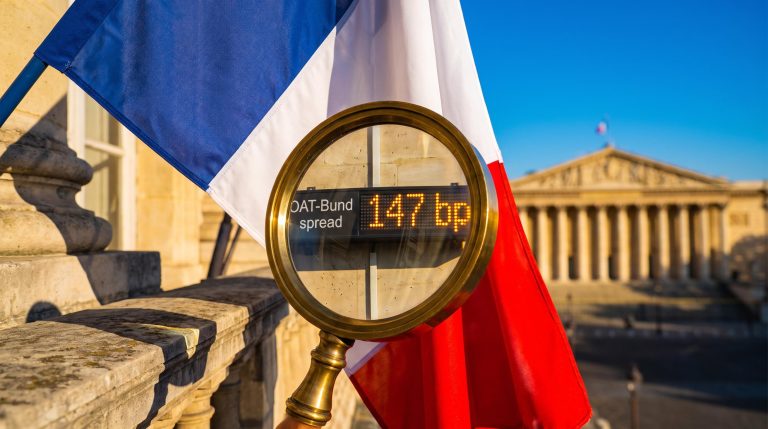
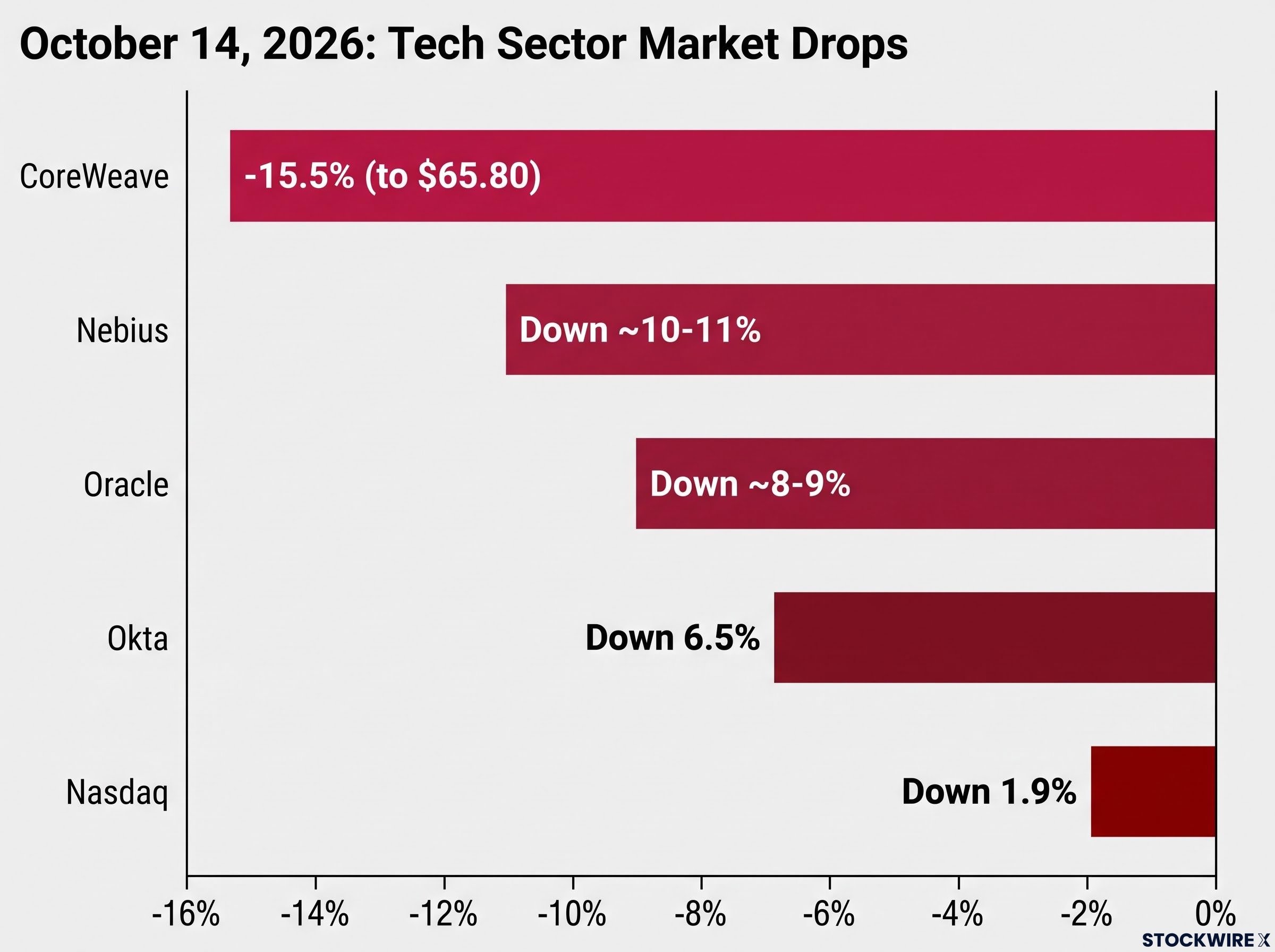
CoreWeave‘s shares fell 15.5% to $65.80 on 14 October 2026. The louder warning came from its bonds, which traded below 78 cents on the dollar and yielded about 15%. If you assume share prices are the first place AI stress shows up, CoreWeave’s debt concerns suggest you may be watching the wrong screen.
The same session brought a hotter-than-expected US core inflation print and a push in the 10-year Treasury yield above 5.3% intraday. The Nasdaq fell 1.9%, while Nebius, Oracle, chip stocks and software names dropped alongside CoreWeave.
Misread the episode as a one-day tech wobble and you could miss a funding problem spreading through the AI build-out. Misread it as a collapse and you could sell into a rate scare.
After this, you will be able to read the credit signals, trace how yields limit AI data centre financing, and judge whether this is a temporary rate shock or a deeper structural problem.
What are bond yields and credit default swaps telling us about CoreWeave?
Start with the numbers on the screen. According to CNBC, CoreWeave’s 9.625% notes due 2032 yielded about 14.8% yesterday, and its 9.75% notes due 2031 yielded about 14.9%. Bloomberg figures cited by the Korea Herald put the 2032 bond below 78 cents on the dollar, with five-year credit default swaps implying a better than 50% chance of default within five years.
Those figures sound alarming. They make more sense once you see how they are produced.
A bond’s coupon is the fixed interest rate it pays on its face value. Its yield is the annual return you earn if you buy it at today’s market price. Here is how a 9.625% coupon becomes a 14.8% yield:
- Investors decide the risk of lending to CoreWeave now deserves roughly 15% a year.
- The bond still pays only its fixed 9.625% coupon.
- The only way to lift the return is for the price to fall.
- Sellers cut prices until the fixed payments, set against a lower purchase price, deliver the higher yield.
A credit default swap (CDS) is a contract that pays out if a borrower defaults. Its spread, quoted in basis points (one basis point is 0.01%), is the annual cost of that protection. One report showed CoreWeave’s five-year CDS approaching 1,000 bps, up from about 855 bps in July and August.
Sources differ here. Morningstar cited bonds near 81 cents and CDS near 881 bps using earlier observations, while the 14 October reports show the more distressed pricing.
| Signal | What it measures | CoreWeave reading | What it implies |
|---|---|---|---|
| Bond yield | Return demanded by lenders at today’s price | ~14.8-14.9% | Lenders see high risk |
| Bond price | Market value per $1 of face value | Below 78 cents | Distressed territory |
| Five-year CDS | Annual cost of default protection | Approaching 1,000 bps | Rising insurance cost |
| Implied default odds | Default probability priced into CDS | Above 50% over five years | A financing stress signal, not a default |
Why credit tends to move before equity
Shareholders ask how big a company can become. Bondholders ask a narrower question: does cash flow cover the fixed payments before the debt matures? That focus makes lenders quicker to flinch when costs climb.
Lenders react to deteriorating cash flow before shareholders do, which is why credit stress signals such as distressed exchanges and tighter bank standards often show up in bond pricing well ahead of the equity screen.
Fitch puts CoreWeave’s gross EBITDA leverage, excluding leases, at about 7.0x in fiscal 2025. EBITDA is earnings before interest, tax, depreciation and amortisation, so that figure means debt is roughly seven times annual operating earnings.
The duration mismatch behind the worry
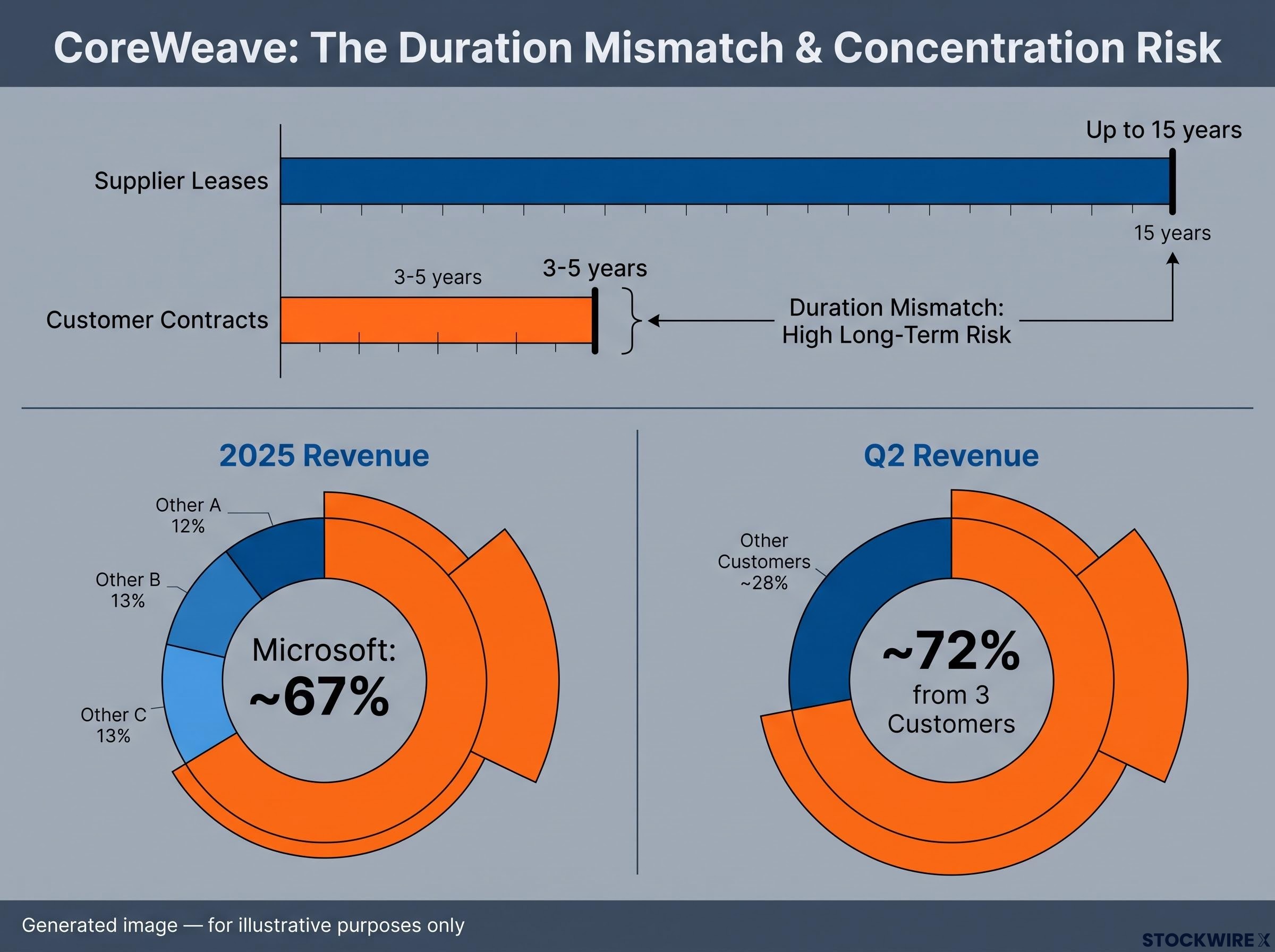
CreditSights analyst Jordan Chalfin, quoted in the Financial Times, flagged the gap between CoreWeave’s long facility leases and its shorter customer contracts. Fitch says supplier leases can run up to 15 years, while customer contracts typically last 3-5 years.
Lenders, not equity traders, are the ones asking whether those long obligations can be met. That makes credit markets your earlier warning light on any leveraged tech name.
When big ASX news breaks, our subscribers know first
How do hot inflation and 5% Treasury yields squeeze AI data centre financing?
The chain starts with the inflation print. Headline CPI came in at 3.7% against a 3.6% consensus, and core CPI at 2.6% against 2.5%. Charles Schwab, citing Bloomberg, said the odds of a Fed rate hike this month jumped to 46% from about 20%, and markets are pricing about three hikes over the next 12 months.
Treasuries moved next. CNBC reported the 10-year yield up 9 bps to about 5.30%, while the original source cited a 5.33% intraday high and a 5.19% close. The sources conflict on the size of the move and the closing level, possibly because of different measurement times.
Either way, your borrowing chain now runs at a higher base rate. Treasury yields set the floor for almost every other loan, so a rise flows through several channels:
- Corporate bonds: new issues must pay more to compete with safer government debt.
- Floating-rate GPU loans: interest bills rise before projects reach full use.
- Long-duration assets: data centres with heavy upfront costs look less attractive.
- REITs: payout yields look less competitive against Treasuries.
- Refinancing: debt raised in cheaper years costs more to roll over.
CoreWeave’s own numbers show the pressure. Interest expense reached $640 million in Q2 2026, up from $267 million a year earlier, against total indebtedness of $35.6 billion.
The scale problem $640 million of quarterly interest against $35-39 billion of planned 2026 capex.
What the AirTrunk delay shows
The squeeze is not limited to CoreWeave. Blackstone-backed AirTrunk postponed a Singapore REIT listing that could have raised roughly US$1.5 billion, now targeting early 2027. Bloomberg-related coverage said it considered lifting the prospective yield from about 5.5% to 6% before rising rates weakened demand.
Higher-for-longer rates mean the same AI build costs more to fund. Treat financing conditions as a limit on how fast AI infrastructure spending can grow, not as background noise. US producer prices and Fed chair Warsh’s speech on Friday are the next tests.
The squeeze may also feed on itself, because heavy AI debt issuance competes for the same bond-market demand as Treasuries, and higher long-term yields can stall projects that only worked at a cheaper cost of capital.
Is this a rate scare or a structural credit problem?
Two explanations fit the same facts, and each deserves a fair hearing.
| View | Core argument | Evidence that would support it |
|---|---|---|
| Cyclical (rate scare) | Inflation and yields temporarily lift funding costs; cuts and strong demand could ease refinancing | Cooling inflation, falling Treasury yields, bond prices recovering |
| Structural (credit problem) | Debt-funded long-lived facilities and fast-depreciating GPUs rest on shorter contracts | Weak renewals, wider spreads even as rates ease, rising leverage |
The structural case is sharpest on collateral. GPUs can lose value quickly as newer chips arrive, so their resale value may fall well short of 15-year facility obligations. Concentration adds risk: three customers made up about 72% of Q2 revenue, and Microsoft accounted for about 67% of 2025 revenue.
The case against panic
More than 98% of 2025 revenue was under committed contracts, and backlog rose to $99.4 billion at 31 March 2026, up from $66.8 billion at 31 December 2025. OpenAI has committed up to about $6.5 billion through May 2031.
CoreWeave also holds $10.0 billion of undrawn facilities and says it has secured more than $32 billion of capital. A March 2026 facility backed by Nvidia GPUs and a Meta contract reportedly received investment-grade treatment from Moody’s and DBRS Morningstar. The 15% yield applies to specific unsecured bonds, not all of CoreWeave’s debt, and CEO Michael Intrator has said the market is acting irrationally.
Who else is exposed: chips, software, Oracle and other neoclouds
- Nebius (down about 10-11%): the same model of costly GPUs, leased facilities and concentrated customers.
- Oracle (down about 8-9%): debt-financed data centre expansion. Sources differ by measurement point.
- Okta (down 6.5%): software valuations can shrink in credit scares even when demand holds.
- Chipmakers: neoclouds are key customers, so weaker orders could dent demand expectations.
The gap is not unique to CoreWeave: the way bond markets price Big Tech now diverges sharply from equity multiples, with long-dated Oracle and Alphabet debt trading well below par while share prices hold up.
The telecom and fibre boom of 2000-01 offers a warning: demand was real, but debt-funded building overshot near-term use. The mixed evidence points to risk concentrated in leverage and renewal timing, not in AI demand itself, so judge each company by its debt structure rather than its AI label.
Which signals should tech investors watch next as financing costs stay high?
A single day’s share price tells you little. A handful of credit and rate indicators tells you whether this episode is easing or spreading:
- Unsecured bond yields and prices: yields holding above about 15% or prices sliding further below 78 cents signal deepening stress.
- CDS spreads: a sustained move through 1,000 bps points to rising default fears.
- The 10-year Treasury yield: a hold above 5.3% keeps funding costs elevated across the sector.
- Fed pricing: hike odds rising past 46% after PPI or Warsh’s speech, or a live October FOMC debate, would tighten conditions.
- Leverage path: progress falling short of Fitch’s forecast of about 5.2x in fiscal 2026 would weaken the counter-case.
- Capital-raising windows: AirTrunk slipping beyond its early 2027 target would suggest markets remain shut.
The test for separating noise from deterioration is simple. If spreads tighten as Treasury yields fall, rates were the driver; if spreads stay wide while rates ease, the problem sits in the credit itself.
The deciding question Will demand and renewals arrive before debt and lease obligations come due?
What the credit scare does and does not prove about AI spending
The stress in CoreWeave’s bonds and CDS is real in pricing, but it is a financing test, not a default. A hotter inflation print and higher Treasury yields magnified it. Credit markets flagged leverage risk before equities did, and financing costs can cap AI infrastructure growth even while demand holds up.
Your next call depends less on any single day’s share move and more on the indicators above. Watch whether spreads follow rates lower or stay stubbornly wide, and whether renewals and capital windows keep pace with obligations.
Past performance does not guarantee future results. Financial projections are subject to market conditions and various risk factors. Forward-looking statements are speculative and subject to change based on market developments and company performance.
This article is for informational purposes only and should not be considered financial advice. Investors should conduct their own research and consult with financial professionals before making investment decisions.