
The number that opens the door is the same number that removes the safety rail. Cross the $2.5 million net asset threshold in Australia and you gain access to share placements, private credit funds, unlisted deals, and private banking relationships that ordinary investors will never be offered. Cross that same threshold and the law stops requiring some of the most important protections the financial system provides.
That contradiction sits at the heart of high-net-worth life in 2026, and it is more consequential than it looks. Wholesale investor status is genuinely valuable, opening structural doors that retail classification keeps shut. It also arrives at a moment of elevated danger: Australians reported $837.7 million in investment scam losses in 2025, and fraudulent pitches are increasingly built to imitate the exact language and appearance of legitimate wholesale offers.
Here is what you need to understand before you sign anything: what wholesale status means legally, what it costs you in protection, and how to tell a genuine offer apart from a sophisticated fraud engineered to exploit the classification.
The $2.5 million threshold: what the law actually says
Under the Corporations Act, there are three routes to being classified as a wholesale investor, sometimes called a sophisticated investor. You can qualify through net assets, through income, or through the size of the product you are buying.
The net asset test requires net assets of at least $2.5 million. The gross income test requires gross income of at least $250,000 per year for each of the two preceding financial years, so a single strong year does not count. The product value test applies when the relevant investment product is worth at least $500,000.
Most people qualify through the net asset route, and that is where the certification process comes in.
How accountant certification works
An accountant can certify your wholesale status based on your net asset position, and that certification is valid for up to two years before it needs to be renewed. For the income pathway, you need documented income at the threshold across each of the two preceding financial years, not just a projection or a single year’s figure.
ASIC’s guidance on accountant certificates sets out exactly which qualifications an accountant must hold to issue a valid certificate, what the certificate must state, and how the two-year validity window operates in practice.
Here is the part that matters most: this status is not permanent, and it is not automatic. It depends on certification, it requires renewal, and it can move with your asset values or income. A market downturn or a change in circumstances can shift where you sit.
| Pathway | Threshold | Documentation | Renewal |
|---|---|---|---|
| Net asset test | $2.5 million in net assets | Accountant certificate | Valid up to 2 years |
| Gross income test | $250,000 per year, two preceding years | Documented income each year | Reassessed on income |
| Product value test | $500,000 product value | Per-transaction | Applies per product |
The important thing to grasp is that crossing these numbers does not make you a sophisticated investor in any real sense. It gives you a legal status with real consequences. Many Australians pass $2.5 million through property appreciation rather than active financial experience, and the law treats them identically to a career fund manager.
When big ASX news breaks, our subscribers know first
What you give up when you qualify as a wholesale investor
It is easy to read wholesale classification as a promotion. It is not. It is a reclassification that quietly removes protections most investors never notice until the moment they need them.
Once you are wholesale, the issuer offering you a product is no longer required to give you the standard consumer safeguards. The scaffolding comes down.
The Binance Australia Derivatives case illustrates how badly client misclassification can go: the Federal Court ordered a $10 million penalty after the operator reclassified more than 85% of its customer base as wholesale clients, stripping 524 retail investors of key protections and contributing to combined losses exceeding $12 million.
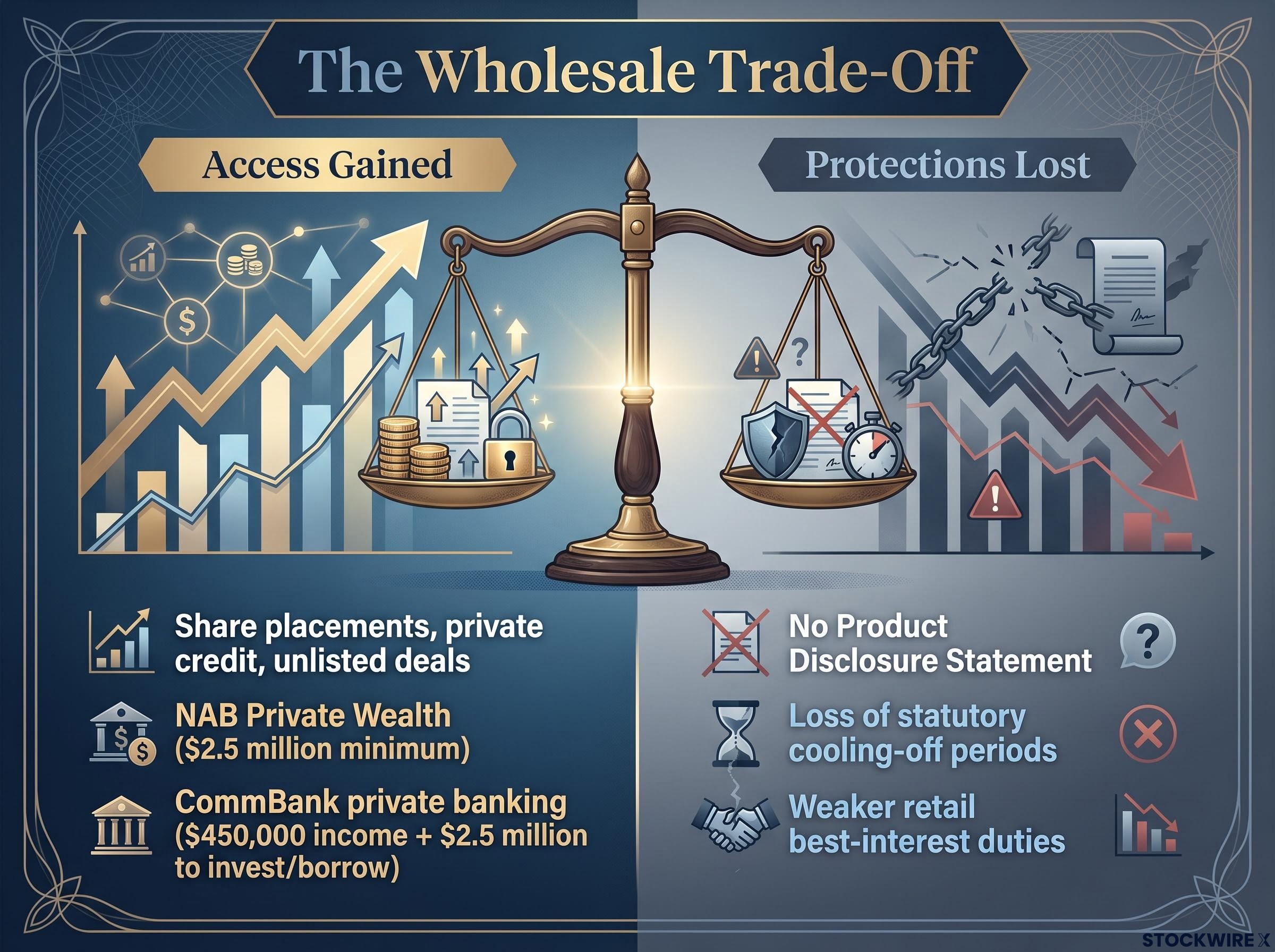
Here is what typically falls away:
- No entitlement to a Product Disclosure Statement or prospectus for many offers
- Reduced application of retail-level disclosure, advice, and suitability obligations
- Loss of statutory cooling-off periods on certain financial products
- Reduced coverage under design-and-distribution controls
- Weaker application of retail best-interest duties
- Greater reliance on contract terms and common law rather than consumer legislation
That last point reshapes your entire position. As a retail investor, consumer-protection law works on your behalf by default. As a wholesale investor, your recourse depends far more on the contract you signed and what common law allows.
What this means for how you get information
The loss of prospectus-level disclosure is not a technicality. A prospectus or Product Disclosure Statement forces an issuer to lay out the risks in a structured, regulated format before you commit. Remove that, and you are relying on whatever the issuer chooses to tell you, plus your own ability to interrogate a complex structure.
For someone who built their $2.5 million through property or superannuation rather than years of trading private placements, that is a meaningful reduction in the information you are guaranteed to receive. You may still access external dispute resolution in some cases, but not always.
A warning on dispute resolution: Wholesale clients may still be able to complain to the Australian Financial Complaints Authority (AFCA) when dealing with licensed providers. But some products and bespoke wholesale arrangements fall outside scheme jurisdiction entirely, which means not every wholesale complaint has a formal resolution pathway.
The question to ask is not what wholesale status lets you access. It is what wholesale status stops the system from requiring on your behalf. That asymmetry is the single most important thing to understand before accepting any offer.
Why the reform debate matters and where it stands now
You are not the only one who thinks these thresholds sit awkwardly. The government’s own review has flagged the framework as inadequate, which tells you the system itself acknowledges a problem it has not yet fixed.
In November 2023, Treasury published its Review of the regulatory framework for managed investment schemes, known as the MIS Review. It made two clear recommendations: that the financial thresholds used to classify wholesale clients be increased to reflect inflation, and that a statutory mechanism be introduced to lift those thresholds periodically over time.
The reasoning is straightforward. Asset prices have climbed since the thresholds were set, pushing long-term homeowners and diligent super savers across the wholesale line despite limited financial literacy. Wealth and sophistication have drifted apart.
The debate breaks down along these lines:
- Regulatory and consumer view: The dollar thresholds are too low in real terms, capturing people whose wealth grew with the property market rather than genuine expertise, and exposing them to complex products without full retail protections.
- Industry view: Substantially higher thresholds could restrict capital-raising for smaller issuers, reduce access for genuinely sophisticated investors, and add compliance cost and complexity.
Both positions are legitimate, which is part of why the matter remains unresolved.
Here is the practical reality: as of September 2026, no legislation implementing these threshold increases has been enacted. The current thresholds of $2.5 million net assets, $250,000 gross income, and $500,000 product value remain in force, unchanged since their introduction.
What this means for you is direct. If you qualify today, you are operating inside a framework the government has publicly identified as insufficient for your protection. You cannot wait for the law to catch up, so you have to navigate the rules exactly as they stand right now.
How fraudsters replicate wholesale investment offers and what to look for
This is where the theory becomes urgent. The gap between a legitimate wholesale offer and a fraudulent one is not always obvious, because the people running the scams have studied what a real offer looks like and rebuilt it convincingly.
According to National Anti-Scam Centre and ACCC reporting, scammers increasingly use professional-looking trading and crypto platforms that mimic licensed providers, fake wealth-management brands promoted through targeted social media and search advertising, and cold approaches that reference your superannuation balance or your “wholesale investor” eligibility to build instant credibility.
The technical vocabulary is a deliberate tool. Words like “wholesale,” “sophisticated investor,” and “private placement” are used to signal exclusivity and make the pitch feel like an invitation rather than a solicitation. Fabricated AFSL numbers, fake ABNs, and plausible corporate documentation complete the illusion.
Wholesale classification removes regulatory guardrails, but behavioural timing errors remain fully in play: research consistently shows that investors acting on exclusivity cues and urgency signals make worse entry decisions regardless of wealth level, which is exactly the cognitive environment a sophisticated fraud pitch is engineered to create.
The pattern is well documented. An ABC News report on 29 April 2026 detailed a fake cryptocurrency platform where victims were recruited through realistic social media advertisements, led to a slick site showing apparent account balances and trading history, then blocked from withdrawing before the operation vanished.
The scale of the threat: Australians reported $837.7 million in investment scam losses in 2025, the single largest scam category that year, according to the ACCC and National Anti-Scam Centre report published 27 March 2026. Total scam losses across all categories exceeded $2 billion.
That figure is not background noise. It tells you investment fraud at scale is a present, active threat aimed specifically at people in your wealth bracket, using offers built to look indistinguishable from the real thing.
Red flags that distinguish a fraudulent wholesale pitch
The warning signs, drawn from ACCC and National Anti-Scam Centre guidance, are consistent enough to memorise:
- Fake or recently registered websites, sometimes with URLs that closely resemble legitimate institutions
- Platforms promoted only through social media or search advertising, with no verifiable presence in mainstream channels
- Requests to transfer funds to personal accounts, overseas accounts, or exclusively via cryptocurrency
- Promises of high, consistent, “guaranteed” returns framed as institutional-grade opportunities closed to ordinary retail investors
- Reluctance or refusal to provide audited performance records, written documentation, or verifiable licence details
If you receive an unsolicited wholesale approach, treat yourself as the intended target of a well-resourced operation, because in this wealth band, you are.
Verifying a wholesale offer before you commit
The good news is that fraud, however sophisticated, tends to collapse under independent scrutiny. Every step below exists because a specific scam tactic exists to defeat it, and understanding that logic is what turns a checklist into genuine vigilance.
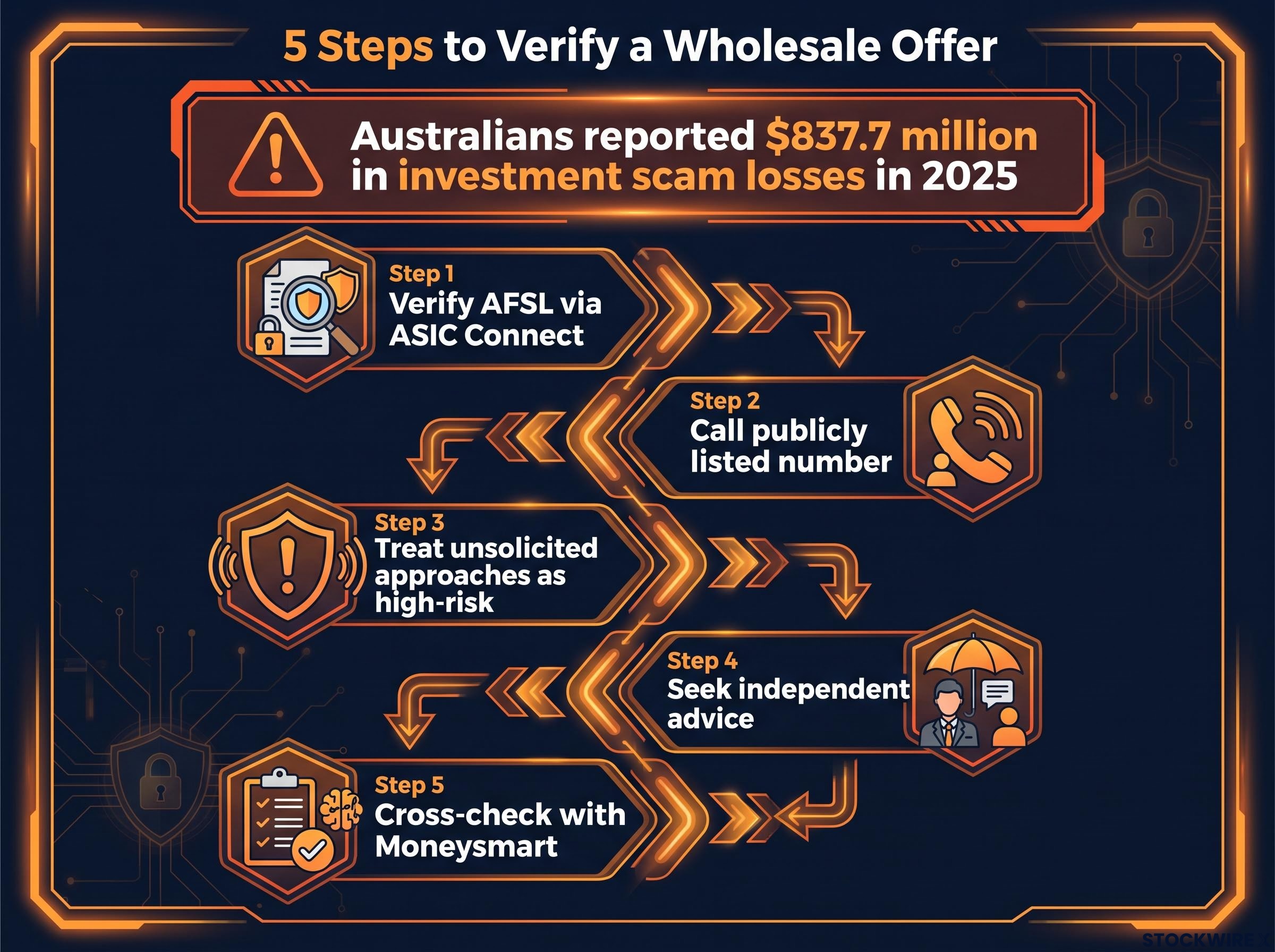
Follow this sequence before committing capital to any wholesale offer:
- Verify the Australian Financial Services Licence independently through ASIC Connect, the official ASIC register, rather than any link contained in the offer, email, or advertisement.
- Find the firm’s contact details on its official website and call the publicly listed number to confirm the offer and the identity of the person contacting you.
- Treat every unsolicited approach as high-risk, especially any that leans on “exclusive” wholesale or sophisticated investor framing to flatter you into moving quickly.
- Seek independent advice from a qualified financial adviser before signing any wholesale client declaration, particularly where no prospectus or Product Disclosure Statement is provided.
- Use Moneysmart, the tool maintained by ASIC, to cross-check the legitimacy of the company before any funds move.
The reason step one insists on the official register is that scammers supply their own links to fake verification pages. The reason step three exists is that urgency and exclusivity are the emotional levers fraud relies on most.
The guiding principle: Legitimate wholesale investment offers should come from licensed entities, be consistent with the investor’s circumstances, and withstand independent scrutiny. Any pitch built on secrecy, urgency, or reluctance to provide documentation should be treated as a serious warning sign and declined.
A reader who works through this sequence has already done more than most fraud victims ever did. It is not complicated, but it requires deliberate action against the exact pressure the pitch is designed to apply.
Navigating wholesale status as a permanent feature of your financial life
Wholesale status is not a one-time box you tick. It is an ongoing feature of your financial life, and now you have the framework to manage it deliberately rather than passively.
The two sides never separate. On one side is real access: share placements, private credit, and private banking relationships that open at your wealth level. NAB Private Wealth targets clients with a minimum of $2.5 million in investable assets, while CommBank private banking requires household income above $450,000 and plans to invest or borrow $2.5 million or more. On the other side sit the protections you traded away to get there.
The structural value of private market access has grown significantly as the largest wealth-creation events in AI and technology remain locked inside private companies valued in the hundreds of billions, with public shareholders holding no position in the growth and wholesale-eligible investors better placed to reach vehicles that do.
The environment is also getting more complex. Division 296 tax is now legislated to apply from 1 July 2026, charging an extra 15% on taxable super earnings attributable to the portion of a total super balance above $3 million. That adds a fresh layer of structuring to consider alongside the classification question.
Here is where to direct your attention now:
- Review any wholesale client declarations you have already signed to understand exactly what they cover
- Verify any pending offer through the official ASIC registers before committing
- Seek qualified financial advice before signing any new wholesale declaration
- Use Moneysmart to cross-check any entity you do not already know
Your wealth level places you in a category the financial system treats differently, in ways that are advantageous and consequential at the same time. Remember too that certification lasts only up to two years, so this is a status that rewards active engagement, not one you can set and forget.
This article is for informational purposes only and should not be considered financial advice. Investors should conduct their own research and consult with financial professionals before making investment decisions.