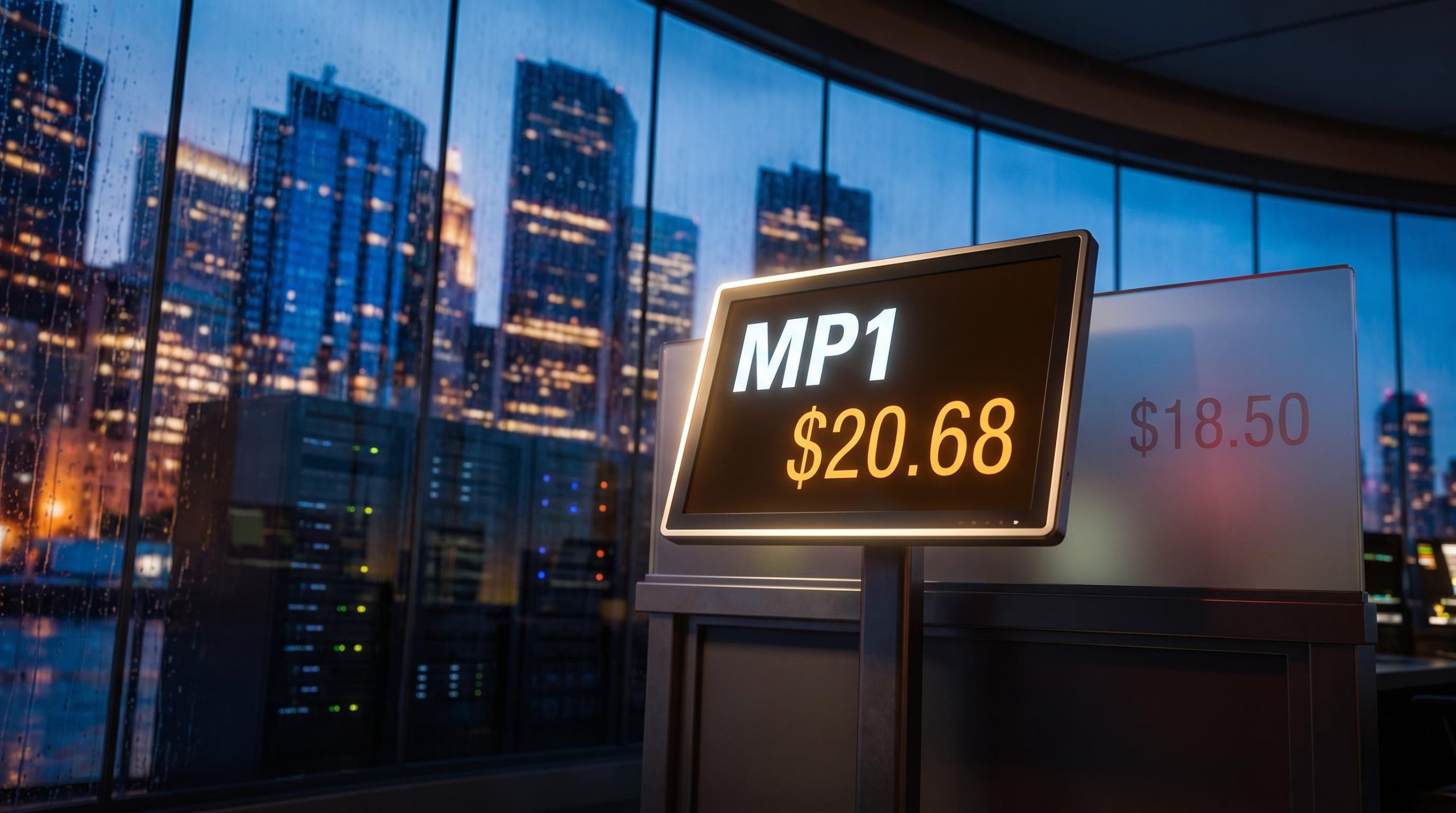
Megaport just secured roughly $978.6 million in new AI infrastructure contracts in a single announcement, and the market responded exactly as you would expect: shares surged close to 10% to $20.68. The commercial momentum is not in doubt.
Yet on the same day, Morningstar raised its fair value estimate on the stock and concluded, plainly, that it is overvalued.
That tension, between genuine deal-making momentum and a share price the leading independent research house considers stretched, is the thing you actually need to resolve before deciding what a post-announcement rally means for you.
The 29 September 2026 trading update disclosed three fresh AI contracts signed through subsidiary Latitude.sh, lifting Megaport’s cumulative strategic contract value to roughly $2.3 billion since April 2026. Alongside the deals, the company raised FY27 revenue guidance by 13% at the midpoint, upgraded its EBITDA margin target by 4 percentage points, and substantially expanded its capital expenditure plan by approximately $500 million.
This analysis unpacks what those numbers prove about the investment case, what they leave unresolved, and how to tell whether the rally is an entry point or a valuation trap.
Inside the $978.6 million deal: what Megaport actually signed
Three contracts, one announcement. Two were signed with new customers (both US-based technology providers), and one with an existing publicly listed enterprise customer. All three cover GPU and CPU compute, networking, and storage aimed at AI applications and inference workloads, the processing that runs trained AI models to generate outputs.
The commercial substance is strong. Combined total contract value (TCV) sits at roughly $978.6 million, with a weighted average contract term slightly above four years, and the deals are expected to add approximately $232.4 million in annual recurring revenue (ARR) once fully deployed.
What drove the bullish reaction, though, is the funding structure sitting underneath. Customers are paying a large share of infrastructure costs upfront, with prepayments on the new contracts totalling roughly $322.6 million.
Stack these deals onto the four contracts worth $458.9 million secured in June 2026, and the scale of the pipeline comes into focus.
The September announcement builds directly on the June 2026 capital raise, when Megaport secured A$827.3 million with approximately 99% institutional participation to fund four earlier AI infrastructure contracts and a A$350 million GPU pool, establishing the funding architecture now being scaled further.
Cumulative strategic total contract value since April 2026 has reached approximately $2.3 billion, with pro forma Group ARR expected to hit around $1.1 billion at full deployment. More than 85% of that ARR is sourced from North America.
Full hardware deployment is targeted for completion by Q4 FY27, with the contracts expected to reach full run-rate in the same window, faster than Megaport’s historical pace.
How customer prepayments are reshaping Megaport’s funding model
The prepayment model is elegant on paper. Customers pre-fund the majority of infrastructure costs to lock in rapid access to GPUs Megaport has already ordered for its GPU pool, which reduces the company’s near-term need for dilutive equity and shifts capital risk onto the buyer.
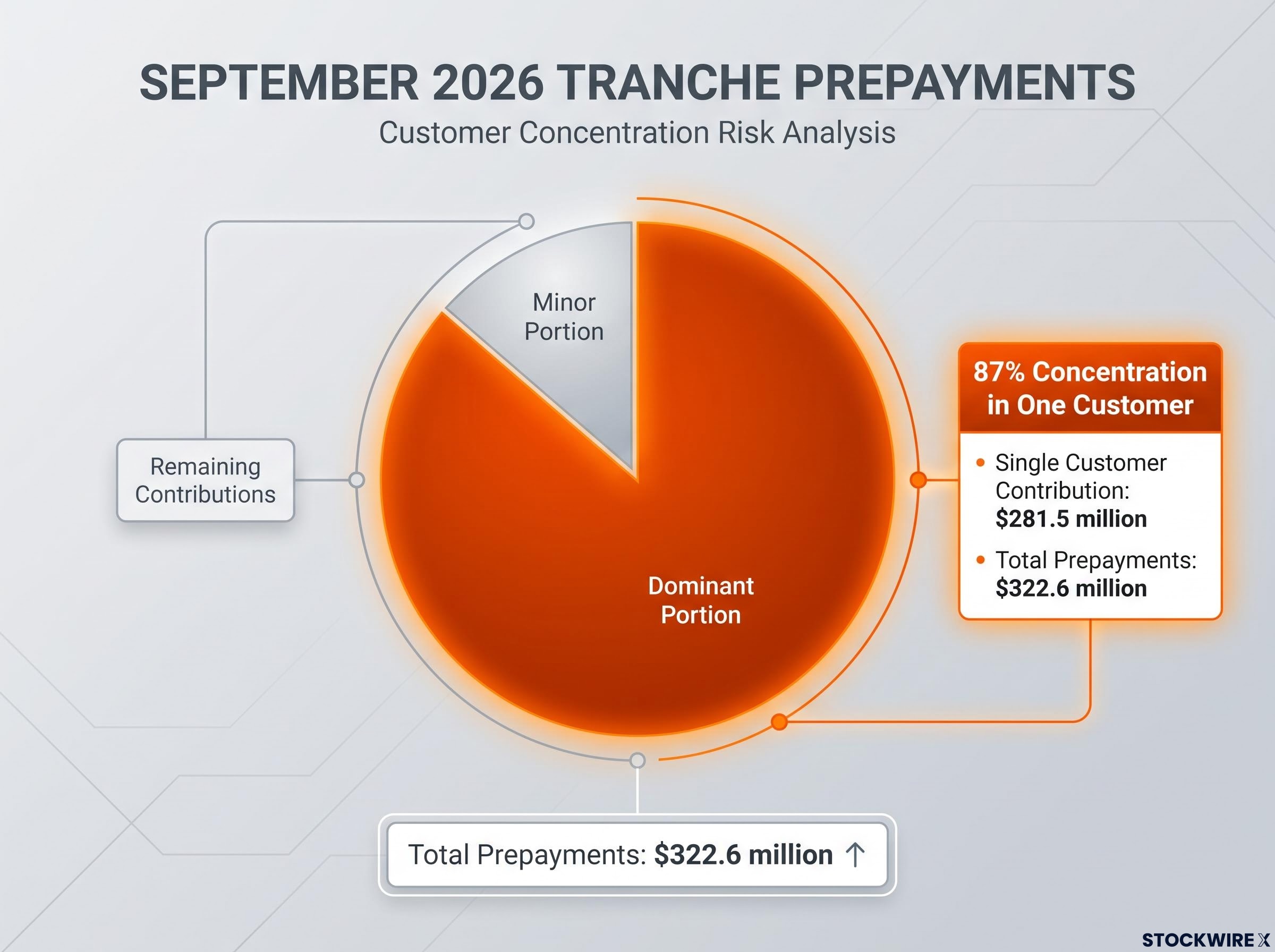
But look closer at the composition. Of the $322.6 million in prepayments, $281.5 million came from a single new customer.
That is not just a balance-sheet win. It means a substantial slice of Megaport’s near-term funding thesis rests on one relationship, and you should factor that concentration into how you read the deal’s apparent financial strength. The model works beautifully while AI investment sentiment stays elevated; it becomes fragile the moment a major counterparty hesitates.
| Metric | June 2026 tranche | September 2026 tranche |
|---|---|---|
| Total contract value | $458.9M | $978.6M |
| Number of contracts | 4 | 3 |
| Expected ARR at full deployment | Contributes to ~$1.1B pro forma Group ARR | ~$232.4M |
| Deployment target | Progressing within pipeline | Q4 FY27 |
When big ASX news breaks, our subscribers know first
What the guidance upgrade actually tells you about the business trajectory
Management put real numbers behind its confidence. FY27 revenue guidance rose to $720-810 million from $620-730 million, a 13% lift at the midpoint. The EBITDA margin target climbed to 42-44% from 38-40%.
The 4 percentage point EBITDA margin upgrade to 42-44% is the earnings-quality signal the market latched onto. It says management expects the new revenue to arrive at higher profitability, not just higher volume.
That optimism is grounded in live momentum rather than projection. Group ARR is currently billing over $500 million, and the segment detail underneath is where the AI story shows through:
- Compute ARR: $201.4 million as at 22 September 2026, up 90% since 30 June 2026 and 227% since the Latitude.sh acquisition
- Network ARR: $302.6 million as at August 2026, up 29% on a constant-currency basis
- Network net revenue retention (NRR): 116%, up 6 percentage points year-on-year
Net revenue retention measures how much recurring revenue existing customers generate over time, so a figure above 100% means the current base is spending more, not less.
Then comes the line that complicates the clean earnings story. FY27 capital expenditure guidance was expanded to $1.78-1.88 billion, up from $1.28-1.38 billion, with roughly $360 million earmarked specifically for GPU pool replenishment.
Hold both numbers in your head at once. A capex program approaching $1.9 billion dwarfs the revenue guidance it is meant to unlock, so anchoring to the margin upgrade in isolation would give you only half the picture.
Management argues the funding is covered. A fully underwritten $827.3 million entitlement offer, combined with pro forma liquidity of roughly $362.2 million and the customer prepayments, is said to fully fund the expanded program and remove the near-term need for further dilutive raising.
| FY27 guidance | Prior | Upgraded |
|---|---|---|
| Revenue | $620-730M | $720-810M |
| EBITDA margin | 38-40% | 42-44% |
| Capital expenditure | $1.28-1.38B | $1.78-1.88B |
The guidance upgrade is the clearest signal yet that management believes the pipeline is real and deployable. It also sets a demanding execution bar, and forming a view on whether that bar is clearable within the stated timeline is central to any position you take.
The GPU-plus-network model: genuine edge or commodity play in waiting?
Give the bull case its full due. Megaport is stitching together two things AI customers need and usually source separately: raw compute and the network that connects it.
The integrated stack has real components behind it:
- GPU compute and CPU capacity via the Latitude.sh platform (acquisition completed 27 November 2025)
- Networking through Megaport’s proprietary interconnection platform
- Storage bundled into the AI infrastructure contracts
- A footprint spanning more than 1,100 data centres across 31 countries, further extended by the Extreme IX acquisition adding India’s leading internet exchange operator
At a moment when GPUs are scarce, the ability to offer aggregated compute and connectivity from one provider is genuinely attractive. The multi-year contracts and large prepayments are evidence of that pull; customers are paying in advance to jump the queue.
Why paying a premium for a business without durable competitive protection is a different risk
Here is where the counter-argument lands. Morningstar does not assign Megaport an economic moat, meaning it sees no structural feature that would protect the company’s returns from competition over the long run.
Morningstar’s no-moat verdict draws on the economic moat framework formalised across five structural sources, including switching costs, network effects, and cost advantages, with the absence of any reinforcing combination the key reason the analyst team declines to assign durable competitive protection to Megaport’s current position.
Morningstar’s Roy Van Keulen raised the fair value estimate 9% to $18.50 (updated 30 September 2026), while characterising the stock as overvalued at roughly $20.68 and viewing its products as susceptible to commoditisation and eventual price-based rivalry.
The distinction matters more than it first appears. A wide-moat business trading at a premium is you paying up for protection that already exists. A no-moat business trading at a premium is you paying up for protection that has not yet been established, and may never be.
Morningstar does expect Megaport to emerge as the dominant player once the networking market consolidates, purely on the strength of its scale. But that is a forward projection, not a structural protection you can bank today.
The no-moat verdict is not a dismissal of the near-term opportunity. It is a warning that the premium currently priced in assumes a durable competitive position that has not been proven, and that assumption is exactly what determines what a fair entry price looks like for you.
Execution risk, customer concentration, and the capex bar investors must clear
Start with the most concrete risk and work outward. Deploying and monetising nearly $1.9 billion in capex within Megaport’s stated 6-9 month procurement and deployment window, while hitting a 16-22 month payback target on the GPU pool, is an operational feat with a narrow margin for error.
The market has already shown how it reacts to capex it is nervous about: shares fell on capex concerns after the FY26 results despite strong contract wins. The upgraded program only sharpens that sensitivity.
The balance sheet arithmetic behind earlier Megaport contract wins was already under scrutiny in May 2026, when analysts flagged a narrow liquidity margin against capex requirements as the primary risk hiding beneath a 33% single-session share price surge, a concern that has since grown in proportion to the expanded program.
One customer accounts for $281.5 million of the $322.6 million in new contract prepayments, roughly 87% concentration in a single counterparty. That is the headline risk metric hiding beneath the deal’s financial strength.
Put the pieces together and the compounded exposure becomes clear. You are effectively being asked to back both Megaport’s operational execution and the continuity of one large customer relationship at the same time, and the share price should reflect that layered risk rather than the contract headline alone.
Here is what to actually watch, ordered from most to least immediately observable:
- Deployment pace against the Q4 FY27 full-run-rate target
- GPU pool payback trajectory against the 16-22 month goal
- Any move toward customer diversification in future contract announcements
- Cash prepayment behaviour as a read on AI investment sentiment
The legacy network business: flagging signals beneath the AI headline
The AI story has drawn attention away from softer signals in the core connectivity business. Morningstar flags decelerating gross customer growth, rising customer acquisition costs, and attrition rates that are elevated relative to software-as-a-service industry norms.
The 116% net revenue retention is a genuine offset, showing the existing base is expanding its spend. But NRR measures how current customers behave, not how healthy the pipeline of new relationships is, so it softens the concern without erasing it.
What the correction risk changes, and what the valuation spread tells you
Set the price against the fundamentals. Morningstar’s $18.50 fair value sits roughly 10-18% below the post-announcement trading range of around $20.68-22, depending on the reporting window. In plain terms, the market is paying today for execution that has not yet been demonstrated.
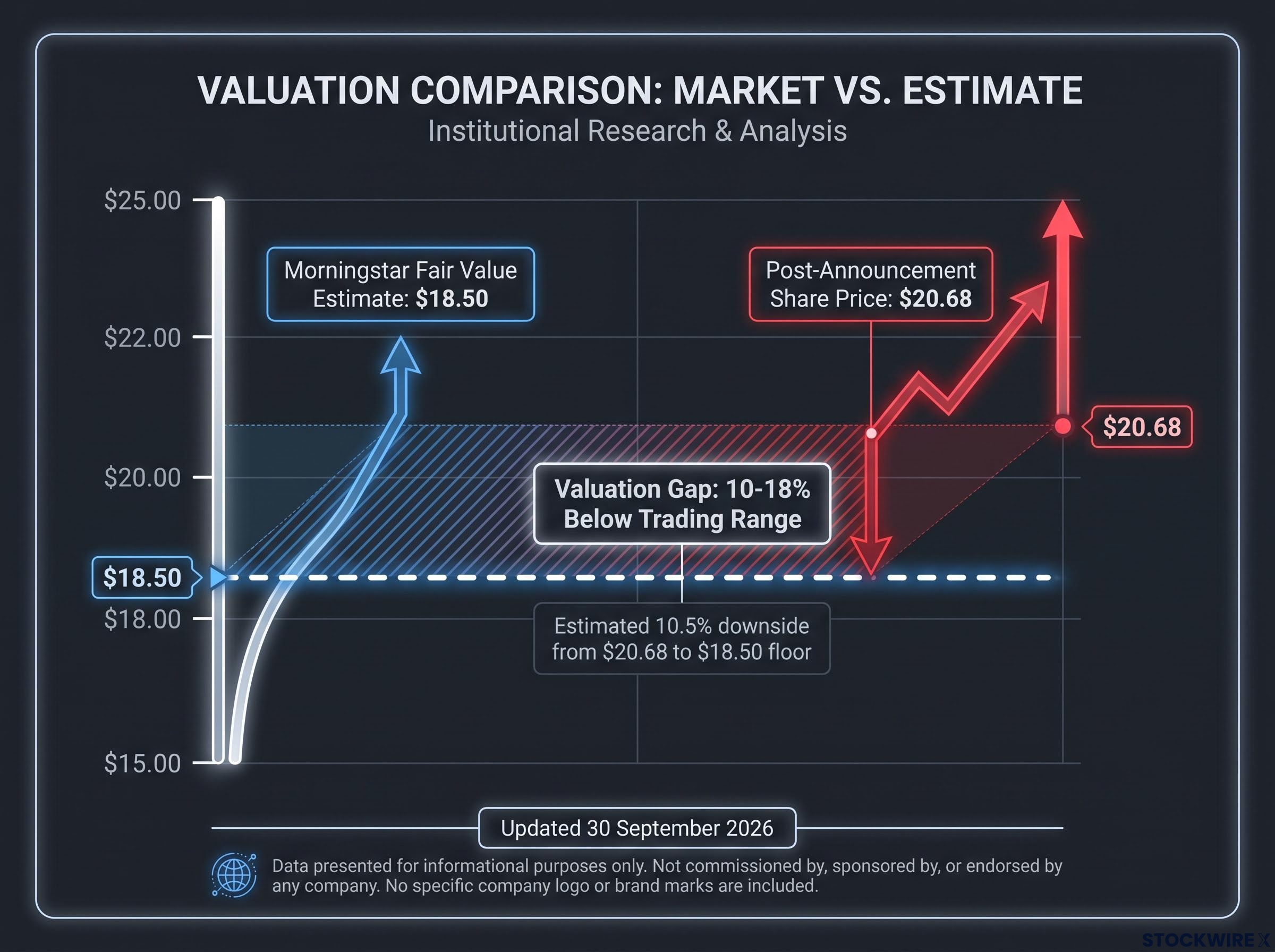
The $18.50 fair value estimate is the anchor to hold against any further share price movement. If execution disappoints, it is a realistic floor, not a pessimistic outlier.
Three variables will decide whether the current premium is validated or reversed:
- Capex deployment pace against the Q4 FY27 target, the single clearest test of execution
- Customer diversification across subsequent contracts, which would reduce the 87% prepayment concentration
- GPU supply normalisation, the structural tail risk; no source attaches a firm date to when the shortage eases, but it will
For Australian investors, one detail deserves weight. Megaport is ASX-listed under MP1, yet more than 85% of its pro forma $1.1 billion ARR comes from North America, so currency movements and offshore execution risk are embedded in the case alongside the local listing. The $827.3 million entitlement offer is the dilution baseline already sitting in the share count.
For Australian investors already holding Megaport through an ASX tech allocation, the position may be adding AI concentration risk that also runs through global equity index weights, infrastructure REITs, and bond sleeves via hyperscaler tenants and issuers, a portfolio-level exposure that position sizing on MP1 alone does not capture.
Put together, the logic is straightforward. If capex executes on schedule and concentration normalises across future deals, the current premium (built on a revenue midpoint of $765 million and a 43% EBITDA margin midpoint) may prove reasonable. If either variable slips, $18.50 is where the ground realistically sits, and you should size any position with that asymmetry in mind.
This article is for informational purposes only and should not be considered financial advice. Investors should conduct their own research and consult with financial professionals before making investment decisions. Past performance does not guarantee future results. Financial projections are subject to market conditions and various risk factors, and forward-looking statements are speculative and subject to change based on market developments and company performance.