The biggest wealth-creation events in technology over the last decade have happened entirely out of sight. Not behind a paywall or inside a premium brokerage account, but inside private companies, before a single public share was ever sold.
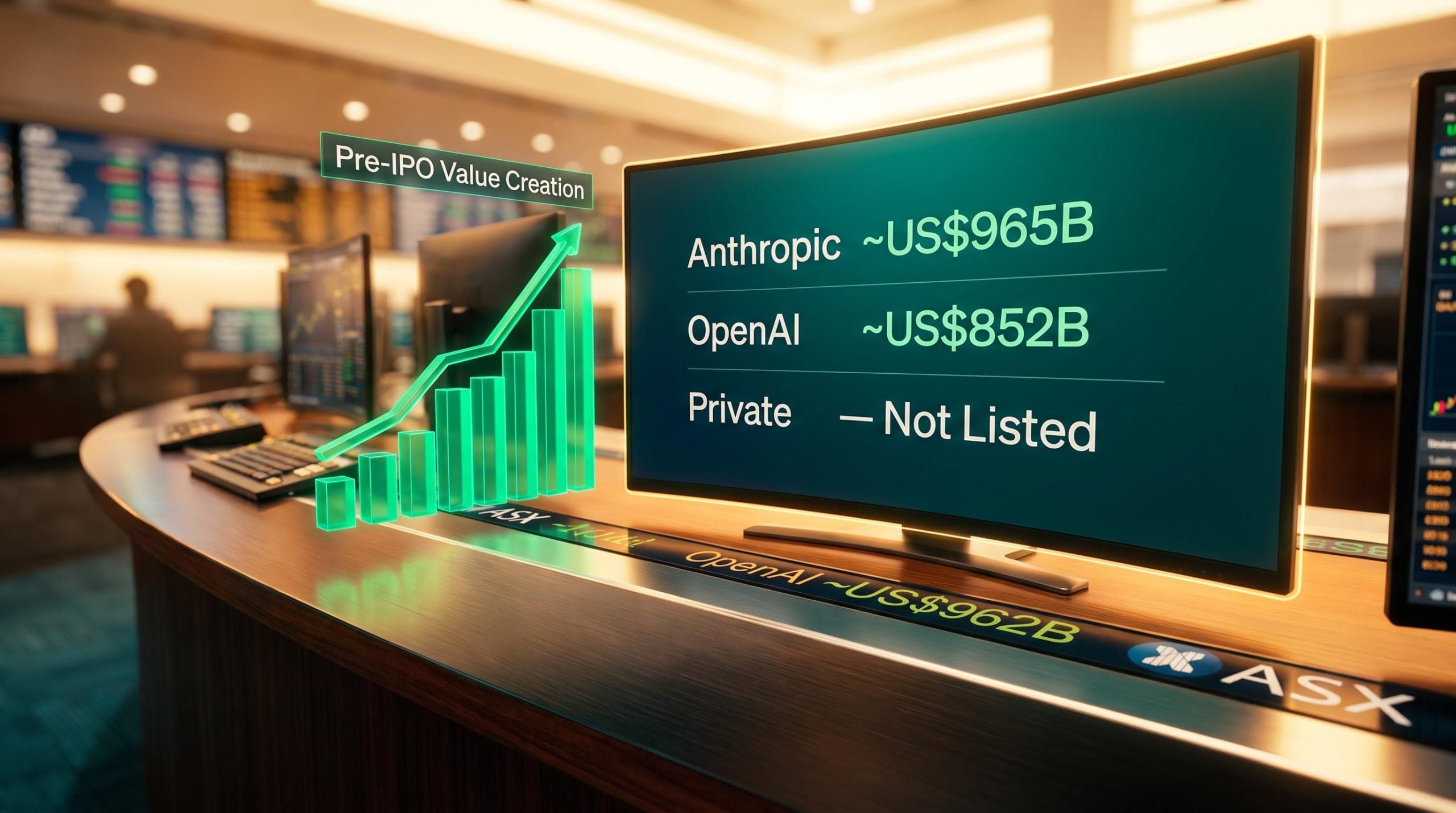
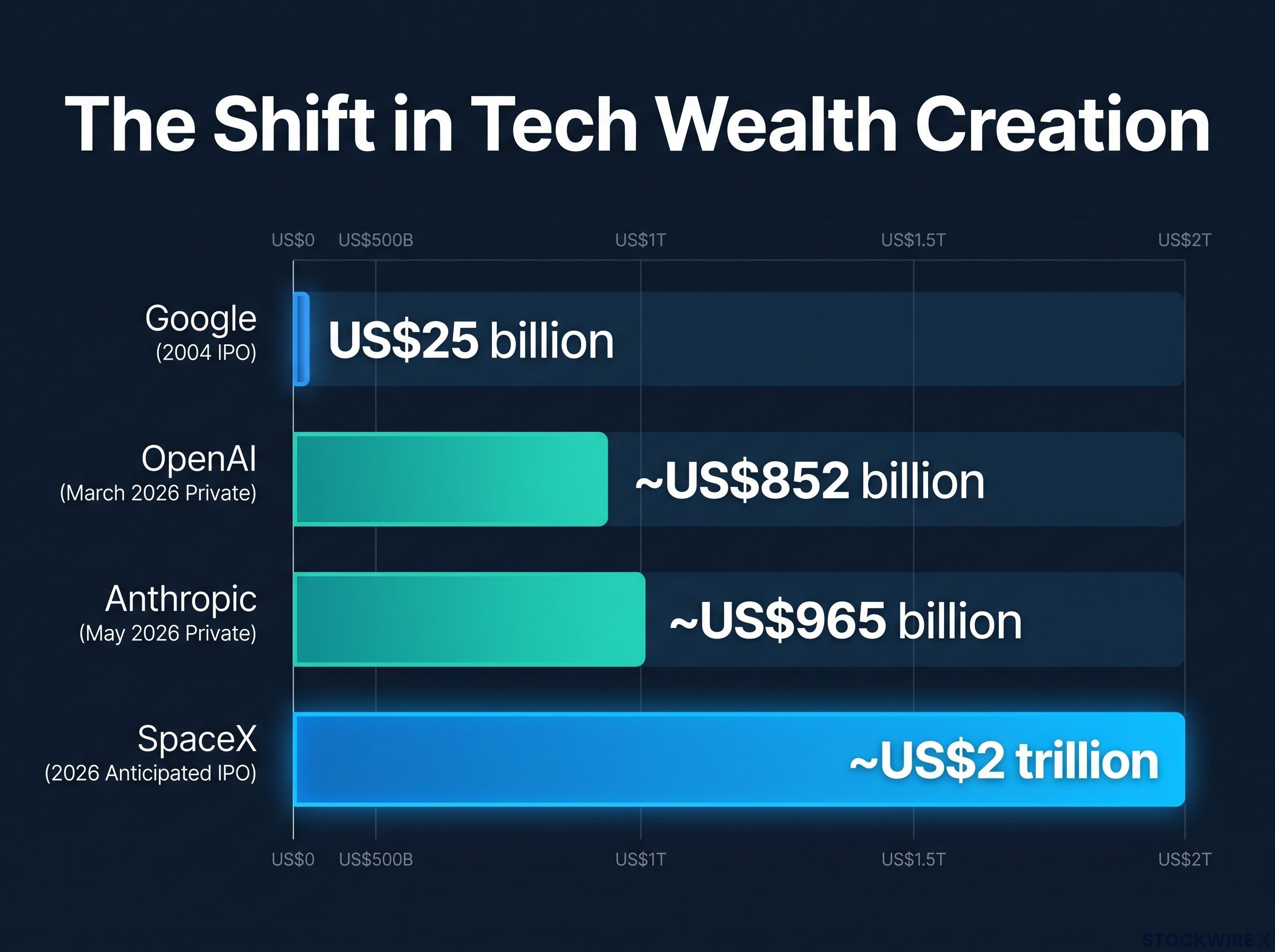
Consider the numbers. Anthropic carries a post-money valuation of approximately US$965 billion as of May 2026. OpenAI sits at roughly US$852 billion as of March 2026. Neither is publicly listed. The growth that produced those figures has accrued entirely to private backers, founders, and employees. If your portfolio holds only listed shares, you have experienced AI primarily as a risk to your existing positions, not as a source of direct returns.
Here is the framework for understanding why that access gap exists, how a category of ASX-listed vehicles is engineered to bridge it, and what structural trade-offs you need to weigh before committing capital.
The era when public markets made you rich early is over
Google listed in 2004 at a valuation of US$25 billion. It has since grown to a market capitalisation measured in the trillions. Public shareholders who bought at the IPO participated across nearly the entire growth runway, from a search engine with momentum to one of the most valuable companies on earth.
The conditions that made that possible no longer hold in the same way. Private capital is now abundant enough that high-growth companies can attract talent, build out their businesses on their own terms, and avoid the short-termism of quarterly public reporting without ever touching public equity markets. Founders list only when they are strategically ready to do so, which in many cases is well past the period of fastest growth. For investors who confine themselves to listed securities, this means entering at a later point in the valuation cycle, with a shorter runway ahead.
Private capital hollowing out public markets is not limited to mega-cap AI companies; the same mechanism has structurally degraded ASX small-cap quality, with private equity and venture capital acting as a two-sided filter that keeps the best growth companies private and removes quality existing public companies through buyouts.
Bain & Company’s Global Private Equity Report 2025 documents the structural expansion of retail access to private markets alongside sustained AUM growth, confirming that the shift away from public-market-first wealth creation is a durable industry trend rather than a cyclical anomaly.
SpaceX makes the shift concrete.
At its anticipated IPO valuation of approximately US$2 trillion, SpaceX reportedly created around 4,100 millionaire employees, with approximately 400 exceeding US$100 million in net worth. That wealth was built almost entirely while the company was closely held.
The build-out of SpaceX’s launch and satellite businesses was simply unavailable to ordinary investors. This is not just an anecdote about a famous company. It illustrates that the wealth-creation mechanism which once rewarded public shareholders now rewards a small class of private backers. If you hold only listed shares, you are structurally outside that class.
- Historical model: Companies listed early, public investors participated across most of the growth runway
- Current model: Companies remain private through peak growth, public investors enter at later-stage valuations with a shorter remaining runway
When big ASX news breaks, our subscribers know first
Why retail investors cannot simply buy into private companies
The barriers are not a single gate you can push through with enough capital or determination. They compound.
- Regulatory and accreditation requirements: Private placements in high-growth startups are typically restricted to accredited and institutional investors under securities regulations. Most individuals do not qualify.
- Deal size and minimums: Private companies limit their shareholder bases deliberately. Minimum investment levels are set for funds and family offices, not individual accounts.
- Illiquidity and timing: Capital is deployed only at specific funding rounds and returned at discrete liquidity events: an IPO, a trade sale, or a secondary transaction. You cannot enter or exit on demand.
- Relationship-driven deal flow: The most desirable deals are significantly oversubscribed, which means issuers choose their capital partners. They favour established funds with track records and network trust, not individual investors seeking allocation.
That last barrier is the one most people underestimate. Oversubscription does not just mean demand exceeds supply. It means the company raising capital can be selective, and selectivity means favouring institutional partners whose presence signals credibility to other investors. Even highly sophisticated Australian retail investors rarely see allocations in companies like OpenAI, Anthropic, or Databricks before they become household names.
These are not barriers that more capital or more research time removes. They are deliberate structural features of how private markets operate, and they require an institutional intermediary to navigate. That is precisely the gap listed vehicles attempt to fill.
What private market investing actually means, and why AI has made it urgent
Private market investing is capital allocated to companies that are not listed on a public exchange. You invest at specific funding rounds, and your returns are realised at discrete liquidity events: an IPO, a trade sale, or a secondary transaction where existing shares change hands. There is no daily market price. There is no sell button you can press on a Tuesday afternoon.
The concept itself is not new. What has changed is how urgent it has become.
The core asymmetry worth grasping is this: the companies actively driving disruption across AI, automation, and new infrastructure tend to be private. The companies absorbing that disruption, across legacy software, media, some financials and industrials, tend to be public. Holding only listed equities means your portfolio captures the damage done to established players without any corresponding position in the businesses doing the disrupting.
Public-only portfolios hold the disrupted, not the disruptors. That is not a neutral position. It is a one-sided exposure to the downside of the same trend.
The AI context makes this especially acute right now.
The AI IPO valuation arithmetic behind both Anthropic and OpenAI rests on revenue assumptions that neither company has publicly disclosed, and the implied forward multiples require a very specific set of conditions to hold simultaneously across compute costs, enterprise adoption rates, and competitive pricing dynamics.
| Company | Private Valuation | Valuation Date | Listed on ASX/NYSE? |
|---|---|---|---|
| Anthropic | ~US$965 billion | May 2026 | No |
| OpenAI | ~US$852 billion | March 2026 | No |
| SpaceX | ~US$2 trillion (at anticipated IPO) | 2026 | No |
For an Australian investor whose superannuation or share portfolio includes legacy financial, media, or industrial names exposed to AI disruption, sitting entirely outside the companies generating that disruption is an active choice with real consequences. The value being created inside those private businesses is not flowing back to portfolios that hold only their public-market targets.
How listed private-market vehicles bridge the access gap
The engineering behind these vehicles solves a specific problem: how do you give public investors daily tradeable access to assets that are, by nature, illiquid?
The answer is a structural separation. The vehicle holds illiquid stakes in private companies at the portfolio level. It then issues publicly traded units on an exchange. The liquidity layer (the listed vehicle you buy and sell) is separated from the asset layer (the private holdings underneath). You trade the wrapper, not the contents.
On the ASX, Pangana’s AIX (AI Private Opportunities Trust) is the listed example built on this design. AIX is structured as a diversified trust rather than a single-company bet, which reduces the risk of any one investment thesis being incorrect. You buy and sell units on the ASX on a daily basis, subject to market liquidity.
Permanent capital structures on the ASX have a longer track record than the current generation of private-market vehicles, and Washington H. Soul Pattinson’s record of approximately 13.4% per annum compounding since 2000 offers a useful reference point for how patient, illiquidity-tolerant capital can outperform public benchmarks when the manager is not forced to sell during dislocations.
How returns are structured across the vehicle’s lifecycle
The distribution mechanics follow a defined timeline, and understanding them before you invest matters more than most marketing materials suggest.
- Years one to two: During the period when the opportunity set is richest, any profits from realisations are paid out to unit holders while the original capital is recycled into new positions. This is the portfolio construction phase.
- Year three onward: Once this reinvestment window closes, the entire proceeds from each realisation, both capital and profits, are returned to unit holders. This is when the investment thesis begins to resolve as portfolio companies migrate from private to public markets.
- Year seven threshold: The management fee drops to zero. This is a structural alignment signal: the manager’s incentive is to realise value within the defined horizon, not to extend the vehicle’s life indefinitely.
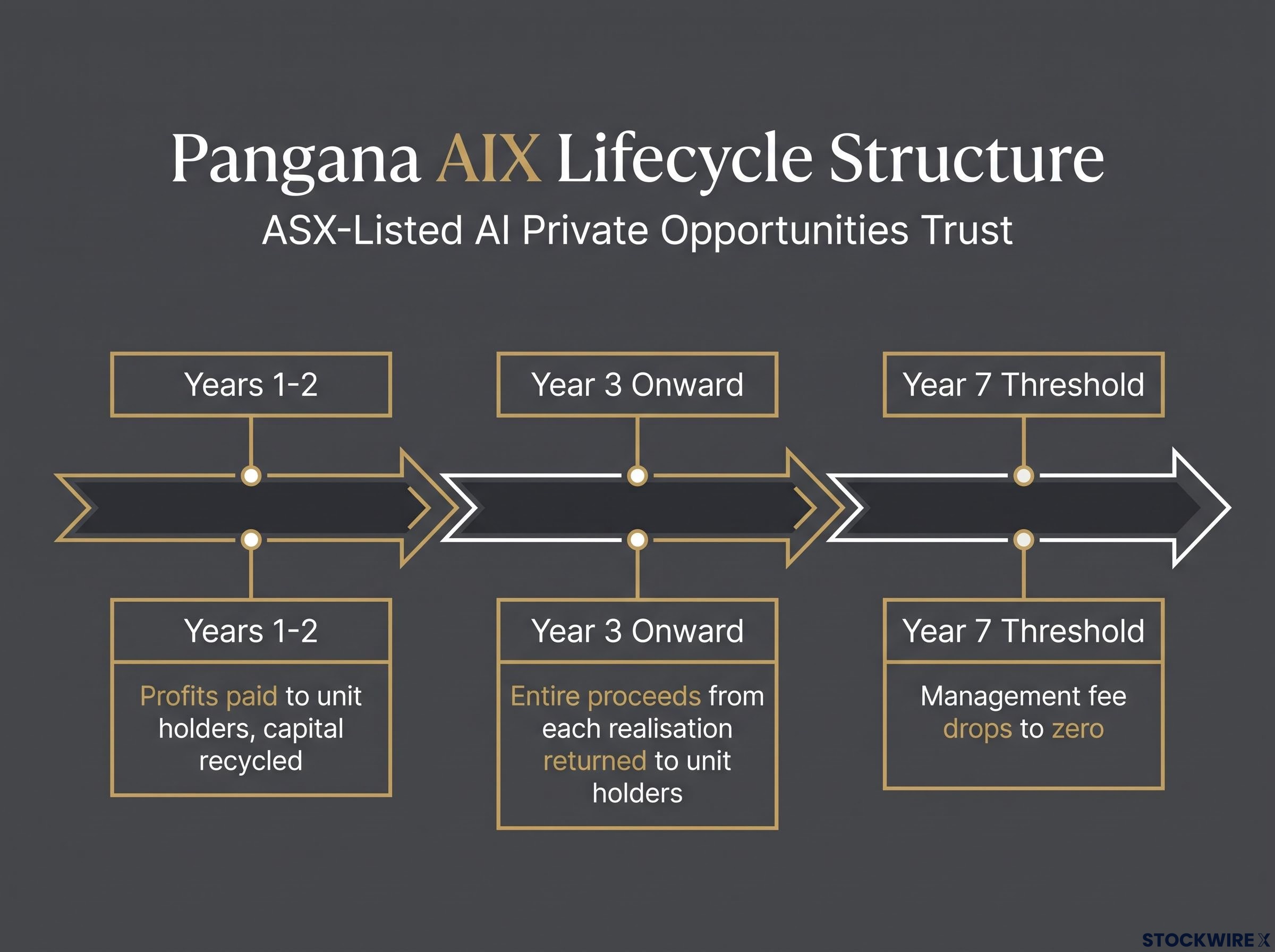
The seven-year wind-down horizon is not arbitrary. It is calibrated to the anticipated migration of portfolio companies from private to public markets, which means the vehicle’s lifecycle is designed to end roughly when its underlying thesis resolves.
Pangana publishes monthly investor reports plus additional disclosures for material announcements between reporting periods, which represents an Australian market standard for this vehicle type.
Co-investment: the mechanism behind access to names like Anthropic and OpenAI
How does a listed vehicle on the ASX end up holding a stake in one of the most oversubscribed private companies on earth? The mechanism is co-investment.
Co-investment works in three steps:
- A lead private equity or venture fund secures an allocation in a target company. Where that allocation is larger than the fund needs for its own portfolio, the surplus creates an opportunity to bring in outside capital.
- The sponsor establishes a dedicated co-investment vehicle and extends invitations to a select group of capital partners, offering participation on the same economic terms as the main fund.
- A listed trust that has demonstrated itself as a dependable, long-term institutional partner may receive one of those invitations, taking a direct equity position in a company that would otherwise be entirely out of reach.
Co-investments provide direct equity exposure to a single company’s equity rather than a diversified fund, which makes deal selection at the manager level critical. For AIX, co-investment is the anticipated mechanism for acquiring stakes in both Anthropic and OpenAI specifically.
Why deal flow quality depends on the manager, not the structure
When demand for a deal far exceeds the available allocation, the sponsor controls who participates. Access is not simply a function of having capital available; it reflects the standing that a manager has built within the private equity ecosystem over time.
When a listed vehicle cites co-investment access to Anthropic or OpenAI, you are buying not just a financial structure but a manager’s network and its institutional reputation. That distinction matters when evaluating competing vehicles. You should scrutinise the manager’s existing relationships and track record in co-investment participation, not just the vehicle’s fee structure or marketing materials. A retail investor working alone seldom receives comparable co-investment opportunities, regardless of capital size.
What to weigh before adding private-market exposure to your portfolio
What these vehicles offer
- Regulated, exchange-traded access via a standard ASX brokerage account
- Indirect exposure to leading private tech companies during their pre-IPO value-creation phase
- A structural hedge against AI disruption risk in public-only portfolios
What they do not remove
- Underlying illiquidity and valuation uncertainty; NAV estimates are not market prices, and secondary-market prices of the vehicle can trade at premiums or discounts to estimated NAV
- Manager dependency: returns are a function of deal flow quality and exit timing
- Long-horizon commitment; these are satellite allocations, not liquid substitutes for listed equities
The right question is not whether to have private-market exposure. It is how much of your portfolio’s risk budget this allocation should consume, given that the underlying assets are long-dated and illiquid.
A vehicle like AIX fits most naturally as a growth-oriented satellite position within a broader portfolio. Because it also offers some exposure to the companies creating AI disruption rather than only those absorbing it, there is a secondary balancing quality worth recognising, though it would be a stretch to categorise it as defensive. Position sizing should reflect that this is a satellite, not a core holding.
For investors who want a structured framework for deciding how much of their portfolio to allocate to high-conviction thesis positions, our dedicated guide to satellite position discipline covers the pre-commitment criteria, maximum sizing rules, and monitoring habits that prevent a single speculative allocation from disrupting long-term compounding.
This article is for informational purposes only and should not be considered financial advice. Investors should conduct their own research and consult with financial professionals before making investment decisions. Past performance does not guarantee future results. Financial projections are subject to market conditions and various risk factors.
A structural shift worth understanding before the window narrows
The argument across this article reduces to a single structural observation: listed private-market vehicles are not a workaround or a marketing construct. They are a response to a genuine and durable shift in where technology value is created. Anthropic, OpenAI, and SpaceX are not edge cases. They are the pattern.
The category of listed vehicles addressing this gap is still developing, which means early understanding confers an advantage over investors who wait until these structures are mainstream. AIX represents one ASX-listed example, and the category is evolving. You should evaluate specific vehicles on manager quality, lifecycle design, fee alignment, and co-investment track record.
The investor who acts with understanding rather than speculation is not chasing performance. They are correcting a structural gap in their portfolio that public markets alone cannot fill. The question now is how much of your risk budget is appropriate for long-horizon private-market exposure, and whether a vehicle with the right manager relationships and lifecycle structure fits that allocation.
—