A Singapore investor holding VOO and an investor holding CSPX own exposure to the exact same 500 US companies. Yet on every dollar of dividends those companies pay, one investor surrenders 30% to the IRS and the other surrenders 15%. The difference has nothing to do with stock selection, market timing, or fund performance.
This is a structural tax outcome, determined entirely by where the fund is legally registered. It applies right now to every Singapore investor holding US-domiciled ETFs in a taxable account, and it compounds quietly with every dividend payment.
Here is what the maths actually looks like on a real portfolio, why the rules work this way, where the most common misconception sits, and how to verify whether your current holdings are costing you more than they need to.
Why the same S&P 500 exposure can carry very different tax bills
Two ETFs can sit side by side in your brokerage app, both labelled “S&P 500,” and carry materially different tax outcomes on identical dividend income. The variable is not the index. It is not the exchange where the fund trades. It is the country where the fund’s legal paperwork was filed: its domicile.
Domicile is the country of legal registration. It determines which tax treaties apply to the fund’s income and how dividends are treated before they ever reach your account. The listing venue, whether that is the NYSE, the LSE, or the SGX, is irrelevant to the tax calculation.
The ETF ownership structure that makes domicile so consequential is the same one that gives passive index funds their cost and diversification advantages: when you buy a single ETF share, the fund, not you, is the legal owner of the underlying securities and the entity subject to the first layer of withholding tax.
| ETF Ticker | Domicile |
|---|---|
| VOO | United States |
| IVV | United States |
| CSPX | Ireland |
| VUAA | Ireland |
An ETF listed on the SGX is not automatically domiciled in Singapore, the US, or Ireland. Only the fund’s prospectus, Key Investor Information Document (KIID), or fund factsheet tells you where it is legally registered. That single data point controls the tax rate applied to every dividend the fund receives.
The most common investor mistake is assuming the listing exchange or the tracked index determines tax treatment. It does not. Getting this wrong costs real money on every dividend payment.
When big ASX news breaks, our subscribers know first
How the US-Ireland tax treaty cuts the withholding rate in half
Singapore has no double taxation agreement with the United States covering portfolio dividends for individual investors. That means Singapore investors holding US-domiciled ETFs face the default IRS withholding rate of 30% on all dividend income. No reduction is available. No filing changes the outcome.
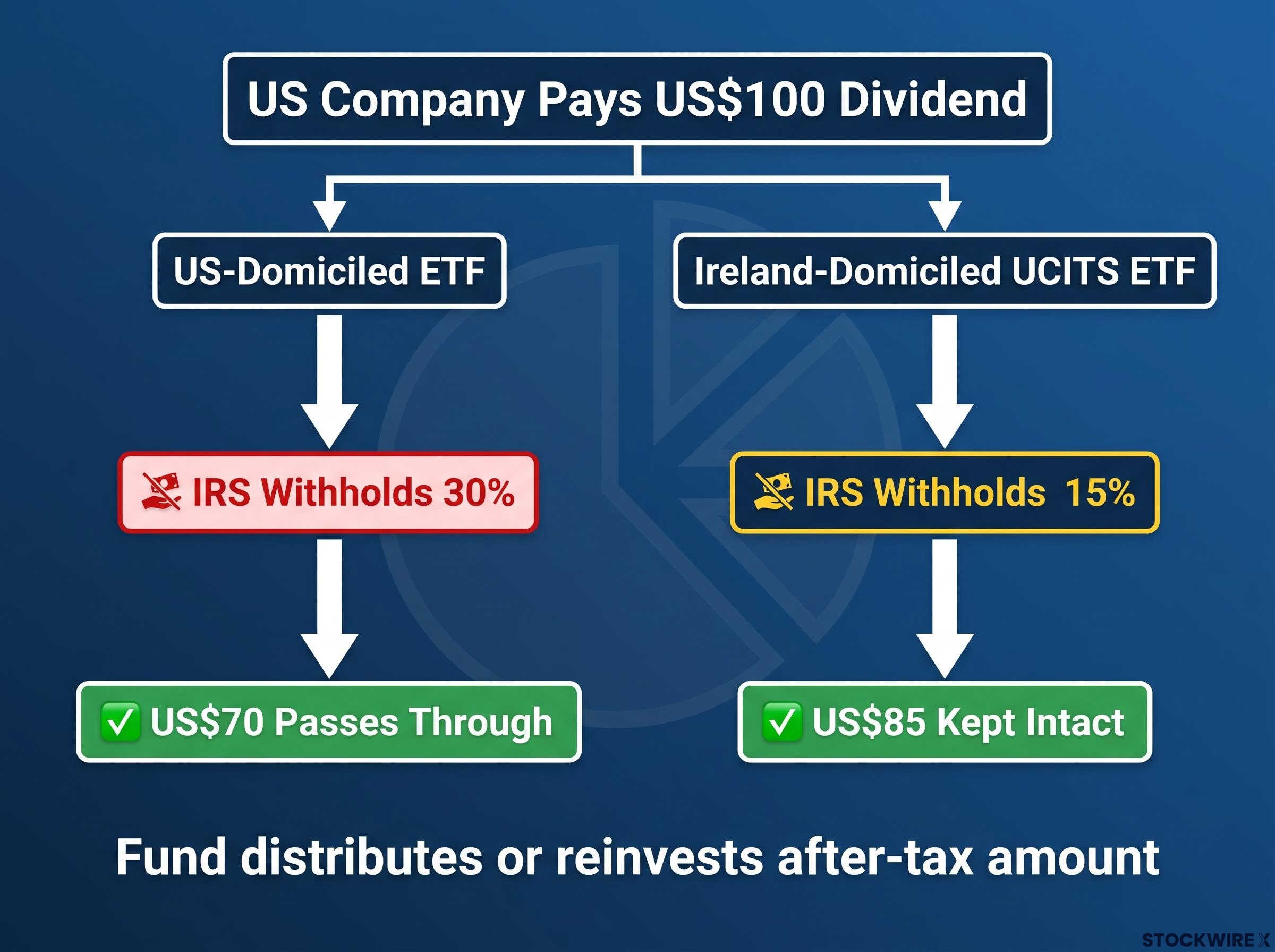
Ireland, by contrast, has a bilateral tax treaty with the US that reduces dividend withholding to 15% for Irish-resident entities, including Ireland-domiciled UCITS funds. When a US company pays a dividend to CSPX or VUAA, the IRS takes 15% instead of 30%. Ireland then imposes no additional withholding on distributions paid by Irish UCITS funds to non-resident investors. For you as a Singapore investor, the 15% at the fund level is the full tax cost.
Ireland-domiciled S&P 500 ETFs such as CSPX and SPYL benefit from the 15% treaty rate on every dividend dollar, meaning investors compound on 85 cents of gross dividend income versus 70 cents under a US-listed structure, a gap that widens materially over multi-decade holding periods.
The chain works in three steps:
- A US company declares and pays its dividend to the fund.
- The IRS withholds at the applicable rate: 30% for US-domiciled funds (no Singapore treaty) or 15% for Ireland-domiciled funds (US-Ireland treaty).
- The fund distributes or reinvests the after-tax amount.
From every US$100 in dividends paid, a US-domiciled ETF passes US$70 through to the Singapore investor after IRS deduction. An Ireland-domiciled UCITS ETF keeps US$85 intact at fund level, with Ireland imposing no further charge on top.
You are not doing anything wrong or missing a filing. The gap exists because Singapore simply has no treaty in place, and there is currently no mechanism to claim back the excess 15 percentage points withheld from US-domiciled ETF dividends. The corrective action is not a form; it is a domicile switch.
What this costs in practice: a portfolio-level dollar calculation
Consider a US$50,000 S&P 500 position generating dividends at an illustrative yield of around 1.3%, which works out to roughly US$650 annually. The 30% withholding rate on a US-domiciled ETF sends approximately US$195 of that straight to the IRS each year. Under the 15% rate that applies to Ireland-domiciled UCITS ETFs, the tax cost falls to around US$97.50.
The annual difference: roughly US$97.50 that stays invested in the Ireland-domiciled structure instead of being handed to the IRS.
That figure compounds. Over a ten-year holding period, the cumulative withholding gap on dividends alone runs into the hundreds, potentially the low thousands, of dollars on a single US$50,000 position, before accounting for the returns those retained dividends would have generated.
| Metric | US-Domiciled ETF (e.g. VOO) | Ireland-Domiciled ETF (e.g. CSPX) | Difference |
|---|---|---|---|
| Annual dividends on US$50,000 at 1.3% yield | US$650 | US$650 | — |
| Withholding rate | 30% | 15% | 15 percentage points |
| Tax withheld | US$195 | US$97.50 | US$97.50 |
| Net dividend retained | US$455 | US$552.50 | US$97.50 |
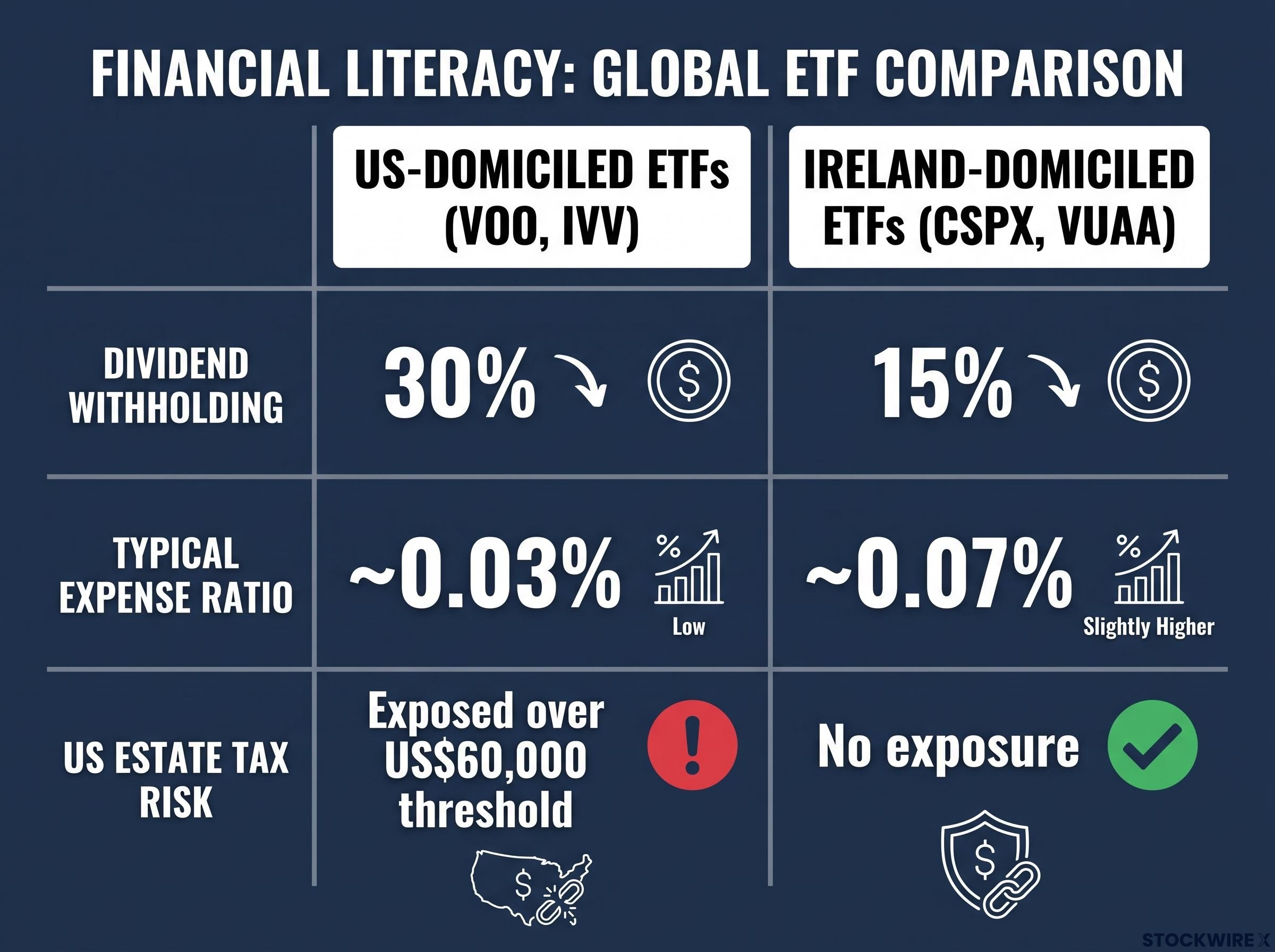
| Typical expense ratio | ~0.03% | ~0.07% | ~0.03%-0.04% |
The 1.3% yield is illustrative and actual S&P 500 dividend yields fluctuate, but the direction and approximate magnitude of the differential is structural, not yield-dependent.
Does the lower expense ratio on US ETFs make up the difference?
This is the most common objection. VOO charges roughly 0.03% in fees; CSPX charges closer to 0.07%. On a US$50,000 position, that fee gap amounts to approximately US$15-US$35 per year.
Compare that to the US$97.50 per year in additional tax withheld from the US-domiciled fund. The fee advantage is an order of magnitude smaller than the withholding tax differential, which applies to all dividend income, not just the management fee layer.
For non-US-person Singapore investors in taxable accounts, the expense ratio advantage does not offset the tax disadvantage over a multi-year holding horizon. The maths clearly favours the Ireland-domiciled structure on an after-tax, net-fee basis.
The total cost of an ETF extends well beyond the published expense ratio: tracking difference, bid-ask spreads, and securities lending income all affect the net return an investor actually receives, and each dimension interacts differently with the domicile-driven tax layer examined here.
The accumulating share class misconception explained
Many Singapore ETF investors believe that selecting an accumulating share class, which reinvests dividends internally rather than distributing them as cash, wipes out the withholding tax drag on their returns. This belief is incorrect.
Dividend withholding tax is deducted by the IRS at the moment the underlying US company pays its dividend to the fund. This happens before the fund makes any decision about distributing or reinvesting the money. The tax event occurs at stage two of the dividend lifecycle, not stage three:
- The US company declares and pays its dividend to the fund.
- The IRS withholds at the applicable rate (30% for US-domiciled funds, 15% for Ireland-domiciled funds).
- The after-tax dividend is either distributed to investors as cash or reinvested into the fund’s net asset value (NAV).
The withholding tax is taken before the fund decides what to do with the money. Accumulating or distributing: the tax bill is the same.
VUAA is Ireland-domiciled and accumulating. It benefits from the 15% treaty rate. A US-domiciled accumulating ETF would still suffer the 30% withholding before reinvestment. Whether a fund is accumulating or distributing affects only what happens to the after-tax dividend amount; it is the domicile that determines what share of income was lost to tax before that point.
If you switched from CSPX (distributing, Ireland-domiciled) to VUAA (accumulating, Ireland-domiciled) thinking you had eliminated the tax drag, you changed your cash-flow preference but moved nothing on the tax front. The decision that actually moves the needle is Ireland versus US domicile, not accumulating versus distributing.
The estate tax risk that the withholding rate comparison does not capture
The dividend withholding differential is the cost you can calculate today. There is a second structural risk that most Singapore ETF comparisons leave out entirely.
US-domiciled ETFs are classified as US-situs assets. For non-US persons, US-situs holdings exceeding a commonly referenced threshold of US$60,000 may trigger exposure to US estate tax. Singapore has no estate tax treaty with the United States, so no treaty protection is available on this point.
- US-domiciled ETFs (such as VOO and IVV) are classified as US-situs assets, exposing non-US-person holders to potential US estate tax.
- Singapore has no estate tax treaty with the US, leaving Singapore investors without treaty protection.
- Ireland-domiciled UCITS ETFs (such as CSPX and VUAA) holding US stocks are not classified as US-situs assets, so they do not trigger US estate tax exposure for Singapore investors.
A Singapore investor with more than US$60,000 in VOO or IVV is carrying a US estate tax exposure they may not know exists. Switching to CSPX or VUAA removes that exposure entirely without changing the underlying market position. This is not a scare tactic; it is a straightforward legal classification that adds a second structural argument for the Ireland-domiciled structure, sitting independently of the dividend withholding calculation.
Who this analysis applies to
The analysis throughout this article applies only to Singapore investors who are not US persons, meaning not US citizens, green card holders, or US tax residents. US persons are subject to US worldwide taxation, and their ETF selection and tax outcomes differ significantly. If you hold US citizenship or a green card, seek US-specific tax advice before applying any of the conclusions here.
Making the domicile decision: what Singapore investors should verify before acting
The structural case is straightforward. Ireland-domiciled UCITS ETFs offer Singapore investors a lower withholding rate on US dividends, no additional Irish tax layer, and no US estate tax exposure, at the cost of a small fee premium that does not change the direction of the conclusion.
Converting that knowledge into a portfolio decision starts with one verification step: confirming the domicile of every ETF you currently hold. Here is how:
- Locate the fund’s prospectus or KIID (available on the fund provider’s website or your brokerage platform).
- Identify the “Domicile” or “Country of Registration” field.
- Confirm whether it reads Ireland or United States, and apply the corresponding withholding rate logic from this article.
Ticker symbols and listing exchanges can be misleading. The prospectus is the authoritative source.
For investors looking at Ireland-domiciled alternatives, common options include:
- S&P 500 exposure: CSPX (distributing), VUAA (accumulating)
- Global equity exposure: IWDA (accumulating), VWRA (accumulating)
This article is for informational purposes only and should not be considered financial advice. Investors should conduct their own research and consult with financial professionals before making investment decisions.
Before acting on any of the structural conclusions here, consult a qualified tax adviser who can assess your specific circumstances, including residency status, portfolio size, and estate planning needs.
The structural case is clear; the verification step is yours to take
Domicile, not listing market or accumulating structure, determines whether you pay 30% or 15% US dividend withholding tax as a Singapore investor. That single variable controls the tax outcome on every dividend payment from every US equity ETF in your portfolio.
Ireland-domiciled UCITS ETFs carry a small fee premium over US-domiciled alternatives. The withholding tax differential substantially outweighs this cost for non-US-person investors over a multi-year holding horizon. The estate tax dimension adds a second, structurally independent argument that reinforces the same conclusion.
This is not a one-time fix. As your portfolio grows, as new ETF products launch, and as brokerages make more fund domiciles accessible, the habit of checking domicile before investing is the skill that keeps paying off. It takes thirty seconds with a prospectus. The cost of skipping it compounds for years.
Building a tax-efficient portfolio structure involves more than choosing the right fund domicile: account type, asset location, and the sequencing of taxable events each add or remove friction from long-term compounding, and the domicile decision sits within a broader set of structural choices that collectively determine after-tax returns.
Past performance does not guarantee future results. Tax rules are subject to change. Consult a qualified tax adviser before making changes to your ETF holdings.