You just bought your first shares. The order went through, the money left your account, and now you are staring at a brokerage screen wondering what actually happens from here. Most beginner investing content stops at the buy button and leaves you without a map for everything that follows.
The purchase itself was the easy part. What comes next is where the real decisions live: how your shares are held, how dividends reach you, when the Australian Taxation Office (ATO) gets involved, and what habits separate investors who build wealth over time from those who quietly erode their own returns through avoidable mistakes.
This guide covers the mechanics and the mindset. By the time you finish, you will know how settlement works, what franking credits actually do for your tax return, what your obligations are at tax time, and how to set up a consistent investing process that turns a single purchase into a portfolio built to last.
What actually happens in the days after your trade goes through
Your trade executes the moment you hit confirm, but you do not legally own those shares yet. The ASX operates on a T+2 settlement cycle, which means the actual exchange of your money for legal title to the shares completes two business days after trade day.
Once settlement is done, how your shares are held depends on your broker’s model, and this is worth understanding before you assume anything about ownership.
Under CHESS sponsorship, the ASX’s Clearing House Electronic Subregister System records the shares directly against your name, and you are issued a Holder Identification Number (HIN) that identifies you as the legal owner on the company’s register. Under a custodial model, the broker or a nominee entity holds legal title on your behalf, and your entitlement is a beneficial interest rather than direct ownership.
Whether your broker uses CHESS or a custodial model is not a minor technical detail. It determines whether your name sits on the company’s register as the legal owner or whether you are relying on your broker’s financial health to protect your holding.
The practical test is straightforward: check whether your broker issued you a HIN or an internal account reference, because that single data point reveals everything about CHESS sponsorship vs custodial ownership and what happens to your holding if your broker encounters financial trouble.
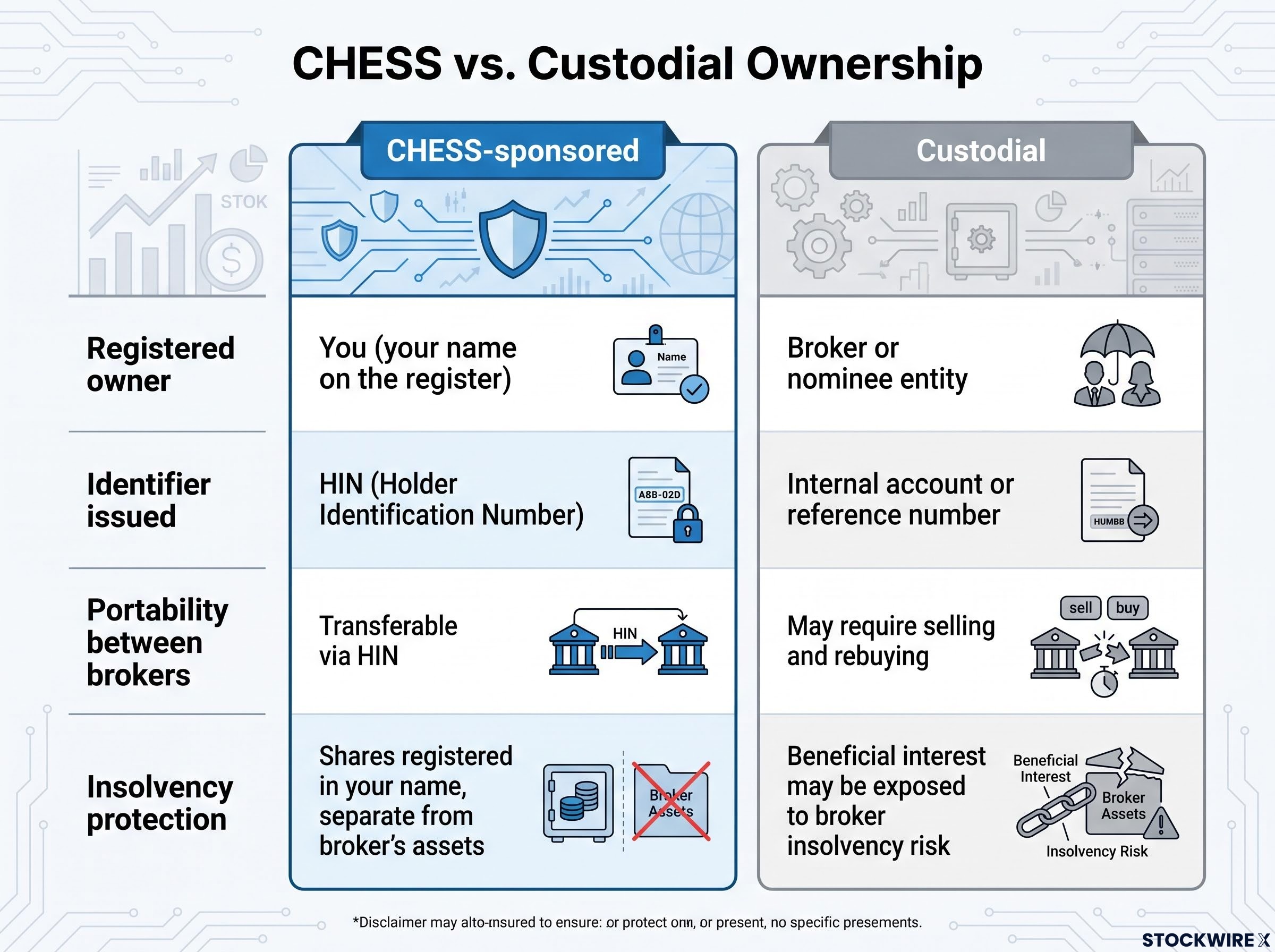
| Attribute | CHESS-sponsored | Custodial |
|---|---|---|
| Registered owner | You (your name on the register) | Broker or nominee entity |
| Identifier issued | HIN (Holder Identification Number) | Internal account or reference number |
| Portability between brokers | Transferable via HIN | May require selling and rebuying |
| Insolvency protection | Shares registered in your name, separate from broker’s assets | Beneficial interest may be exposed to broker insolvency risk |
Once settlement completes, three things become live for you:
- Dividend eligibility, tied to whether you are on the register before the ex-dividend date
- Tax exposure, because dividend income and future capital gains are now your responsibility
- The ability to build on the holding through additional purchases over time
When big ASX news breaks, our subscribers know first
How dividends reach you, and what franking credits actually do
A dividend is a distribution of company profits to shareholders. Many established ASX companies pay dividends twice a year (an interim and a final dividend), though the schedule varies by company.
To receive an announced dividend, you need to buy before the ex-dividend date. If you buy on or after that date, the dividend goes to whoever held the shares before the cutoff. Dividends are not guaranteed; companies can cut, suspend, or cancel them when profits fall or priorities shift. Yield should always be assessed alongside profit stability and dividend cover ratios (how easily a company’s profits cover its dividend payments).
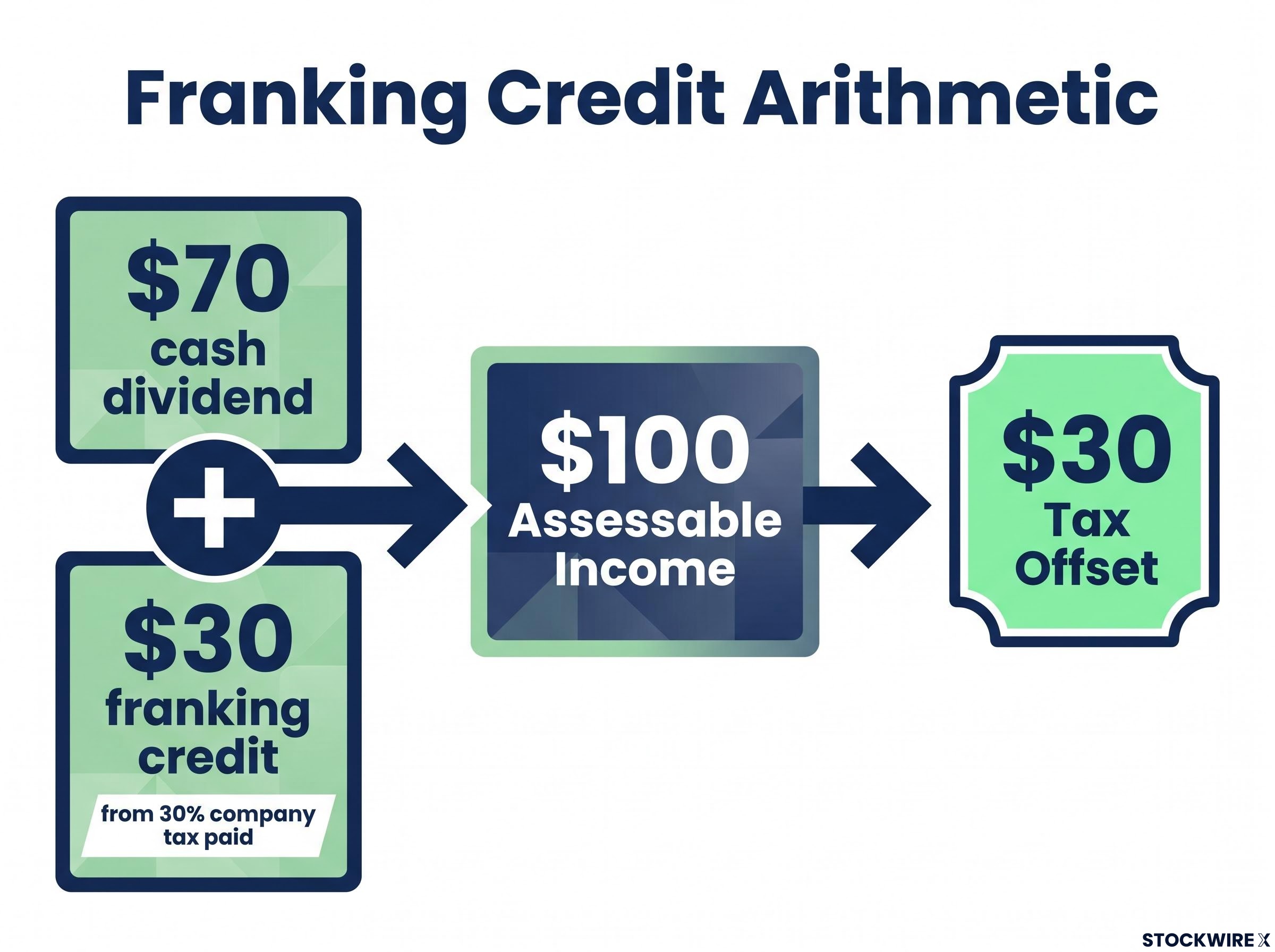
The real advantage for Australian investors, though, is the franking credit system. When an Australian company pays tax on its profits (typically at 30%), it can attach a franking credit to dividends paid from those taxed profits. On your tax return, you include the cash dividend plus the franking credit in your assessable income, but you also claim the credit as a tax offset.
Franking credit arithmetic: A company pays you a $70 cash dividend with a $30 franking credit attached. Your assessable income is $100 ($70 + $30). You then receive a $30 tax offset, reducing the tax you owe on that income.
The three franking scenarios work like this:
- Fully franked: Credits reflect all company tax paid on the underlying profits (typically 30%), giving you the full offset
- Partially franked: Credits reflect only some of the tax paid; your offset is reduced accordingly
- Unfranked: No credits attached; the full cash amount is taxed at your marginal rate with no offset
If your marginal tax rate is higher than 30%, you pay the gap. If it is lower, the excess credits can generate a refund from the ATO. For lower-income investors and retirees especially, this refundable nature means the ATO can actually send money back at tax time, which makes franking credits a material financial outcome worth understanding regardless of your income level.
Choosing between cash dividends and reinvestment plans
Many companies offer a Dividend Reinvestment Plan (DRP), which automatically converts your cash dividend into additional shares, usually with no brokerage cost. It is a practical way to compound your holding without placing manual trades.
The tax treatment, however, is identical. The ATO treats reinvested dividends as though you received the cash first and then used it to buy more shares. Each new parcel of DRP shares carries its own cost base for future capital gains tax (CGT) calculations, which means you need to keep records of every reinvestment event.
DRP participation is usually a simple election made through the share registry, and you can change it at any time.
The tax obligations Australian share investors cannot ignore
Buying shares is not a tax event. Tax becomes relevant at two points: when you receive dividend income, and when you sell shares for a gain or loss.
The first practical step is supplying your Tax File Number (TFN) when you open a brokerage account. Failing to do so results in automatic withholding at the highest marginal tax rate on certain income, which is an unnecessary cost you can avoid entirely.
Here are the four main rules you need to track:
- Dividend income declaration: All dividends, including franking credits and DRP reinvestments, must be declared in your annual tax return
- CGT on sale: If you sell shares for more than your cost base, the profit is a capital gain added to your assessable income
- 45-day holding rule: You must hold shares “at risk” for at least 45 days (90 days for preference shares), excluding acquisition and disposal days, to claim the full franking credit benefit
- DRP cost base record-keeping: Each DRP parcel has its own cost base, so you need to track every reinvestment event for accurate CGT calculations
The 50% CGT discount is where holding period becomes a strategic variable, not an afterthought. Individuals who hold shares for more than 12 months include only half of the net capital gain in their assessable income. For investors patient enough to hold through short-term volatility, this can roughly halve the tax payable on a profitable sale.
The 50% discount that makes the 12-month holding threshold so valuable to investors today is also the subject of significant change, with CGT reforms taking effect in 2027 replacing the discount with CPI indexation of the cost base and introducing a 30% minimum rate floor that will alter after-tax outcomes across income brackets.
| Holding period | Assessable gain on $5,000 profit | Tax impact |
|---|---|---|
| Under 12 months | $5,000 (full gain) | Taxed at your full marginal rate |
| Over 12 months | $2,500 (50% discount applied) | Only half included in assessable income |
If you sell at a loss, the capital loss can be carried forward indefinitely to offset future capital gains, but it cannot be used against ordinary income.
One integrity rule worth knowing: dividend washing (buying shares on a special ASX market to receive an extra franked dividend while still holding the original parcel) will result in the ATO denying the franking credit on the second parcel.
Personal tax outcomes depend on your individual circumstances, including income level, investment structure, and holding period. A registered tax agent should be consulted for specific decisions.
Six mistakes that trip up first-time investors, and why they happen
These are not character flaws. They are predictable responses to an environment that rewards patience but constantly tempts you toward action. Recognising them before they happen is the simplest way to protect your returns in the first year.
Behavioural discipline in long-term investing is harder to maintain than most new investors expect; research shows around 30.9% of investors who panic-sold during a major market downturn never re-entered equities, permanently forfeiting the recovery gains that an automated contribution schedule would have captured throughout the decline.
- Over-monitoring prices. Daily checking heightens emotional reactions and encourages short-term trading decisions. Share investing rewards a long-term perspective, and watching prices move hour by hour works against that orientation.
- Investing money you may need soon. Committing funds you are likely to need in the short term is a structural problem: a market downturn at the wrong moment can force you to sell at a loss rather than waiting for a recovery. Keeping a separate cash buffer for near-term expenses is what makes your share investments genuinely long-term in practice.
- Acting on tips and headlines. By the time information reaches social media or mainstream news, it is typically already priced into the market. Conducting your own research before purchasing is the habit that replaces reactive buying.
- Ignoring brokerage and fees. Platform costs are easy to overlook, but they accumulate across every trade you make. Taking the time to compare fee structures before committing to a broker can be the difference between returns that compound in your favour and costs that quietly compound against you.
- Not understanding your custody arrangement. A surprising number of new investors are unsure whether their broker holds shares under CHESS sponsorship or a custodial structure. The distinction matters because it shapes your legal ownership, your ability to move holdings between platforms, and the protections available to you if your broker encounters financial trouble.
- Trying to time the market. Calling the right moment to buy or sell is something even experienced professionals consistently get wrong. A disciplined, rules-based approach to investing tends to deliver better outcomes for most people than chasing entry and exit points.
The mistakes that cost beginner investors the most are rarely caused by bad stock picks. They are caused by process failures, and fixing the process is within your control regardless of what markets are doing.
What dollar-cost averaging is, and why it suits most beginners
Dollar-cost averaging (DCA) means investing a fixed dollar amount on a regular schedule, whether that is weekly, fortnightly, or monthly, regardless of where the market sits. The arithmetic consequence is straightforward: you buy more shares when prices are lower and fewer when prices are higher, which averages your cost per share over time.
The mechanical benefit matters, but the behavioural benefit matters more. DCA converts investing from a discretionary, emotionally charged decision into a routine. You no longer need to decide whether today is the right time to buy. The schedule decides for you, and that removes the pressure to predict the right moment.
The behavioural case for dollar-cost averaging on the ASX is well established, but the evidence also shows lump-sum investing outperforms in roughly 60-75% of historical scenarios, a comparison that matters most when you are deciding how to deploy a windfall or a savings balance rather than contributing from regular income.
Some Australian brokers offer automation to make this effortless. Selfwealth by Syfe, for example, offers an Auto-Invest feature through which you can set up a recurring investment into a chosen stock or ETF on a weekly, fortnightly, or monthly cadence for a fixed dollar amount. This removes the need to log in and place each trade yourself, making consistent DCA straightforward to maintain.
If you have just made your first purchase and are anxious about when to buy again, setting up a regular DCA schedule is the single most effective step you can take. It keeps you invested through volatility without requiring a timing call each time.
To implement DCA, three steps are all you need:
- Choose a fixed dollar amount you can commit consistently
- Set a regular schedule (weekly, fortnightly, or monthly)
- Use an auto-invest feature if your broker offers one, so the process runs without manual intervention
Reviewing your portfolio without letting it run your week
A quarterly or annual review is the right default cadence for most investors. Daily or weekly checking pulls you back toward the emotional monitoring that DCA is designed to eliminate.
When you do review, focus on whether your holdings still match your goals, risk tolerance, and time horizon, rather than reacting to recent price movements. As your portfolio grows and your questions become more complex, ASIC Moneysmart and ATO guidance are reliable, impartial starting points for ongoing learning.
Turning your first purchase into a portfolio built to last
You now understand the structural elements that sit underneath every share you own: settlement and custody determine how your holding is protected, dividends and franking credits generate income and tax advantages, CGT rules shape the real return you keep, avoiding common mistakes preserves that return, and a DCA habit grows it consistently over time.
These are not separate topics you file away individually. They work as an interconnected system. Your custody model protects the holding. Dividends generate income. Tax rules determine how much of that income and those gains you actually keep. Avoiding behavioural mistakes preserves what you have built. And DCA ensures you keep building.
The difference between investors who stay in the market for a decade and those who drift away after a year is rarely about picking better stocks. It is about having a clear enough understanding of the mechanics, and a consistent enough process, to stay composed when markets move against you.
Your three immediate action steps:
- Read your broker’s Product Disclosure Statement (PDS) to confirm whether you are CHESS-sponsored or in a custodial arrangement
- Locate your first dividend statement when it arrives (or set up your TFN with the share registry now if you have not already)
- Decide on a DCA schedule and, if available, activate your broker’s auto-invest feature
Your broker and share registry will provide annual statements summarising dividends, franking credits, and cost base information, which simplifies tax reporting at the end of each financial year. For specific financial or tax decisions, a licensed financial adviser or registered tax agent can provide guidance tailored to your circumstances.
This article is for informational purposes only and should not be considered financial advice. Investors should conduct their own research and consult with financial professionals before making investment decisions.