
Westpac shares have climbed nearly 18% over the past year, yet two different valuation models using the same dividend produce fair value estimates ranging from $34 to $49 per share. That spread is not a calculation error. It illustrates precisely why knowing which metrics to use, and how to read them, separates a considered assessment from a guess.
Australian retail investors carry heavy exposure to Big Four bank shares, particularly through self-managed super funds (SMSFs) and dividend-focused portfolios. Yet bank financial statements are structured differently from most other listed companies. The standard price-to-earnings (P/E) ratio that works for industrial stocks misses what actually drives bank value: the margin earned on lending, the efficiency of capital deployment, and the regulatory buffers that determine how much cash can flow back to shareholders.
This guide covers the three operational metrics every bank investor needs to understand (net interest margin, return on equity, and the CET1 capital ratio), uses Westpac’s current H1 2026 data as a live reference throughout, and then shows how those metrics feed into a practical valuation framework suited to Australian conditions, including the role of franking credits.
Why bank shares need their own analytical toolkit
Banks are financial intermediaries. Their primary product is the spread between what they pay to borrow money (deposits and wholesale funding) and what they charge to lend it out. That makes their revenue structure fundamentally unlike a retailer, a software company, or a manufacturer. Lending income represents approximately 87% of Westpac’s total revenue, a concentration that demands margin-specific analysis rather than headline earnings comparisons.
Standard metrics can mislead. A P/E ratio applied to a bank captures earnings that are heavily shaped by provisioning decisions, the estimates management makes about future loan losses, not just operational performance. Two banks with identical lending businesses can report meaningfully different earnings simply because one has taken a more conservative provisioning stance.
Westpac trades at $37.44 with a 52-week return of +17.77% and a beta of 0.75, positioning it as a low-volatility defensive holding. But understanding whether that price is justified requires a different lens. The three metrics that professional analysts use to cut through bank complexity are:
- Net Interest Margin (NIM): Measures the spread between what the bank earns on loans and what it pays for funding, expressed as a percentage of earning assets.
- Return on Equity (ROE): Measures how efficiently the bank converts shareholder capital into profit.
- CET1 ratio: Measures the bank’s highest-quality capital as a proportion of its risk-weighted assets, the safety buffer that determines dividend capacity.
When big ASX news breaks, our subscribers know first
Net interest margin: the engine room of bank profitability
NIM is the difference between what a bank earns on its loan book and what it pays for funding (deposits and wholesale debt), expressed as a percentage of earning assets. It is the single most direct measure of a bank’s core business economics.
Several forces push NIM up or down. Lending competition compresses it when banks undercut each other to win mortgage and business loan market share. Rising funding costs from wholesale debt markets or deposit rate competition squeeze it further. Fixed-rate loan roll-offs, where borrowers who locked in lower rates during 2020-2022 refinance at higher rates, can expand it. The Reserve Bank of Australia’s (RBA) cash rate trajectory shapes the backdrop against which all of these forces operate.
Lending income represents approximately 87% of Westpac’s total revenue, which is why NIM is the single most important profitability metric for bank investors to track.
Westpac reported a NIM of approximately 1.94% in its H1 2026 interim results on 5 May 2026, placing it above the sector average of approximately 1.78% reported by KPMG’s Big Four Half-Year Results 2026 analysis. Mild NIM compression was observed across the sector during H1 2025, with H2 2025 showing stabilisation. A bank sitting above the sector average has more cushion to absorb competitive pressure before its profitability erodes.
| Bank | NIM (H1 2026, approx.) | Position vs Sector Average (~1.78%) |
|---|---|---|
| CBA | 2.05% | Above average |
| Westpac | 1.94% | Above average |
| NAB | 1.85% | Above average |
| ANZ | 1.78% | In line with average |
Knowing where a bank sits relative to its peers on NIM gives investors a baseline for assessing whether its margin advantage is durable or cyclical.
Return on equity: how efficiently is the bank using your capital?
ROE is net profit divided by shareholders’ equity. It measures the annual return the bank generates for every dollar of capital that shareholders have contributed. A bank reporting 10% ROE is earning $0.10 per year on every dollar of equity on its books.
Westpac reported a trailing ROE of approximately 9.74% and a Return on Tangible Equity (ROTE) of 10.97% excluding notable items. Analysts often prefer ROTE because it strips out intangible assets (such as goodwill from past acquisitions) that cannot absorb losses, giving a cleaner picture of capital efficiency. Against a sector average of approximately 10-11% (per KPMG’s H1 2026 analysis), Westpac sits at the lower-mid range.
CBA stands apart at approximately 14.2% ROE, which is why it commands a premium. ANZ trails at approximately 9.5%.
How price-to-book connects back to ROE
The price-to-book (P/B) ratio and ROE are inseparable in bank analysis. A bank trading above 1.0x book value is only worth that premium if it can sustain ROE above its cost of equity. If ROE falls below the cost of equity, the bank is destroying capital in real terms, and a P/B above 1.0x becomes increasingly difficult to justify.
Westpac’s P/B sits at 1.80x, at the top of its 10-year historical range of approximately 1.5-1.8x. Its estimated cost of equity, derived from the Capital Asset Pricing Model (CAPM) using a beta of 0.75, is approximately 9%.
The spread between Westpac’s ROE of approximately 9.7% and its cost of equity of approximately 9% is thin but positive. This means the bank is earning just enough above its required return to justify a modest premium to book value. If ROE were to slip below 9%, that justification weakens materially.
CBA’s ROE of approximately 14.2% explains why it commands a P/B of approximately 2.5x; Westpac’s ROE of approximately 9.7-10.9% justifies a more modest premium.
CET1 ratio: the safety buffer that shapes dividends and buybacks
The Common Equity Tier 1 (CET1) ratio measures the proportion of a bank’s risk-weighted assets covered by the highest quality capital, ordinary shares and retained earnings. It is the primary regulatory safety buffer, the number the Australian Prudential Regulation Authority (APRA) watches most closely.
APRA’s effective minimum for major Australian banks sits at approximately 10.25-10.5%, incorporating the base requirement plus applicable buffers to meet the “unquestionably strong” standard. The headroom above that minimum is what matters to shareholders, because surplus capital is what funds dividends, buybacks, and acquisitions.
APRA’s unquestionably strong capital benchmarks set a CET1 floor of 10.5% for major Australian banks, a threshold that was established to ensure the domestic banking system could absorb severe economic shocks without requiring government support.
Westpac reported a CET1 ratio of approximately 12.53% (per Rask Media, May 2026), providing roughly 200 basis points of headroom above the effective minimum. No CET1 requirement increases have been flagged by APRA for 2026, per public disclosures. The sector average sits at approximately 12.3% (APRA Quarterly ADI Statistics, March 2026).
| Bank | CET1 Ratio (approx.) | Headroom Above APRA Effective Minimum (~10.5%) |
|---|---|---|
| CBA | 12.8% | ~230 bps |
| Westpac | 12.53% | ~200 bps |
| NAB | 12.05% | ~155 bps |
| ANZ | 12.0% | ~150 bps |
A CET1 ratio comfortably above the regulatory minimum means a bank can sustain its dividend through a moderate economic downturn without a capital raise. For income-focused investors, this matters directly. A high CET1 enables three things:
- Dividend support: Sustained payouts even if earnings dip temporarily.
- Share buybacks: Returning surplus capital to shareholders when management sees shares as undervalued.
- Acquisition flexibility: Capacity to pursue strategic opportunities without dilutive capital raisings.
Putting it together: valuing Westpac using a dividend discount model
The Dividend Discount Model (DDM) is the preferred valuation framework for Australian bank shares because banks pay large, relatively stable, fully franked dividends with predictable payout ratios. The model values a stock based on the present value of its future dividend stream, and for banks with mature, recurring cashflows, this approach aligns directly with why most investors hold them.
Why franking credits change the maths for Australian investors
Fully franked dividends carry a franking credit that represents company tax already paid. Australian resident taxpayers and SMSFs in accumulation phase can fully utilise these credits, either as a tax offset or a cash refund. Foreign investors and some tax-exempt entities cannot.
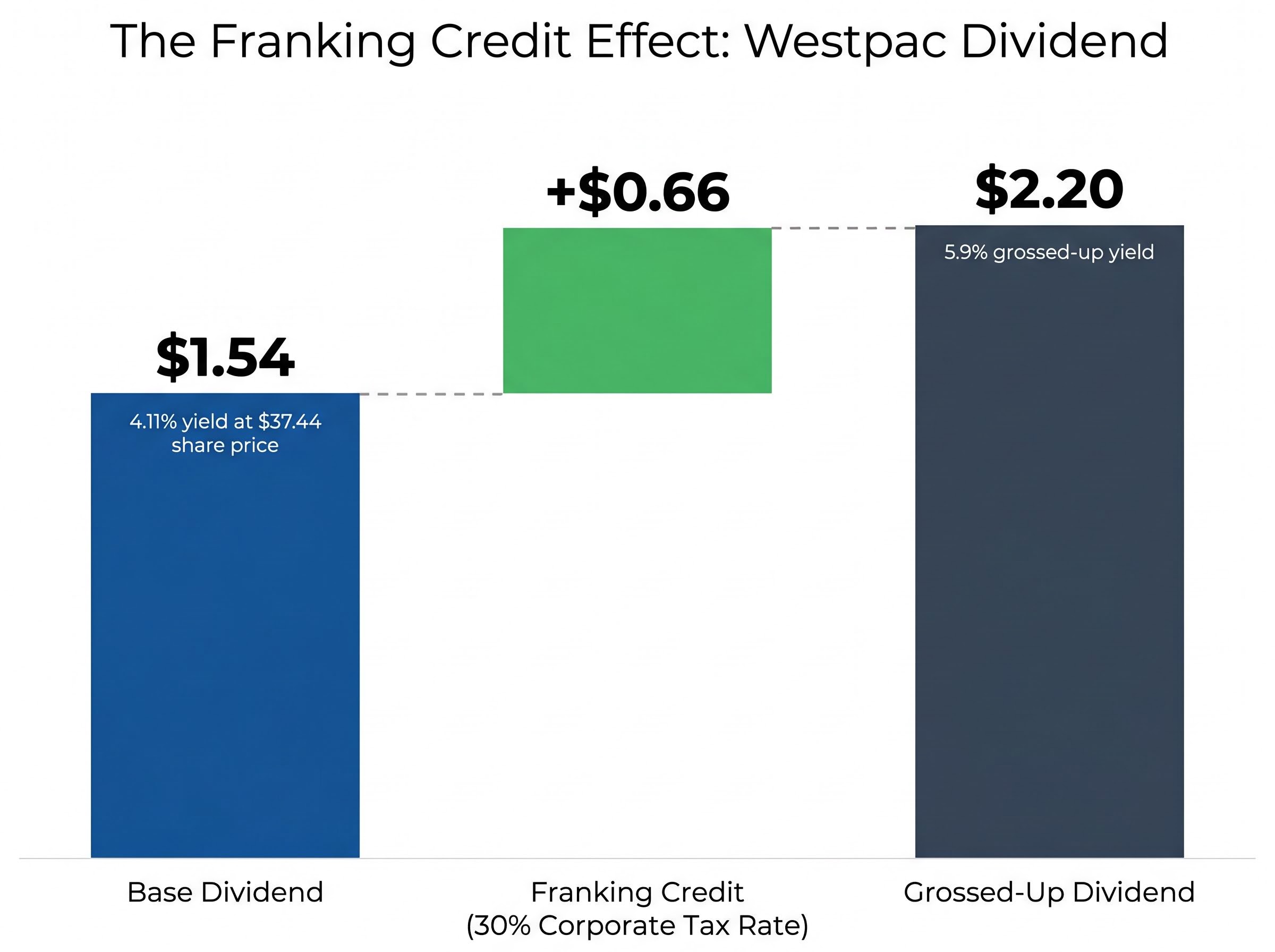
The correct gross-up formula uses the corporate tax rate of 30%: gross-up factor = 1 / (1 – 0.30) = 1.4286. Applied to Westpac’s implied annual dividend of approximately $1.54 (based on a 4.11% yield at $37.44):
- Franking credit: $1.54 x (0.30 / 0.70) = $0.66
- Grossed-up dividend: $1.54 + $0.66 = $2.20
The grossed-up yield of approximately 5.9% is the economically correct comparison yield for eligible investors, not the headline 4.11%.
The ATO franking credit rules govern exactly which investors can utilise imputation credits as a tax offset or cash refund, with eligibility determined by residency status and the investor’s marginal tax rate, making the grossed-up yield calculation economically meaningful only for qualifying Australian taxpayers.
The DDM calculation follows five steps:
- Identify the grossed-up annual dividend ($2.20 for eligible Australian investors).
- Set the discount rate (the required rate of return, derived from CAPM; approximately 9-10% for a defensive bank with a beta of 0.75).
- Set the terminal growth rate (a conservative estimate of long-run dividend growth; 4% aligns with nominal GDP growth assumptions).
- Apply the Gordon Growth Model: Fair Value = Grossed-Up Dividend / (Discount Rate – Terminal Growth Rate).
- Compare the result to the current share price.
At a 9% discount rate, a grossed-up Westpac dividend implies a fair value of approximately $44. Nudge the rate to 10% and the same model outputs $36.67, a spread of more than $7 on a single assumption.
At 9%: $2.20 / (0.09 – 0.04) = $44.00 implied fair value. At 10%: $2.20 / (0.10 – 0.04) = $36.67, approximately in line with the current market price of $37.44. Without franking credit gross-up, the basic DDM produces an estimated fair value of approximately $34-$35, placing the current share price above that estimate.
That wide spread illustrates why no single model produces a reliable answer in isolation. Using P/B as a cross-check (Westpac at 1.80x, at the top of its historical range) alongside the ROE-to-cost-of-equity comparison provides a more complete picture. A hybrid approach, DDM plus P/B plus ROE analysis, is more reliable than any single framework applied alone.
For investors who want to pressure-test the discount rate and growth rate inputs used in the DDM calculation above, our full explainer on ASX bank macro valuation assumptions walks through five qualitative dimensions, including RBA rate sensitivity, employment, and property market exposure, that produce radically different fair value outputs from identical models.
The Big Four side by side: where Westpac fits in the peer landscape
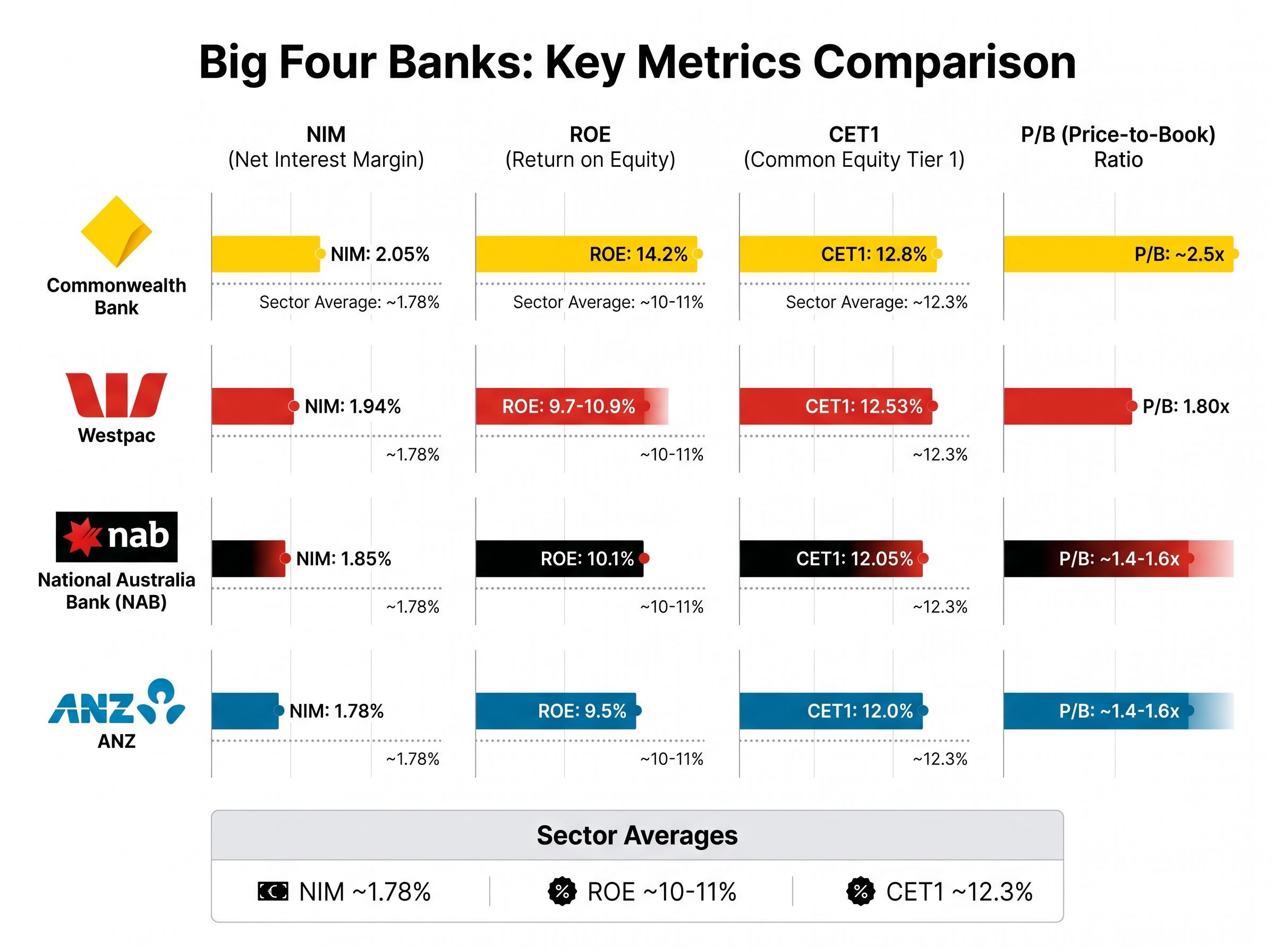
Seeing all four banks through the same lens transforms the individual metrics into a comparative decision tool. The table below consolidates the three metrics covered in this guide alongside the P/B ratio that ties them together.
| Bank | NIM (approx.) | ROE (approx.) | CET1 (approx.) | P/B |
|---|---|---|---|---|
| CBA | 2.05% | 14.2% | 12.8% | ~2.5x |
| Westpac | 1.94% | 9.7-10.9% | 12.53% | 1.80x |
| NAB | 1.85% | 10.1% | 12.05% | ~1.4-1.6x |
| ANZ | 1.78% | 9.5% | 12.0% | ~1.4-1.6x |
| Sector Average | ~1.78% | ~10-11% | ~12.3% | — |
CBA’s P/B premium of approximately 2.5x is justified by its sector-leading ROE of 14.2%, which sits well above its cost of equity. NAB and ANZ trade at more modest multiples with ROEs closer to the cost-of-equity threshold.
NAB’s H1 2026 results offer a concrete illustration of why surface-level price moves can mislead: its underlying profit grew 6.4% yet the share price fell nearly 3% on results day, a reaction that only makes sense when examined through the same NIM, ROE, and CET1 lens applied to Westpac above.
Westpac’s competitive position across each dimension:
- NIM: Above the sector average at 1.94%, though below CBA’s 2.05%.
- ROE: Mid-range at 9.7-10.9%, thin margin above estimated cost of equity.
- CET1: Above the sector average at 12.53%, providing solid capital headroom.
- P/B: At the top of its 10-year historical range at 1.80x, which requires sustained ROE above the cost of equity to remain justified.
No single metric determines which bank is the better investment. The right combination depends on whether an investor prioritises income yield, capital growth, or capital safety.
What the metrics say, and what they cannot tell you
The NIM, ROE, and CET1 framework provides a structured starting point for comparative bank analysis. Westpac sits above the sector average on NIM, in the lower-mid range on ROE, above average on CET1, and at the top of its historical P/B range. Those readings give an investor clear reference points, but they are not a complete investment thesis.
Several factors sit outside this framework:
- Credit quality deterioration: NIM and ROE do not capture what happens to a loan book in a downturn. Rising bad debts can erode profitability faster than margin compression.
- RBA rate sensitivity: The RBA rate environment and fixed-rate loan roll-offs remain live headwinds for sector NIM through 2026, per the RBA Financial Stability Review (March 2026).
- DDM model dependency: Fair value outputs shift materially with small changes to the discount rate, as the $44 versus $36.67 spread demonstrated.
- Franking credit reliance: The grossed-up yield is only economically relevant for investors who can fully utilise franking credits. Tax position changes the valuation.
Westpac’s beta of 0.75 confirms its defensive profile but does not insulate against a sector-wide rerating if credit quality deteriorates across Australian housing markets.
The analyst consensus on ASX bank shares heading into mid-2026 is notably bearish despite the sector’s 8.87% year-to-date gain, with sell ratings concentrated on the names that have outperformed most on price momentum, a pattern that historically precedes periods where valuation fundamentals reassert themselves over sentiment-driven buying.
The practical takeaway is a hybrid approach: DDM for a fair value range, P/B as a cross-check against historical norms, and the ROE-to-cost-of-equity comparison to test whether the current price premium is earned. A framework that acknowledges where it stops is more useful than one that overpromises.
This article is for informational purposes only and should not be considered financial advice. Investors should conduct their own research and consult with financial professionals before making investment decisions. Past performance does not guarantee future results. Financial projections are subject to market conditions and various risk factors.