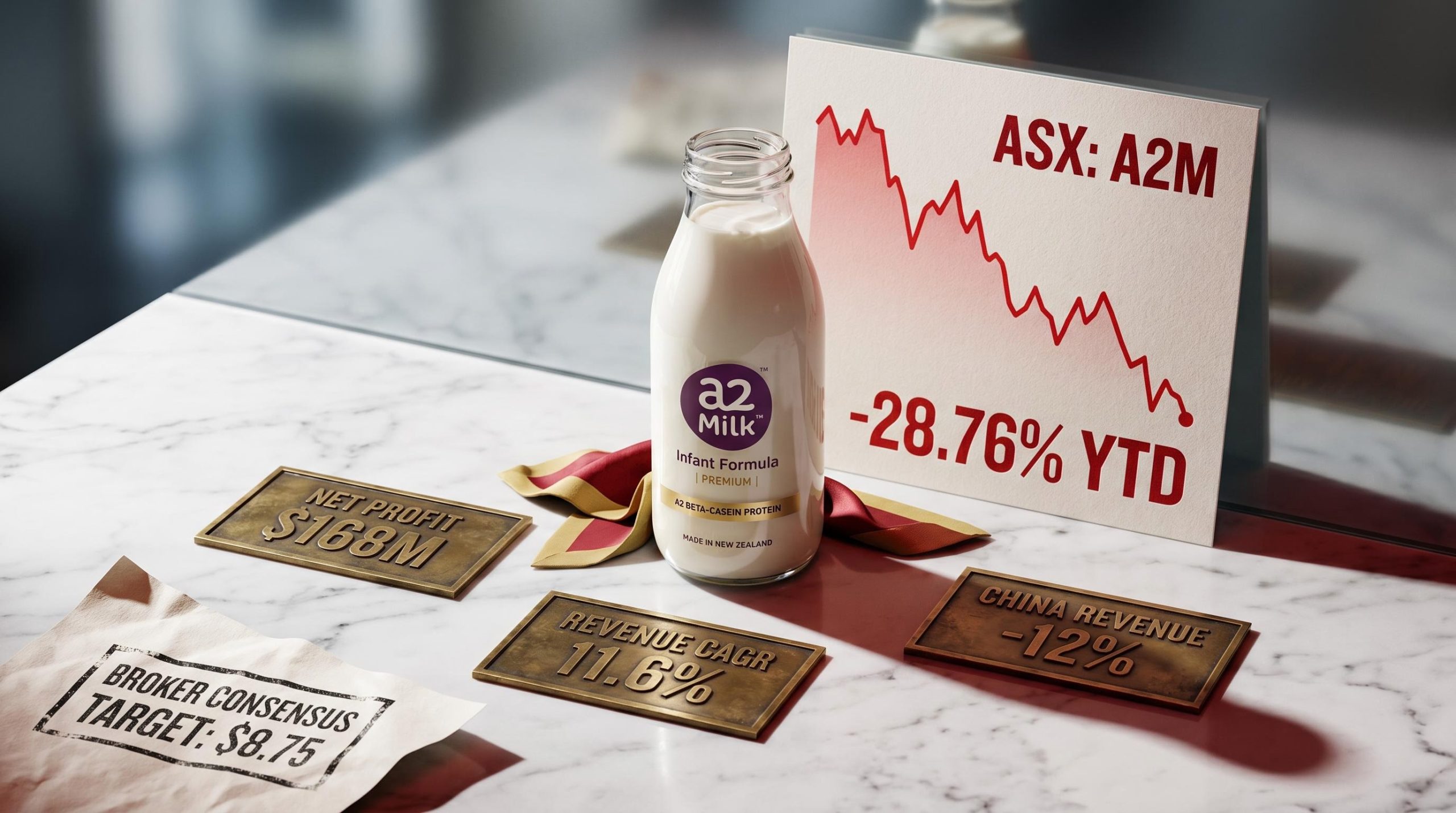
A2 Milk shares have shed nearly 29% since 1 January 2026, yet the company just reported a $168 million net profit and 11.6% compound annual revenue growth over three years. That gap between operational performance and share price behaviour is the puzzle at the centre of any current investment assessment.
Retail investors searching for A2M stock analysis today tend to sit with one of two questions: is this a quality business that has been oversold, or is the market correctly pricing in structural deterioration in China and supply chain risk? Both questions require a firm grip on the financials before reaching a view on valuation. What follows walks through A2 Milk’s business model, its revenue and profit growth record, its balance sheet metrics, the China demand and supply chain pressures driving the selloff, and the distinction between company quality and share price value, giving Australian retail investors a data-driven starting framework.
What A2 Milk actually sells, and why the A2 protein claim matters commercially
A2 Milk markets dairy products containing only the naturally occurring A2 beta-casein protein type, positioning them as easier to digest than conventional A1-containing milk. The company was founded in New Zealand in 2000 and has since built a premium consumer brand anchored in three pillars:
- Branded A2 protein differentiation: a single-protein dairy proposition marketed at a price premium to conventional alternatives
- Asset-light supply model: A2M does not own farms or manufacturing facilities, instead partnering with more than 25 accredited dairy farms across Australia
- Premium infant formula focus: infant formula is the highest-margin product line and the primary driver of the China revenue base
That asset-light structure is the source of both the company’s strong gross margins and its most concentrated risk. Without capital-intensive production assets, returns on invested capital can remain high. Without control over production, a single supplier disruption can ripple through the entire supply chain.
The Synlait dependency and what it means for supply reliability
Synlait Milk, based in New Zealand, manufactures A2M’s powdered infant formula. A2M holds a 9.5% equity stake in Synlait, enough to create financial alignment but not operational control.
That distinction became tangible on 15 January 2026, when a supply disruption announcement sent A2M shares down 12% in a single session. A 10% shortfall in formula powder supply during Q1 2026 forced reliance on costlier alternatives. The stake aligns incentives; it does not guarantee reliability.
When big ASX news breaks, our subscribers know first
Revenue growth and profit trajectory: what the numbers show over three years
A2M’s financial trend over the past three years tells a story of acceleration, and the profit line is where it gets interesting.
| Metric | Three Years Prior | FY25 Result | Three-Year CAGR |
|---|---|---|---|
| Revenue | — | $1,673 million | 11.6% |
| Net Profit | $81 million | $168 million | 27.6% |
| Gross Margin | — | 45.8% | — |
Revenue grew at 11.6% per year. Profit grew at 27.6%. That divergence is the signature of improving operational leverage: the business is converting a larger share of each additional revenue dollar into profit, rather than simply expanding the top line.
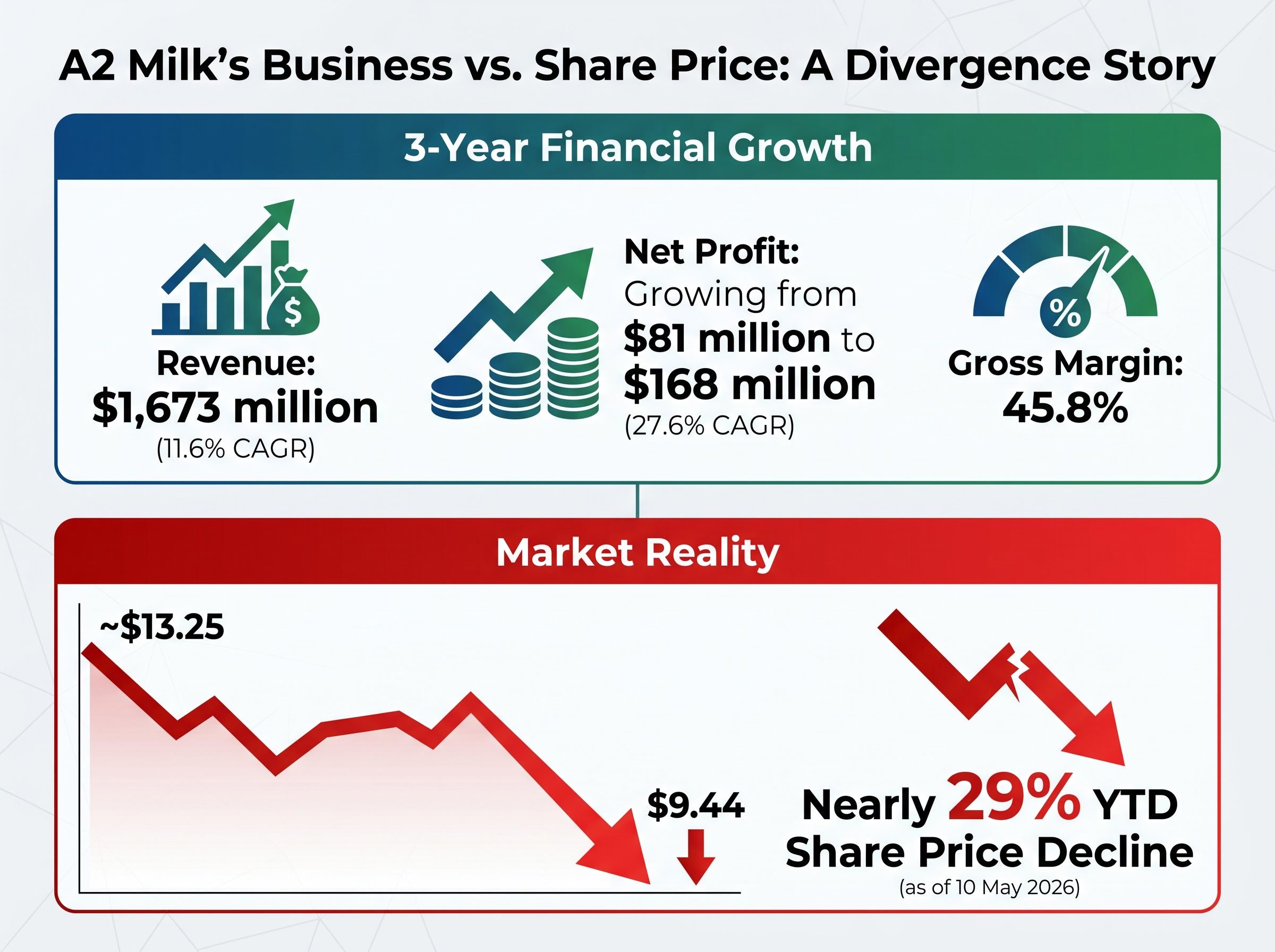
A2M’s net profit has compounded at 27.6% per year over three years, growing from $81 million to $168 million.
Gross margin of 45.8%, which measures how much of each sales dollar remains after direct production costs but before overhead, sits at a level consistent with premium consumer brands. For a retail investor weighing whether the selloff has created an opportunity, this profit acceleration is the foundational data point. Revenue growth alone would not justify the same attention.
Reading the balance sheet: net cash strength sitting alongside a leverage red flag
The headline balance sheet number looks reassuring. Net debt, calculated as total borrowings minus cash on hand, sits at negative $903 million. A negative figure means cash holdings substantially exceed total debt.
- Net debt: negative $903 million. Cash on the balance sheet exceeds total borrowings, indicating the company is not reliant on external debt financing for operations.
- Debt-to-equity ratio: 5.3%. Total debt is a small fraction of shareholder equity, a low-leverage indicator.
- Return on equity (ROE): 12.8%. Net profit divided by shareholder equity, measuring how efficiently the company generates returns from the capital shareholders have contributed.
- Free cash flow: negative $120 million in FY25. The cash the business generated from operations, after capital expenditure, was an outflow rather than an inflow.
The first two metrics paint a conservative picture. The fourth complicates it.
Return on equity and what 12.8% signals about capital efficiency
Return on equity of 12.8% in FY24 is a moderate result. It does not signal exceptional capital efficiency of the kind that commands premium valuations in consumer staples, nor does it indicate underperformance. For investors evaluating whether A2M generates adequate returns on the equity shareholders have contributed, 12.8% suggests the business is productive but not yet extracting the full benefit of its asset-light model.
The negative free cash flow of $120 million is the metric that warrants closer scrutiny. A company can hold substantial cash reserves and still burn through operating cash in a given year. The balance sheet snapshot and the cash flow statement tell different stories, and investors who rely on only one will draw incomplete conclusions.
The China demand picture and why it is the central risk investors are pricing
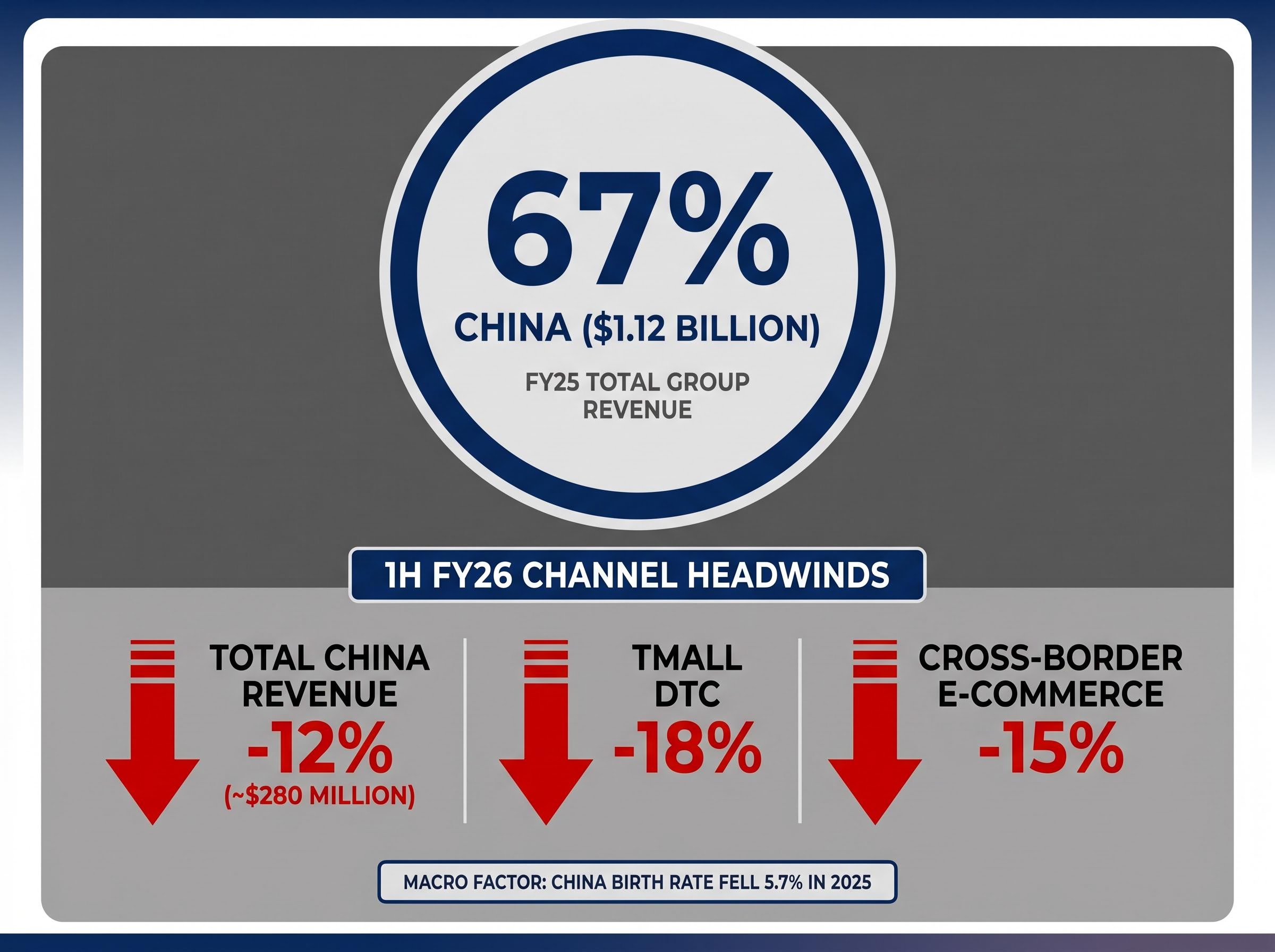
China contributed $1.12 billion in FY25 revenue, representing 67% of total group sales. That single concentration fact shapes almost every other risk in the investment thesis.
China accounts for 67% of A2M’s total group revenue. That single fact shapes almost every other risk in the investment thesis.
The FY25 result grew 8% year on year. The 1H FY26 picture is markedly different.
| Channel | FY25 / Prior Period | 1H FY26 Change |
|---|---|---|
| Total China Revenue | $1.12 billion (67% of group) | Declined 12% to approx. $280 million |
| Tmall DTC | — | Fell 18% |
| Cross-border E-commerce | — | Declined 15% |
| China Contribution (% of Group) | 67% | — |
Three headwinds are converging. China’s birth rate fell 5.7% year on year in 2025, compressing the addressable market for infant formula. Nationalist consumer sentiment is shifting wallet share toward domestic brands. And cross-border e-commerce, a channel A2M has historically relied on to reach Chinese consumers, declined 15% in 1H FY26.
Bubs Australia’s China reset provides a useful peer reference point: after clearing inventory issues in China, Bubs redirected growth capital toward the US market and upgraded FY26 earnings guidance, illustrating one strategic pathway available to ASX-listed infant formula producers facing China headwinds.
China’s birth rate data from the National Bureau of Statistics recorded just 7.92 million registered births in 2025, a 17% decline from the prior year and the fourth consecutive annual population fall, compressing the addressable market for premium foreign infant formula at precisely the moment A2M is attempting a premiumisation push.
Regulatory pressure adds a further layer. China’s State Administration for Market Regulation (SAMR) tightened import rules in December 2025, mandating stricter labelling and origin traceability for foreign infant formula. The result was an approximately three-month delay to A2M’s new product registrations and an estimated $15 million in compliance costs.
Management has responded with a premiumisation push: the A2 Platinum+ formula launched in March 2026 targets a 20% price uplift, and 500 new Mothercare store partnerships in Tier-2 cities were secured in Q4 2025. Management guidance points to 5-10% China growth resumption in H2 FY26. Whether that guidance proves achievable against the structural demographic backdrop remains the open question.
The FY26 guidance downgrade compounds the picture further: A2M cut its revenue growth forecast to low-to-mid double digits and slashed EBITDA margin expectations to 14.0%-14.5%, as five converging supply constraints shifted revenue recognition from FY26 into FY27.
Two separate questions: evaluating business quality and assessing whether the price reflects it
The data above supports two distinct analytical questions that retail investors often conflate:
- Is A2M a quality business? The revenue trend, profit CAGR, gross margins, and cash-rich balance sheet all point to a business with genuine operational strengths.
- Is A2M a good price today? That requires assessing what an investor pays relative to earnings, cash flow, and growth expectations, a separate exercise entirely.
A stock can be a high-quality business and still be overvalued. It can show deteriorating fundamentals and still be cheap. The 28.76% year-to-date decline, from approximately $13.25 to $9.44 as of 10 May 2026, does not by itself create value.
The expectations gap between A2M’s reported $168 million profit and its 29% share price decline is a version of a dynamic that recurs across earnings seasons: markets price outcomes relative to forward expectations, not absolute results, and a profit beat can still represent a miss against what was already embedded in the share price.
The broker consensus picture reinforces that distinction.
| Broker | Rating | Price Target | Date |
|---|---|---|---|
| Morgans | Hold | $8.50 | 28 April 2026 |
| Bell Potter | Sell | $7.80 | 2 May 2026 |
| UBS | Neutral | $9.20 | 20 March 2026 |
| Consensus (7 analysts) | 4 Hold, 2 Sell, 1 Buy | $8.75 | May 2026 |
The consensus average target of $8.75 implies approximately 11% downside from the $9.44 close on 10 May 2026. Bell Potter downgraded to Sell on 2 May, cutting its target to $7.80. UBS upgraded to Neutral from Sell following the FY25 profit beat but warned of near-term China regulatory headwinds. Even after a nearly 29% fall, analyst targets on balance do not suggest the stock is cheap at current levels.
The April 2026 intraday low of $6.96 and the January 2026 peak of $9.97 illustrate the volatility range investors have faced this year.
What the financials tell you, and where the research has to go next
The financial data establishes four findings with reasonable clarity:
- Double-digit revenue growth at an 11.6% three-year CAGR, demonstrating sustained demand for A2M’s product lines
- Accelerating profit growth at a 27.6% three-year CAGR, indicating improving operational leverage
- A premium gross margin of 45.8%, consistent with branded consumer staples positioning
- A net cash balance sheet with a leverage caution, given the negative $120 million free cash flow in FY25
Two questions remain unresolved by the financials alone:
- Is the China channel decline cyclical or structural? A birth rate decline of 5.7%, rising domestic competition, and regulatory tightening could represent a temporary headwind or the beginning of a sustained market share erosion. The data does not yet distinguish between the two.
- Does the current share price adequately reflect the known risks? The broker consensus, with an average target of $8.75 against a $9.44 close, suggests the market has not yet discounted the stock to a level analysts consider attractive, even after a 29% decline. The broader ASX:XST consumer staples index is down 18% year to date, providing additional sector context.
The next research steps for investors building on this framework include reviewing A2M’s H2 FY26 trading update guidance, studying the full-year earnings release when available, and comparing valuation multiples against ASX consumer staples peers to assess relative positioning.
For investors who want to apply this framework to A2M’s upcoming H2 FY26 trading update and full-year earnings release, our comprehensive walkthrough of earnings report analysis covers the six-step method for reading GAAP reconciliation tables, spotting buried guidance cuts, and distinguishing non-GAAP adjustments from genuine operating performance.
This article is for informational purposes only and should not be considered financial advice. Investors should conduct their own research and consult with financial professionals before making investment decisions. Past performance does not guarantee future results. Financial projections are subject to market conditions and various risk factors.