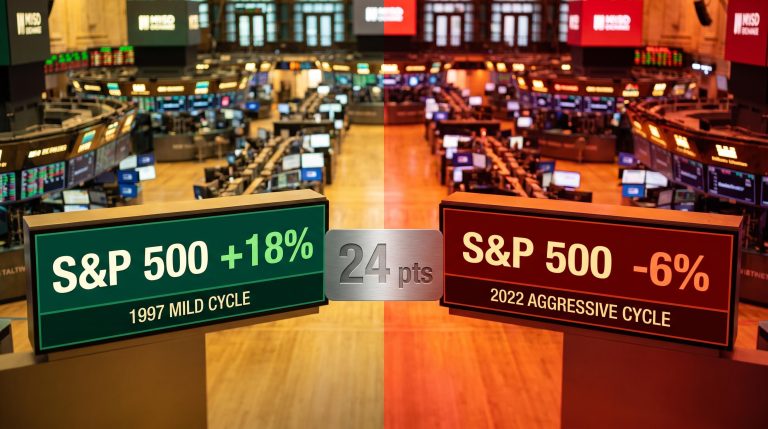
Four Canadian ETF providers launched covered call all-in-one funds targeting U.S. equities around the same period, and on the surface they look nearly interchangeable.
Dig one layer deeper and the differences are meaningful. What each fund owns, how aggressively it writes calls, whether it hedges your currency exposure, and how much leverage it applies vary enough to produce materially different outcomes.
USHI, HHIS, Biggie, and PayU all promise enhanced income from U.S. equity exposure layered with covered calls and modest leverage. But “enhanced income” means different things depending on whether the portfolio tilts toward speculative NASDAQ names or broad S&P 500 balance, whether your distributions arrive in CAD-hedged form or move with the loonie, and whether the call-writing overlay runs conservative or aggressive.
For Canadian investors weighing these funds for an income sleeve, those choices decide the outcome.
This is a decision-support framework, not a product endorsement. The comparison below maps each fund’s structural choices against the others so you can identify which one, or which combination, actually fits your income objectives and your tolerance for risk.
What all four funds share, and why that matters before you compare them
Before the differences matter, the similarities need to register. These four funds are variations on a single architecture, not four distinct investment approaches.
Every one of them combines three ingredients:
Leveraged covered call ETFs carry a portfolio delta of approximately 0.92, meaning they absorb roughly 92% of underlying index moves while the call overlay redirects the remaining participation into premium income; that structural trade-off is what makes the 25-33% leverage in USHI, HHIS, Biggie, and PayU a feature rather than an anomaly.
- A base of U.S. equity holdings
- A covered call overlay that writes options against some portion of those holdings to generate premium income
- Explicit leverage ranging from 25% to 33% of net asset value (NAV)
A covered call is an options contract the fund sells against a stock it already owns. It collects a premium up front in exchange for agreeing to sell the stock at a set price, the strike price, if the buyer chooses to exercise. That premium is where a large share of the distribution income comes from. It is also where the ceiling on growth comes from.
When a call is written, the fund’s maximum gain on that holding is capped. The most it can realise is the strike price plus the premium received plus any dividends paid before the option is exercised. According to Ninepoint’s simplified prospectus for its HighShares range, which covers USHI, that cap is the exact mechanism producing both the enhanced income and the limit on upside. You cannot have one without the other.
All four are classified as complex products under Canadian Securities Administrators (CSA) and Ontario Securities Commission (OSC) frameworks. That classification is not cosmetic. Dealer suitability guidance often restricts these products to clients who already have experience with derivatives and market-linked investments, which tells you who the regulators think they are for.
The structural details that follow show how close together these funds actually sit.
| Fund | Leverage Limit | Calls Written On | Distribution Frequency | Management Fee |
|---|---|---|---|---|
| USHI | Up to 33% of NAV | Up to 50% of NAV | Bi-monthly (twice monthly) | 0.40% |
| HHIS | Up to 25% | Not disclosed | Not disclosed | 0.40% |
| Biggie | Up to 33% | More aggressive than HHIS | Not disclosed | 0.40% |
| PayU | Target ~25% of NAV | Not disclosed | Semi-monthly | ~0.60% |
The distribution numbers reinforce the point. PayU pays a semi-monthly distribution of $0.2000 per unit, implying roughly $4.80 annualised. USHI anticipates a bi-monthly distribution of $0.0625 per share, implying roughly $1.50 annualised. Neither is guaranteed.
Distributions are not fixed Ninepoint states explicitly in its HighShares communications that distributions “may fluctuate” and that there is no assurance the fund will make any distribution in a given period.
Here is what this shared DNA means for you. A major U.S. market drawdown, or a stretch of low volatility that shrinks option premiums, hits all four funds in a similar way. Owning two or three of them does not eliminate that core risk the way spreading capital across genuinely different asset classes would. If you treat holding several of these as diversification, you are carrying more concentrated risk than you think.
When big ASX news breaks, our subscribers know first
How the portfolios actually differ, and why the category label is almost useless
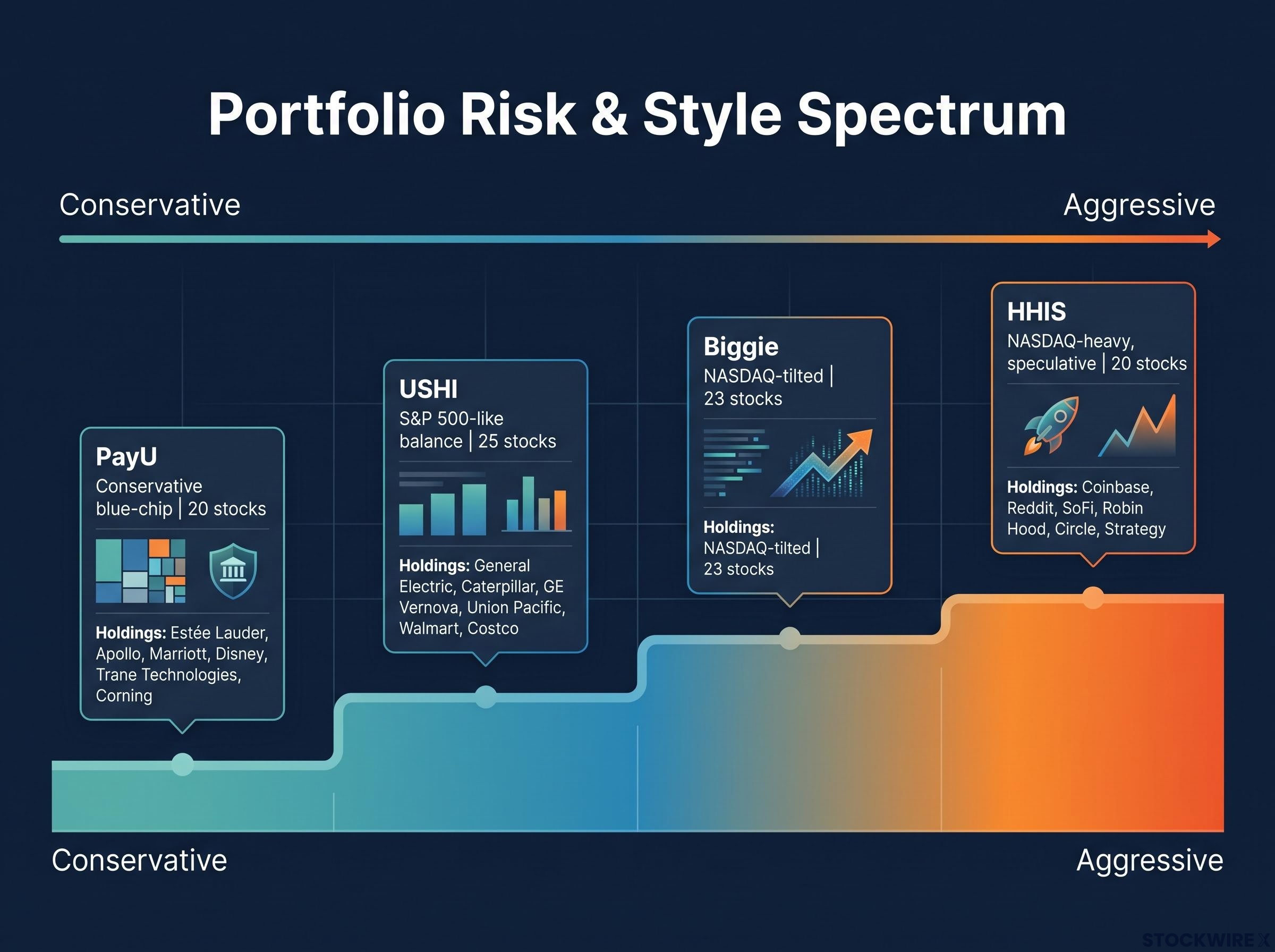
Once you accept the shared machinery, the portfolios are where the real decision lives. Ranked from most conservative to most aggressive, the order runs PayU, then USHI, then Biggie, then HHIS. Portfolio composition, more than leverage or call aggressiveness, is what drives each fund’s place on that spectrum.
| Fund | Portfolio Style | Notable Holdings | Stock Count | Speculative Names |
|---|---|---|---|---|
| PayU | Conservative blue-chip | Estée Lauder, Apollo, Marriott, Disney | 20 | No |
| USHI | S&P 500-like balance | General Electric, Walmart, Goldman Sachs | 25 | No |
| Biggie | NASDAQ-tilted | NASDAQ-oriented, few speculative names | 23 | Low weight / mostly absent |
| HHIS | NASDAQ-heavy, speculative | Coinbase, Reddit, SoFi, Robin Hood | 20 | Yes |
That table is why “U.S. equity covered call ETF” is almost too broad to be useful. The gap between USHI’s industrial and healthcare breadth and HHIS’s crypto-and-fintech tilt is not a rounding difference. It is a different bet entirely.
The conservative camp: USHI and PayU
USHI holds 25 stocks, the highest count of the four, and its sector breakdown closely mirrors a broad S&P 500 allocation. Technology is the largest segment but not dominant. Industrials sit at an estimated 13%, well above HHIS and Biggie, and include General Electric (roughly 5% of the portfolio, around $319B market cap), Caterpillar, GE Vernova, and Union Pacific (yielding around 2%). Consumer staples show up through both Walmart and Costco.
There is no SpaceX, no crypto-adjacent equity, nothing speculative in USHI. It is a broad-market income vehicle wearing a covered call overlay.
PayU is the most conservative of the four, and it does something none of the others do. Its 20 holdings include blue-chip names that appear in no peer fund here: Estée Lauder, Apollo Global Management, Marriott, Walt Disney, Trane Technologies, and Corning. Those give it a genuinely different return-driver profile.
PayU’s industrials weighting is comparable to USHI’s, which makes these two funds more alike than the fee gap suggests. PayU charges roughly 0.60% against USHI’s 0.40%, yet they occupy neighbouring positions on the risk spectrum.
The growth-tilted camp: Biggie and HHIS
HHIS sits at the aggressive end. It is NASDAQ-heavy with a speculative growth tilt, and it holds names entirely absent from USHI:
- Robin Hood
- SoFi
- Circle
- Coinbase
- Strategy
Those higher-volatility names throw off richer option premiums, which supports a higher distribution. The trade-off is that the same call overlay caps the upside on exactly the names most likely to surge.
Biggie is the middle ground. It leans more NASDAQ than USHI but carries the speculative names at much lower weights, or not at all. What distinguishes Biggie from HHIS even where holdings overlap is its more aggressive covered call writing relative to its leverage.
Here is the read for your own objectives. If you want broad U.S. equity income without concentrated bets on crypto-adjacent and fintech disruptors, USHI or PayU fit. If you are deliberately chasing higher premiums from higher-volatility names, and you accept that the overlay also caps the upside on those names, HHIS is the fund doing that work.
Currency hedging and leverage, the structural choices that shape your actual returns
Currency hedging and leverage read like technical footnotes. For a Canadian investor drawing income, they are first-order decisions.
The hedging split is clean. USHI and HHIS are unhedged, so you keep full USD exposure. Biggie and PayU are hedged to the Canadian dollar, which stabilises your CAD distributions but adds hedging costs and tracking differences on top of the frictions the covered call overlay already introduces. Those costs stack. They do not offset each other.
| Fund | Currency Treatment | Leverage Limit | Management Fee | Distribution Frequency |
|---|---|---|---|---|
| USHI | Unhedged (USD retained) | Up to 33% | 0.40% | Bi-monthly |
| HHIS | Unhedged (USD retained) | Up to 25% | 0.40% | Not disclosed |
| Biggie | CAD-hedged | Up to 33% | 0.40% | Not disclosed |
| PayU | CAD-hedged | Target ~25% | ~0.60% | Semi-monthly |
The practical trade-off comes down to which direction the loonie moves:
- CAD weakens against USD. Unhedged holders (USHI, HHIS) benefit, because their USD assets and distributions convert into more Canadian dollars. Hedged holders (Biggie, PayU) miss that lift. During periods of global stress, USD strength can cushion portfolio losses for the unhedged funds.
- CAD strengthens against USD. Unhedged holders see CAD returns reduced even when the underlying U.S. equities perform well. Hedged holders get more stable CAD distributions, which is why hedged products suit investors who budget in Canadian dollars, retirees in particular.
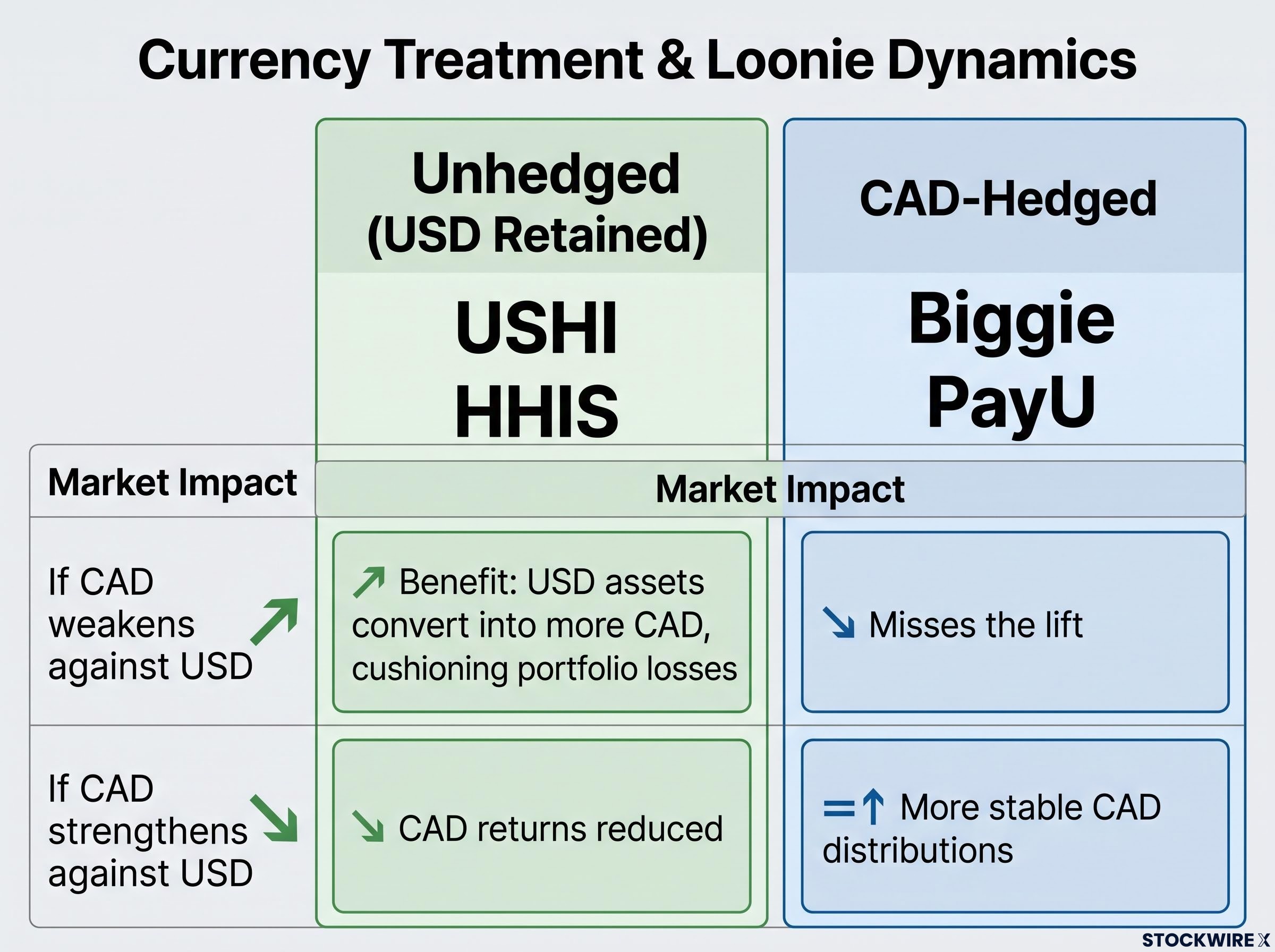
This is not a minor technicality when you are living off the income. A meaningful CAD/USD move can shift the Canadian-dollar value of unhedged distributions by several percentage points in either direction. Against a headline yield in the high teens, that is material.
Leverage compounds the point. Even “modest” leverage of 25% to 33% magnifies both gains and losses. Pair it with a covered call overlay that already caps the upside, and the asymmetry tilts unfavourably. You keep the full downside amplification while the growth that would compensate for it has been sold away.
Embedded leverage in these funds is structurally permanent, not a daily-reset mechanism, which means the compounding volatility drag that punishes short-term holders of 2x and 3x products does not apply in the same way to the 25-33% exposure additions used by USHI, Biggie, HHIS, and PayU.
CSA and OSC suitability guidance requires advisors to confirm that clients understand hedging can help or hurt depending on which way the currency moves. That is regulatory language for a real risk you should weigh before the yield number does your thinking for you.
CSA and CIRO suitability guidance explicitly flags leveraged, options-based, and derivative-linked products as requiring deeper know-your-product and suitability analysis before a dealer can recommend them to a client, which is precisely why these four funds sit in a restricted-access category rather than a general retail shelf.
What these funds are really built for, and whether holding more than one makes sense
Before asking which fund suits you, ask whether you belong in this category at all. These are income tools with a specific purpose, not general-purpose equity holdings.
They are built for a particular investor:
- Suited to: Investors with high risk tolerance, who deliberately prioritise current cash flow over capital growth, and who understand that distributions can fall when volatility declines and that capital losses remain possible even with the income overlay.
- Not suited to: Long-horizon investors primarily seeking capital growth, and investors who may not grasp what makes up the distribution, whether it is option premium, genuine dividend income, or return of capital.
That distinction matters because the covered call overlay imposes a real cost on long-term returns.
The upside cap, in the provider’s own words Ninepoint’s simplified prospectus states that when a call option is written, the fund’s maximum realisable amount on the underlying security is limited to the strike price plus the premium received plus any dividends payable before exercise.
In a strong bull market, systematically selling calls can materially reduce total return relative to a plain equity ETF. Ninepoint acknowledges this directly. Fee-only advisors at PWL Capital have argued consistently that the headline yields on these products may not be sustainable when volatility falls or markets trend sideways, and that caution deserves weight.
Covered call ETF returns over the 2023-2026 period nearly matched their index benchmarks in strong bull conditions while falling materially harder in the 2022 bear market, a historical pattern that puts the upside cap and downside exposure asymmetry in concrete numbers rather than theoretical terms.
Matching each fund to an investor profile
One sentence each, based on the structural picture:
- PayU fits the most conservative income seeker who wants CAD-stable distributions and blue-chip exposure.
- USHI fits the investor wanting broad U.S. sector balance while keeping USD exposure.
- Biggie fits the investor comfortable with a NASDAQ tilt and CAD hedging.
- HHIS fits the investor deliberately chasing maximum income from high-volatility speculative names and accepting the risk that comes with it.
Does combining multiple funds add value?
Combining a hedged and an unhedged fund, say USHI plus PayU, adds a currency dimension. Combining a NASDAQ-tilted and an S&P-broad fund, say HHIS plus USHI, adds a sector dimension. That is real relative diversification within the covered-call universe.
But all four share the same structural ceiling on long-term total return imposed by the call overlay, and a broad U.S. equity drawdown hits every one of them at once. The original comparison characterises USHI as complementary to an existing HHIS-and-Biggie position rather than a replacement, while noting significant overlap across all four.
So if you already hold HHIS and Biggie and are eyeing USHI, the real question is whether USHI’s S&P 500-like breadth and unhedged USD profile add enough differentiation to justify another management fee layer. It is not whether USHI is a better fund in isolation.
Making a deliberate choice in a crowded product category
The right fund is not the one with the highest yield. It is the one whose structure matches your objectives. Three decision variables settle it before you look at a single distribution figure:
- S&P-broad diversification versus NASDAQ-growth tilt. USHI and PayU on one side, HHIS on the other, Biggie in between.
- CAD-hedged income stability versus unhedged USD diversification. PayU and Biggie hedge; USHI and HHIS do not.
- Conservative call writing with broader sector balance versus aggressive call writing on higher-volatility names.
The comparison has real limits worth respecting.
A material information gap Management expense ratios and asset figures are not yet available for most of these funds given their recent launches. USHI began trading 15 September 2026 and PayU was announced 20 July 2026. Full distribution and performance histories do not yet exist. The only fee differentiation available today is PayU at roughly 0.60% against 0.40% for the other three.
That gap means the comparison will sharpen over the next two to four quarters as real distribution records and total expense figures arrive. Committing to a headline yield today carries more uncertainty than the marketing suggests.
These funds are not substitutes for a diversified portfolio. They are income tools with specific trade-offs, best used deliberately by investors who have already resolved the broader asset allocation question.
A satellite income allocation is the structurally correct place for covered call ETFs within a broader portfolio: the core-satellite framework explicitly assigns capped-upside, high-distribution instruments to the satellite sleeve so that the core’s compounding function is not undermined by the call overlay’s ceiling on long-term growth.
This article is for informational purposes only and should not be considered financial advice. Investors should conduct their own research and consult with financial professionals before making investment decisions. Past performance does not guarantee future results, and financial projections are subject to market conditions and various risk factors.