On 17 September 2026, two days after the Senate blocked landmark crypto legislation, the SEC did something Wall Street had been waiting years for: it opened a five-year regulated window for banks and brokers to trade tokenised stocks on blockchain infrastructure.
The pivot came not from a new law but from an administrative order. That distinction matters enormously for anyone trying to understand what just changed and how long it will last.
The failure of the CLARITY Act left the crypto industry without the legislative certainty it wanted. What filled the vacuum was not chaos but a coordinated set of moves from the SEC and CFTC that, together, give mainstream financial institutions enough cover to start building tokenised-asset infrastructure now.
For anyone watching from the sidelines, the moment raises a practical question. What does tokenisation in financial markets actually do to the places where you invest, and is this shift permanent?
Here is what follows: a plain-English breakdown of what tokenisation means in mechanical terms, what the new regulatory framework permits and does not permit, and how durable these changes really are for anyone making long-term financial decisions.
What tokenisation actually does to a financial market
You buy a stock today, and you do not fully own it for two more days. That gap, familiar to anyone who has watched a trade “settle,” is exactly what tokenisation is built to close.
The current standard is T+2 for most U.S. equities, recently pushed to T+1 for some instruments. That “T” stands for the trade date, and the number is how many business days pass before ownership and cash actually change hands. During that window, your capital is in transit and technically at risk between the trade and the transfer.
T+1 settlement became the U.S. equity standard in May 2024, compressing the window during which capital sits exposed between trade execution and ownership transfer, and it is precisely that residual one-day gap that tokenisation’s atomic settlement model is designed to eliminate entirely.
Tokenisation converts ownership of a traditional asset, a stock, bond, or fund share, into a programmable token on a blockchain ledger. A blockchain ledger is simply a shared digital record that multiple parties can update and trust without a central reconciler. The record of who owns what becomes digital and transferable in real time.
The mechanical breakthrough is something called atomic settlement. Both the asset token and the payment token transfer at the same instant on the same ledger, so the delivery of the asset only completes when payment locks, and vice versa.
Why T+0 becomes possible Atomic settlement means the asset and the payment move together, enforced by code, on one shared ledger. There is no multi-day reconciliation between separate custodians and clearing systems, which is what collapses the settlement cycle from T+2 toward T+0, or same-moment settlement.
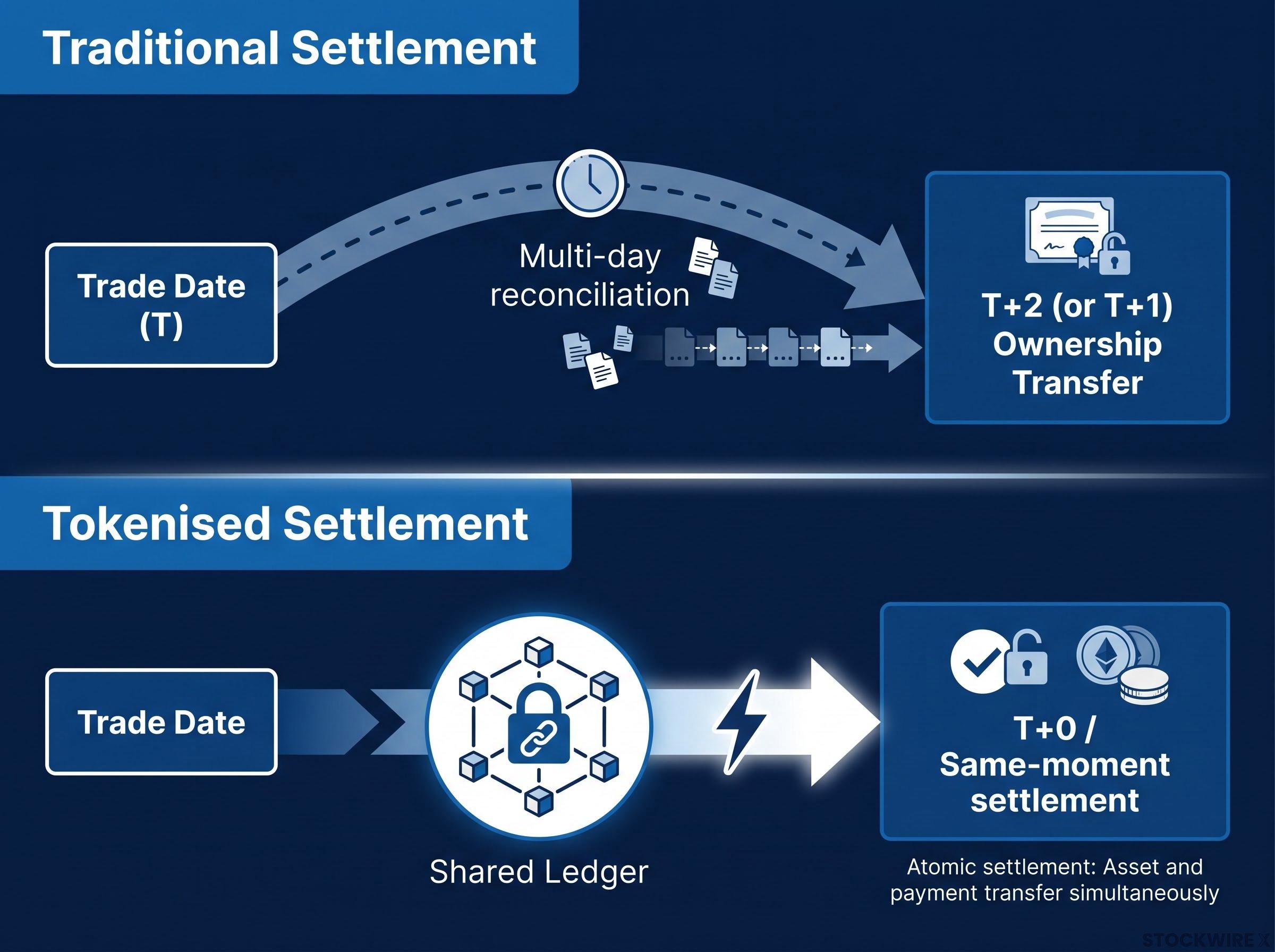
For you, this is not just a back-office efficiency. It is a direct reduction in how long your money sits exposed between hitting “buy” and actually owning the asset.
From crypto native to Wall Street mainstream
These three capabilities are what tokenisation introduces to traditional finance:
- Fractional ownership: a token can represent any fraction of an underlying asset, so a single high-priced share can be split among many investors.
- Atomic settlement: asset and payment transfer simultaneously, enabling near-instant, same-day settlement.
- Programmable compliance: rules such as eligibility and access checks can be written directly into the token.
None of this is theoretical. Cryptocurrency markets have run with near-instant settlement natively for roughly a decade, which is the proof of concept the whole idea rests on. The open question was always whether those features could be brought inside regulated equity markets.
Institutional pilots since 2024 have shown the answer is a hybrid model. BlackRock launched its tokenised U.S. dollar-yield fund, commonly referenced as BUIDL, in 2024, with fund shares issued as blockchain tokens backed by traditional short-term assets. JPMorgan’s Onyx Tokenized Collateral Network and Franklin Templeton’s on-chain money-market fund followed the same template: on-chain settlement mechanics layered over conventional custody and legal structures. The blockchain modernises the plumbing; the legal ownership stays where it always was.
When big ASX news breaks, our subscribers know first
The regulatory architecture that just opened the door
What looks like a workaround is actually a designed experiment with visible parameters. Read the two agency actions together and the deliberate logic becomes clear.
The centrepiece is the SEC’s 17 September 2026 Innovation Exemption. It is a five-year conditional order that releases designated Tokenized Securities Venues from the standard definition of “exchange” under the Securities Exchange Act of 1934, letting them operate permissioned automated market makers for tokenised National Market System (NMS) stocks. An automated market maker is software that prices and matches trades automatically from a pooled reserve of assets, rather than through a traditional order book.
Liquidity providers inside these venues get parallel relief from dealer registration requirements for the same five-year period. Crucially, issuers keep the right to object before tokenised versions of their stocks are listed, so a company cannot have a blockchain version of its shares forced into existence.
Alongside the SEC order, the CFTC issued no-action relief for passive software providers. That is the complementary piece: it gives infrastructure and fintech firms room to build the technical layer, providing code and interfaces, without automatically becoming registrants.
The CFTC’s stated approach CFTC Chairman Michael Selig pledged to deliver crypto rules under existing statutory authority rather than waiting for Congress to legislate.
The table below sets the two actions side by side.
| Feature | SEC Innovation Exemption | CFTC No-Action Relief |
|---|---|---|
| Agency | Securities and Exchange Commission | Commodity Futures Trading Commission |
| Target beneficiary | Tokenized Securities Venues and their liquidity providers | Passive software and interface providers |
| Activity permitted | Trading tokenised NMS stocks via permissioned AMMs | Building code and interfaces for tokenised markets |
| Duration | Five years from Federal Register publication | Not fully specified in public excerpts |
| Key condition | Issuer objection rights; permissioned venues only | Applies to passive providers, not active registrants |
Timing tells the story. The SEC acted just two days after the CLARITY Act’s cloture vote failed 49-50 on 15 September 2026, falling 11 votes short of the 60 required. With no law arriving, the regulators used the tools they already had.
The CLARITY Act’s cloture vote on 15 September 2026 failed 49-50, eleven votes short of the threshold required to advance the bill, and the immediate market reaction — Bitcoin falling roughly 4% and Coinbase dropping more than 10% in a single session — captured how directly the regulatory vacuum affects listed crypto equities.
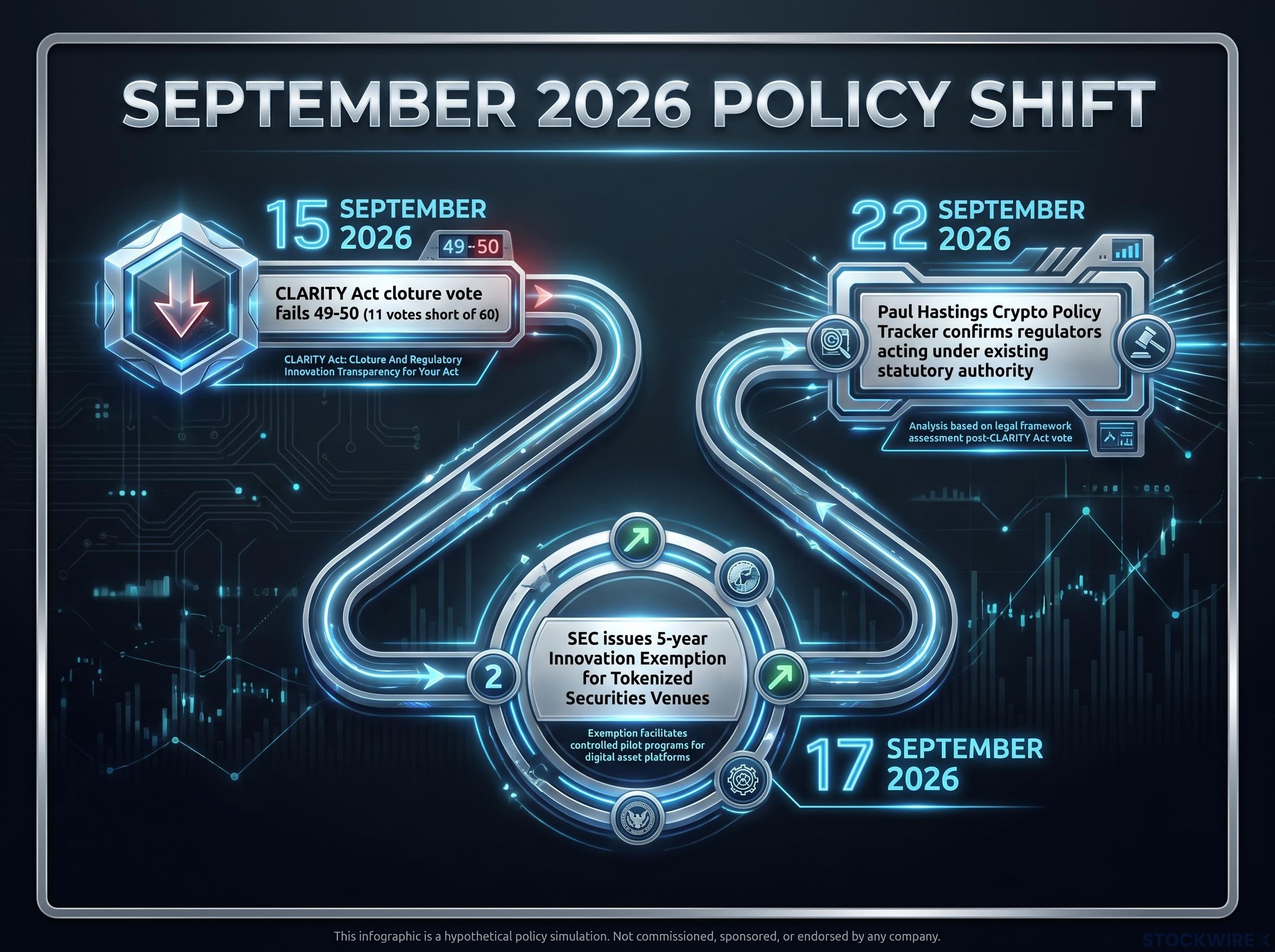
The exemption expires five years from Federal Register publication, and the order builds in a public comment process for modifications. Note what this framework does not do: it confines tokenised-stock trading to permissioned venues and AMM liquidity pools, not open or permissionless trading of regulated equities.
For you, the read is straightforward. This is not a permanent green light but a structured experiment, and every institution building on it is doing so on a clock they can see.
How durable is this shift, and what could reverse it
The framework is real. Its foundation is not solid.
Here is the core legal distinction. The SEC’s exemptive order rests on the current commission’s interpretation of its existing Exchange Act authority, which means a future commission can revise or rescind it without any act of Congress. Legislation like the CLARITY Act would have provided a statutory floor beneath the whole regime. An administrative order does not.
Administrative orders are the operative tool across multiple areas of the current regulatory agenda: when Congress stalls, agencies act under existing statutory authority, and the durability of that approach depends entirely on whether a future commission or court accepts the same interpretation of those powers.
That leaves any institution relying on this framework with three concrete exposure points:
- A known sunset date: the exemption expires in five years, creating a fixed point after which today’s operating assumptions may no longer hold.
- Regulatory philosophy risk: exemptive relief and no-action letters are vulnerable to shifting priorities whenever commission chairs or majorities change, and to court challenges that can narrow the interpretation.
- No statutory backstop: with the CLARITY Act stalled, there is no legislative floor. If an agency reverses course, tokenised venues and service providers can be upended quickly.
For any investor or institution watching this space, the durability question is the one that decides everything. It determines whether tokenisation becomes permanent infrastructure or stays a time-boxed experiment, and the honest answer right now depends on which party controls the SEC and whether Congress comes back to the issue.
Where the CLARITY Act stands now
The bill is stalled, not formally dead. A motion to reconsider was entered, and Senator Thom Tillis cast a strategic “no” vote specifically to preserve the procedural right to reintroduce the legislation later.
Two disputes sank the cloture vote on 15 September 2026: ethics concerns tied to Trump administration crypto ventures, and disagreement over whether stablecoins should be allowed to pay yield to holders. As the ABA Banking Journal put it, the Senate vote “leaves the fate of the bill uncertain in the current Congress.”
The ABA Banking Journal coverage of the CLARITY Act vote documents both the 49-50 cloture result and the two substantive disputes that sank it: unresolved ethics language tied to Trump administration crypto ventures, and disagreement over whether stablecoins should be permitted to pay yield to holders.
Reintroduction before 2027 is considered unlikely. According to the Paul Hastings Crypto Policy Tracker dated 22 September 2026, the working model going forward is regulators acting under existing statutory authority, which means the five-year SEC exemption is the operative framework for the foreseeable future.
Who benefits, who is exposed, and what remains unresolved
The same framework that hands large incumbents a regulated runway also concentrates regulatory risk and quietly favours whoever can afford the compliance to navigate conditional exemptions. That tension runs through the entire stakeholder map.
The clearest beneficiaries are large broker-dealers and exchanges. They already own the compliance infrastructure to operate inside permissioned AMM structures and conditional SEC exemptions, and they gain the ability to offer new products like fractionally tokenised blue-chip stocks within a familiar regulated perimeter. Fintech and infrastructure providers benefit too, since the CFTC’s no-action relief gives them clarity to build without triggering registration.
The issuer-consent provision is the mechanism most commonly underestimated in early coverage of the exemption: every company that objects to having a tokenised version of its stock listed shrinks the addressable market for Tokenized Securities Venues, and commercial disputes like the AMC Entertainment case show this constraint is already live.
| Stakeholder group | Current regulatory position | Primary benefit | Primary risk or concern |
|---|---|---|---|
| Large broker-dealers and exchanges | Covered by SEC exemption; compliance-ready | Regulated runway to launch tokenised products | Five-year sunset; reliance on provisional relief |
| Fintech and infrastructure providers | Covered by CFTC no-action relief for passive software | Clarity to build technical rails without registration | Undefined scope and duration of relief |
| Crypto-native firms and smaller fintechs | Outside permissioned venue structure | Potential future bridge into regulated assets | Incumbents may entrench gatekeeping advantage |
The existing pilots show why the resourced players move first. JPMorgan’s Onyx Tokenized Collateral Network tokenised BlackRock money-market fund shares as collateral in a repo-style transaction, with legal title and custody staying with traditional providers. Franklin Templeton’s on-chain money-market fund records investor positions on a public blockchain while portfolio management and custody remain inside the regulated fund complex.
Market-structure experts and clearing firms flag four unresolved operational risks, each carrying roughly equal weight:
- Custody and legal title: if on-chain and off-chain records disagree, which one is legally controlling in a dispute, and how do bankruptcy and asset segregation work.
- Counterparty and credit risk: atomic settlement does not remove exposure to stablecoin issuers and smart-contract counterparties, and the underlying credit risk can propagate fast on a real-time ledger.
- Central counterparty role: clearinghouses like the DTCC provide netting and default management, and experts argue on-chain settlement does not eliminate the need for a central body to mutualise losses.
- Cyber and operational resilience: concentrating settlement into smart-contract code means bugs or attacks can have immediate, wide-ranging effects.
Skeptics make a pointed argument. Without legislative mandates, they say, tokenisation may mostly modernise incumbents’ infrastructure while preserving their gatekeeping role, rather than changing who holds market power.
Analyst commentary, not confirmed policy Brett Rentmeester of Windrock Wealth Management characterises near-23-hour daily trading windows as directionally imminent for major exchanges. No formal regulatory approvals or exchange announcements confirmed this as of late September 2026, so treat it as an outlook rather than fact.
The takeaway for you is that this framework opens a regulated lane for the most resourced participants first. Whether it eventually widens to give retail investors broader access depends on whether the legal and systemic risk questions get answered within the next five years. Voices such as Larry Fink of BlackRock and Vlad Tenev have endorsed the long-term trajectory toward blockchain-based financial infrastructure, but endorsement is not resolution.
Five years to prove the model, or go back to Congress
Strip away the detail and the SEC’s five-year window is the real decision point. Regulators have created conditional space for tokenised-stock trading to operate and evolve, with a public comment process as the ongoing mechanism for revision. The outcome of that experiment is what determines whether permanent legislation ever becomes politically viable.
Three variables will shape how it lands:
- Legal and systemic risk resolution: whether custody, counterparty, and central counterparty questions get satisfactory answers within the exemptive period.
- Legislative revival: whether the CLARITY Act or a successor is reintroduced and passes in the next Congress.
- Political coalition conditions: whether the questions around the Trump administration’s crypto involvement ease enough to rebuild the bipartisan support the bill held in the House roughly a year before the September vote.
The proof-of-concept layer is already in place. BlackRock BUIDL, JPMorgan Onyx, Franklin Templeton, and WisdomTree have shown the hybrid model works. What agency guidance cannot provide, as both the ABA Banking Journal and Paul Hastings stress, is investment-grade certainty. That still requires legislation.
For you, the practical near-term reality is this. Tokenised financial products, fractional stock tokens, on-chain fund shares, and tokenised collateral instruments, will become steadily more available through mainstream institutions over the next two to five years.
The right question is not whether tokenisation is coming to U.S. markets. It is. The unresolved question is how permanent the regulatory foundation will be when a tokenised product lands in front of you, and that answer is genuinely still open.
This article is for informational purposes only and should not be considered financial advice. Investors should conduct their own research and consult with financial professionals before making investment decisions. These statements are speculative and subject to change based on market and regulatory developments.