For years, the SEC’s default position on anything touching crypto was containment. Enforcement actions, rejected applications, and pointed warnings about investor risk defined the relationship. Then on 17 September 2026, Chair Paul Atkins described a new framework for SEC tokenized stocks as a move to bring U.S. capital markets “into the digital age.” The reversal in posture is the story before any of the details are.
That framework, the Innovation Exemption, is not a permanent rule change. It is a five-year, conditional trial with a public comment process built in, and it has already moved money. Crypto-adjacent names including Circle (CRCL) and Robinhood (HOOD) saw immediate attention, and the same announcement has surfaced a live public fight over whether a company can stop its own stock from being tokenized.
Here is what the regulatory structure actually permits, how specific stocks are positioned in response to it, and the unresolved tension that will determine whether this framework widens or narrows over its five-year window. The aim is to leave you with the tools to evaluate the opportunity, not just a recap of the headline.
What the SEC actually approved on 17 September, and what it did not
The headline read as a clean approval of tokenized stocks. The order itself is narrower, more conditional, and time-limited in ways that change how durable the catalyst really is.
The SEC issued two paired, conditional exemptions. The first lets qualifying Tokenized Securities Venues (TSVs), the specialised platforms where these tokens trade, list and trade tokenized versions of National Market System stocks without being regulated as a full exchange under the Securities Exchange Act of 1934. The second gives certain liquidity providers relief from dealer registration requirements.
According to Reuters, this grants platforms trading tokenized stocks five years of relief from many of the rules that bind Nasdaq and the NYSE. Axios described the order as “a pair of five-year, conditional exemptions.” The word conditional matters as much as the word approval.
“This is a significant step to bring U.S. capital markets into the digital age,” said Paul Atkins, SEC Chair.
The permitted infrastructure includes permissioned automated market makers and liquidity pools, the on-chain plumbing that matches buyers and sellers. But the exemptions come with strings. TSVs must meet a set of conditions before and during operation:
- Public notice before listing a tokenized version of any stock
- Regularly published USD-denominated transaction data, including price, size, and volume
- Books and records obligations
- Technology safeguards
- Trading-halt coordination with other markets
Then there is the limitation that reshapes the entire opportunity: TSVs are barred from listing a tokenized version of a stock if the issuer objects. The company gets a veto.
The Innovation Exemption conditions for TSVs include volume limits, auditable smart contract requirements, and a formal issuer objection process, a set of operational constraints that make the exemption substantially more conditional than the headline approval language suggests.
That single provision tells you the tokenized market for individual equities will not be universal or automatic. It will depend partly on corporate willingness to participate, a variable you cannot price from the regulatory text alone. A framework with a built-in issuer veto and a five-year sunset carries very different staying power than a permanent rule change would.
For context, this was not the SEC’s first tokenization move of the year. In March 2026, it approved a Nasdaq proposal for tokenized settlement of mainstream equities. The two actions sit at different layers of the market.
The Innovation Exemption arrived just two days after the Senate blocked the most consequential crypto market-structure legislation in American history, a sequencing that reveals how the SEC moved to establish its own regulatory footprint precisely when Congress failed to provide one.
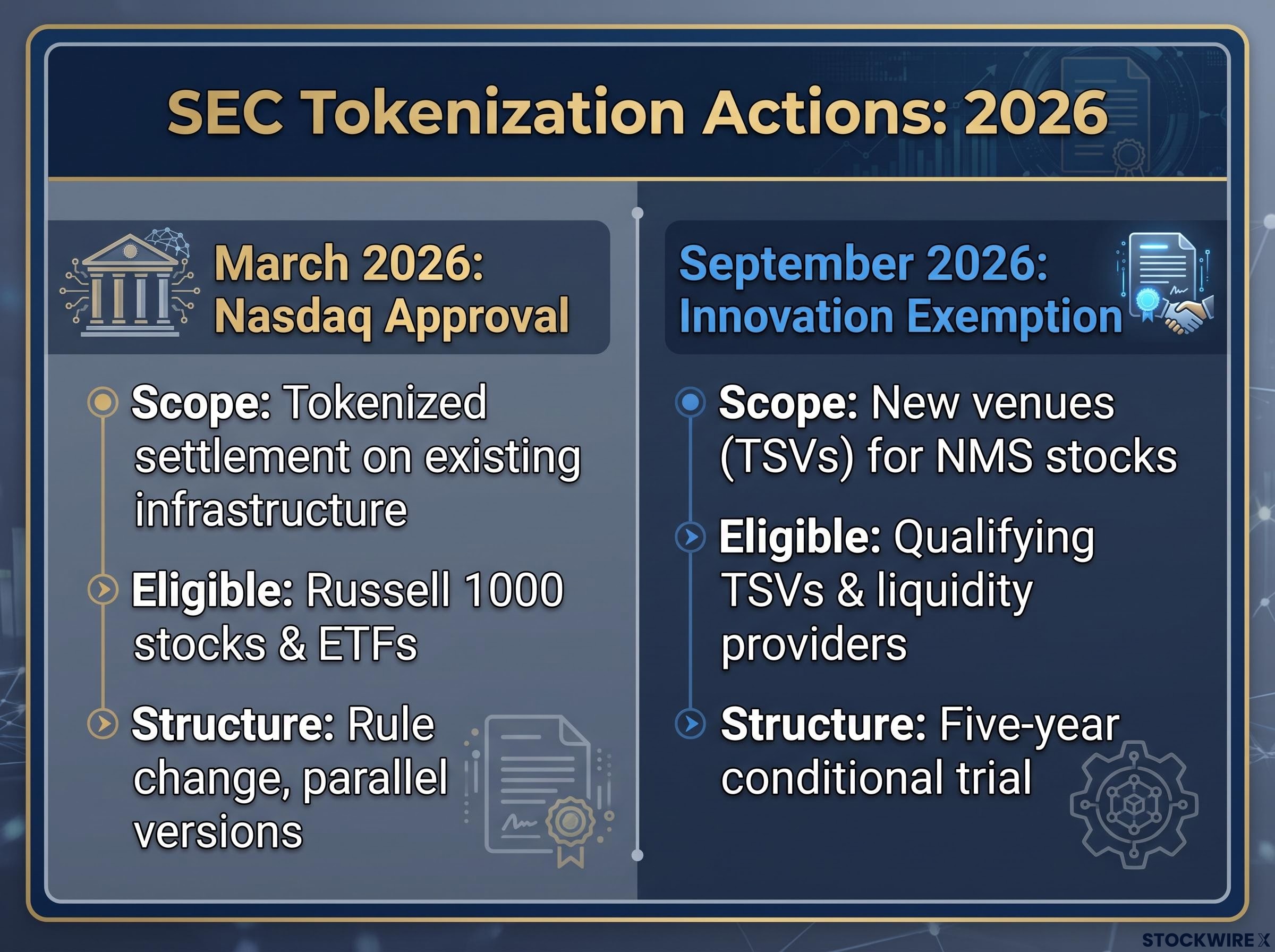
| Feature | Nasdaq approval (March 2026) | Innovation Exemption (September 2026) |
|---|---|---|
| Scope | Tokenized settlement on existing infrastructure | New venues (TSVs) trading tokenized NMS stocks |
| Eligible securities/venues | Russell 1000 stocks and major index-tracking ETFs | Qualifying TSVs and liquidity providers |
| Structure/duration | Rule change, parallel token and book-entry versions | Five-year conditional trial with public comment |
When big ASX news breaks, our subscribers know first
How tokenized stocks actually work, and why the mechanics matter for investors
Picture holding a tokenized stock. To you, it behaves like a digital token in a wallet. Underneath, the SEC framework insists it must behave like the real thing.
That is the first mechanical fact worth internalising. The order explicitly states that tokenized stocks permitted under the exemption are not derivatives. They must carry the same rights and privileges as the underlying shares, including dividends and voting rights.
From there, three structural advantages unfold. Settlement happens on-chain and instantly, replacing the conventional T+2 cycle where trades take two days to finalise. Trading runs 24/7 rather than inside fixed market hours. And fractional ownership becomes automatic, letting you hold a slice of a share rather than a whole one.
Tokenized repo markets extend the same on-chain settlement logic into short-term debt, where Deutsche Bank projects a $250 billion drain of precautionary reserves from the Federal Reserve as intraday finality eliminates the capital buffers repo participants currently hold against settlement delays.
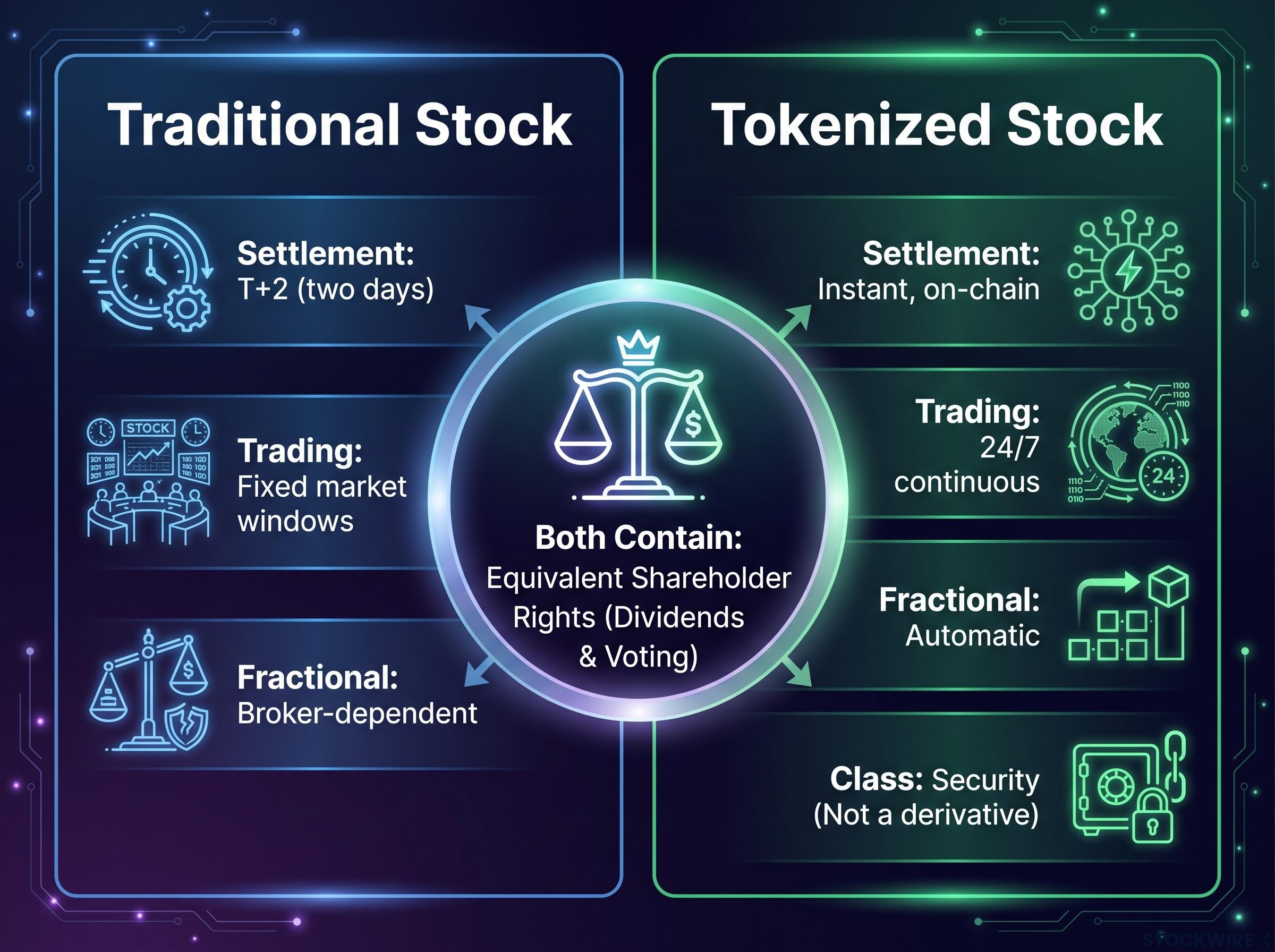
| Feature | Traditional stock | Tokenized stock (SEC framework) |
|---|---|---|
| Settlement cycle | T+2 (two days) | Instant, on-chain |
| Trading hours | Fixed market windows | 24/7 continuous |
| Fractional ownership | Broker-dependent | Automatic |
| Shareholder rights | Full (dividends, voting) | Equivalent (dividends, voting) |
| Regulatory classification | Security | Security, not a derivative |
The rights-equivalence requirement is the whole game. It is what separates this regulatory structure from the unregulated tokenized equity experiments that came before it. If you hold a tokenized version of a stock under this framework, you have the same legal standing as a conventional shareholder, not a new and murkier class of exposure.
Robinhood’s tokenized model in practice
Robinhood offers the clearest working example of how a broker builds this. According to CNBC and Benzinga coverage, its stock tokens are issued by a separate entity and backed by underlying shares held by an intermediary. The token is a claim; the real shares sit behind it.
This model has been applied across a surprising range. Robinhood has offered tokens tied to publicly listed AMC Entertainment shares, and earlier tokens tied to private-company equity in OpenAI and SpaceX, extending access to shares ordinary investors normally cannot touch.
Notably, this predates the exemption. In a CNBC interview on 8 July 2025, CEO Vlad Tenev defended the private-company tokens against structural concerns, stressing they were backed by real shares. The model was already operational more than a year before formal regulatory clarity arrived, which tells you the September order legitimised existing practice as much as it invented new possibility.
Circle, Robinhood, and the equity trade following the exemption announcement
The announcement produced immediate, tradeable volatility. What it has not yet proved is whether that volatility marks a one-session repricing or the start of a sustained re-rating.
The clearest single data point comes from a Circle options position. According to day trader Nick Valdez and collaborator Drew, working in a live day trading room, a call option opened near the session low returned about 180% the same day.
Circle options outcome: approximately 180% same-day gain, from roughly $100 of initial capital, on a contract with about 30 days to expiration.
Treat that as evidence of intraday volatility magnitude, not as a representative return on Circle exposure generally. It captures how sharply the news moved short-dated contracts, nothing more.
The same analysis flagged Circle resistance near $98, where a descending trend line sits, with the round-number $100 level just above it. Those are the near-term zones a trader would watch for a decisive break or rejection.
Robinhood offered a different setup. Valdez identified a bull flag, a continuation pattern where price consolidates in a tight downward channel after a sharp rise before, in theory, resuming higher. The measured target came in near $127.
The analyst disagreement on Robinhood spans $106 per share across 20-28 analysts, a spread that maps almost exactly onto the stock’s 2025 realised price range and reflects three compounding uncertainties: the future crypto regulatory regime, the pace of revenue diversification, and the durability of its position with younger investors.
| Metric | Circle (CRCL) | Robinhood (HOOD) |
|---|---|---|
| Key catalyst | SEC tokenization exemption | Exemption plus Tenev CNBC appearance |
| Key level | Resistance ~$98 / $100 | Target ~$127 |
| Pattern / outcome | Options ~180% same-day gain | Bull flag continuation |
| Timeframe | ~30-day option | ~7 days from analysis |
| Key risk variable | Rejection at descending trend line | Failure to hold above resistance |
The bull flag rests on an ascending trend line originating 5 September 2026, which has provided support repeatedly. The complication is that price has failed to sustain closes above key resistance, pulling back after each attempt. A clean pattern still needs a buyer.
That is where the catalyst layer matters to you. Tenev was scheduled for a CNBC appearance on the evening of 17 September 2026 to discuss tokenization and the SEC’s stance. If that drives retail attention into sustained buying above resistance, the flag resolves upward. If he delivers a disappointing message, the same attention could accelerate a reversal.
The issuer-consent fault line, and why it will shape the framework’s five-year arc
The most instructive part of this whole story is not a price chart. It is a public disagreement between two chief executives, because it exposes the structural tension buried inside the SEC’s order.
AMC Entertainment CEO Adam Aron publicly objected to tokenized AMC shares. In a CNBC appearance on 9 September 2026, Tenev pushed back, and the exchange became a proxy for a genuine legal question: how far does an issuer’s control extend once its stock trades publicly and someone else builds a product on top of it?
Tenev’s framing was that a tokenized share is a “neutral wrapper” built on stock that already trades freely.
“Once a company’s stock is public, firms should generally be free to create products referencing those shares,” is the essence of Tenev’s position, with the qualifier that what requires issuer consent depends on “what exactly you’re doing.”
The SEC framework leans the other way. TSVs must give public notice before listing a tokenized version of a stock, and they are barred from listing at all if the issuer objects. Under the current trial rules, Aron’s objection is legally enforceable and Tenev’s philosophical argument is not.
Both positions are defensible. Tenev’s captures a real principle about secondary products on public securities. The SEC’s protects issuers worried about brand, volatility, or regulatory exposure. The trial framework has, for now, sided with the issuer.
What this means for anyone holding tokenized-infrastructure equities is concrete. The issuer veto caps the total addressable market for TSVs at equities whose issuers are either supportive or passive. Every company that resists shrinks the pool.
The reason this is not a settled question is the order’s own design. It includes a public comment process about possible modifications, an explicit signal that the current conditions are not final. Over five years, three variables will move:
- SEC public comment outcomes and any resulting framework modifications
- The evolution of issuer-consent legal norms as more disputes surface
- Operational or technology failures at TSV platforms
Any one of those could widen the framework or tighten it. Investors treating the September order as a finished green light are pricing certainty the order does not contain.
What this framework changes, and what remains unresolved
Hold two truths at once here. The framework changes something real, and it leaves something equally real unresolved. Collapsing either into pure optimism or pure scepticism gets you the wrong position size.
What it definitively changes: the September order creates legal infrastructure for tokenized U.S. equities that did not exist before. It positions brokers to compete on 24/7 trading, instant settlement, and fractional ownership. And it signals the SEC’s willingness to experiment at scale rather than default to enforcement.
The Innovation Exemption sits inside a broader legislative push to onshore dollar liquidity: the stablecoin regulatory architecture created by the GENIUS Act mandates that issuers hold short-duration US Treasuries against every circulating token, creating a structural bid for government debt that runs parallel to the tokenized equity experiment.
| What the framework resolves | What remains unresolved |
|---|---|
| Market hours: 24/7 permitted | Regulatory permanence: five-year sunset |
| Settlement: instant, on-chain | Issuer participation: veto in place |
| Shareholder rights: equivalence required | Compliance burden: heavy on brokers |
The compliance side deserves weight. Brokers offering tokenized products must preserve dividends, voting, and corporate actions on-chain, meet real-time reporting obligations, and manage blockchain infrastructure directly. That is a materially heavier operating model than conventional brokerage.
Tenev has framed tokenization as a way to “distribute access to U.S. stocks globally,” pointing to a business-model expansion beyond traditional brokerage. Whether that ambition converts into durable revenue is precisely what the five-year window will test.
Three variables should sit at the top of your watchlist, in priority order:
- SEC revision risk, since public comment could tighten conditions as easily as expand them
- Issuer-consent legal evolution, which sets the ceiling on the addressable market
- TSV operational and technology risk, where a single failure could reset regulatory tolerance
For anyone weighing a medium-term position in tokenized-infrastructure names like Robinhood or Circle, the honest read is that the regulatory green light is real but the business-model validation is still being written. That makes position sizing and timeline calibration more important than directional conviction.
This article is for informational purposes only and should not be considered financial advice. Investors should conduct their own research and consult with financial professionals before making investment decisions. Past performance does not guarantee future results. Financial projections are subject to market conditions and various risk factors, and forward-looking statements are speculative and subject to change based on market and regulatory developments.