For about four decades, cancer researchers called KRAS “undruggable.” In 2026, a Phase 3 pancreatic cancer trial reported that a drug aimed squarely at it roughly doubled overall survival compared with chemotherapy.
That result settles one argument and opens another. The hard question is no longer whether KRAS can be hit. It is what happens after it is hit, and why tumours so often find a way back. That problem is called KRAS resistance, and it now shapes where pancreatic and lung cancer research is heading.
If you read the 16 June 2026 StockWire X piece on how pancreatic cancer trials are driving ASX biotech valuations, this is the biology that article took for granted. It covers the science beneath the headlines and share price moves.
Here you get a working framework for three things: why resistance follows almost every targeted therapy, how combination treatments are meant to counter it, and what the strongest clinical evidence so far does and does not show.
How daraxonrasib turned KRAS from a dead end into a target
KRAS is one of the most commonly mutated cancer-driving genes, and it is mutated in the large majority of pancreatic cancers. A cancer-driving gene is one whose faulty version pushes cells to grow and divide without normal controls. For decades, though, no drug could grip the KRAS protein, because it lacked an obvious binding pocket where a drug molecule could attach.
The wall came down in stages. The first KRAS G12C inhibitors reached lung cancer patients earlier this decade, targeting one specific version of the mutation. Newer approaches then widened the range of KRAS variants that drugs could reach.
Revolution Medicines’ daraxonrasib belongs to that broader wave. It is a RAS(ON) inhibitor, meaning it targets the active, switched-on form of RAS proteins rather than a single variant such as G12C. In the RASolute 302 Phase 3 trial in previously treated metastatic pancreatic cancer, it delivered the field’s landmark result.
Overall survival, RAS G12 population (primary endpoint) Median overall survival was 13.2 months with daraxonrasib versus 6.6 months with physician’s-choice chemotherapy, in a trial of 500 patients (248 versus 252). The hazard ratio for death was 0.40, a 60% reduction in the risk of death.
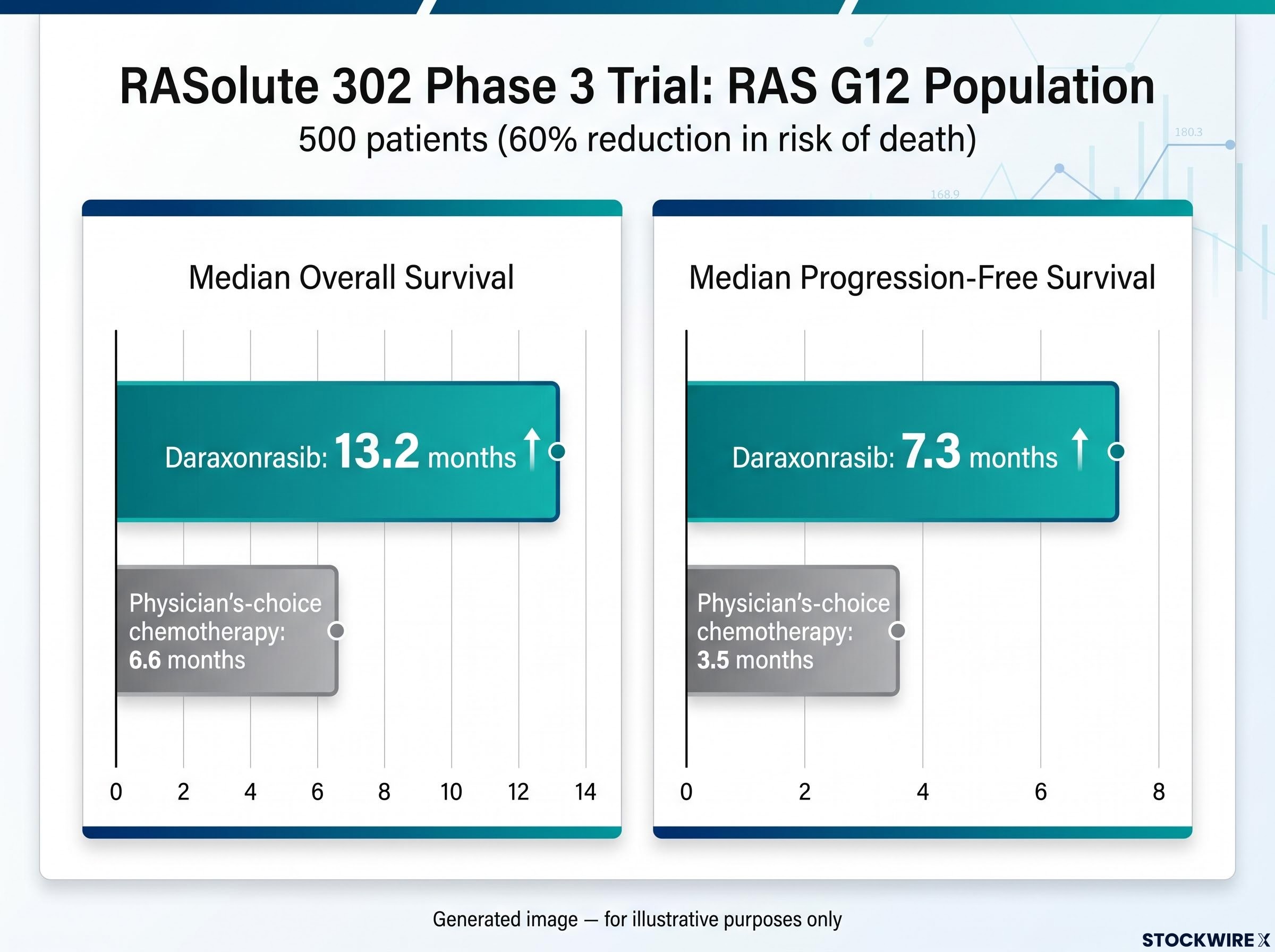
Median progression-free survival, the time before the cancer grew or spread, was 7.3 months versus 3.5 months in the same RAS G12 population. In the overall trial population, the chemotherapy comparator for survival was 6.7 months. The data were reported at ASCO 2026, with simultaneous publication in the New England Journal of Medicine on 31 May 2026.
For you as a reader, the target question is now settled. The useful question about any KRAS story from here is how long the benefit lasts.
Once you know how long a KRAS benefit is likely to last, you can start to weigh the valuation frameworks that translate trial milestones into share price moves for ASX biotech stocks.
That question is already pressing, because every targeted therapy before daraxonrasib has met the same problem.
When big ASX news breaks, our subscribers know first
Why does KRAS resistance happen, and what sets pancreatic tumours apart?
Targeted treatments shut down one particular pathway that a tumour needs in order to grow. Such narrow focus is both their advantage and their weak point. Because cancer cells mutate readily, a drug’s heavy selective pressure favours any cell that happens to find a different way to keep going.
The usual pattern is a strong initial response, then adaptation, then progression. First-generation KRAS inhibitors followed it: they produced meaningful responses, but limited durability is a recognised shortcoming.
Resistance in three forms
Educational sessions at ASCO and AACR in 2026, along with reviews from Dana-Farber, MD Anderson, Memorial Sloan Kettering and the NCI RAS Initiative at Frederick National Laboratory, describe three broad classes.
| Resistance class | What happens | Example |
|---|---|---|
| On-target | The KRAS gene itself changes so the drug binds poorly or is overwhelmed | Secondary KRAS mutations (such as Y96), extra copies of mutant KRAS |
| Bypass signalling | The cell switches on a parallel growth signal around the blocked one | Receptor tyrosine kinases (EGFR, HER2, MET), SHP2, PI3K/AKT |
| Microenvironment | The tissue around the tumour shields it and limits drug delivery | Dense fibrotic stroma, immune-suppressing cells |
Receptor tyrosine kinases are proteins on the cell surface that pass growth signals inward. The patterns differ by tumour type. According to NCI RAS Initiative reviews and oncologists such as Frank McCormick, lung cancers often show bypass signalling and secondary KRAS mutations, while pancreatic cancers are dominated more by stromal and microenvironment resistance.
That tells you a lung result cannot simply be carried over to pancreatic cancer, and the reverse holds too.
The stroma problem in pancreatic cancer
Pancreatic tumours sit inside dense fibrotic stroma, a thick, scar-like tissue that can make up a large share of the tumour mass. It limits how far chemotherapy penetrates and keeps immune cells out. FAK, short for focal adhesion kinase, is a signalling protein involved in building and maintaining that environment.
The idea behind FAK inhibition is to erode that protective wall instead of striking the tumour itself. For this reason, the FAK inhibitor narmafotinib is being tested with chemotherapy and not as a single agent.
Keep a clear caveat in mind. Independent pancreatic cancer experts see stroma targeting as biologically compelling but clinically unproven, and earlier attempts with hedgehog pathway inhibitors and PEGPH20 disappointed despite strong laboratory data.
How do combination strategies counter KRAS resistance?
If a tumour escapes one drug by switching routes, the obvious response is a second drug. In broad terms, a partner agent can do one of three jobs.
- Block the escape route: inhibit the bypass pathway at the same time, so surviving cells have nowhere to switch.
- Change the environment: alter the protective tissue around the tumour so the main drug works better.
- Deepen the initial response: kill more cells early, leaving fewer survivors from which resistance can grow.
The logic has worked before in other cancers:
- In BRAF-mutant melanoma, combining BRAF and MEK inhibitors (dabrafenib plus trametinib) turned short-lived responses into more durable remissions.
- In KRAS G12C colorectal cancer, sotorasib or adagrasib paired with the EGFR antibodies panitumumab or cetuximab produced higher response rates and longer disease control than G12C inhibition alone.
Companies are picking different partners for different tumour weaknesses, but they share one premise: RAS inhibition alone will not be enough.
Not everyone agrees combinations are the best answer. Another camp favours sequencing, using one KRAS inhibitor until resistance appears and then switching to a next-generation agent such as a pan-RAS(ON) drug or one built to bind common resistance mutants.
Toxicity drives much of that caution. Overlapping side effects, including liver enzyme rises, gastrointestinal problems, low blood counts and skin reactions, have already appeared when KRAS G12C inhibitors are combined with other targeted drugs. If a regimen forces frequent dose cuts, its theoretical durability may never show up in routine care.
So when you see a combination announced, ask two questions. Which of the three jobs is the second drug meant to do, and is the side-effect cost likely to be acceptable?
What did Tango’s combination data show, and what does it not show?
The first real patient test of the combination bet came from Tango Therapeutics. Its ongoing Phase 1/2 study pairs vopimetostat, an investigational PRMT5 inhibitor, with Revolution Medicines’ RAS(ON) inhibitors in MTAP-deleted, RAS-mutant metastatic pancreatic cancer. MTAP deletion is the loss of a gene that, according to Tango, occurs in about 40% of pancreatic cancers.
What the numbers show
The headline came from the dose escalation arm combining vopimetostat with daraxonrasib. The objective response rate, the share of patients whose tumours shrank meaningfully, was 92%: 11 of 12 response-evaluable patients with at least 14 weeks of follow-up, with 9 of the 11 responses confirmed.
| Combination | KRAS target | Evaluable patients | ORR | Six-month PFS |
|---|---|---|---|---|
| Vopimetostat + daraxonrasib | Broad RAS(ON) | 12 | 92% (11 of 12) | 90% |
| Vopimetostat + zoldonrasib | KRAS G12D | 27 | 52% (14 of 27) | 74% |
Disease control rates were 100% and 96% respectively. A small lung cancer subset showed 3 of 3 patients responding, all confirmed.
These patients were heavily pre-treated. Of 59 treated in total, more than half received the combination as third-line therapy and 70-77% had liver metastases, according to Tango’s 8 June 2026 release (data cutoff 28 May 2026). Most side effects were Grade 1 or 2, with no related Grade 4 or 5 events and no discontinuations due to adverse events, and Tango says it intends to take the daraxonrasib combination into Phase 3 in first-line MTAP-deleted pancreatic cancer.
Why this is not a read-across to narmafotinib
Here is the line to hold. Vopimetostat works selectively in MTAP-deleted cancer cells, exploiting one specific genetic weakness. Narmafotinib is a FAK inhibitor with a different mechanism in a different setting, so Tango’s results do not predict Amplia’s.
What the data support is the overall approach: teaming a RAS inhibitor with a drug that hits a separate, matching weak spot gave response levels that go past what either agent would normally deliver on its own. They do not validate any other particular combination.
For you, this is strong early evidence that the combination approach has merit. With only 12 patients in dose escalation, it should shape how you frame the question, not what you expect from any single drug.
Amplia’s position in the KRAS field, and what remains unproven
Amplia’s evidence so far
Amplia Therapeutics (ASX: ATX) is a Melbourne-based developer of FAK inhibitors. Its lead drug, narmafotinib, is an investigational oral FAK inhibitor holding FDA orphan drug and Fast Track designations in pancreatic cancer.
In the single-arm ACCENT trial, narmafotinib with gemcitabine and Abraxane in first-line advanced pancreatic cancer produced a confirmed response rate of 35%, or 42% including unconfirmed responses, according to Amplia’s ASCO GI 2026 announcement. Patient numbers were not available in the research behind this piece; you should check that announcement for the sample size. Against the MPACT trial, a historical benchmark rather than a randomised control, chemotherapy alone showed a 23% response rate, and progression-free survival was 7.7 months versus 5.5 months, with side effects reported as similar to chemotherapy alone.
At the AACR Special Conference on RAS Oncogenesis in March 2026, Amplia presented preclinical data showing narmafotinib enhanced KRAS inhibitor activity and blocked resistance pathways in pancreatic and lung cancer models. Separately, AMPLICITY tests the drug with FOLFIRINOX, and the first stage of a Phase 2b announced on 19 May 2026 will enrol 12 newly diagnosed patients at Australian sites, with enrolment expected by Q4 2026 and safety and pharmacokinetic results expected in Q2 2027. An ovarian cancer study with ANZGOG is also agreed.
The FDA-aligned Phase 2b is designed as the first stage of a registrational study, and it will test daily narmafotinib dosing for the first time alongside gemcitabine and Abraxane.
The Lilly collaboration, precisely described
On 4 August 2026, Amplia announced a Clinical Trial Collaboration and Supply Agreement with Eli Lilly. The planned Phase 1b/2b will test narmafotinib with olomorasib, Lilly’s KRAS G12C inhibitor, in second-line KRAS G12C-mutant non-small cell lung cancer, at sites in Australia and the US.
Lilly supplies olomorasib; Amplia runs the trial and keeps ownership of narmafotinib and the data. The start is planned for late 2026, subject to protocol finalisation. The choice of lung follows the mutation: G12C is relatively common in lung cancer and uncommon in pancreatic cancer.
What this does not tell you
- Amplia’s resistance evidence is preclinical and has not been shown in patients.
- Tango’s results involve a different drug class, genetic vulnerability and patient population.
- Tango’s 92% comes from 12 evaluable patients in dose escalation, and small early results often moderate in larger trials.
- A supply agreement is not a licence or commercial partnership and does not signal Lilly’s view of narmafotinib.
- The Lilly study is early-stage, not registration-enabling, and its start depends on protocol finalisation.
- ACCENT is single-arm, compared with MPACT only as a historical benchmark.
- The daraxonrasib Phase 3 result belongs to another company’s drug.
The honest reading Encouraging single-arm chemotherapy results, preclinical resistance data and a planned trial alongside a Lilly KRAS inhibitor form a clear, testable hypothesis. None of it is proof.
Treat Amplia as a hypothesis positioned where the field is focused, and weigh each claim by the stage of evidence behind it.
What changes now that KRAS is druggable, and what to watch next
The question has moved from whether KRAS can be drugged to how long the benefit holds. Combinations are the leading answer, though sequencing advocates and toxicity concerns keep that debate open.
Three markers are worth tracking: Tango’s Phase 3 planning for vopimetostat plus daraxonrasib, the late-2026 start of the Amplia-Lilly study subject to protocol finalisation, and Amplia’s Phase 2b first-stage enrolment and Q2 2027 safety readout. Treat each as a signal to follow, not an outcome to assume.
For readers wanting to weigh each trial signal, our full explainer on reading clinical milestones shows which evaluative body stands behind each type of announcement.
This article is for informational purposes only and should not be considered financial advice. Investors should conduct their own research and consult with financial professionals before making investment decisions. Clinical results described here are early-stage and subject to change as trials progress.
Disclosure: This article is sponsored by Amplia Therapeutics (ASX: ATX), which has a commercial relationship with StockWire X. This content is not medical advice. Narmafotinib is investigational and available only within clinical trials; speak with your doctor about any treatment decisions.
—