Most investors who want a piece of the nuclear revival start in the wrong place. They chase volatile uranium miners or gamble on which reactor design will dominate the next two decades.
Both bets ignore a quieter reality: the biggest constraint in nuclear power right now is not fuel or design, it is the physical hardware. Reactor pressure vessels, steam turbines, and heavy forgings carry procurement lead times of four to five years, and only a handful of qualified manufacturers on the planet can supply them.
That scarcity creates a distinct category of opportunity. If you want to invest in the nuclear supply chain, the smart money is not on the commodity, it is on the companies that build the irreplaceable components everyone needs regardless of which reactor wins.
This guide gives you a framework for evaluating heavy manufacturing near-monopolies and supply chain bottlenecks as defensive assets. By the time you finish, you will know how to spot the pricing power, read the order books, and tell a profitable moat from a systemic risk.
The structural advantage of manufacturing over commodity mining
Here is the distinction that separates the professionals from the retail crowd. Uranium miners live and die by the spot price. When uranium rallies, their margins expand; when it falls, their profits evaporate, and you have no control over that swing.
The demand pressure feeding into these long-lead-time components does not exist in isolation; uranium spot prices sat at approximately $88-90 per pound as of late May 2026, with Bank of America forecasting structural deficit conditions through at least 2030 as hyperscalers lock in nuclear power purchase agreements years in advance.
Component suppliers operate on an entirely different clock. They lock in multi-decade construction and operations-and-maintenance (O&M) cycles across multiple reactor designs, meaning their revenue is tied to contracts, not commodity charts.
The nuclear renaissance is a picks-and-shovels opportunity. You do not need to guess which reactor design wins the gold rush. You just need to own the companies selling the shovels every prospector requires.
This is not a fringe view. A detailed research report from Ocean Wall screened 144 companies using a 25-point scoring system, ranking each on criteria like supply chain localisation and deliverability. The firm backs this thesis with real capital through its 5T Nuclear Fund, managed in partnership with 5T in Zurich.
The logic behind the screen is worth understanding. Ocean Wall favours a two-tier institutional approach: diversified exposure to component makers over concentrated bets on single-country miner ETFs.
Why does that matter to you? Because it eliminates technology-selection risk. Whether the winning reactor is a Westinghouse AP1000, a small modular reactor, or a design not yet finalised, that reactor still needs valves, turbines, and forgings.
The engineers and fabricators sit at the choke point. When an industry shifts toward long-term component contracts, the true pricing power lands with the people who make the parts, not the ones digging the ore.
For your portfolio, the read is straightforward. Your capital is better protected in a company with a multi-year order book than in one exposed to daily commodity volatility. One offers visibility; the other offers a coin flip.
That defensive quality is precisely why large investors are increasingly prioritising supply chain infrastructure over pure-play mining exposure. They are not chasing the upside of the energy transition through speculation. They are capturing it through the companies that hold the physical keys to construction.
When big ASX news breaks, our subscribers know first
Deconstructing the reactor pipeline and its critical parts
To evaluate a component maker, you first need to understand what a modern reactor actually requires and why those parts are so hard to make.
A large reactor is built around a handful of critical components. The reactor pressure vessel (RPV) is the sealed steel container that holds the nuclear core and its coolant. Around it sit steam turbines, which convert heat into electricity, and compressors that manage the plant’s pressure systems.
These are not off-the-shelf parts. Each must be certified to stringent nuclear-grade standards before it can be installed, and that is where the barrier begins.
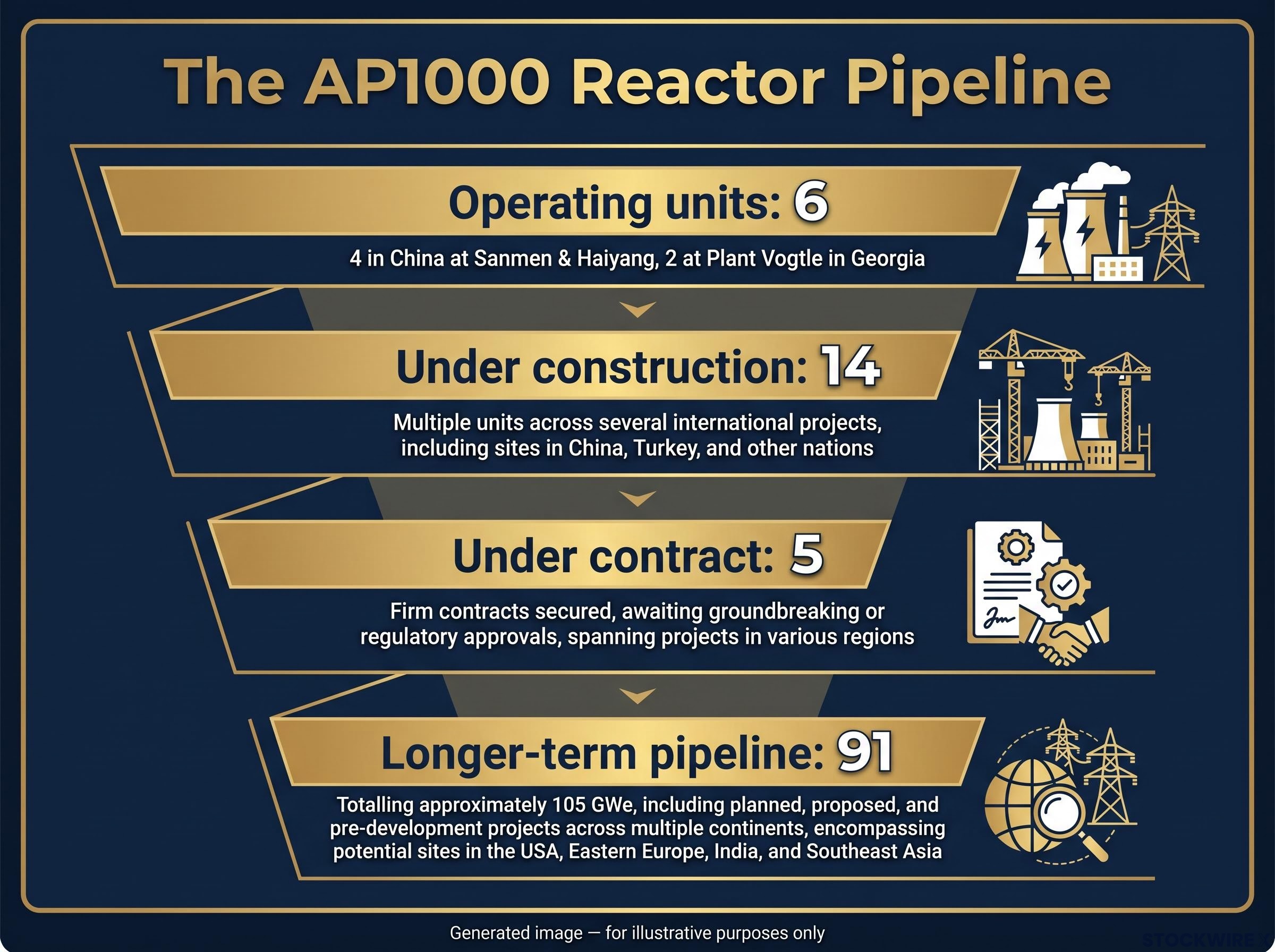
Now consider the scale of demand hitting this supply chain. The Westinghouse AP1000 reactor is one of the most widely deployed modern designs, and its global pipeline is expanding fast:
- Operating units: 6 in full commercial operation worldwide (4 in China at Sanmen and Haiyang, plus 2 at Plant Vogtle in Georgia)
- Under construction: 14 additional AP1000-technology reactors
- Under contract: 5 further units beyond those already being built
- Longer-term pipeline: up to 91 potential reactors, totalling approximately 105 GWe
That longer-term pipeline includes up to 10 reactors tied to US Department of Energy supply chain loans, up to 10 more under a Department of Commerce partnership, and further units across Poland, Bulgaria, Ukraine, and the potential resumption of the two-unit V.C. Summer project.
Here is the part that turns demand into an investment moat. You cannot simply build a factory and start supplying these components next year.
Nuclear-grade forgings must comply with rigorous codes such as RCC-M and ISO 19443, quality standards that govern how nuclear equipment is designed, fabricated, and traced. Achieving that qualification takes years of process development, capital investment, and regulatory approval.
Nuclear additive manufacturing represents one of the most active frontiers in this supply chain, with the sector projected to surpass USD 40 billion in 2026 and AM material consumption in energy expected to exceed USD 800 million by 2034, signalling that the component qualification challenge is drawing innovators beyond traditional heavy forging.
That means new competitors cannot pivot into this market on demand. When you set the enormous AP1000 pipeline against the near-impossibility of quickly scaling new qualified manufacturing capacity, you see exactly why the few existing suppliers hold such an unshakeable commercial position. The demand is guaranteed; the supply is locked behind a wall most firms will never scale.
Where the pricing power sits: near-monopolies and massive order books
Theory only takes you so far. The real proof of pricing power lives in the financial backlogs of the companies that dominate this space, and the numbers are substantial.
Start with Doosan Enerbility. For Western-allied nations, it is close to irreplaceable when it comes to forging the largest reactor pressure vessels. Its Changwon plant houses a 13,000-tonne and a 17,000-tonne forging press capable of handling ingots up to 540 tonnes, and it has already supplied between 32 and 34 pressure vessels and 108 to 124 steam generators globally.
Then there is BWX Technologies (BWXT), arguably the most defensive play in the sector. Roughly 70% of its revenue comes from US government contracts, giving it a recurring, politically insulated income base. Its year-end 2025 backlog stood at $7.26 billion, and Q2 2026 adjusted EBITDA reached $155.5 million.
The turbine and grid giants complete the picture. GE Vernova reported a total backlog of $176 billion in Q2 2026, targeting at least 125 GW of gas power equipment by year-end 2026. Siemens Energy carried a group order backlog that reached €162 billion earlier in the year, and traded at a price-to-earnings (P/E) multiple of 33.6x as of mid-September 2026.
| Company | Speciality Component | Key Competitive Advantage | Recent Backlog/Revenue Metric |
|---|---|---|---|
| Doosan Enerbility | Reactor pressure vessels, steam generators | Ultra-large press capacity with no comparable allied-country alternative | 32-34 RPVs and 108-124 steam generators supplied globally |
| BWXT | Large-scale nuclear manufacturing components | ~70% of revenue from US government contracts | $7.26B backlog (end 2025); $155.5M Q2 2026 adjusted EBITDA |
| GE Vernova | Turbines, grid technology | Multi-year slot reservations for gas power equipment | $176B total backlog (Q2 2026) |
| Siemens Energy | Turbines, grid and power generation equipment | Record grid technology order book | €162B group backlog; P/E of 33.6x (mid-Sept 2026) |
Look at what these numbers actually tell you. When manufacturers are reserving component slots up to five years in advance, you are looking at guaranteed future revenue that insulates these stocks from short-term macroeconomic shocks. That forward visibility is the entire investment case.
The high barrier to entry for heavy forging
Doosan’s dominance is not luck; it is a wall built from capital and certification. Replicating its combination of ultra-large press capacity, decades of accumulated process knowledge, and multi-market certifications such as ASME Section III, Korea’s KEPIC, and China’s HAF would require hundreds of millions of dollars and years of qualification work.
ASME Nuclear Component Certification under Section III of the Boiler and Pressure Vessel Code governs the design, fabrication, examination, and testing of vessels, pumps, valves, and piping systems, making it one of the primary qualification frameworks a new supplier must satisfy before delivering a single nuclear-grade component.
That is why credible competitors are so scarce. Japan Steel Works remains one of the very few forgers globally capable of processing components at this scale, and even it cannot instantly absorb a wave of new global demand.
Why four-year delays are actually your strongest investment moat
Now for the counterintuitive part. Those four-to-five-year lead times that look like a problem are, from an investor’s seat, the most powerful feature of the entire thesis.
The industry reads these bottlenecks two ways. Policy bodies like the American Nuclear Society and the US Department of Energy treat them as fundamental execution risk: constraints that inflate costs, blow out schedules, and threaten project viability. Strategy consultants and investors see the same delays as a structural bottleneck that guarantees pricing power for whoever controls the gating components.
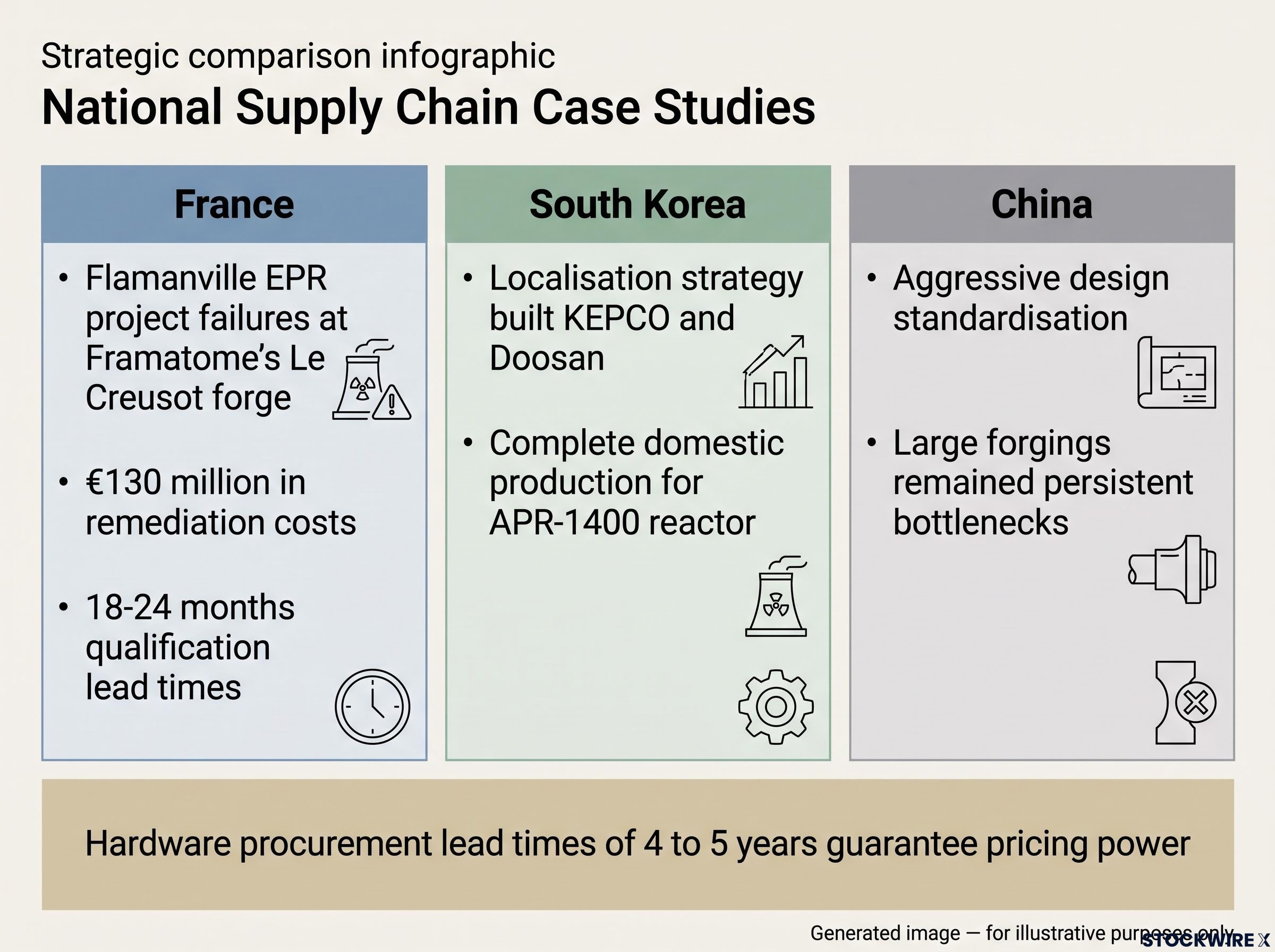
History settles the argument. Domestic supply chain control has been the single biggest determinant of a successful nuclear build-out, and three national case studies prove it:
- France: The Flamanville EPR project suffered quality-control failures (carbon segregation) at Framatome’s Le Creusot forge, leading to €130 million in remediation costs. Typical qualification lead times for pressure equipment stretched to 18-24 months. Reliance on a single forge exposed the entire programme to one point of failure.
- South Korea: A deliberate, multi-phase localisation strategy built national champions like KEPCO and Doosan, eventually enabling complete domestic production for the APR-1400 reactor. Sustained investment in heavy manufacturing turned a dependency into a global export advantage.
- China: Aggressive design standardisation and continuous workforce pipelines delivered fleet-scale construction, yet large forgings and instrumentation-and-control systems remained persistent bottlenecks capable of stalling unit commissioning.
The constraint runs deeper than hardware. Shortages extend to nuclear-qualified machinists, welders, inspectors, and project managers, skilled roles that take years to train and cannot be conjured overnight.
Supply chain concentration risk of this kind is not unique to nuclear; the semiconductor industry’s dependence on Taiwan for approximately 90% of leading-edge chip production offers a directly comparable case study in how single points of failure in critical manufacturing create systemic portfolio exposure that investors routinely underestimate until a disruption forces repricing.
This creates a chicken-and-egg trap. Suppliers refuse to expand capacity without firm orders, while utilities hesitate to commit without a proven supply chain, and that standoff cements the dominance of whoever moved first.
So which side of the trade do you want to be on? These systemic delays inflate costs for project developers, but they lock in high-margin, multi-year contracts for the component manufacturers. Your capital belongs with the suppliers holding the bottleneck, not the developers fighting through it.
Positioning a portfolio for a supply-constrained renaissance
The core argument comes down to this: the smartest capital is flowing into the unavoidable bottlenecks of nuclear construction, not the speculative ends of uranium mining or reactor design.
The companies that control the four-to-five-year lead times hold the genuine pricing power in this sector. Their multi-year order books convert a global constraint into guaranteed, high-margin revenue, and that is what makes them defensive rather than speculative.
Your next step is a screening exercise. When you review energy names for your portfolio, look for three things: deep government backing, manufacturing infrastructure that cannot be quickly replicated, and order books stretching years into the future. Those three traits, together, are the signature of a durable moat.
Screening for undervalued stocks in industrial sub-sectors with thin analyst coverage, such as heavy nuclear forging, frequently surfaces the pricing-power candidates described here before they attract institutional attention, because the same low-coverage dynamic that hides the opportunity also suppresses the valuation multiple until order book growth makes the moat impossible to ignore.
This article is for informational purposes only and should not be considered financial advice. Investors should conduct their own research and consult with financial professionals before making investment decisions.
Past performance does not guarantee future results, and financial projections are subject to market conditions and various risk factors. The bottleneck is real, and for once, the constraint works in the supplier’s favour.