
A government just committed CAD 36 billion to cutting its own tax take on new business investment, dropping Canada’s effective tax rate on a fresh dollar of capital to less than half the United States level. And currency markets barely twitched.
That gap between the size of the policy and the silence of the market is where this story gets interesting.
The Productivity Mega Deduction, announced on 15 September 2026 by Prime Minister Mark Carney at Canada’s first Investment Summit, is a structural rewrite of how the country taxes new capital, not a short-term stimulus package. Understanding it means separating three questions that most coverage runs together: what it does, what it costs, and why it left the Canadian Dollar cold.
This piece pulls those three questions apart, so you can judge whether this shift to the Canadian business investment tax framework matters to your view on Canada, without the noise of the first day’s flat market reaction drowning out the structural story.
From gradual write-offs to instant deductions: how the Productivity Mega Deduction actually works
To feel what changed, you have to know how Canada used to tax a machine, a pipeline, or a software licence. Under the old system, a business could not deduct the full cost of a new asset the year it bought it. Instead it claimed a slice each year through the Capital Cost Allowance (CCA), a schedule that spreads the deduction across the asset’s useful life.
That slow drip mattered. A deduction you take today is worth more than the same deduction spread over ten years, so the old system quietly raised the real after-tax cost of investing.
The Mega Deduction breaks that pattern. According to Finance Canada, it converts most new depreciable capital to permanent first-year full expensing, letting a business deduct 100% of a qualifying asset’s cost in the year it becomes available for use. The change applies to qualifying property acquired on or after 15 September 2026, though tax specialists note the enabling legislation had not been fully enacted as of mid-September 2026, so much of the analysis still refers to the measure as proposed.
Finance Canada’s Mega Deduction announcement confirms the permanent full expensing treatment, the 6.4% METR figure, and the CAD 36 billion five-year fiscal cost, providing the primary legislative basis on which all subsequent economic modelling and analyst commentary rests.
The headline effect is the marginal effective tax rate, or METR: a single figure economists use to capture how much tax weighs on the return from one extra dollar of investment. Budget 2025 measures had already pulled Canada’s METR from 15.4% down to 13.0%. The Mega Deduction cuts it again, to 6.4%.
| Stage | METR | Key Change |
|---|---|---|
| Pre-Budget 2025 | 15.4% | Standard gradual CCA depreciation |
| After Budget 2025 measures | 13.0% | Accelerated capital cost allowance introduced |
| After Productivity Mega Deduction | 6.4% | Permanent 100% first-year expensing on most new capital |
That move from 13.0% to 6.4% is not a tweak. It roughly halves the effective tax burden on a new dollar of capital, which changes the financial maths on projects that were previously sitting right on the line between worth doing and not worth doing.
Which assets qualify and which do not
The regime covers a wide spread of asset types, listed in the Prime Minister’s Office release. Grouped loosely by sector, they include:
- Infrastructure: oil and gas pipelines, rail track, bridges and roads
- Digital and intangible: software, research and development (R&D), computer equipment, patents
- Extractive: mining property
- Transport and telecom: aircraft and vehicles, fibre-optic cable
The reach here is what stands out. Government estimates put eligible coverage at roughly 65-67% of new depreciable investment, up from around 15% under the prior framework. Not every depreciable asset qualifies, and that two-thirds figure is the government’s own estimate of how broad the net has become. Ottawa argues the resulting 6.4% METR makes Canada the most competitive G7 country for new business investment, at less than half the U.S. rate.
When big ASX news breaks, our subscribers know first
The CAD 36 billion price tag: what Canada’s government expects to get back
A policy this generous with deductions is expensive by design, because every dollar deducted upfront is a dollar of tax the government does not collect this year. The reported cost is CAD 36 billion over five years, running from fiscal 2026-27 to 2030-31. Scotiabank strategists Shaun Osborne and Eric Theoret did not soften the figure.
Scotiabank on the cost The Productivity Mega Deduction carries a “hefty” price tag of CAD 36 billion over five years, per Shaun Osborne and Eric Theoret, Scotiabank, 16 September 2026.
So what does Ottawa expect in return? Federal modelling, as reported by National Observer, lays out three headline figures:
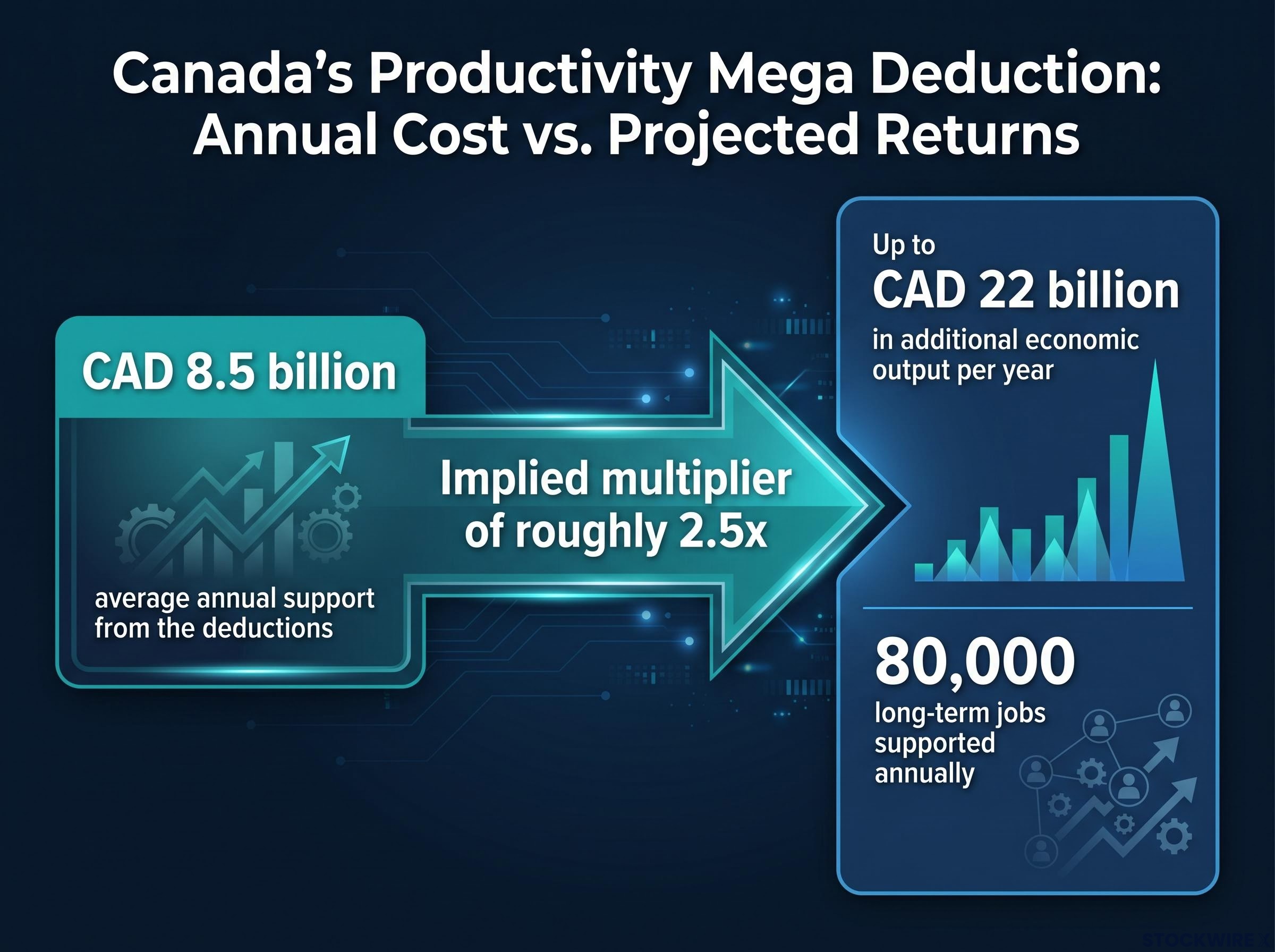
- CAD 8.5 billion in average annual support from the deductions over the first five years
- Up to CAD 22 billion in additional economic output per year
- 80,000 long-term jobs supported annually
Read those numbers side by side and the ambition becomes clear. The government is effectively wagering that CAD 8.5 billion in annual support generates CAD 22 billion in yearly output, an implied multiplier of roughly 2.5x. Whether you find that credible comes down to a single question: do you believe firms will pour the tax savings into new productive capital, or bank them as retained earnings?
Trade war headwinds add a complicating layer to the fiscal arithmetic: the 50% US tariffs on roughly $20 billion in Canadian goods, which bypassed USMCA protections entirely, create a drag on the export revenue and corporate profitability that the Mega Deduction is designed to stimulate, meaning the policy is partly racing against an externally imposed investment deterrent.
There is a credibility check worth holding onto. C.D. Howe Institute economist Alexandre Laurin, quoted by the Globe and Mail on 15 September 2026, read the aggregate cost as implying roughly a 7.5% average annual reduction in corporate tax revenues. That is a meaningful slice of the corporate tax base handed back in the hope of faster growth.
For anyone weighing Canada as a place to deploy capital, or watching its fiscal path, both sides of the ledger matter. The spend is fixed and known. The return is a projection. The distance between those two things is exactly where analytical judgment has to do its work.
Why Canada’s productivity gap made this kind of policy almost inevitable
A tax cut this large gets sold as a productivity fix rather than a giveaway, and there is real economics behind that framing. The mechanism runs through the user cost of capital, the total pre-tax return a project must clear to be worth financing. Lower the METR and you lower that hurdle, which raises the after-tax return on investment and nudges firms to green-light projects that previously fell just short.
Over time, more investment means more capital per worker, faster adoption of new technology, and higher measured labour productivity. That chain is the theory the whole policy rests on.
The reason Canada reached for this lever is a diagnosis, not a whim. The C.D. Howe Institute has long framed the country’s productivity weakness as structural rather than cyclical, pointing to chronically thin business investment in machinery, equipment, and intellectual property. The Bank of Canada has described the gap as persistent across economic cycles, the kind of problem that short-term demand policy cannot touch.
Canada’s growth outlook through 2027 was already under pressure before the Mega Deduction arrived, with Q2 2025 GDP contracting at a 1.6% annualised rate and TD Economics projecting a below-potential trajectory through at least 2027, a structural backdrop that helps explain why Ottawa reached for a permanent cost-of-capital fix rather than a cyclical demand stimulus.
That distinction matters for how you read the scale of this measure. If the shortfall were cyclical, a temporary boost would do. Because it is structural, a permanent change to the cost of capital looks proportionate rather than extravagant.
There is a detail in the design that deserves attention. The deduction covers intangibles, software, R&D, and patents, not just heavy machinery. That is the feature separating this from an old-style accelerated depreciation break aimed at factories and equipment. For anyone judging whether Canada is genuinely chasing knowledge-economy productivity, that inclusion arguably matters more than the headline METR.
Economists are careful, though, to call lower METRs necessary rather than sufficient. For the reduction to fully translate into productivity gains, three conditions typically need to hold:
- Genuinely improved investment incentives that firms act on rather than pocket
- A competitive market structure that rewards productive firms and lets capital flow to them
- Complementary investment in skills, innovation, and supporting infrastructure
Miss any of those and the tax saving can leak away without lifting output. The policy tilts the incentive. It cannot force the response.
International precedents and what they tell us about Canadian ambitions
Canada is not the first to try this. The UK’s 130% “super-deduction,” running from 2021 to 2023, and the near-full expensing under the U.S. Tax Cuts and Jobs Act of 2017 are the closest analogues, and they share Canada’s core logic: cut the METR on equipment to pull investment forward.
The connection between investment tax policy and productivity is not unique to Canada: Australia’s parallel experience, where new CGT rules arrived in an economy that had already seen business investment halve from roughly 12% of GDP to around 6% since the early 2000s, illustrates what happens when tax settings work against capital formation over an extended cycle rather than correcting it.
The evidence from those schemes is instructive rather than conclusive. Studies generally find that expensing measures do lift investment in eligible assets, but the durable productivity payoff depends heavily on whether the regime is permanent or temporary. Time-limited schemes tend to shift the timing of spending firms would have done anyway.
Canada’s version is framed as permanent, and that is the design choice economists tend to favour. A permanent change to the cost of capital is more likely to alter long-run capital allocation than a window that firms simply rush to beat.
Why the Canadian Dollar did not move, and when that might change
Here is the resolution to the paradox in the opening. A CAD 36 billion structural tax shift landed, and the Canadian Dollar essentially ignored it. Scotiabank strategists Osborne and Theoret said so directly, with USD/CAD trading near 1.39 on 16 September 2026.
Scotiabank on the FX impact The Productivity Mega Deduction “is not an immediate driver for the CAD,” per Shaun Osborne and Eric Theoret, Scotiabank, 16 September 2026.
That is less strange than it first looks. Short-run exchange rates for a major currency like the Canadian Dollar are set by interest rate expectations, commodity prices, and global risk appetite, not by individual domestic fiscal announcements. On the day, Scotiabank pointed to a Bank of Canada hawkish tilt and looming Federal Reserve decisions as the forces steering USD/CAD around 1.39.
The CAD non-reaction to the Mega Deduction fits a pattern Scotiabank strategists identified weeks earlier: fiscal and trade announcements that carry a long implementation horizon tend to be overridden in FX markets by near-term rate differential signals, a dynamic that helps explain why USD/CAD held near 1.39 despite the structural scale of the policy.
The deeper reason is timing. A fiscal measure moves a currency only when it changes expectations about future growth, inflation, or sovereign risk in a way that is both large and credible. A policy whose effects show up over the medium to long term, once investment actually accelerates, does not meet that bar on announcement day.
So when could this become a currency story? The conditions are specific:
- A sustained surge in business investment that lifts Canada’s potential growth and pushes up real interest rates
- Visible improvement in non-resource exports and the current account balance
- Broad, durable investor confidence that the policy will stick and reshape capital formation
There is a downside path too, and it deserves equal weight on your risk map:
- Widening deficits if the revenue foregone is not offset by growth
- Rising debt and pressure on Canada’s credit ratings
- A weaker fiscal picture that, combined with soft commodity prices, could eventually weigh on the Canadian Dollar rather than lift it
For anyone with currency or macro exposure to Canada, the practical takeaway is this. The policy’s signal is genuine, but its market timing is long. It belongs in your structural-outlook column, not your near-term positioning column, and the moment to revisit it is when implementation data starts to accumulate.
Mapping what the Mega Deduction can and cannot fix
The honest read on this policy sits between euphoria and dismissal. It changes some things clearly and leaves others untouched, and holding both facts at once is the only way to judge it fairly.
What the tax change directly improves
On the measurable side, the Mega Deduction delivers real shifts:
- A lower user cost of capital, cutting the after-tax hurdle a new project must clear
- Broader eligibility for immediate expensing, covering an estimated 65-67% of new depreciable investment
- A 6.4% METR that Ottawa positions as the most competitive in the G7, strengthening Canada’s pitch for inbound capital-intensive projects
For a firm weighing a marginal investment in a qualifying sector, the financial case genuinely improves. That is not projection. That is arithmetic baked into the tax code.
Where the structural gaps remain
The mechanism has limits the tax code cannot reach:
- Competition policy and the weak market pressure that lets less productive firms persist
- Regulatory barriers that slow the reallocation of capital toward better firms
- Innovation ecosystem quality, which the OECD and IMF tie closely to Canada’s productivity shortfall
- A distributional skew: firms with strong current profits and existing tax liabilities are best placed to use immediate expensing
That last point carries a real distributional concern. The qualifying asset list, pipelines, mining property, rail, bridges, and roads, concentrates the benefit in energy, mining, infrastructure, and transport. The C.D. Howe Institute frames Canada’s productivity gap as multi-causal, needing reforms well beyond the tax wedge.
So the read you should carry into the coming quarters is a two-hander. The mechanism is sound, and the mechanism alone is not enough. Whether firms channel the savings into new productive capital or simply distribute them depends on factors, competition, regulation, and management choices, that no deduction can dictate.
A significant bet on investment, with a long horizon for the payoff
Strip the policy back and its logic is simple. By pushing the METR on new capital to 6.4%, the lowest among major economies, Canada is repositioning its tax system to compete for global capital on price, betting that investment volume follows the incentive. The CAD 36 billion five-year cost is the size of that wager.
Scotiabank frames the relevance as medium to long term, which is also the horizon over which you can fairly judge whether the bet is paying off. The announcement told you the intent. Only the data from here tells you the result.
These are the indicators worth tracking:
- Business capital formation figures from Statistics Canada, the most direct read on whether firms are actually investing more
- Corporate tax revenue trends measured against Laurin’s roughly 7.5% annual reduction benchmark
- Non-resource export performance and any Bank of Canada commentary linking investment to potential growth
- Legislative passage of the enabling bill, since the measure remained proposed rather than enacted as of 16 September 2026
Whether this policy delivers hinges not on the summit stage but on what Canadian firms do with the improved incentives over the next three to five years. If you follow the capital formation data, you will read the real-world impact far sooner and far more clearly than anyone tracking fiscal commentary alone.
This article is for informational purposes only and should not be considered financial advice. Investors should conduct their own research and consult with financial professionals before making investment decisions. Past performance does not guarantee future results, and financial projections are subject to market conditions and various risk factors. Forward-looking statements regarding the policy’s economic impact are speculative and subject to change based on implementation and economic developments.