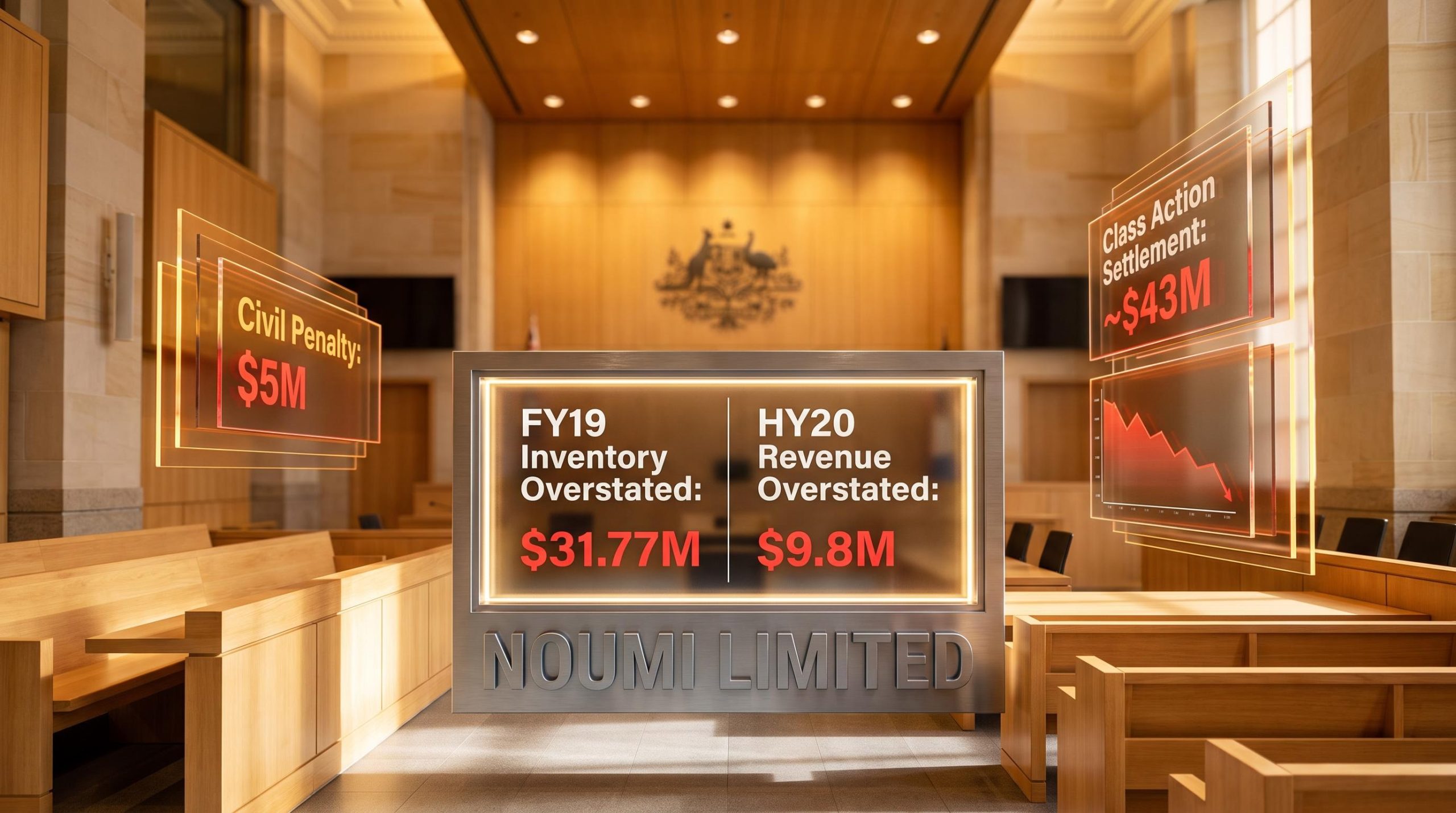
Two financial reporting periods. Tens of millions of dollars in overstated inventory and phantom revenue. And a civil penalty that, at its theoretical maximum, could have reached $11.2 billion before a Federal Court judge applied proportionality and landed on $5 million.
The Noumi Limited case (formerly Freedom Foods Group) is one of Australia’s most instructive recent examples of what happens when management reporting failures cascade through a listed company’s accounts, go undisclosed to the market, and eventually reach civil penalty proceedings brought by the Australian Securities and Investments Commission (ASIC). The case spans a company penalty, a CFO disqualification, and a CEO trial that remains unresolved as of mid-2026.
What follows maps the full arc of how the misconduct worked, how Australian law responded to it across multiple simultaneous enforcement tracks, and what still remains unresolved. If you track ASX-listed governance or want to understand how ASIC constructs layered civil penalty cases against companies and their officers, this is the case to know.
What Noumi’s accounts were actually hiding
Start with the inventory. In both FY19 (the year ended 30 June 2019) and HY20 (the half-year ended 31 December 2019), Noumi carried unsaleable, expired stock on its balance sheet at cost. Under accounting standards, inventory must be valued at the lower of cost and net realisable value, which is the amount the company could actually expect to receive from selling it. When stock is expired or unsaleable, that value drops to zero, and the company is required to write it down immediately. Noumi did not.
AASB 102 Inventories sets the valuation rule that Noumi failed to apply: inventory must be measured at the lower of cost and net realisable value, with write-downs required immediately when stock is damaged, obsolete, or otherwise no longer recoverable at cost.
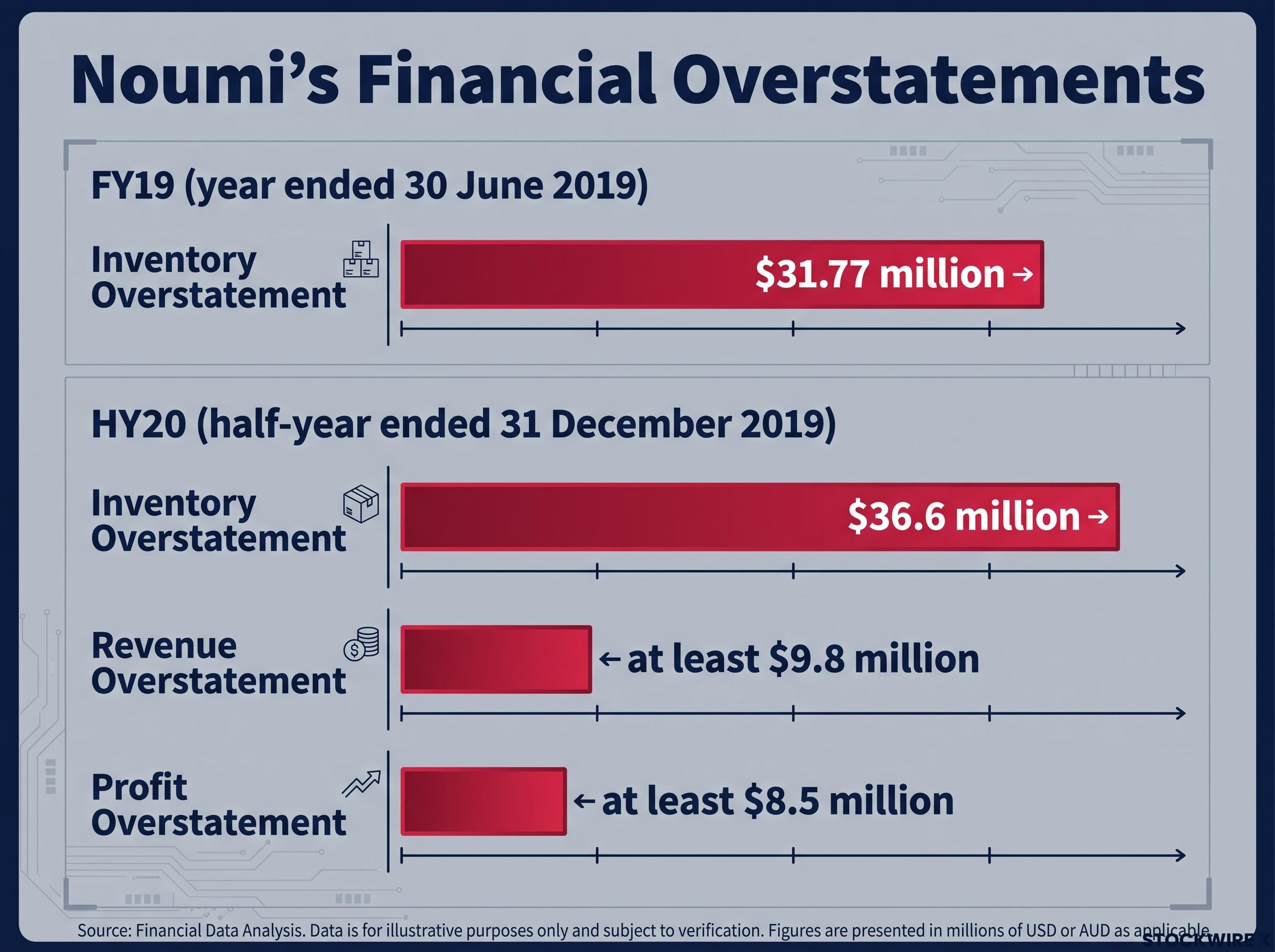
The result: FY19 inventory overstated by approximately $31.77 million. HY20 inventory overstated by approximately $36.6 million. That alone inflated the asset side of the balance sheet by tens of millions of dollars across two consecutive reporting periods.
Then came the revenue layer. In HY20, invoices were recorded as earned revenue even though they did not lead to cash inflows or meet the conditions for proper recognition. Revenue is only recognisable when the performance obligations attached to a sale have been satisfied. Recording invoices as revenue before those conditions are met inflates both the top line and the bottom line simultaneously.
Revenue recognition remains one of ASIC’s named financial reporting scrutiny areas for FY2026-27, alongside asset impairment and financial instrument measurement, precisely because the conditions for recognising a sale as earned revenue are the same conditions that Noumi’s HY20 accounts failed to satisfy.
HY20 revenue was overstated by at least $9.8 million. Profit was overstated by at least $8.5 million.
The compounding effect matters. The balance sheet overstated assets through the inventory distortion. The income statement overstated earnings through the revenue distortion. If you were an investor reading those accounts, you were seeing a company that appeared stronger on every financial dimension than it actually was.
| Misstatement | Approximate amount |
|---|---|
| Inventory overstatement (FY19) | $31.77 million |
| Inventory overstatement (HY20) | $36.6 million |
| Revenue overstatement (HY20) | At least $9.8 million |
| Profit overstatement (HY20) | At least $8.5 million |
The company rebranded from Freedom Foods Group to Noumi Limited on 30 November 2021, following significant financial write-downs and governance upheaval. The new name marked an attempt to reset. The legal consequences of the old accounts were only beginning.
When big ASX news breaks, our subscribers know first
Why continuous disclosure law made this a regulatory matter, not just an accounting one
The accounting errors were serious. But the reason ASIC brought civil penalty proceedings is not that the numbers were wrong. It is that the wrong numbers sat on the public record, uncorrected, while investors traded the company’s shares based on them.
The company-level obligation
Section 674 of the Corporations Act 2001 and the ASX Listing Rules require listed companies to immediately disclose any information a reasonable person would expect to have a material effect on the price or value of their securities. Continuous disclosure is the mechanism that gives investors the right to make decisions based on truthful information. It is not about accuracy for accuracy’s sake; it is about market integrity.
When a company’s financial statements are materially misstated, the misstated accounts themselves become the continuous disclosure failure. Every day those accounts sit on the public record without correction is, in principle, a fresh day of non-compliance.
For Noumi, the Federal Court calculated 244 trading days of contravention before applying proportionality. Across those 244 days, the theoretical maximum penalty exposure was approximately $11.2 billion. That number is an arithmetic construct rather than a realistic outcome, but it tells you something about how the regime is designed: prolonged non-disclosure is meant to be arithmetically catastrophic in theory, even when courts exercise proportionality in practice.
The per-day contravention structure that produced Noumi’s theoretical $11.2 billion maximum exposure was applied identically in the Electro Optic Systems proceedings, where the Federal Court declared a separate contravention for each of the 14 weeks of non-disclosure under section 1317QA of the Corporations Act.
The personal liability trigger
The regime does not stop at the company. Officers who are “knowingly involved” in a company’s continuous disclosure breach face personal liability. The “knowingly involved” standard sits between carelessness and orchestration: it requires more than negligence, but it does not require proof that the officer designed or directed the breach. If you knew the relevant facts and participated in the contravention, the standard can reach you.
ASIC Chair Sarah Court said, in connection with these proceedings, that directors and officers are obliged to take reasonable steps to ensure their company’s financial reporting is accurate, and that this obligation is an active one. Accurate financial information, she noted, underpins investor confidence and the integrity of Australia’s markets.
That framing matters. It tells you the regulator views disclosure as something officers must actively ensure, not something they can passively assume is being handled.
How the penalty against Noumi was structured, and what it actually signals
A Federal Court judgment handed down on 5 August 2024 required Noumi to pay a civil penalty of $5 million for contravening its continuous disclosure obligations, with the company having admitted those contraventions. ASIC had filed the civil penalty proceedings in February 2023.
The Court also ordered Noumi to contribute $50,000 to ASIC’s costs. The penalty was structured across three tranches, reflecting a practical acknowledgment of the company’s financial position:
- $2 million within 28 days of judgment
- $1.5 million within 12 months of judgment
- $1.5 million within 24 months of judgment
Noumi’s 2024 annual report confirmed the company recognised a provision of $5.05 million (covering the penalty and cost contribution) in its consolidated financial statements.
The more consequential outcome here is not the dollar figure. It is the formal judicial finding that the financial statements were materially misleading and that continuous disclosure obligations were contravened over an extended period. That finding closes off any future argument about whether the accounts were misleading. The question is settled.
For you as a reader, the tranche-based schedule is a practical detail. The admission of contraventions is the legally significant element, and it is the one that carries weight in every proceeding and class action that references this case going forward.
The CFO’s personal accountability: what the Nicholas penalty established
In a judgment delivered on 17 October 2024, the Federal Court imposed a civil penalty of $100,000 on former CFO and company secretary Campbell Nicholas and barred him from managing corporations for a period of four years.
The findings against Nicholas were specific and layered:
- Implicated in Noumi’s continuous disclosure breaches through knowing participation
- Failed in his duties as an officer of the company
- Furnished false or misleading information to the board and to the company’s external auditors
Each finding carries its own weight, but the third is the one that cuts deepest into the governance chain. A CFO sits at the intersection of financial reporting, board communication, and external audit. Directors exercising their oversight responsibilities depend on the accuracy of what management tells them. Auditors conducting their work depend on the same information. When the CFO corrupts that information flow, the consequences cascade through every governance layer above.
Why this matters beyond the individual
The disqualification is qualitatively different from the financial penalty. $100,000 is a sum. A four-year disqualification removes Nicholas from the corporate sector entirely for that period. For you, assessing officer accountability in Australian law, the disqualification is the sharper instrument. It says: the penalty for corrupting the information chain is not merely financial; it is exclusion from the system you exploited.
The four-year director disqualification imposed on Nicholas was ordered by the Federal Court through civil penalty proceedings, but director disqualification in Australian law also operates through a separate administrative channel under section 206F of the Corporations Act, which allows ASIC to ban an officer without a court order entirely.
Boards and auditors may act in good faith and still produce materially wrong financial statements if the information they receive from management is false. The Nicholas outcome makes that dependency visible and attaches personal consequences to the officer who breaches it.
Beyond ASIC: the $43 million class action settlement and Deloitte’s exposure
The ASIC penalty is not the only accountability track. Separately, investors pursued a class action against Noumi and its former auditor, Deloitte, alleging that from 2014 to 2020 the company’s financial accounts did not provide a true and fair view of its financial performance and position.
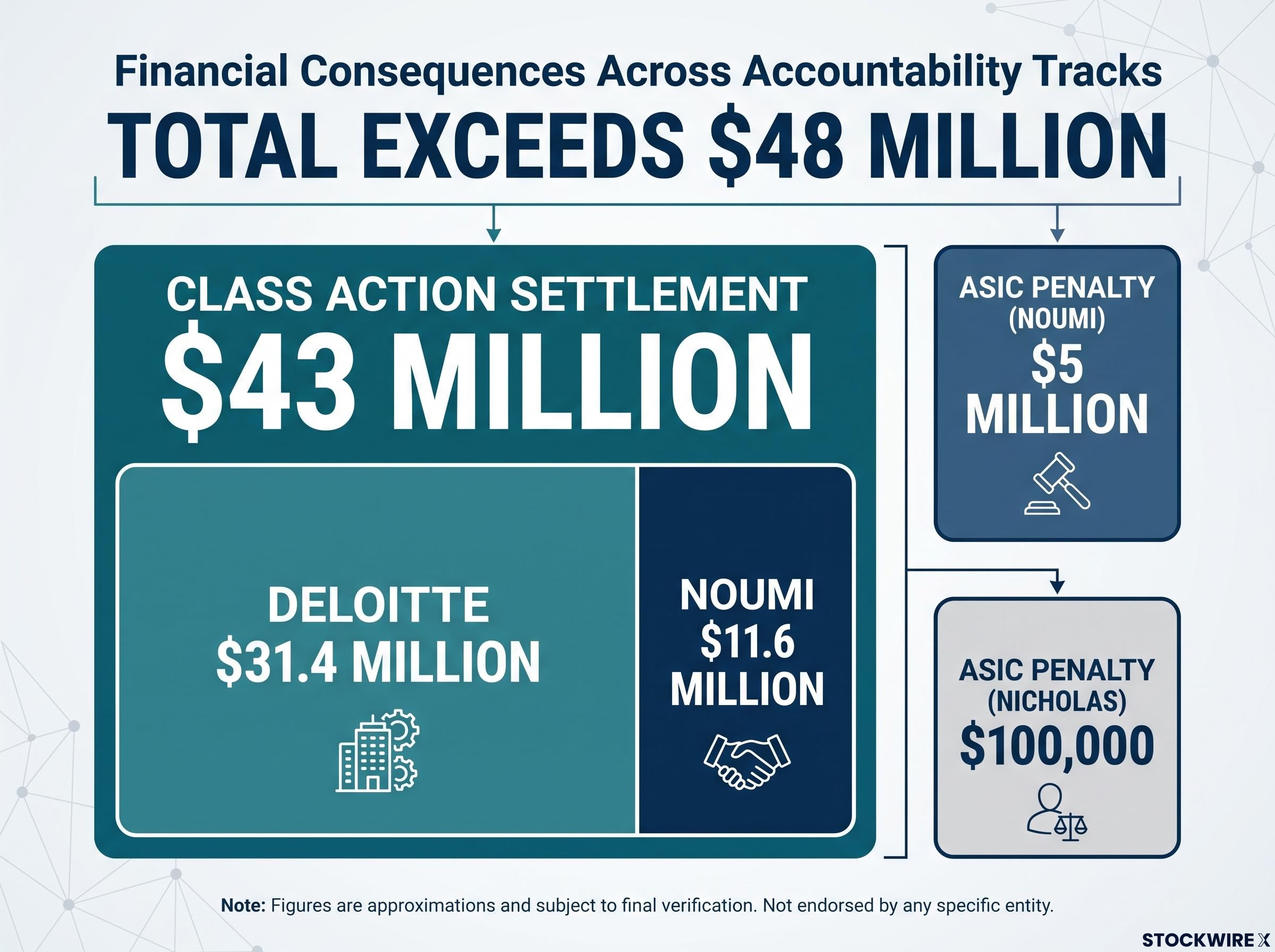
The settlement tells its own story. Noumi and Deloitte agreed to settle the claims for approximately $43 million. Deloitte contributed approximately $31.4 million, roughly three-quarters of the total. Noumi paid the balance of approximately $11.6 million.
This settlement is entirely separate from the ASIC civil penalty proceedings and does not constitute a finding of liability in those proceedings.
But the scale matters. Deloitte’s contribution of roughly three-quarters of a $43 million settlement signals that when audited accounts later prove to have not presented a true and fair view, the external auditor can face exposure that dwarfs the regulatory penalty imposed on the company itself. The $5 million ASIC penalty against Noumi is one-eighth of Deloitte’s settlement contribution alone.
| Accountability track | Outcome | Amount |
|---|---|---|
| ASIC penalty (Noumi) | Civil penalty, admitted contraventions | $5 million |
| ASIC penalty (Nicholas) | Civil penalty + 4-year disqualification | $100,000 |
| Class action settlement | Settlement (no finding of liability in ASIC proceedings) | ~$43 million (Deloitte ~$31.4M; Noumi ~$11.6M) |
The total financial consequence across all tracks exceeds $48 million. For you, that reframes the $5 million ASIC penalty: it is one component of a much larger accountability picture that operates across public enforcement, private shareholder litigation, and auditor exposure simultaneously.
The Macleod proceedings: what remains unresolved and why it matters
No finding of liability has been made against former CEO Rory Macleod. The proceedings are ongoing before the Federal Court, and nothing in this article should be read as prejudging the outcome.
ASIC’s proceedings against Macleod were commenced as part of the original February 2023 action. They concern the same FY19 and HY20 misstatements of inventory and revenue that formed the basis of the findings against Noumi and Nicholas.
The case has not yet reached a substantive hearing. Before it could, interlocutory disputes over legal professional privilege had to be resolved, including questions about whether communications retained their privileged status after voluntary disclosures to regulators. A Full Federal Court decision resolved those privilege issues in favour of ASIC and Noumi’s position, clearing the procedural path for the substantive case to proceed.
The current procedural position:
- Privilege disputes resolved (Full Federal Court, in ASIC/Noumi’s favour)
- Substantive case against Macleod pending
- Further case management before the Court scheduled for 27 August 2026
The 2026 hearing date tells you that major executive accountability proceedings in Australia routinely span years. Complex Federal Court corporate litigation involves numerous interlocutory steps before the substance is heard. If you are following this case for governance or investment reasons, treat it as an ongoing story rather than a resolved one.
What the Noumi case tells you about accountability in Australian listed markets
Three accountability threads run through this case, and the regulatory framework is designed to pursue each one independently. Noumi paid a $5 million penalty and admitted its continuous disclosure contraventions. Campbell Nicholas paid $100,000 and was disqualified for four years. Rory Macleod’s proceedings remain before the Federal Court with a next hearing in August 2026.
Alongside those regulatory outcomes, the $43 million class action settlement (a separate matter, with no finding of liability in the ASIC proceedings) demonstrates that private enforcement by shareholders operates as a parallel track, and that auditor exposure can exceed the company’s own regulatory penalty by a significant multiple.
The governance lesson is specific. Continuous disclosure is not a gate you pass once. It is a daily, active requirement. Every day that price-sensitive information remains undisclosed is a fresh contravention. ASIC Chair Sarah Court’s statement that directors and officers bear an active obligation to ensure accuracy reinforces this: the regime holds individuals accountable, not just the corporate entity.
The Federal Court’s findings on executive liability for compliance failures in ASIC v Bekier drew a precise line between executives who controlled information flows to the board and non-executive directors who received inadequate reporting, the same information-dependency that the Nicholas judgment made visible in the Noumi chain of command.
What remains open
The Macleod proceedings are the live component. When they are resolved, the outcome will add a further data point to how Australian courts treat CEO-level accountability for financial reporting failures. For now, the accounting and disclosure failures of 2019 are still producing legal consequences in 2026, illustrating the long tail of corporate misconduct prosecuted through civil penalty proceedings.
The Noumi case is not an outlier. It is a template for how Australian regulators and courts approach layered accountability: company, officer, auditor, each on their own track, each producing consequences that compound rather than substitute for each other. That framework applies to every ASX-listed governance failure you will encounter going forward.
This article is for informational purposes only and should not be considered financial advice. Investors should conduct their own research and consult with financial professionals before making investment decisions.