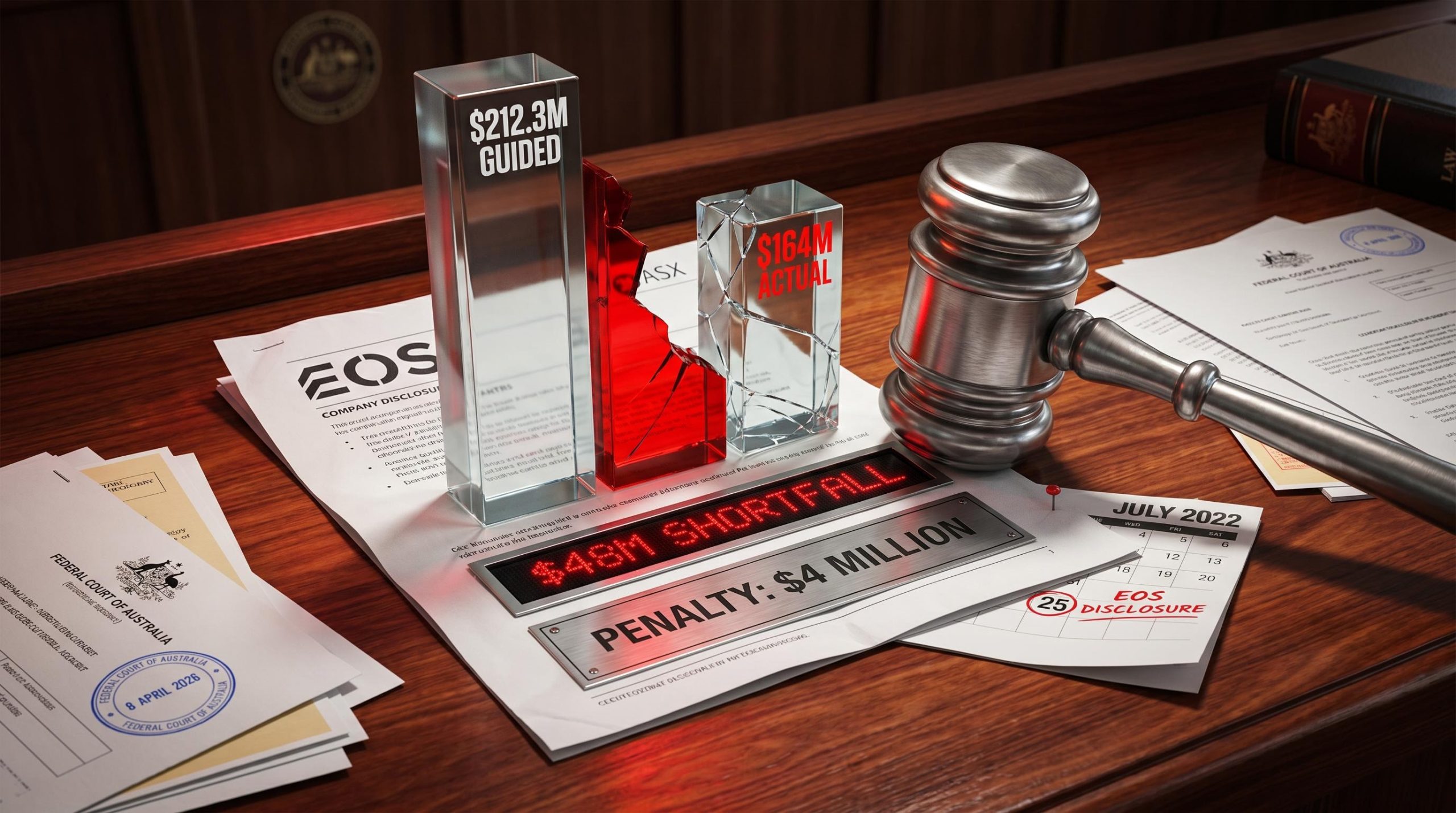
For 14 weeks in 2022, Electro Optic Systems Holdings (ASX: EOS) knew its revenue was tracking roughly $48 million below its own guidance and told the market nothing. The Federal Court’s 8 April 2026 judgment, ordering EOS to pay $4 million for that silence, is the latest ASIC enforcement action to test how seriously ASX-listed companies treat their continuous disclosure obligations. The case was not a close call: EOS had internal awareness of a material revenue shortfall and chose not to correct its public guidance for over three months. What follows explains exactly what EOS did wrong, why the court found the penalty appropriate, what ASIC’s enforcement posture signals to other listed companies, and what separate proceedings against former CEO Dr Ben Greene mean for individual director accountability.
What EOS knew and when it chose to stay silent
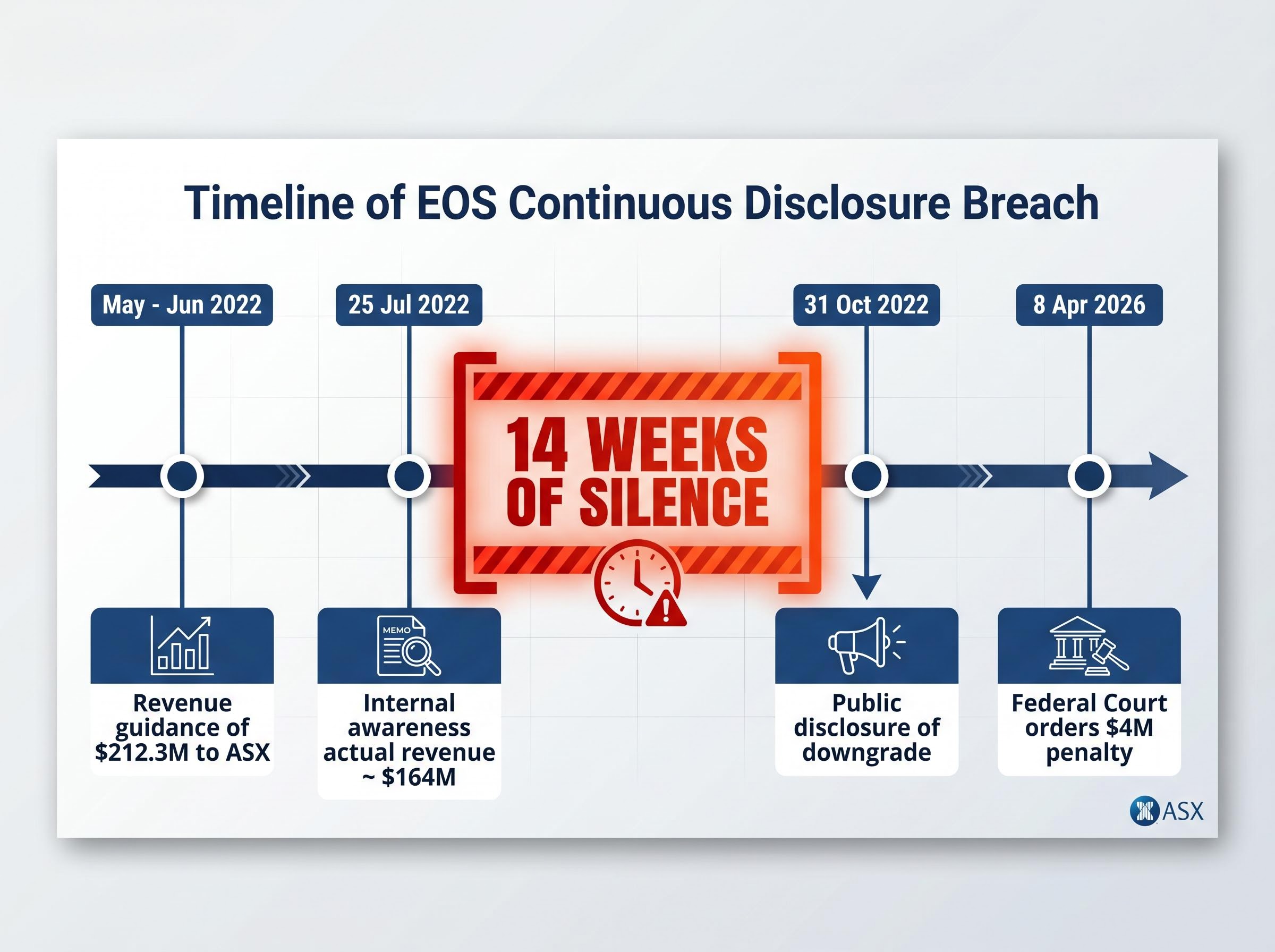
The timeline of the EOS continuous disclosure breach is the core of the Federal Court’s findings. The sequence runs as follows:
- May to June 2022: EOS communicated guidance to the ASX that revenue would meet or exceed $212.3 million.
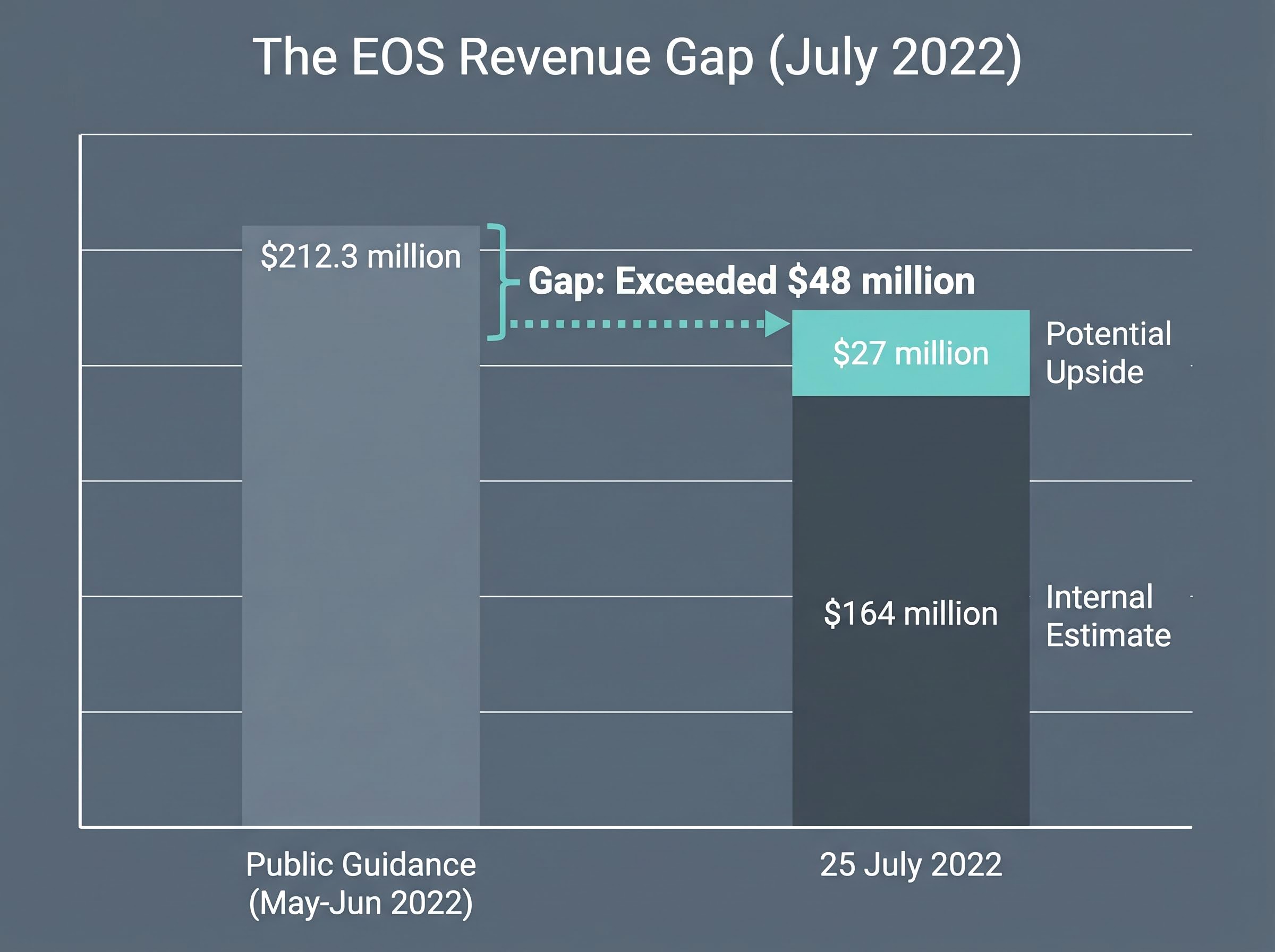
- 25 July 2022: EOS became internally aware that actual revenue would land at approximately $164 million, with potential upside of a further $27 million, still well short of guidance.
- 31 October 2022: EOS publicly disclosed the revenue downgrade, approximately 14 weeks after internal awareness.
- 8 April 2026: The Federal Court issued its penalty judgment.
Guided revenue: $212.3 million. Internal estimate as of 25 July 2022: approximately $164 million. The gap exceeded $48 million.
The court declared EOS in contravention of section 674A(2) of the Corporations Act from 25 July onward and on every subsequent day through to 31 October, treating each day of non-disclosure as a separate contravention under section 1317QA.
Investors who bought or held EOS shares during that 14-week window were making decisions based on guidance the company already knew was materially wrong.
When big ASX news breaks, our subscribers know first
How Australia’s continuous disclosure regime works and why timing is everything
The EOS case did not turn on a grey area in the law. It turned on a straightforward application of Australia’s continuous disclosure regime, a framework that treats awareness and obligation as simultaneous.
Under the ASX Listing Rules and the Corporations Act, listed companies must disclose information to the market immediately once they become aware of it, provided it meets the materiality threshold. The three core elements are:
- Materiality threshold: Information is material if a reasonable person would expect it to have a material effect on the price or value of the company’s securities.
- Immediacy requirement: Once material information is known internally, disclosure must follow promptly. There is no grace period for internal deliberation.
- Statutory alignment: The ASX Listing Rules operate in tandem with the Corporations Act, meaning a breach of continuous disclosure obligations is both a listing rule breach and a statutory contravention carrying court-ordered penalties.
What counts as “material” information
The materiality test asks whether a reasonable person would expect the information to have a material effect on the price or value of the entity’s securities. Applied to EOS, a $48-million-plus gap between guided and likely actual revenue plainly meets this threshold. No reasonable investor would consider that gap immaterial to a buy, hold, or sell decision.
The court’s use of section 1317QA to declare a contravention for each day of non-disclosure illustrates how the regime compounds legal exposure the longer a company delays. As ASIC Chair Joe Longo stated, disclosure delays undermine investor confidence and market integrity.
The $4 million penalty and what the court said about it
The penalty was agreed between the parties and endorsed by Justice Ian Jackman at a hearing on 2 April 2026, with the formal judgment issued on 8 April 2026. ASIC’s official media release confirming the outcome followed on 9 April 2026.
| Detail | Particulars |
|---|---|
| Penalty amount | $4 million (agreed between parties) |
| Hearing date | 2 April 2026 |
| Judgment date | 8 April 2026 |
| Court / Judge | Federal Court of Australia / Justice Ian Jackman |
| Statutory provisions | s 674A(2) and s 1317QA, Corporations Act |
| Costs order | EOS ordered to pay ASIC’s legal costs |
Justice Jackman endorsed the $4 million figure as appropriately sized relative to EOS’s scale and financial capacity, achieving both specific and general deterrence without being disproportionate.
The agreed-penalty structure carries its own signal. A company that settles rather than contests enforcement action has effectively accepted the breach, and the financial consequence extends beyond the headline figure once ASIC’s legal costs are factored in.
ASIC’s action against Dr Ben Greene and what individual liability means for directors
The corporate penalty resolved one dimension of the EOS disclosure failure. A second remains open.
ASIC commenced separate proceedings against former EOS CEO and Director Dr Ben Greene for alleged breaches of directors’ duties in connection with the same disclosure failure. The proceedings were initiated in November 2025 and remain ongoing as of May 2026.
The 8 April 2026 judgment on the corporate penalty makes no reference to Dr Greene. ASIC’s 9 April 2026 media release similarly omits any mention of the individual proceedings, confirming they run on an independent track.
The rationale for pursuing individuals separately is straightforward: corporate penalties alone do not create personal accountability for the decision-makers involved. The current status of each enforcement stream:
- Corporate penalty: Resolved. $4 million paid, plus ASIC’s legal costs.
- Individual proceedings against Dr Ben Greene: Ongoing as of May 2026. No hearing dates or outcomes have been publicly confirmed. The Federal Court of Australia case tracker and future ASIC media releases are the recommended sources for updates.
For investors evaluating board-level governance risk, the distinction matters. Even after a company resolves its regulatory exposure through an agreed penalty, former executives may face personal liability through separate court proceedings.
What the EOS case signals for ASX-listed companies and their investors
The EOS outcome is consistent with ASIC’s stated commitment to enforcing continuous disclosure as a market integrity priority. Three takeaways apply to ASX-listed companies and their boards:
- Awareness triggers obligation. Once a company’s management knows material information, the disclosure clock starts. Multi-week delays now demonstrably attract court-ordered penalties and cost recovery.
- Penalties are court-ordered and public. The agreed $4 million penalty, endorsed by the Federal Court, establishes a visible benchmark for what companies face when they treat material guidance downgrades as discretionary.
- Individual director liability runs independently of corporate resolution. A company settling with ASIC does not shield the individuals who made or permitted the non-disclosure decision.
ASIC Chair Joe Longo has stated that disclosure delays undermine investor confidence and market integrity, positioning the EOS enforcement outcome as part of a broader regulatory programme.
The case also illustrates how disclosure weakness can generate compounding scrutiny. In December 2025, ASX separately flagged inadequate disclosure in an EOS high-energy laser contract announcement, an incident distinct from the 2022 breach. EOS responded with an internal disclosure policy overhaul.
As of 6 May 2026, EOS shares traded at approximately $10.23, up roughly 5.25% year-to-date, with an average analyst target of $12.96. Simply Wall St noted governance risk in a post-judgment assessment, a flag that underscores how enforcement history can follow a company even when the headline penalty is paid.
A $4 million lesson the ASX’s disclosure rules are not optional
EOS’s 14-week silence on a revenue downgrade exceeding $48 million cost the company $4 million in penalties and ASIC’s legal costs. Separate proceedings against former CEO Dr Ben Greene remain unresolved.
The disclosure gap was not a technicality. It was a period during which retail investors lacked information the company already held, information that plainly met the materiality threshold under the Corporations Act.
As ASIC continues to enforce continuous disclosure obligations through court-ordered penalties, the EOS case sets a clear benchmark: material information is not discretionary, and the cost of treating it as such is now a matter of public record.
This article is for informational purposes only and should not be considered financial advice. Investors should conduct their own research and consult with financial professionals before making investment decisions.