The NASDAQ 100 can absorb a newly listed trillion-dollar company in roughly 15 days. The S&P 500 cannot touch it for at least a year. For investors holding broad market ETFs, that asymmetry may matter more than any hype cycle surrounding the largest private technology companies approaching public listings.
SpaceX, OpenAI, and Anthropic are the most closely watched private companies in the world right now, with combined market estimates placing their collective value in the trillions of dollars. As each approaches the possibility of a public listing, a structural feature of how major US indices admit new members is drawing renewed attention from portfolio-minded investors. What follows is an explanation of what the NASDAQ fast-entry rule actually does, how it compares to S&P 500 inclusion criteria, where each of the three major AI-era companies sits on the path to listing, and what that means for investors evaluating their current ETF exposure before these IPOs arrive.
The three companies everyone is watching: where each one actually stands
SpaceX sits nearest to a conventional public listing based on available reporting. Market estimates place its anticipated valuation between $1 trillion and $2 trillion, and coverage from 2024-2026 has framed a listing as expected or anticipated. However, no SEC S-1 registration statement has been filed, no NASDAQ or NYSE listing notice exists, and no roadshow has been officially confirmed through May 2026. Reports of a mid-2026 roadshow remain attributed to unnamed sources rather than official company communications.
OpenAI faces a different kind of obstacle. The company operates under an unusual structure in which the OpenAI nonprofit remains the controlling entity over OpenAI Global LLC, which issues capped-profit equity interests rather than ordinary common stock. Financial analysts and major financial press, including the Financial Times and Bloomberg, have repeatedly highlighted this structure as a material complication for a conventional IPO. Public investors typically expect normal common equity with standard voting and economic rights. No formal conversion to a standard for-profit corporation has been announced as of May 2026, and no specific IPO timeline has been disclosed. The company’s estimated valuation sits at approximately $1 trillion (a market estimate, not formally disclosed).
OpenAI’s nonprofit-controlled structure is more than a regulatory technicality: it creates compounding uncertainties around Microsoft’s equity stake, the mechanics of any for-profit conversion, and shareholder recourse that have no clean precedent in prior large-cap IPOs.
Anthropic occupies a third position entirely. Backed by Amazon and Google through confirmed large strategic investments, Anthropic’s valuation rose from $18-$30 billion in early large funding rounds to substantially higher levels in subsequent tranches, according to the Wall Street Journal, Financial Times, and Bloomberg. Claims of a $300 billion valuation following a January 2026 funding round have not been independently confirmed by major financial media. What is confirmed: over 1,000 companies globally are each spending more than $1 million annually on the Claude platform. Anthropic remains pre-profit, and that status would create a specific eligibility barrier for S&P 500 inclusion even after a potential listing.
For investors already holding broad technology positions, Microsoft and Google (Alphabet) currently provide indirect, partial exposure to OpenAI and Anthropic respectively through existing ownership stakes.
| Company | Estimated Valuation | Key Structural Barrier | Profitability Status | Indirect Public Exposure |
|---|---|---|---|---|
| SpaceX | $1-$2 trillion (market estimate) | No S-1 filed; no confirmed roadshow or listing date | Not publicly disclosed | None via public equity |
| OpenAI | ~$1 trillion (market estimate) | Nonprofit-controlled, capped-profit structure requires restructuring | Not publicly disclosed | Microsoft (ownership stake) |
| Anthropic | $18-$30B+ confirmed rounds; higher claims unconfirmed | Pre-profit status blocks S&P 500 eligibility post-listing | Pre-profit | Google/Alphabet, Amazon (ownership stakes) |
Understanding exactly where each company sits, rather than treating all three as equivalently imminent, helps investors set accurate expectations and avoid decisions based on timelines that remain unconfirmed.
When big ASX news breaks, our subscribers know first
Why the NASDAQ 100 and S&P 500 play by completely different rules
Most investors assume the major US indices work roughly the same way. They do not. The NASDAQ 100 and the S&P 500 operate under fundamentally different inclusion methodologies, and the gap between them is not a quirk. It reflects distinct philosophies about what each index is designed to capture.
How the NASDAQ 100 fast-entry rule works
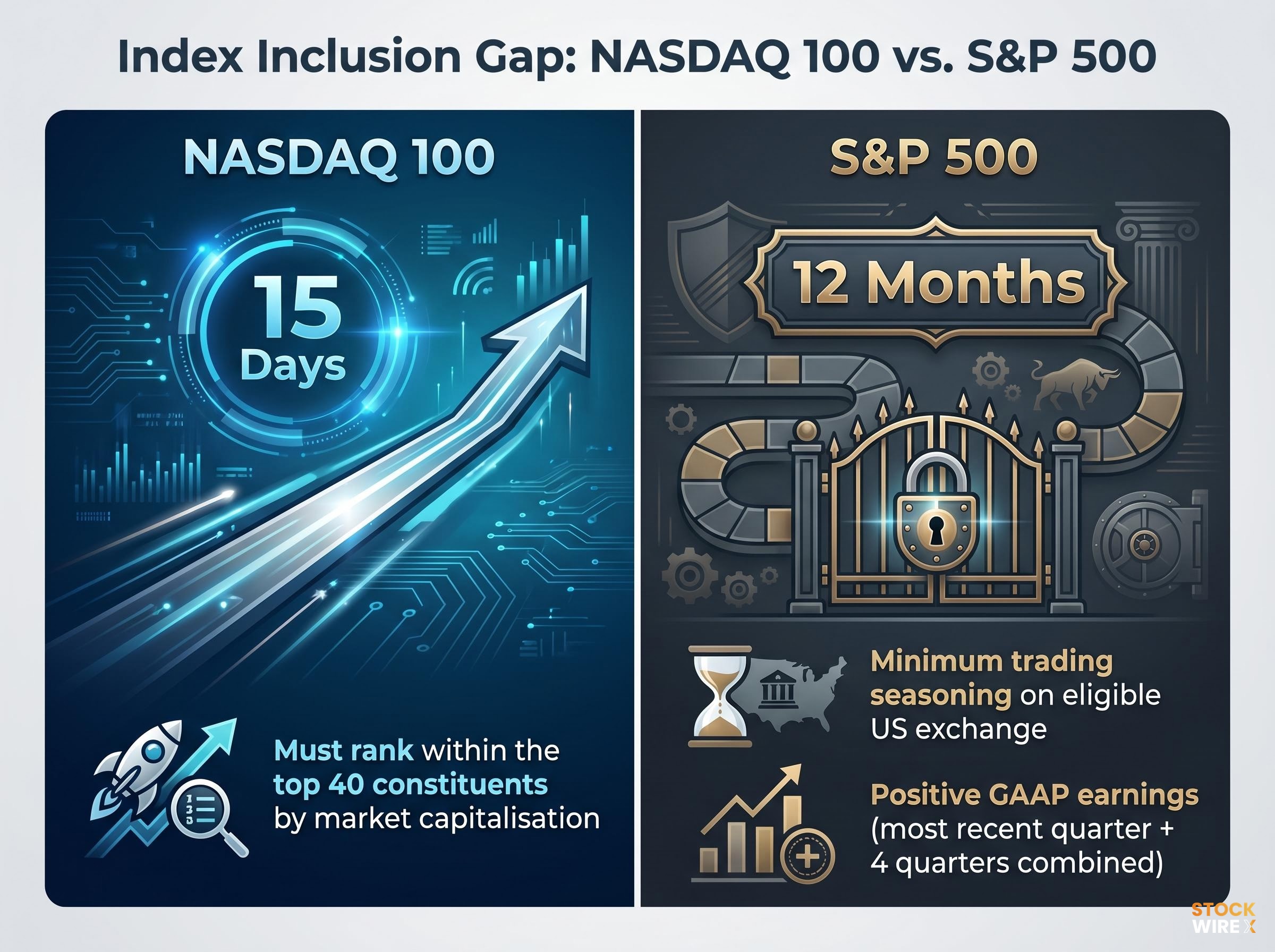
The official Nasdaq 100 Index Methodology provides a mechanism for large IPOs to bypass the standard annual reconstitution process. Under the fast-entry rule, a newly listed company can be added to the NASDAQ 100 approximately 15 days after listing, provided it ranks within the top 40 constituents by market capitalisation. The NASDAQ explicitly positions itself as the preferred listing venue for high-growth technology and innovation companies emerging from the venture capital ecosystem. A trillion-dollar AI company listing on the NASDAQ would almost certainly clear the top-40 threshold on day one.
The Nasdaq 100 Index Methodology published directly by Nasdaq Global Indexes codifies the fast-entry rule and specifies that candidates ranked within the top 40 by market capitalisation and meeting all eligibility criteria may be added approximately 15 trading days after listing, making the mechanism a confirmed structural feature rather than an informal practice.
What the S&P 500 actually requires before adding a new member
The S&P 500’s gates are more numerous and more rigid. According to the S&P U.S. Indices Methodology, a company must satisfy all of the following simultaneously:
- Listing seasoning: a minimum of 12 months trading on an eligible US exchange
- GAAP profitability: positive GAAP earnings in the most recent quarter, plus positive aggregate GAAP earnings across the four most recent quarters combined
- Market capitalisation: above the index’s minimum threshold
- Liquidity and public float: sufficient trading volume and shares available to public investors
All four gates must be satisfied at the same time. A company cannot queue through them sequentially.
Precedent: Tesla reportedly reached approximately the seventh-largest US company by market capitalisation before it achieved the profitability required for S&P 500 inclusion. The stock traded publicly for years while the index could not add it. That delay is not historical trivia; it is the same rule that would apply to any pre-profit AI company listing today.
What this means for your ETF: which index gets there first
The rule difference described above is not abstract. It translates directly into what an ETF is required to hold and when.
Index-tracking ETFs are obligated to adjust their holdings when the underlying index reconstitutes. The Invesco QQQ Trust (QQQ), along with newer low-cost NASDAQ 100 clones, must purchase any fast-entered constituent at or around the effective rebalancing date. The sequence from listing to portfolio inclusion for a qualifying company works as follows:
The index inclusion timeline matters most to investors who hold ETFs rather than individual stocks, and that distinction turns on what ETF ownership actually means: an obligation for the fund manager to mirror the index, including any new constituent added through a fast-entry or standard reconstitution process.
- The company lists on the NASDAQ exchange
- The index provider assesses whether the new stock ranks within the top 40 by market capitalisation
- If it qualifies, a fast-entry decision is made
- An effective inclusion date is set, approximately 15 days after listing
- NASDAQ 100-tracking ETFs purchase shares to match the new index weighting
S&P 500-tracking ETFs face no such obligation during that period. They cannot hold the company until all S&P 500 eligibility criteria are satisfied and the index committee acts, potentially 12 or more months later.
NASDAQ 100-tracking ETFs could hold a newly listed AI company within weeks. S&P 500-tracking ETFs may wait more than a year.
For an investor whose equity exposure is concentrated in S&P 500-tracking ETFs, the first year after a major AI IPO could represent a window of unintended exclusion from a company reshaping the index composition. ETF.com and Nasdaq ETF Insights commentary from 2024-2025 confirms this tracking mechanism, though no named analyst has yet explicitly tied the fast-entry rule to SpaceX, OpenAI, or Anthropic by name. The implication follows directly from the confirmed index methodology documents.
Is the AI investment boom built on real demand or inflated expectations?
The excitement is real. So is the question of whether it is durable.
Current AI sector growth metrics suggest the industry has moved past the speculative early phases most commonly associated with bubble conditions. Alphabet reported that token consumption across its AI services expanded by approximately 60% quarter-over-quarter in Q1 2026. Google Cloud revenue growth exceeded 60% year-over-year, with operating margins climbing from below 10% to approximately 32%. These are not speculative projections; they are disclosed financial results showing monetisation at scale.
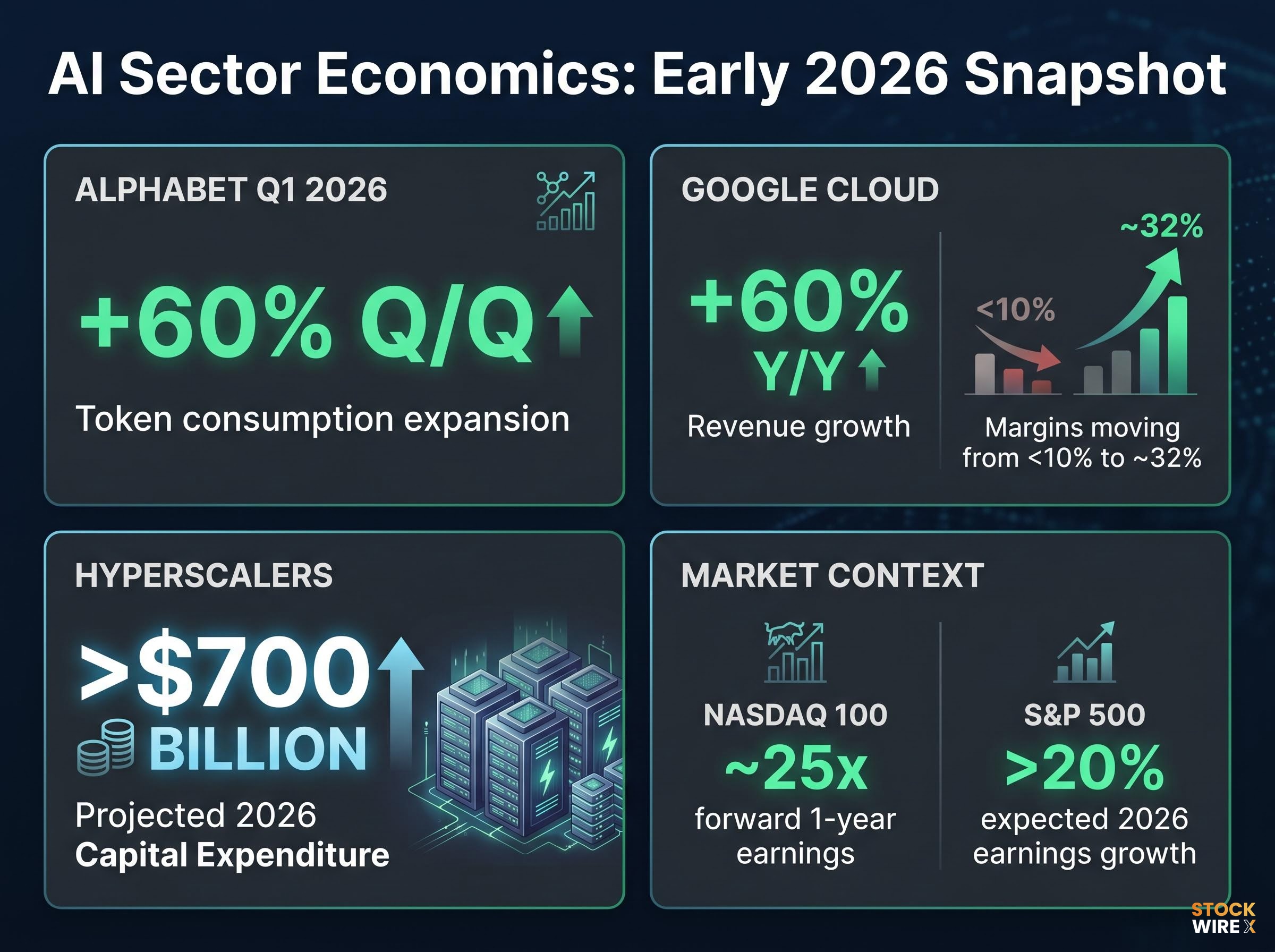
The financial health of the companies deploying the most capital adds further context. Most major hyperscalers hold net cash positions when accounting for cash balances against total debt, placing them in a strong financial position despite projected capital expenditure exceeding $700 billion for 2026. Oracle stands out as an exception, carrying a relatively elevated debt load compared to its peers.
The NASDAQ 100 is currently trading at roughly 25 times forward one-year earnings, which sits below its long-term historical average. The S&P 500’s expected earnings growth for 2026 exceeds 20%.
NASDAQ 100 valuation levels provide the necessary backdrop for assessing whether a fast-entry inclusion event would arrive into a market priced for perfection or one with room to absorb new large-cap constituents; the index has rallied approximately 18% from its April lows, pushing momentum indicators into overbought territory near defined resistance.
None of this means bubble risk has vanished. The three metrics analysts are monitoring for early signs of deceleration are:
- Slowing growth rates across AI-exposed companies
- Declining margins at major cloud providers
- Weakening earnings performance among hyperscalers
These indicators would signal that capital deployment is outpacing genuine demand. As of May 2026, none of the three has triggered. Investors evaluating whether to reposition ETF exposure ahead of major AI listings need this baseline read on whether the sector’s underlying economics justify current valuations, rather than relying solely on narrative momentum.
Before the IPO arrives: how investors can think about positioning now
The index mechanics described in this article are confirmed and actionable as a framework. The IPO timelines are not. That distinction matters for how investors use this information.
A practical starting point is a three-step self-audit of current ETF holdings:
- Identify whether each equity ETF in the portfolio tracks the NASDAQ 100 or the S&P 500. The index methodology determines the inclusion timeline for any future mega-cap listing.
- Check for existing indirect AI exposure. Investors holding Microsoft already carry partial exposure to OpenAI through its ownership stake. Investors holding Alphabet carry partial exposure to Anthropic. This changes the calculus for those who already hold broad technology positions.
- Assess tolerance for the seasoning gap. If a large AI company lists and enters the NASDAQ 100 within weeks but does not reach the S&P 500 for a year or more, determine whether that gap is acceptable or whether adding NASDAQ 100 exposure is warranted.
A note on timing uncertainty
None of the three companies has a confirmed public listing date as of May 2026. SpaceX’s reported mid-2026 roadshow timeline is attributed to unnamed sources and has not been confirmed by named sources in major financial media. No S-1 has been filed. OpenAI’s nonprofit-controlled structure has not been formally converted, meaning a near-term conventional IPO remains uncertain. Anthropic has disclosed no listing plans.
The index mechanics discussed in this article are confirmed methodology rules. The IPO timelines are speculative and subject to change. Investors are best served treating the former as a durable framework for ETF evaluation and the latter as a set of possibilities that will require confirmation before action.
This article is for informational purposes only and should not be considered financial advice. Investors should conduct their own research and consult with financial professionals before making investment decisions.
The index gap is real regardless of when these IPOs land
The NASDAQ 100 fast-entry rule and the S&P 500’s 12-month seasoning requirement are codified features of index methodology. They are not predictions about any specific company. Whenever SpaceX, OpenAI, or Anthropic lists publicly, the same structural asymmetry will apply: NASDAQ 100-tracking ETFs are positioned to capture large-cap technology IPOs earlier than S&P 500-tracking vehicles by design.
For US equity investors, the practical takeaway is straightforward. Knowing which index your ETF tracks determines how quickly your portfolio responds to the next wave of large technology listings. That knowledge allows for deliberate portfolio construction rather than accidental exposure gaps discovered after the fact.
The IPO dates remain unconfirmed. The index rules do not. Reviewing current ETF allocations now, with that distinction in mind, is the most concrete step available while the rest of the timeline takes shape.
For investors evaluating whether S&P 500-tracking ETFs are already capturing AI-sector gains through existing constituents, our full explainer on S&P 500 breadth dynamics examines the April 2026 data showing that only 23% of index constituents outperformed the benchmark, revealing how narrowly the headline gains were concentrated in the same AI and semiconductor mega-caps that dominate the index.