Australia’s IPO advertising rules were written for a market where information moved slowly and selectively. A company planning a float could barely say its own name publicly before lodging a prospectus. ASIC is now proposing to change that, and the shift touches every part of how public offerings are planned, marketed, and understood by ordinary investors.
The proposal sits inside a broader multi-year ASIC agenda that includes a fast-track IPO timetable trial, simplified sell-side research rules, and updated financial product advertising guidance. Understanding the pre-prospectus advertising reform in isolation misses the larger picture: Australia’s capital markets regulator is systematically narrowing the gap between how public and private markets operate.
Here is what the current rules actually say, what ASIC wants to change, what stays the same regardless of the outcome, and what it all means if you are watching the IPO market or planning to participate in one.
What the law currently says about pre-IPO advertising
Section 734 of the Corporations Act is the operative prohibition. It broadly bans advertising or publicising offers that require a prospectus before that prospectus is lodged with ASIC. The restriction is wide, and in practice it leaves companies with almost nothing they can say publicly in the lead-up to a float.
A narrow exception exists for what the industry calls “tombstone” advertising, limited to pre-lodgement communications about offers of unquoted securities. Under this exception, issuers can only:
- Identify the offeror and the securities
- State that a prospectus will be available when the securities are offered
- Direct anyone wanting to acquire the securities to use the application form in or accompanying the prospectus
- Optionally, explain how to obtain a copy of the prospectus
That is the full extent of what is permitted. No discussion of strategy, growth outlook, or business model. No testing of investor appetite.
The existing framework has been described as belonging to “another era” given how information now moves through digital channels, social media, and real-time financial platforms.
Regulatory Guide 254 (RG 254), reissued on 7 April 2026, retains this advertising and publicity framework in full. Separately, the ASIC Corporations (IPO Communications) Instrument 2020/722 provides limited class relief for pre-prospectus communications to employees and shareholders, but that operates alongside the general prohibition, not as a replacement for it.
For you as an investor, this is why IPO campaigns tend to feel like they appear fully formed with no public lead-up. The company preparing to float legally cannot discuss its business publicly until the prospectus is lodged.
When big ASX news breaks, our subscribers know first
How the current rules already bend: existing relief instruments
The current regime is not quite as monolithic as Section 734 suggests. ASIC has already recognised the case for some flexibility through the ASIC Corporations (IPO Communications) Instrument 2020/722, which grants class relief allowing pre-prospectus communications to employees and shareholders of the issuing company.
The problem is the scope. This existing relief covers internal audiences only. It does not extend to the broader market, institutional investors considering participation, or the retail investors who may ultimately be offered securities.
What crowd-sourced funding and PDS regimes already allow
The inconsistency becomes sharper when you compare the IPO framework with other fundraising structures. Crowd-sourced equity funding and product disclosure statement (PDS)-based offers already operate under more flexible advertising regimes. REP 823, released on 5 November 2025, found that the pre-prospectus advertising rules applying to IPOs sit out of step with the equivalent PDS advertising and publicity framework, and are also out of date given how information now circulates.
This matters because it tells you ASIC has long accepted the principle that some pre-offer communication is appropriate. The circle has simply been drawn too narrowly for it to matter to anyone outside the company itself. The proposed reforms are a logical extension of a framework that already accepts limited exceptions, not a radical departure from regulatory philosophy.
What ASIC is proposing to permit, and under what conditions
Under ASIC’s proposed framework, companies would be permitted to advertise unquoted securities before prospectus lodgement, with expanded content beyond basic identification. The key shift is that issuers could discuss their business, strategy, and the planned float publicly, something the current rules prohibit entirely.
The expanded permission comes with four conditions that would attach to any pre-prospectus communication:
- All pre-prospectus communications must name the issuer and any seller of the securities being offered
- The issuer must ensure a prospectus is made available no later than the point at which the securities are offered or listed
- Communications must set out when investors will be able to access the prospectus and through what channel
- Investors must be directed to the prospectus as the document on which they should base their investment decisions
Pre-prospectus communications would still need to be consistent with the eventual prospectus and cannot be misleading or deceptive. ASIC has framed the changes as positioning Australia alongside comparable overseas regulatory settings, and as closing the gap with other domestic fundraising frameworks that already permit broader pre-offer communications.
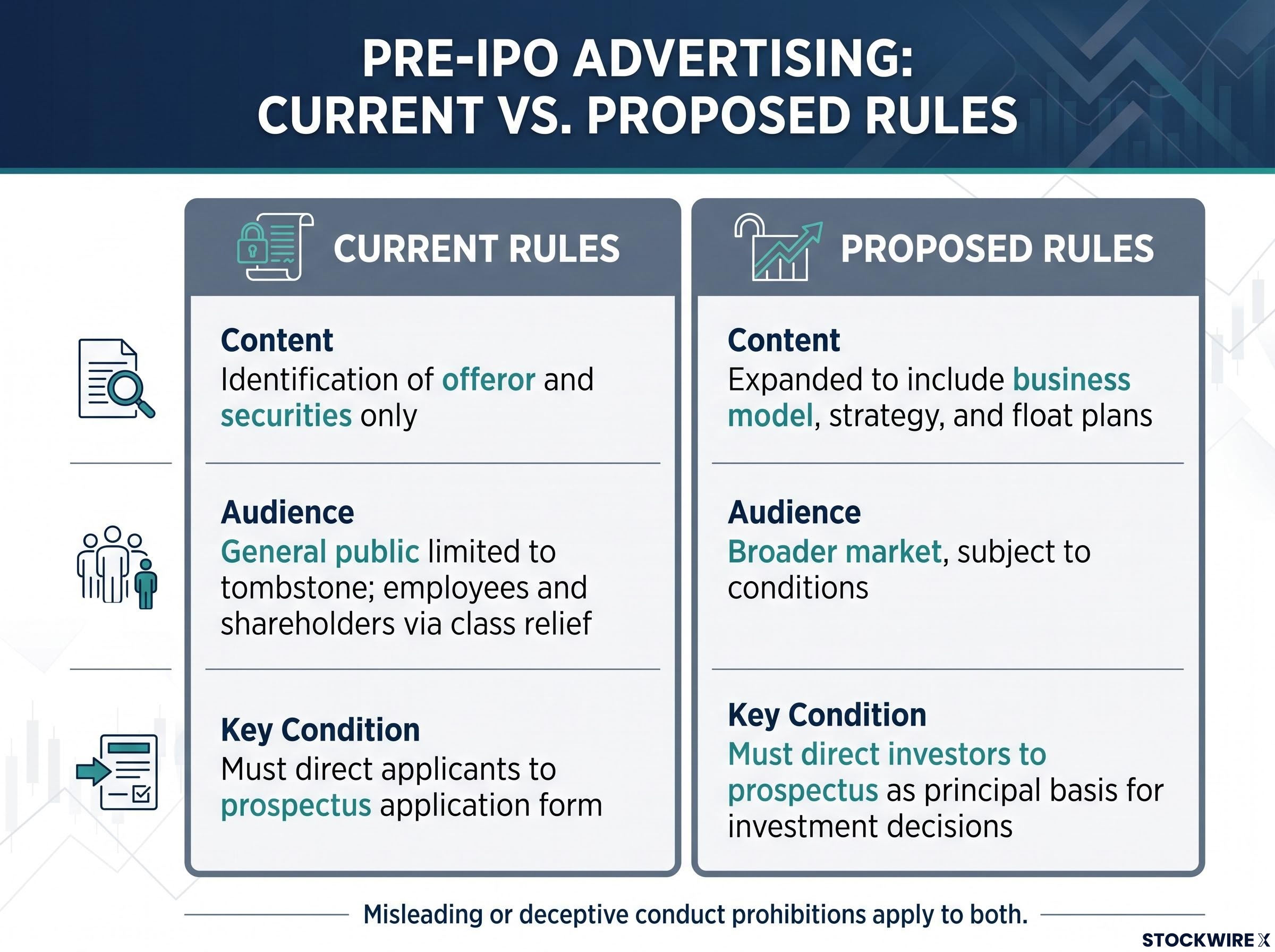
The proposals were released in 2026, with public feedback sought until 11 September 2026. If you are tracking this reform, verify the current consultation status against ASIC’s official publications, as the timeline may have evolved since publication.
| Element | Current rules | Proposed rules |
|---|---|---|
| What can be said publicly | Identification of offeror and securities only; no business discussion | Expanded content including business model, strategy, and float plans |
| Audience | General public limited to tombstone; employees and shareholders via class relief | Broader market, subject to conditions |
| Key condition | Must direct applicants to prospectus application form | Must direct investors to prospectus as principal basis for investment decisions |
| Consistency requirement | Misleading or deceptive conduct prohibitions apply | Must be consistent with eventual prospectus; misleading or deceptive conduct prohibitions apply |
The conditions tell you something important: this is a shift in what companies can say publicly, not a removal of accountability. The prospectus remains the document that carries legal weight, and pre-prospectus advertising is explicitly subordinated to it.
Why these rules existed in the first place, and why ASIC says they need updating
The original pre-prospectus advertising restrictions were designed to address three specific risks:
- Selective drip-feeding: Stopping issuers from pushing only positive information into the market ahead of formal disclosure, rather than presenting a balanced picture
- Insufficient analysis: Steering investors away from basing decisions on marketing material alone, and towards the more complete picture provided by the full prospectus
- Information asymmetry: Ensuring all investors have access to the same formal disclosure at the same time
Those protections made sense in a market where information moved through controlled channels. The problem ASIC now faces is that the information environment has changed fundamentally, and the restrictions have not kept pace.
Under current settings, companies preparing to float cannot:
- Explain their strategy and growth plans to the public
- Test investor demand before committing to the full prospectus process
- Correct rumours or misinformation circulating ahead of a float
ASIC has characterised the existing framework as belonging to “another era” given contemporary digital communications realities.
REP 823, released on 5 November 2025, formally acknowledged that the pre-prospectus advertising restrictions are inconsistent with how advertising already works under the PDS regime. The original design assumed information asymmetry was something a regulator could control by restricting formal channels. In a digital environment, the asymmetry already exists through informal channels, social media, and market speculation. Structured pre-prospectus advertising would actually give ASIC more visibility and control over what is being communicated, rather than less.
ASIC has framed the proposed changes as a recalibration of the original protection, not a removal of it. That distinction matters when you are evaluating whether this represents genuine modernisation or regulatory loosening.
The broader reform picture: what else ASIC is changing in Australia’s public markets
The pre-prospectus advertising proposal is one piece of a coordinated regulatory agenda. ASIC’s broader programme targets the structural gap between Australia’s public and private markets, a gap that has widened as superannuation funds and institutional investors increasingly direct capital into private market alternatives.
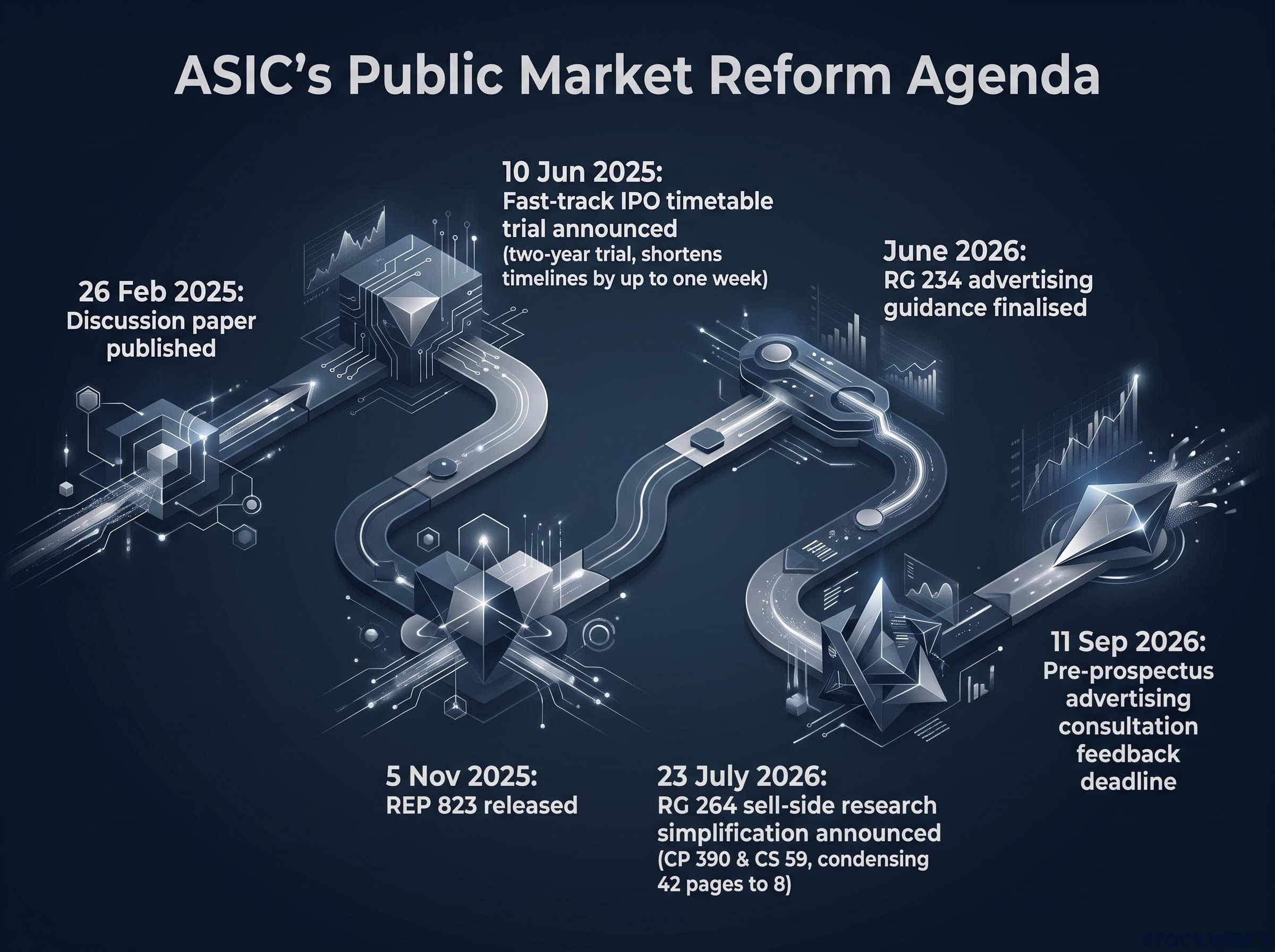
The strategic foundation was laid in a discussion paper published on 26 February 2025, which explored the dynamics between public and private markets, drawing attention to the trend of fewer companies listing publicly, the expanding pool of capital flowing into private assets, and the increasing weight of superannuation in that equation. A follow-up response report, REP 823, released on 5 November 2025, confirmed the direction of travel: ASIC would pursue reforms to make public listing more attractive and reduce unnecessary regulatory friction.
ASIC’s capital markets reform plan sequences the IPO advertising change alongside infrastructure accountability measures, digital finance experimentation under Project Acacia, and enforcement recalibration, making the pre-prospectus advertising consultation one node in a structurally coherent programme rather than a standalone policy adjustment.
| Reform | Status | Key detail |
|---|---|---|
| Pre-prospectus advertising | Consultation (feedback sought until 11 September 2026) | Expanded pre-lodgement communications for IPOs, subject to conditions |
| Fast-track IPO timetable trial | Operational (announced 10 June 2025, two-year trial) | Qualifying offer documents receive informal ASIC review a fortnight before public lodgement, shortening overall IPO timelines by as much as one week |
| RG 264 sell-side research simplification | Consultation (announced 23 July 2026, via CP 390 and CS 59) | RG 264 guidance condensed from 42 pages down to 8, replacing prescriptive rules with a principles-based approach |
| RG 234 advertising guidance | Finalised (June 2026) | Updated guidance on advertising of financial products and services |
| RG 228 prospectus guidance | Under review | Part of broader modernisation agenda |
Taken together, these reforms tell you that ASIC is systematically removing friction from the path to public listing. That is relevant context if you are watching whether Australia’s listed market can compete with the increasingly attractive private capital alternatives that superannuation funds and institutional investors now access at scale. The IPO advertising change alone is unlikely to move the dial significantly; the full package is what determines whether the reform programme is coherent and sufficient.
What the proposed changes mean for companies and investors in practice
For companies planning a float
If the proposed reforms are implemented, companies preparing for an IPO would gain meaningfully expanded pre-listing communication options:
- Public discussion of the business: Issuers could speak about their business model, growth strategy, and the planned float before lodging a prospectus, something currently prohibited
- Demand testing: Earlier marketing would help gauge investor appetite and adjust deal structure or timing, reducing execution risk
- Rumour management: Companies could actively address market speculation or misconceptions before the prospectus lands
- Controlled messaging environment: Legitimised pre-prospectus advertising gives both issuers and ASIC a structured framework for reviewing pre-IPO communications
The trade-off is discipline. All pre-prospectus content must remain consistent with the eventual prospectus, and companies will need robust internal controls over messaging. The prospectus remains the document that carries legal liability.
The prospectus framework does not operate in isolation: continuous disclosure obligations attach once a company lists, meaning that executives who used expanded pre-prospectus advertising to shape market expectations face personal liability if those representations later diverge from timely disclosures required under ASX Listing Rule 3.1.
For investors watching the market
A richer pre-prospectus information environment creates real benefits and real risks for you:
- More lead time: You could learn about upcoming IPOs earlier, track company narratives, and form preliminary views ahead of prospectus lodgement
- More promotional noise: Pre-prospectus material will likely be more extensive and marketing-driven in tone; your job is to distinguish between promotion and formal disclosure
- The prospectus still counts: Under Chapter 6D of the Corporations Act, the prospectus remains the legally accountable disclosure document regardless of any changes to the pre-prospectus framework
- Investor discipline matters more, not less: Treat pre-prospectus communications as context and signalling, not as a basis for final investment decisions
ASIC has framed legitimising pre-prospectus advertising as enhancing regulatory oversight, not reducing it. By making pre-IPO communications visible and structured, ASIC can more easily review and act on problematic content. But for you, the practical discipline is straightforward: wait for the prospectus, read it critically, and treat everything that came before it as context rather than commitment.
The reform shifts when information flows, not what ultimately carries legal weight. If you treat expanded pre-prospectus advertising as equivalent to formal disclosure, you will be making a category error that the new rules do not protect against.
A framework in motion, not a settled outcome
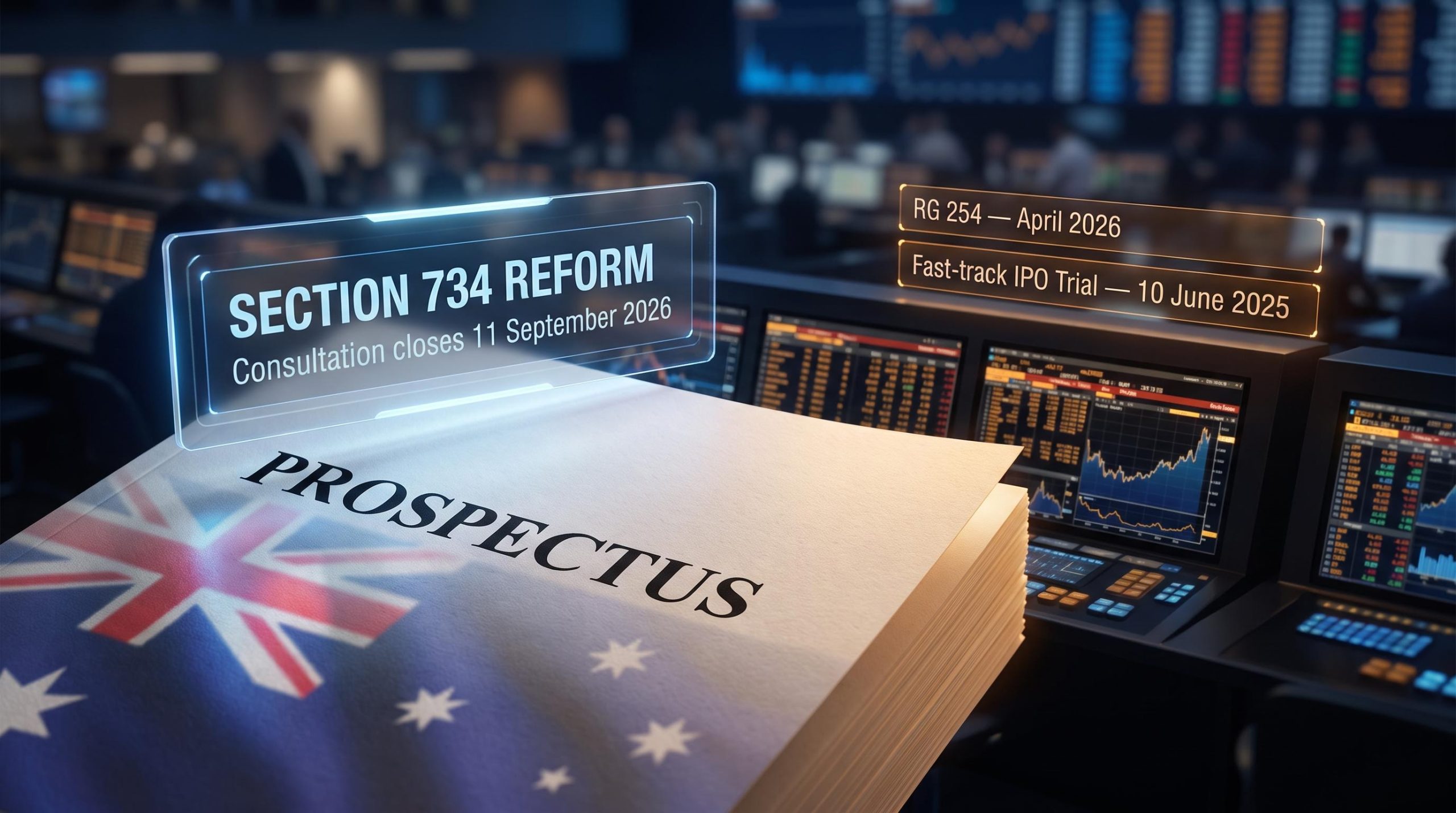
The current legal position is clear: Section 734 restrictions remain in force, RG 254 retains the existing advertising framework as of its April 2026 reissue, and no final rule change has been made. The proposed pre-prospectus advertising reforms are in consultation, with feedback sought until 11 September 2026 per the original source. Verify the current status against ASIC’s official publications, as the consultation timeline may have evolved.
The final form of the rules will depend on stakeholder input from issuers, intermediaries, and investor groups. The fast-track IPO trial, announced on 10 June 2025, is already operational and sits independent of the advertising consultation outcome.
What does not change regardless of outcome is the principle that the prospectus is the document that counts, for both legal liability and investment decision-making. That principle survives any version of the advertising reform.
For readers wanting to understand the full pathway from pre-IPO communications through to benchmark inclusion, our dedicated guide to ASX listing requirements covers both the eligibility criteria every company must clear and the separate index composition rules that govern ASX 200 inclusion.
ASIC’s approach across these reforms reflects a consistent underlying intent: reduce unnecessary complexity in public-market processes, raise the quality and timeliness of information available to investors, and preserve the disclosure-based protections that sit at the core of the regime.
This article is for informational purposes only and should not be considered financial advice. Investors should conduct their own research and consult with financial professionals before making investment decisions. These proposed reforms are subject to change based on the outcomes of ASIC’s consultation process and subsequent regulatory decisions.