In June 2025, Australia’s securities regulator secured guilty pleas from four individuals who used Telegram groups to inflate small-cap share prices before selling at the peak, leaving retail investors holding devalued stock. The scheme was not novel. It was not technically sophisticated. It worked because most of its victims did not know what to look for.
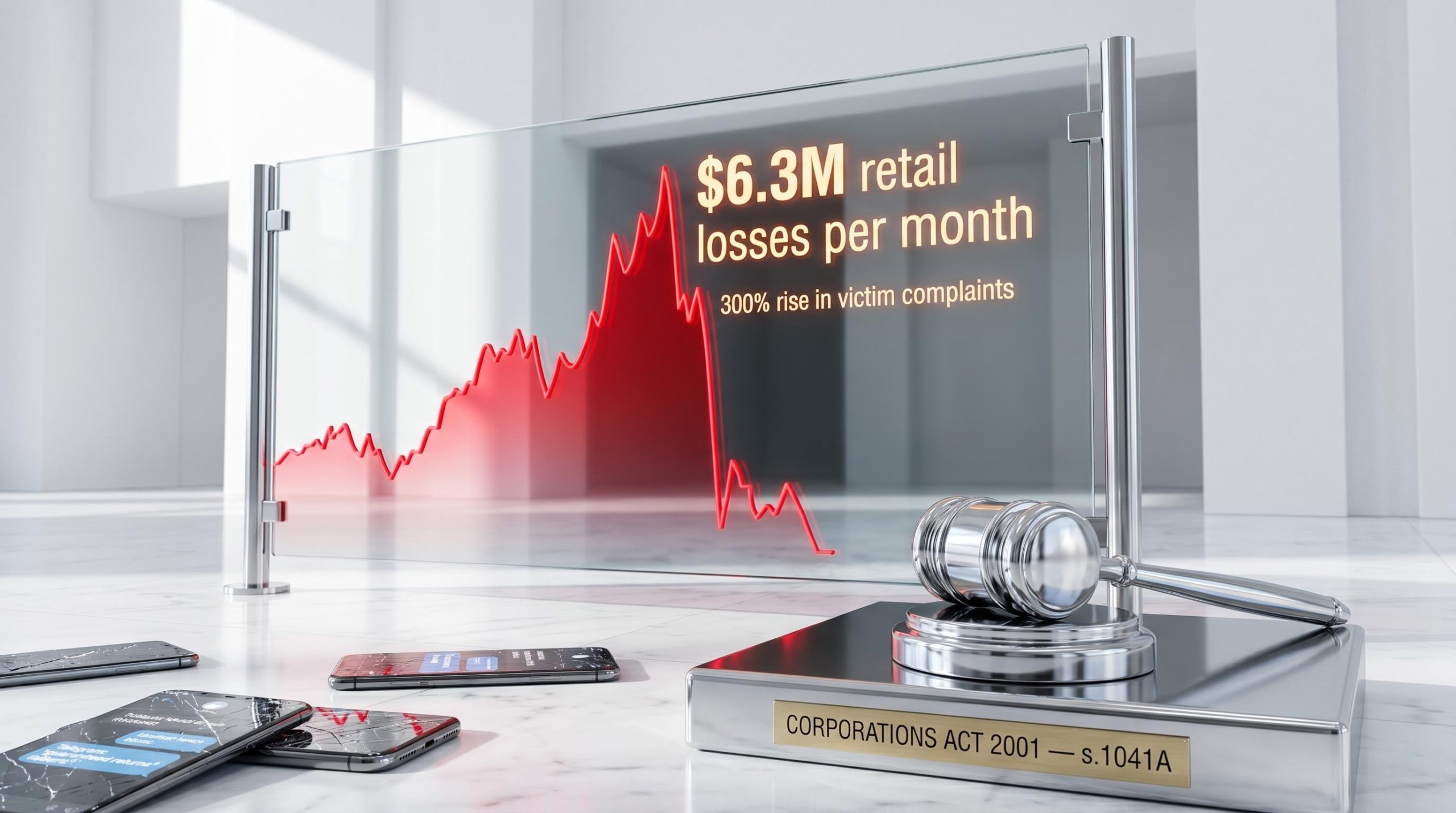
The financial harm from market manipulation in Australia is measurable and ongoing. ASIC reported a “notable rise” in pump-and-dump reports in December 2025, and Commissioner Alan Kirkland described these schemes as a “serious threat to market integrity and investor confidence.” A 2022 benchmark, the most recent quantified figure available, placed retail losses from pumped events at approximately $6.3 million per month. Crypto assets and thinly traded small-cap stocks remain the primary vehicles.
What follows explains exactly how pump-and-dump schemes, wash trading, and spoofing work at a mechanical level, who orchestrates them, why certain markets are targeted, and what signals retail investors can use to identify artificial activity before it costs them money.
Why low-liquidity markets are the natural habitat of price manipulation
Thinly traded assets, whether small-cap shares or low-volume crypto tokens, can be moved with relatively small amounts of capital. When there are few genuine buyers and sellers to absorb orders, a single coordinated group can shift the price in a direction that would be impossible in a deeply liquid market. This is not coincidence. Manipulators select these markets precisely because the price impact per dollar deployed is highest where genuine participation is lowest.
ASIC’s December 2025 warning (25-316MR) identified thinly traded overseas stocks and crypto assets as the primary vehicles for schemes targeting Australians. The structural features that make a market vulnerable are consistent across asset classes:
- Low average daily volume: fewer participants means each order carries disproportionate weight in price formation.
- Wide bid-ask spreads: the gap between what buyers offer and what sellers want signals thin competition and makes artificial price movement easier to execute.
- Small free float or circulating supply: a limited number of shares or tokens available for trading means a smaller capital base is needed to dominate order flow.
Amanda Zeller, ASIC Senior Executive Leader for Market Integrity, stated that schemes are “increasingly sophisticated” and involve “criminal gangs” targeting low-liquidity small-cap stocks. She noted that social media has dramatically amplified the reach of these schemes since COVID-19.
Understanding this structural vulnerability is the foundation for everything that follows. Any asset displaying these characteristics warrants heightened scrutiny, regardless of how compelling the promotion around it appears.
When big ASX news breaks, our subscribers know first
Pump-and-dump schemes: the mechanics of coordinated inflation and exit
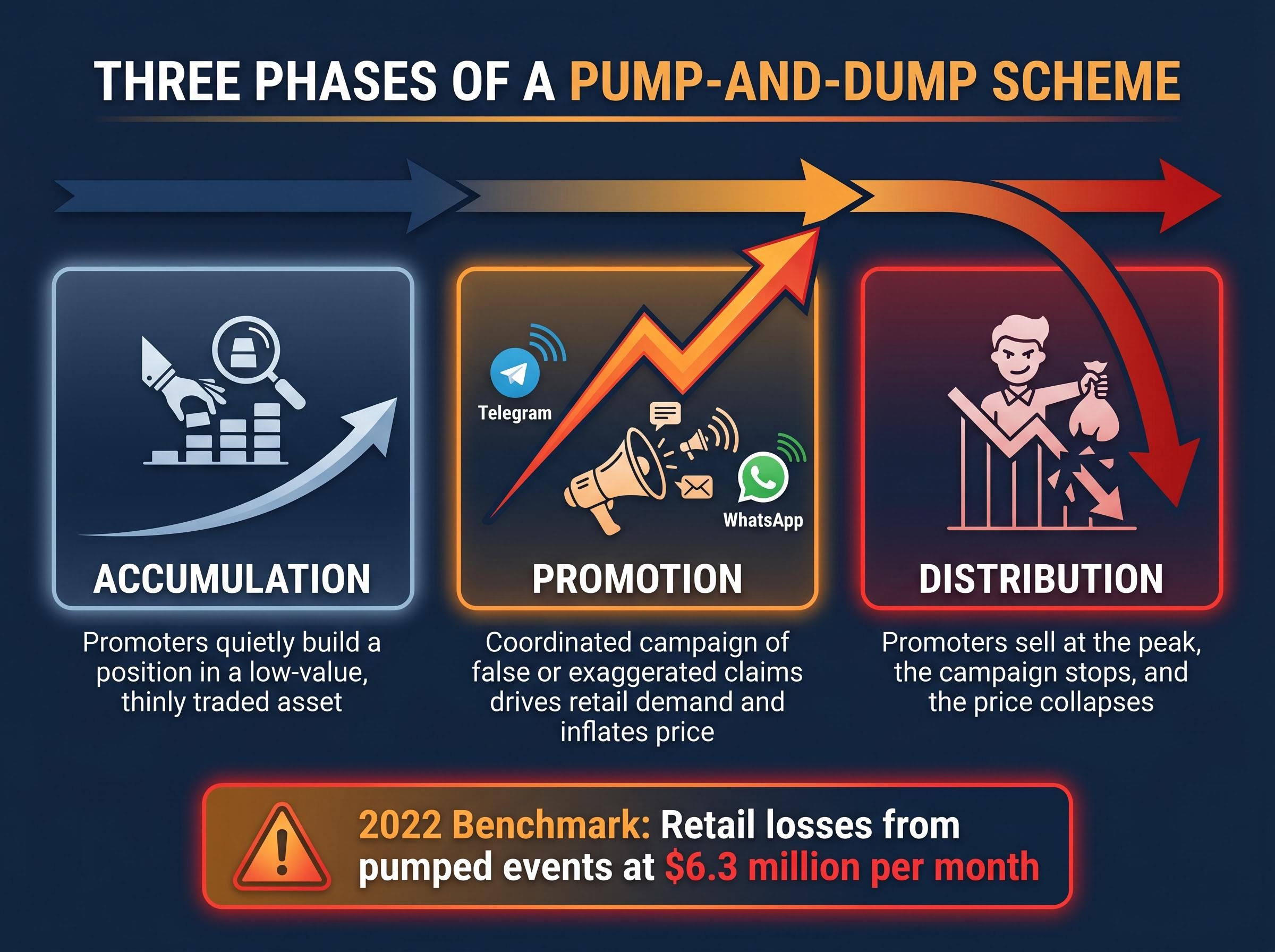
A pump-and-dump scheme operates in three distinct phases. Each phase is deliberate, and recognising the sequence makes the pattern visible in real conditions rather than only in hindsight.
- Accumulation: Promoters quietly build a position in a low-value, thinly traded asset. Purchases are spread over time to avoid triggering price alerts or unusual volume signals.
- Promotion: A coordinated campaign of false or exaggerated claims is deployed to attract buyers. The promotional push drives genuine retail demand, inflating the price well above its pre-scheme level.
- Distribution: Promoters sell their accumulated holdings at or near the peak price. Once selling is complete, the promotional campaign stops, demand evaporates, and the price collapses.
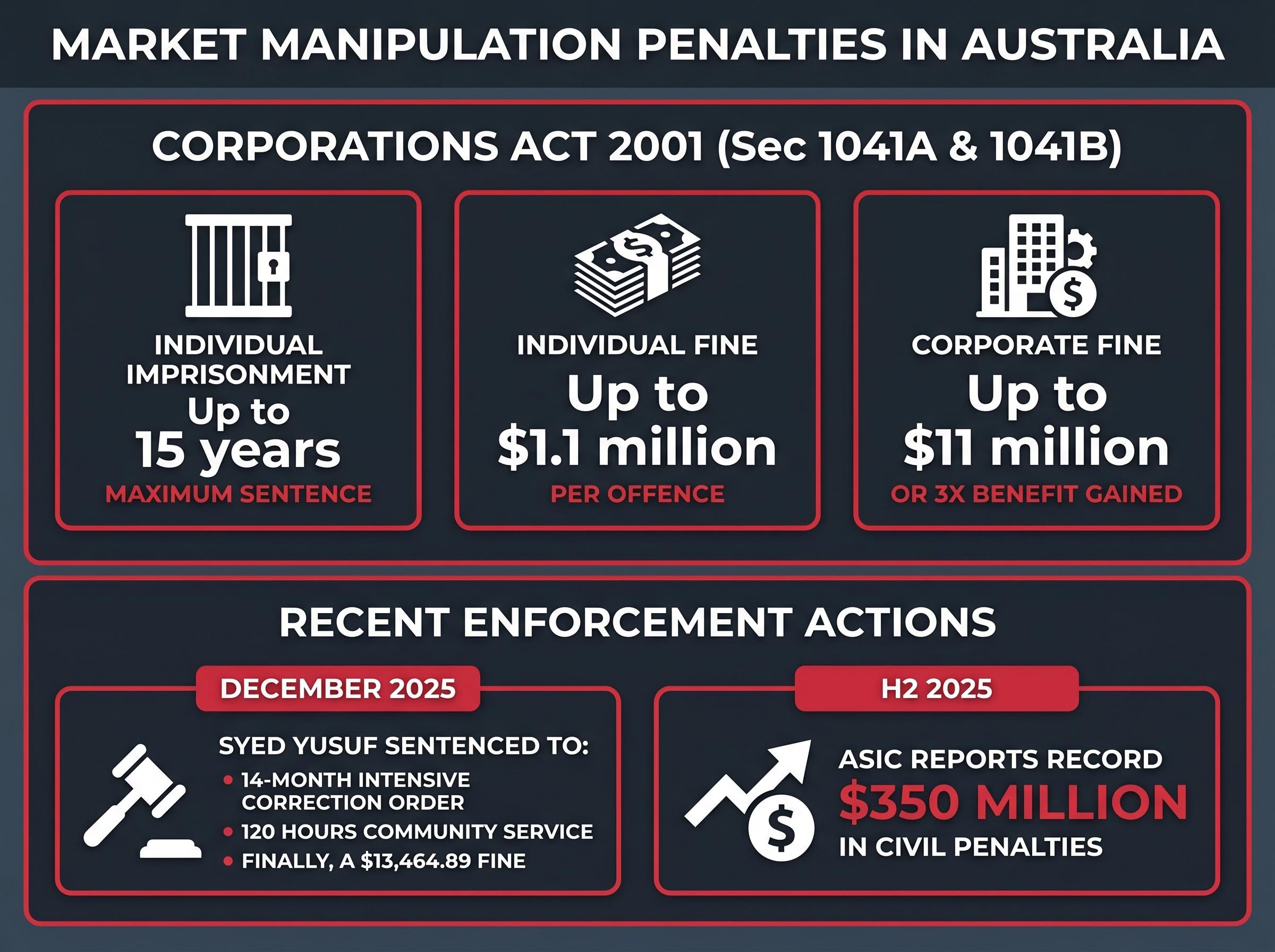
The June 2025 ASIC enforcement case (25-098MR) matched this template precisely. Four individuals pleaded guilty to using Telegram groups to inflate Australian small-cap share prices before exiting. In December 2025 (25-315MR), sentencing was handed down in Sydney District Court. Syed Yusuf received a 14-month Intensive Correction Order, 120 hours of community service, and a fine of $13,464.89. All four individuals received non-custodial sentences.
The scheme’s scale extends well beyond Australia. A July 2025 FBI public service announcement reported a 300% rise in U.S. victim complaints about pump-and-dump scams involving stocks and crypto over the prior year, a figure included here for international context.
ASIC Commissioner Alan Kirkland described pump-and-dump schemes as a “serious threat to market integrity and investor confidence,” causing losses for “unsuspecting investors.”
How Telegram and social media became the distribution infrastructure
Closed messaging groups on Telegram and WhatsApp allow promoters to reach large numbers of retail investors with coordinated messaging while avoiding public scrutiny. The messages are difficult for regulators to monitor in real time, and the groups can be created, populated, and deleted rapidly.
ASIC’s Moneysmart.gov.au guidance identifies specific tactics used in these channels: fake celebrity endorsements, urgency language, and “guaranteed returns” framing designed to override rational assessment. The post-COVID surge in social media investment communities created the environment that amplified this infrastructure. More retail investors joined online groups seeking investment ideas, and promoters exploited the trust dynamics within those communities.
What wash trading actually does to the market data you rely on
Trading volume is one of the first data points a retail investor checks when assessing an unfamiliar asset. A stock or token showing strong daily volume appears actively traded, liquid, and worth investigating. Wash trading manufactures that signal from nothing.
The mechanism is straightforward. Simultaneous or near-simultaneous buy and sell orders are placed in the same asset, often between related parties or accounts controlled by the same actor. No genuine change in ownership occurs. No real economic exposure changes hands. The only thing that changes is the volume figure displayed on the trading screen.
The distortion this creates is significant. Artificially inflated volume attracts genuine investors who believe they are entering a healthy, liquid market. In reality, the depth of participation is a fabrication.
| What the data appears to show | What is actually happening |
|---|---|
| High trading volume | Same beneficial owner on both sides of the trade |
| Active, liquid market | No genuine change in ownership |
| Strong price discovery | No real price discovery occurring |
Wash trading is prohibited under sections 1041A and 1041B of the Corporations Act 2001, which cover the creation of a false or misleading appearance of active trading. No specific named Australian enforcement cases involving wash trading in 2024-2025 were documented in available sources; however, the conduct is illegal under the same provisions that cover pump-and-dump. Internationally, FINRA’s 2025 alert noted a significant spike in complaints from social media investment groups promoting manipulative schemes, including crypto assets.
Spoofing: how a fake order book misleads the traders reading it
A retail investor watching an order book sees what appears to be a queue of genuine buying or selling interest at various price levels. Spoofing exploits this trust. Large buy or sell orders are placed in the order book to create the impression of demand or supply at a particular price, then cancelled before they can be filled.
The order book mechanics that govern how bids and offers are matched by price-time priority are the same mechanics that spoofing and wash trading distort; a manipulator does not need to break the rules of the system, they need only exploit the trust that other participants place in the signals it generates.
The sequence unfolds in four steps:
- A large order is placed at a specific price level, creating the appearance of significant buying or selling pressure.
- Other market participants, seeing the apparent demand or supply, adjust their own orders in response.
- The price moves in the direction the spoofer intended as participants react to the false signal.
- The fake order is cancelled before it can be executed, leaving the spoofer to trade at the new, artificially influenced price.
Spoofing is prohibited under sections 1041A and 1041B of the Corporations Act 2001, covering the creation of a false or misleading appearance of supply or demand. No specific named Australian spoofing enforcement cases in 2024-2025 were documented in available sources. The penalty framework for this conduct includes up to 15 years imprisonment for individuals, fines up to $1.1 million per offence for individuals, and up to $11 million for corporations (or three times the benefit gained, whichever is greater).
Why algorithmic markets amplify spoofing impact
Algorithmic trading systems are programmed to detect order book signals and respond in milliseconds. A spoofer does not need to fool a human reading the order book; they need to fool an algorithm interpreting it.
This makes spoofing particularly effective in high-frequency environments and in crypto markets where algorithmic trading is prevalent. The fake order only needs to exist long enough for automated systems to register and react. By the time a human trader would question the order’s legitimacy, the price movement has already occurred and the order has been withdrawn.
The legal framework Australians need to understand
All three tactics covered in this article, pump-and-dump, wash trading, and spoofing, are prohibited under the same legislative provisions. Sections 1041A and 1041B of the Corporations Act 2001 cover both the creation of false impressions of active trading and the artificial influence of asset prices. These are not grey-area practices subject to regulatory interpretation. They are criminal offences with substantial consequences.
| Penalty category | Maximum penalty |
|---|---|
| Individual imprisonment | 15 years |
| Individual fine (per offence) | $1.1 million |
| Corporate fine (per offence) | $11 million or 3x the benefit gained, whichever is greater |
ASIC’s enforcement activity in this area is accelerating. The regulator reported a record $350 million in civil penalties across the second half of 2025 (26-032MR), reflecting broad enforcement activity across financial markets. ASIC’s “Gatekeeper Expectations” guidance reinforces the obligation of market participants, including brokers and platform operators, to monitor social media for coordinated pump-and-dump activity. The guidance classifies coordinated online promotions as market manipulation under the Corporations Act.
The same ASIC enforcement posture that produced the pump-and-dump guilty pleas in June 2025 has extended across the crypto derivatives sector, with the Federal Court ordering a $10 million penalty against Binance Australia in March 2026 for misclassifying 524 retail investors as wholesale clients.
ASIC also participated in a London regulators’ meeting in late 2025 where sophisticated manipulation schemes were discussed, though no joint enforcement actions emerged from available sources.
Seven signals that should stop you before you invest
The mechanics described in this article become directly useful when translated into observable warning signs. One unusual data point may be noise, but multiple signals appearing together around the same asset warrant serious scrutiny.
- A sudden, unexplained volume spike in a previously dormant asset. This is consistent with the accumulation phase of a pump-and-dump or with wash trading designed to manufacture the appearance of interest.
- Promotional messages in closed Telegram or WhatsApp groups urging immediate action. This matches the distribution infrastructure ASIC has identified in recent enforcement cases.
- Claims of “guaranteed returns” or language designed to create urgency. ASIC’s Moneysmart.gov.au guidance identifies this as a consistent tactic used in pump-and-dump promotions.
- Fake celebrity endorsements or finfluencer hype attached to a thinly traded stock or token. These are documented promotional tactics flagged by ASIC.
- An order book showing large buy or sell orders that repeatedly appear and disappear. This pattern is consistent with spoofing, where fake orders are placed to mislead other participants and then cancelled.
- The asset is thinly traded with wide bid-ask spreads and a small free float. These are the structural conditions that make manipulation viable, as explained earlier.
- The opportunity arrived unsolicited, through a channel not affiliated with a licensed financial adviser or regulated platform. ASIC’s December 2025 warning (25-316MR) flagged overseas stocks and crypto promoted via social media as current high-risk vehicles.
Short interest data on ASX-listed stocks can serve as an independent cross-check against promotional narratives: stocks with rising institutional short positions while simultaneously attracting social media promotion present a contradiction worth investigating before committing capital.
The consensus across ASIC, FBI, and FINRA materials is that FOMO, fear of missing out, is the primary psychological lever used against retail investors. Every tactic described in this article relies, to varying degrees, on creating the perception that an opportunity is slipping away and that immediate action is required.
Vigilance is the only effective first line of defence
All three tactics, pump-and-dump, wash trading, and spoofing, share the same underlying objective: manufacturing false signals that lead retail investors to make decisions based on fabricated data. The promotional message, the volume spike, the order book pressure: each is designed to create confidence where none is warranted.
The scale of the threat is not theoretical. ASIC reported a “notable rise” in pump-and-dump reports in late 2025. The 2022 benchmark of $6.3 million in monthly retail losses from pumped events remains the most recent quantified figure, suggesting sustained harm. Internationally, the FBI’s July 2025 public service announcement documented a 300% rise in U.S. victim complaints, indicating the problem is growing across multiple jurisdictions.
The knowledge covered in this article is the most practical first line of protection available. For readers who encounter suspicious activity, three steps apply:
- Identify the warning signs: apply the seven signals above before committing capital to any asset promoted through unofficial channels.
- Report to ASIC: suspected manipulation can be reported directly to ASIC to support enforcement and protect other investors.
- Consult Moneysmart.gov.au: ASIC’s consumer guidance provides up-to-date information on current scam tactics and how to verify the legitimacy of investment opportunities.
Investors active in crypto assets, one of the two primary vehicles ASIC has identified for manipulation schemes, will find our full explainer on Australia’s crypto regulatory framework covers the Corporations Amendment (Digital Assets Framework) Act 2026, the licensing obligations now in force, and what AFSL status means practically for platform selection and investor protection.
This article is for informational purposes only and should not be considered financial advice. Investors should conduct their own research and consult with financial professionals before making investment decisions.