Most people believe wealth starts the moment a salary lands in their account. The truth is that it starts earlier, in the decision about what skills you sell and what you do with the money those skills generate.
That distinction matters more now than it has in years. Australia’s wage growth has settled into a steady rhythm, with the Australian Bureau of Statistics Wage Price Index rising 3.2% over the twelve months to the June quarter 2026. Steady, but not spectacular, which means cash left sitting idle continues to lose ground against the cost of living.
Investing in yourself is usually pitched as a soft, feel-good idea. Here it works as a hard financial framework: three connected levers that turn vocational upskilling, long-term equity ownership, and a disciplined investor identity into a single wealth-building engine. Here is how each lever works, and why ignoring any one of them leaves money on the table.
Understanding the dual engine of human and financial capital
Wealth accumulation runs on two engines, and most people only ever start one.
The first is human capital: your ability to earn. Every pay rise, promotion, or new qualification lifts the amount of income you can generate. The second is financial capital: what you do with that income once it arrives, specifically whether you channel it into growth assets that compound over decades.
Focus on income alone and you tend to spend more as you earn more, a pattern where lifestyle expands to swallow every raise. Focus only on investing while your income stalls, and you are trying to compound a trickle. The strategy works when both engines run together.
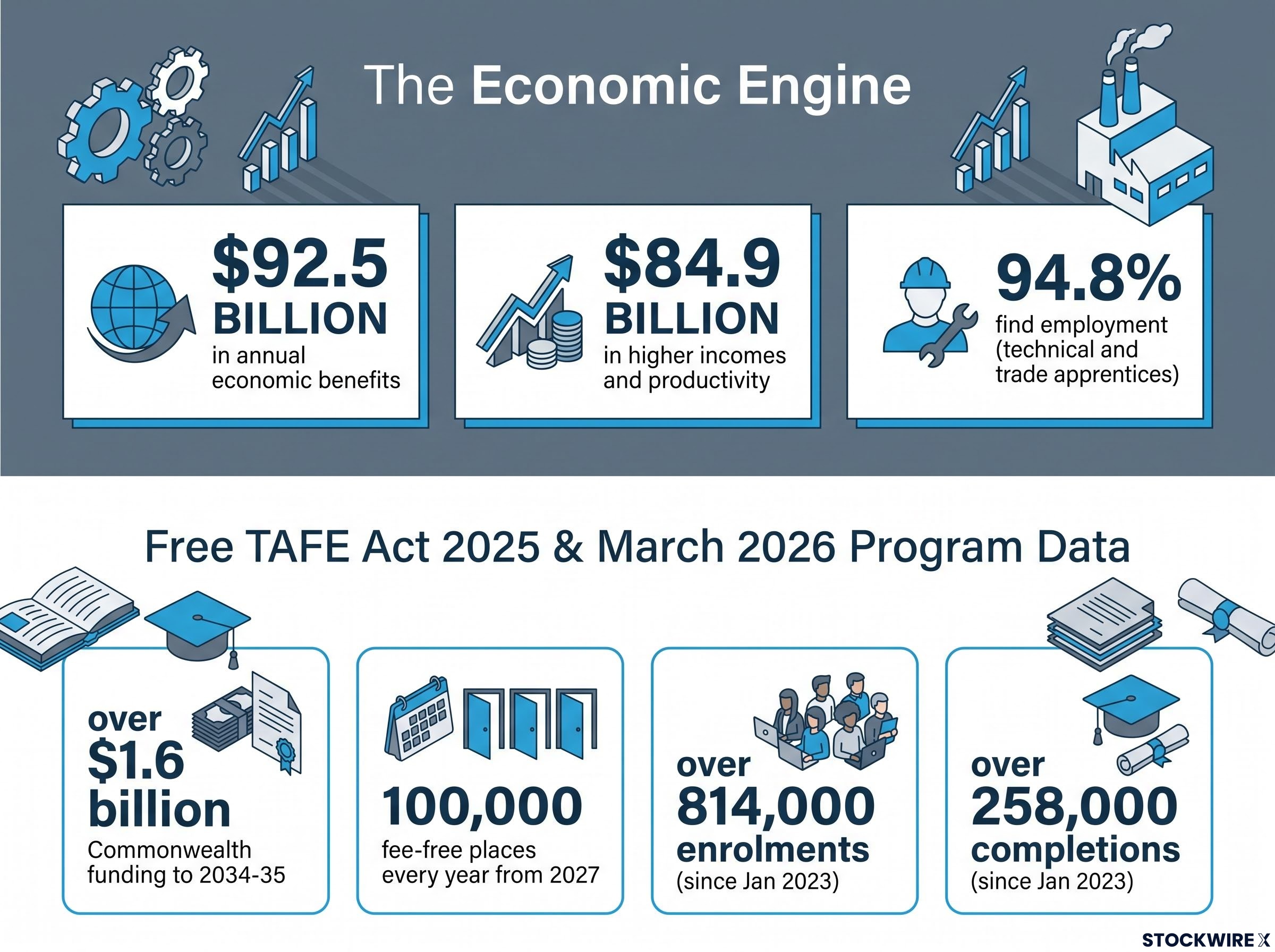
The macroeconomic evidence backs the earning engine. According to research cited by the sector, the TAFE system supports an estimated $92.5 billion in annual economic benefits, including $84.9 billion in higher incomes and productivity from TAFE-credentialled workers. Skills, in aggregate, are a genuine wealth machine.
The relationship between investment risk and return over long horizons is not intuitive: Australian residential property delivered 9.16% annualised returns and equities 7.55% over 20 years, while cash produced a negative real return after inflation, a documented outcome that persists even when measuring periods that include major drawdowns.
Here is the part that changes how you should think about your own salary. Your earning capacity is the fuel supply for everything downstream, which means a stagnant income does not just cap your lifestyle. It quietly chokes your long-term investment potential by starving the portfolio of new capital.
A rising income feeds financial capital in three concrete ways:
- Higher contribution capacity: more surplus each month means larger, more frequent investments and fuller use of superannuation limits.
- Better debt servicing: stronger cash flow lets you clear high-interest debt faster, freeing more money to invest sooner.
- Improved risk tolerance: a secure, growing income makes it psychologically easier to stay invested through volatility rather than selling in fear.
The takeaway is simple. Your career is not separate from your portfolio. It is the first stage of it.
When big ASX news breaks, our subscribers know first
Navigating the credential trap to maximise earning power
Here is the uncomfortable part: more education does not automatically mean more money.
The assumption that any degree pays for itself is breaking down. Research from Birch (2025) found the wage premium on a Bachelor degree dropped by roughly 13% for both men and women, a symptom of credential inflation, where qualifications become more common and therefore worth less in the market. The premium on a Master’s degree fell even further, down 13.2% for men and 16.6% for women.
Not every pathway is fading, though. PhDs and Graduate Certificates held their value, and the strongest returns increasingly sit in vocational and trade skills where shortages are acute. Almost half of all technician and trade occupations remain in persistent shortage, and the outcomes are hard to argue with: 94.8% of apprentices who complete their training in technical and trade occupations find employment.
This is where Australian policy hands you a genuine opening. Under the Free TAFE Act 2025, fee-free TAFE is now a permanent national feature, with the Commonwealth committing over $1.6 billion through to 2034-35 to fund at least 100,000 fee-free places every year from 2027. Program data to March 2026 shows the scale already achieved: more than 814,000 enrolments and over 258,000 completions since January 2023.
The strategic point is targeting. Upskilling only pays when it aims at a shortage, not just any credential.
AI wage premiums illustrate the earnings case for targeted upskilling with unusual clarity: PwC’s analysis of over one billion job postings found that roles requiring AI skills now command a 62% wage premium, compounded from 25% just two years earlier, which maps directly onto the income-engine argument for skills that aim at genuine market shortages.
| Qualification type | Current wage premium trend | Strategic wealth implication |
|---|---|---|
| General Bachelor degree | Falling, down approximately 13% (Birch, 2025) | High cost and foregone income for a shrinking pay-off. Scrutinise before committing. |
| Master’s degree | Falling sharply, down 13.2% (men) and 16.6% (women) | Risk of over-qualification with limited extra cash flow to invest. |
| Vocational and trade (shortage areas) | Resilient, with strong employment outcomes | Low-barrier, fee-free entry and near-certain employment fuels contributions. |
What this tells you is that education is a filter decision, not a default one. Getting more of it will not lift your income unless you aim it at where the market is genuinely short, and fee-free TAFE removes the debt excuse for making that move.
The mathematical reality of market endurance
Earning the money is only half the equation. What you do next decides whether it compounds or corrodes.
The clearest evidence sits in the numbers. The 2026 Vanguard Index Chart, covering the 30-year period from 1 July 1996 to 30 June 2026, shows that $10,000 invested in Australian equities grew to $132,931. The same $10,000 left in cash grew to just $32,459.
That gap of more than $100,000 is the price of choosing comfort over compounding, on a single small starting sum. Scale that across a working life and repeated contributions, and the cost of hiding in cash runs into hundreds of thousands of dollars in lost potential.
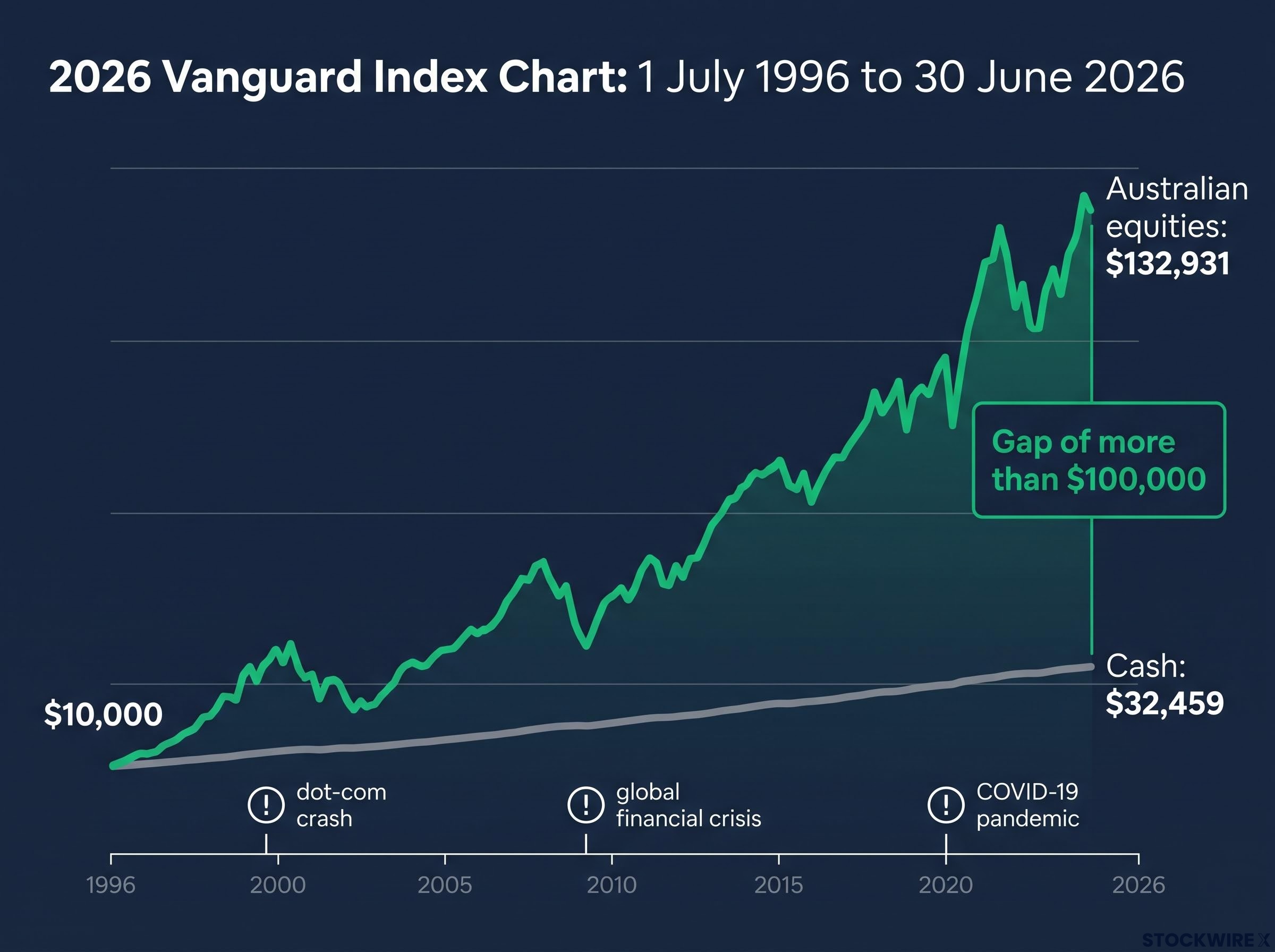
The three decades in that chart were not calm. They spanned the dot-com crash, the global financial crisis, and the COVID-19 pandemic. Cash still finished last, which is the whole point: the market rewards those who endure it, not those who time it.
The reason people flee is rarely rational. Loss aversion makes short-term drops feel more painful than equivalent gains feel good. Herding pushes people to sell when everyone else is selling. Liquidity crises, a lack of accessible cash, force investors to sell growth assets at depressed prices just to cover living costs.
Building safeguards against panic selling
Discipline is easier when it is structural rather than emotional. Three safeguards do most of the work:
Long-term investing discipline depends less on analytical skill than on behavioural architecture: automated contributions, a maximum quarterly account-checking rule, and a pre-written selling policy agreed to while markets are calm collectively make staying invested the default behaviour rather than a daily act of willpower.
- Hold an emergency liquidity buffer. Keep 3 to 6 months of living expenses in cash so a crisis never forces you to sell shares at the bottom.
- Set a pre-defined asset allocation. Spreading capital across shares, bonds, property, and cash cushions the blow when one asset class falls, reducing the urge to react.
- Schedule your portfolio reviews. Limiting checks to quarterly or semi-annual reviews stops daily market noise from triggering emotional decisions.
The lesson to carry forward is blunt. Avoiding volatility does not protect your wealth. Over a lifetime, it quietly guarantees you fall behind.
Why self-concept forms the ceiling on financial execution
Everything so far assumes you can actually stick to the plan. Whether you can comes down to something most financial advice ignores: who you believe you are.
Behavioural science is clear that people act in line with how they identify themselves, not merely what they are trying to do. Someone who has adopted an “investor identity” monitors their superannuation, scrutinises spending, and treats every income rise as fuel for future wealth. Someone merely “trying to save” does none of this reliably, because the behaviour has no identity anchoring it.
The way you frame the goal matters. Research from Stanford University found that asking people about “being a voter” rather than simply “voting” lifted turnout dramatically in a 2011 study. A 2016 replication found no significant difference, which tells you something important: a linguistic nudge alone is not enough. Durable habits require the identity to be embedded in routines, communities, and how you narrate your own life.
Identity also steers where your money goes. Studies show individuals invest roughly 20% more in assets that align with their identity, and undervalue gains from identity-incongruent assets by 17-27%. Your self-concept is quietly writing your asset allocation.
A striking figure captures the danger of the wrong identity: 41% of people who avoid markets report being explicitly proud not to own risky financial investments. For them, staying out has become a point of pride, and that pride costs them decades of compounding.
The realisation to sit with is this. Until you actively adopt the identity of a disciplined investor, you remain exposed to panic selling and lifestyle creep no matter how high your income climbs. The mindset is the ceiling.
Integrating mindset and mechanics for the next decade
The three levers only work as a set. Strategic upskilling generates the cash flow, the share market provides the compounding vehicle, and an investor identity supplies the discipline to keep both running through the inevitable downturns.
Policy is doing part of the work for you. Fee-free TAFE removes the debt barrier to raising your income, but that is only the first move. What secures financial independence is the deliberate allocation of the income that follows.
This article is for informational purposes only and should not be considered financial advice. Investors should conduct their own research and consult with financial professionals before making investment decisions. Past performance does not guarantee future results, and financial projections are subject to market conditions and various risk factors.
So run the audit now. Look honestly at your earning trajectory, ask whether your skills point at a genuine shortage, and check whether your capital is compounding in the market or eroding in cash. Both answers, together, decide the next decade.
For readers who have accepted the compounding case but have not yet made their first market investment, our comprehensive walkthrough of how to start investing in Australia covers realistic first-year expectations and the habit architecture that keeps a portfolio intact through the most emotionally difficult early period.