
Most of what you read about rising interest rates treats them as a wrecking ball. Higher rates crush growth stocks, inflate borrowing costs, and drain value out of the market. That story is mostly true. It is also incomplete.
For a specific class of businesses, high rates are not a penalty. They are a profit engine, quietly turning other people’s money into a passive revenue stream.
That distinction matters more now than it has in nearly two decades. As of 15 September 2026, the US 10-year Treasury yield sat at roughly 5.01%, its highest since 2007, while the Federal Reserve held the federal funds rate at 3.50-3.75% through the summer.
This is not a fleeting spike. Analysts increasingly describe it as a structural shift, a higher-for-longer regime driven by fiscal deficits, rising government debt, and steady global demand for safe assets.
What follows is a practical framework for spotting the exact business models built to harvest elevated yields, so you can adapt your equity strategy for a world where 5% money is the new normal rather than a passing storm.
The hidden mechanics of float and interest margins
Look at a screen showing the 10-year Treasury at 5.01%, and it is tempting to read that number purely as a cost. Borrowing is expensive. Mortgages hurt. Leverage bites. But before you look at any specific company, you need to understand two mechanisms that flip that logic entirely for businesses sitting on the right side of the transaction.
The first is float. The second is net interest margin. Together they explain why some companies quietly get richer as rates climb.
Understanding the power of float
Float is money a company collects upfront but does not have to pay out until later. An insurer takes your premium today and may not settle a claim for years. An exchange holds collateral posted by traders. In the gap between collecting the cash and spending it, the company invests that money and keeps the returns.
In a low-rate world, float earns almost nothing. At 5%, the same pile of dormant cash becomes a serious income source without the company selling a single extra product.
Net interest margin, or NIM, works on a similar principle for lenders. NIM is the spread between what a bank pays to hold your deposits and what it charges to lend that money out. When rates rise, banks can often reinvest cheap, sticky deposits at much higher yields, widening that spread.
Here is the reframe you need. Stop seeing interest rates only as a borrowing penalty. For companies holding float or funded by cheap deposits, a high rate is a massive, passive revenue stream flowing directly to shareholders.
Consensus among global brokerages, per Reuters surveys from September 2026, is that policymakers may need to keep rates elevated for longer to tame structural inflation. Goldman Sachs projects the longer-run policy rate settling around 3-3.25%, well above the post-crisis norm. That durability is what turns these mechanisms from marginal footnotes into primary earnings drivers.
The 10-year Treasury at 5.01% reflects a structural rate shift driven by quantitative tightening, fiscal deficits, and the withdrawal of price-insensitive central bank buyers, forces that a single favourable inflation print is unlikely to reverse.
Redefining the cost of capital
There is a second-order effect worth understanding. Higher baseline rates reset the hurdle rate for equities, the minimum return an investment must clear to justify the risk. A 5% risk-free yield corresponds to roughly a 20x earnings multiple as a benchmark.
Against that backdrop, businesses that fund themselves without debt suddenly look far more attractive to institutional capital. When your competitors are bleeding cash on interest payments and you are earning it, the market notices.
This foundation lets you look past a company’s core product and evaluate its balance sheet as a standalone profit centre.
When big ASX news breaks, our subscribers know first
Financial toll booths harvesting the rate premium
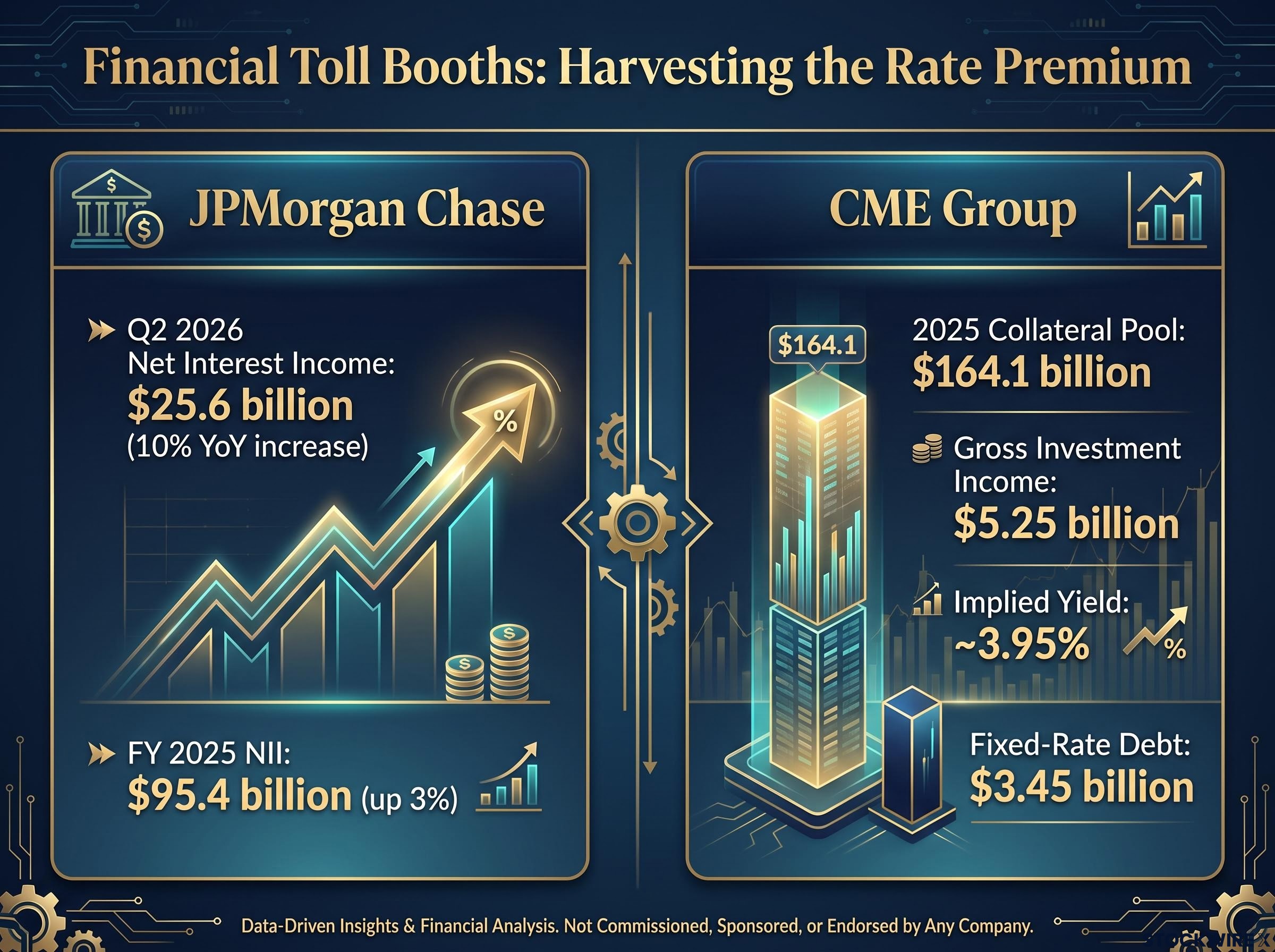
Retail banking is the obvious place to start, because the mechanics are familiar. JPMorgan Chase, funded by a vast and sticky base of retail deposits, reported net interest income of $25.6 billion in the second quarter of 2026, a 10% year-over-year increase. For the full 2025 fiscal year, NII came in at $95.4 billion, up 3%.
That is the visible tip. The more lucrative rate-driven profits often hide somewhere less obvious: the plumbing of derivative and futures markets.
Exchanges like CME Group require traders to post cash as margin, collateral that sits with the clearing house to guarantee trades. In a high-rate world, the interest earned on that enormous collateral pool largely accrues to the exchange itself.
The numbers make the point. CME’s 2025 collateral pool of roughly $164.1 billion generated $5.25 billion in gross investment income at an implied yield near 3.95%. Crucially, CME carries only $3.45 billion in fixed-rate debt against a collateral pool nearly 47 times larger. Higher short-term rates widen that spread almost purely in the exchange’s favour.
CME’s Q1 2026 record revenue of $1.88 billion illustrates how exchange float income compounds across rate cycles, yet the stock’s forward free cash flow yield has exceeded 5-6%, a multiple that historically signals structural problems rather than a business achieving all-time operational highs.
There is a bonus effect. High-rate environments tend to be volatile, and volatility drives trading volumes. More contracts traded means more margin posted, which means an even larger float earning interest.
Here is what that means for you as an equity holder. A bank’s deposit base and an exchange’s margin requirement represent billions in other people’s dormant cash, working on your behalf and converting into your dividend yield.
| Institution Type | Revenue Engine | Rate-Driven Advantage |
|---|---|---|
| Large Banks | Net interest income from lending sticky retail deposits | Reinvest cheap deposits at higher yields, widening net interest margin |
| Futures Exchanges | Interest earned on customer margin and collateral pools | Small fixed-rate debt against a huge collateral float, plus volume boost from volatility |
The distinction matters for stock selection. Cyclical lenders can see a temporary earnings bump that fades. Structural toll booths, holding float they did not have to borrow, offer more sustainable yield protection.
How massive cash reserves weaponise corporate strategy
So far the story has been about operational earnings. The next shift is subtler and arguably more powerful. In a 5% world, a large cash pile stops being a defensive cushion and becomes an offensive weapon aimed squarely at leveraged competitors.
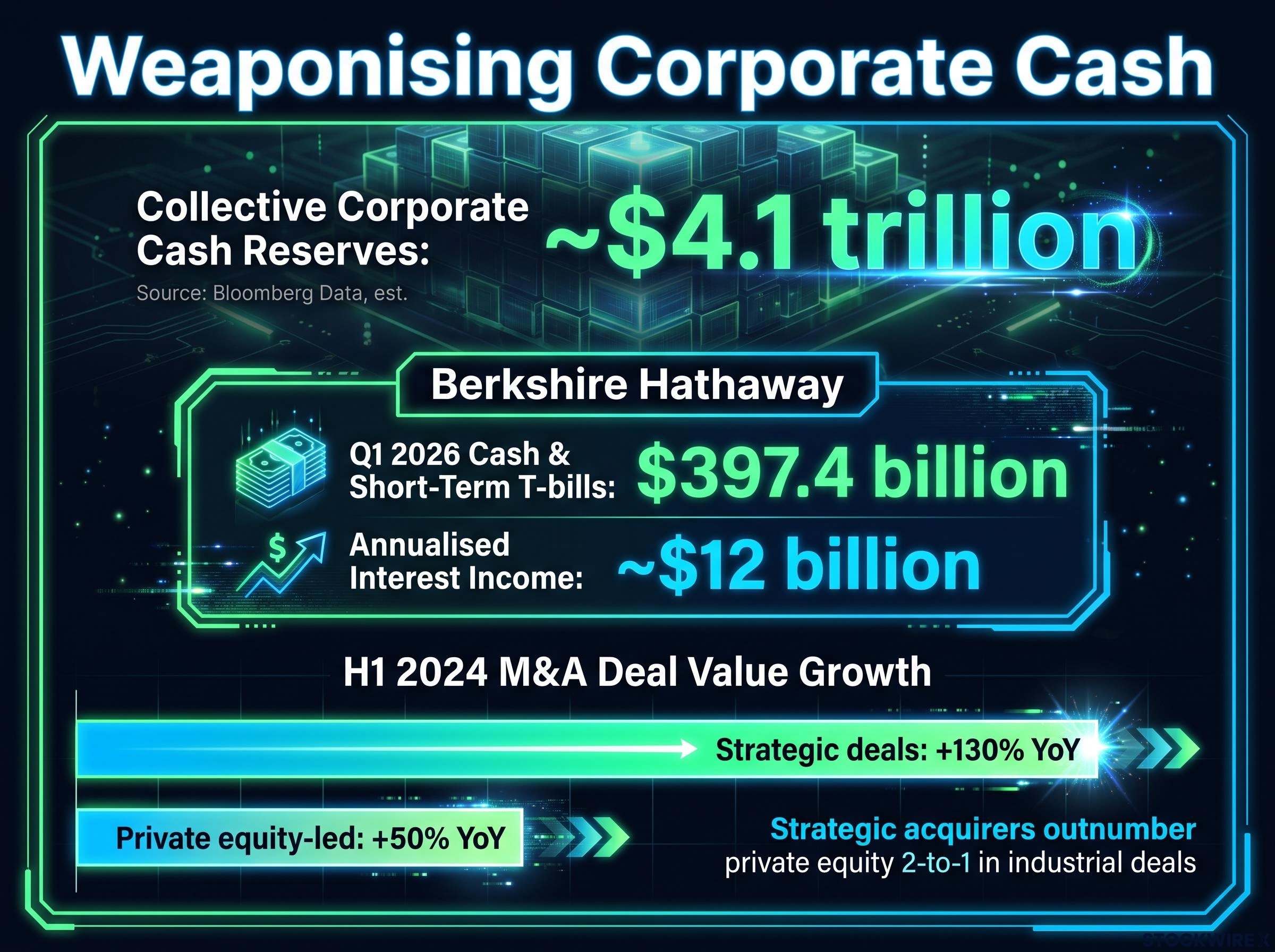
Property and casualty insurers show the income side of this clearly. By holding short-duration investment portfolios, typically two to three years, they can rapidly reinvest maturing assets at elevated yields. The classic example is Berkshire Hathaway, which held $397.4 billion in total cash and short-term Treasury bills by the first quarter of 2026, generating annualised interest income near $12 billion.
That kind of firepower changes the game in mergers and acquisitions. When cheap leverage disappears, private equity firms lose their primary advantage, and cash-rich corporates step into the vacuum.
The private equity retreat
Private equity runs on borrowed money. Higher debt costs force these firms to bid lower on targets or walk away entirely, because the maths on a leveraged buyout stops working when the loans get expensive.
Corporate buyers exploit that gap. Sitting on roughly $4.1 trillion in collective cash reserves, they can fund acquisitions internally or with cheap investment-grade debt, consolidating market share at favourable multiples while their leveraged rivals are sidelined.
The shift in market power shows up in deal data.
In the first half of 2024, strategic deal value rose approximately 130% year-over-year, compared to just a 50% rise for private equity-led deals. Strategic acquirers now outnumber private equity buyers by roughly two-to-one in industrial deals.
Here is the reframe. A massive cash pile in a high-rate world is not dead money dragging down returns. It is active ammunition, compounding value while simultaneously destroying private equity’s ability to compete.
That means you can treat certain cash-rich stocks as aggressive consolidation plays, not merely safe havens. The balance sheet you once viewed as conservative may be the most aggressive asset the company owns.
The structural traps hiding in yield plays
Before you rush to buy every bank and exchange in sight, a dose of caution is essential. Not all financial institutions benefit equally from high rates, and chasing yield blindly can walk you straight into a balance sheet landmine.
The core danger is that a strong income statement can hide a weak asset side. A bank might report a healthy net interest margin while its loan book quietly deteriorates.
Private credit stress is the mirror image of the toll-booth advantage: BDCs trading at 17-26% discounts to stated NAV and $7 billion in gated redemptions in Q1 2026 show precisely what happens to leveraged strategies when high rates expose fragile asset quality rather than harvest it.
The FDIC 2026 Risk Review documents how concentrated commercial real estate exposures and unrealised securities losses remained the primary balance sheet vulnerabilities for US banks entering the current rate cycle, giving concrete regulatory weight to the screening criteria outlined here.
The three main risks to interrogate are:
- Commercial real estate defaults: The IMF and FDIC have repeatedly warned that concentrated commercial real estate exposures pose a serious threat, particularly for smaller and regional banks facing rising borrower defaults.
- Unrealised bond losses: The 2023 banking stress showed how higher rates create large paper losses on fixed-rate securities and held-to-maturity portfolios, even while margins look fine on the surface.
- Sudden rate reversals: A sharp fall in rates after a higher-for-longer stretch could trigger asset-price corrections and abruptly switch off the earnings engines these businesses depend on.
There is a further trap in the mechanics themselves. Not every lender enjoys widening margins. Banks holding long-term fixed-rate assets while paying up for rate-sensitive deposits can actually see their net interest margins shrink as funding costs climb.
Cheapness alone is not a green light either. European bank valuations have stayed depressed despite supportive rate levels, a reminder that rate-beneficiary stocks can trade cheaply when the wider market fears a debt-induced recession.
The takeaway for your process is direct. Before you buy a bank purely for its net interest margin, interrogate its commercial real estate exposure and its unrealised bond losses. Check the asset side of the balance sheet as rigorously as the income statement, or you risk buying a value trap dressed up as a yield play.
Positioning your portfolio for a structural yield plateau
The through-line is straightforward. A higher-for-longer rate environment does not simply punish equities across the board. It rewards a specific set of businesses built to harvest yield, and it demands you shift deliberately toward companies with structural cash advantages.
The bond bear market, now 71 months in drawdown as of July 2026 with the stock-bond correlation at its most extreme negative reading since 1996, has broken the classic 60/40 hedge and reset the baseline return available from fixed income to levels not seen since 2007.
The most durable move is owning the entities that collect the tolls and hold the floats: deposit-funded banks with genuine margin leverage, exchanges earning interest on client collateral, and cash-rich corporates using their balance sheets as consolidation weapons.
But the same environment that fuels those earnings can expose fragile asset quality. Your job is to balance rate-driven income against the risks hiding beneath it, checking commercial real estate exposure, unrealised losses, and reinvestment durability before you commit.
Get that balance right, and high rates stop being a threat to your portfolio and start becoming a tailwind for the right holdings.
This article is for informational purposes only and should not be considered financial advice. Investors should conduct their own research and consult with financial professionals before making investment decisions.
Past performance does not guarantee future results. Financial projections are subject to market conditions and various risk factors. Forward-looking statements regarding interest rates are speculative and subject to change based on market developments.