4 Stock Valuation Methods Tested on a Live ASX Case Study
2 hrs ago


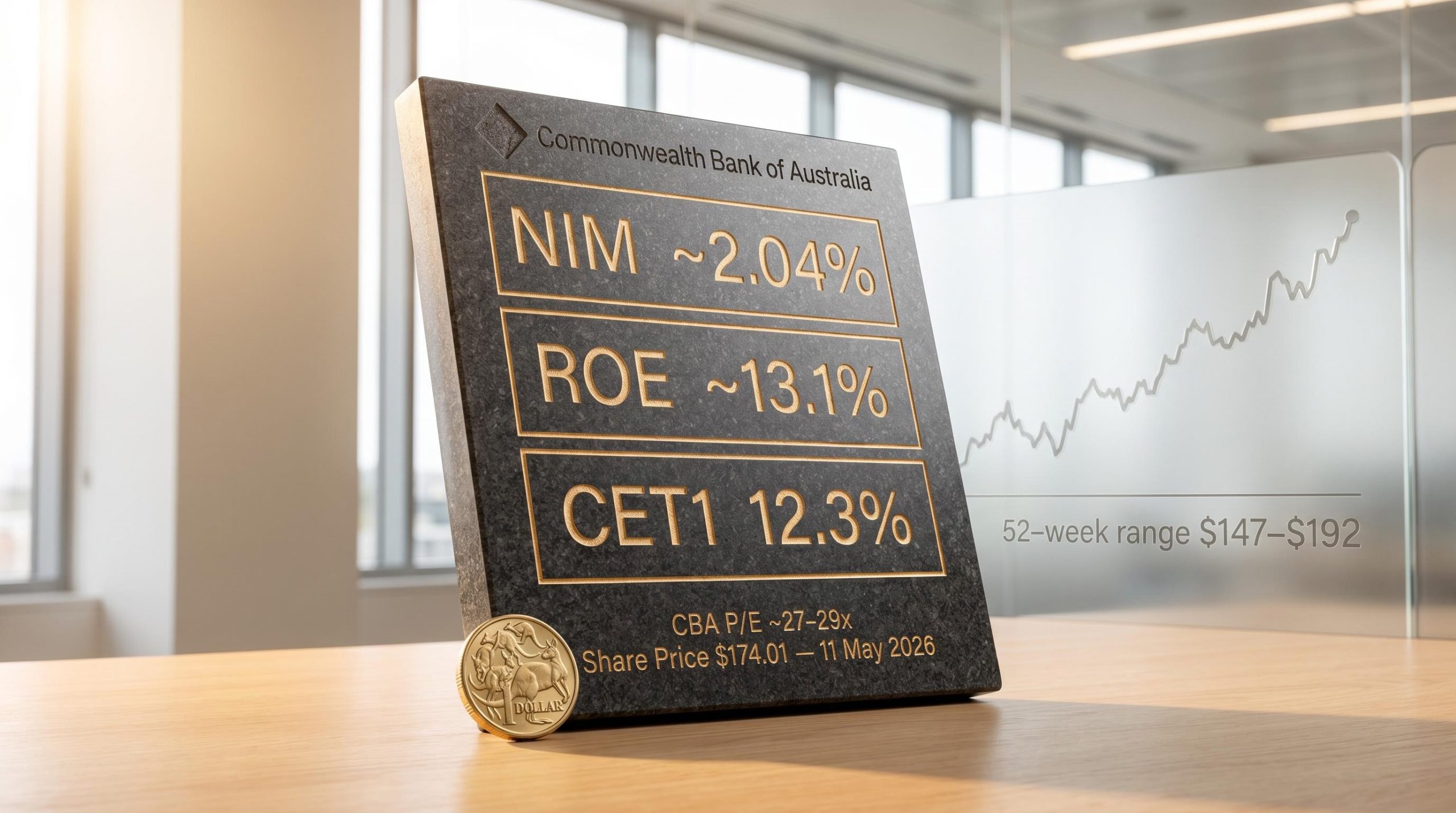
Commonwealth Bank of Australia (CBA) closed at $175.91 on 9 May 2026, yet the average analyst 12-month price target sits at roughly $126. A dividend discount model (DDM), the valuation framework most suited to a mature bank, produces fair value estimates between $98 and $144. The gap between what the market is paying for CBA and what income-based valuation says it is worth has never been wider in the bank’s modern trading history. This article walks through how to build a DDM for CBA using real dividend data, explains how each assumption shapes the output, and then examines what the current share price implies about the growth the market is betting on. The goal is not a verdict. It is a framework readers can update as conditions change.
Banks are not software companies. They do not reinvest all their profits into hypergrowth; they distribute a large share of earnings as dividends. That makes the DDM, a model that values a stock purely on the cash dividends a shareholder can expect to receive over time, a natural fit for a business like CBA.
The DDM for income stocks is structurally suited to ASX banks, utilities, and REITs precisely because regulatory capital requirements and distribution mandates constrain how much earnings can be reinvested, making future dividend streams more predictable than in most other sectors.
Three conditions make the DDM appropriate:
CBA paid $4.65 per share in fully franked dividends in FY24, with a payout ratio of approximately 75% of earnings per share. At its November 2025 Investor Day, management guided toward a sustainable payout range of 70-80% and dividend growth of 3-4% annually.
DDM Formula DDM Value = Next Year’s Dividend / (Discount Rate – Dividend Growth Rate)
The formula strips away sentiment, momentum, and index-fund flows. It answers one question: what is the income stream alone worth at a given required return? Price-to-earnings ratios tell investors what the market is paying for a dollar of profit. The DDM tells them what a dollar of dividends is actually worth.
Building a DDM starts with choosing the right dividend input. Three options are available, and each represents a different assumption about what value a CBA shareholder actually receives.
| Input Type | Dividend Value | Notes |
|---|---|---|
| FY24 paid dividend | $4.65 | Last confirmed full-year payout, fully franked |
| FY25 forecast dividend | $4.76 | Based on analyst consensus (range $4.80-$4.90, midpoint rounded) |
| FY25 grossed-up dividend | $6.80 | Includes franking credits at 30% corporate tax rate |
The grossed-up figure deserves explanation. Australian companies that pay tax on their profits can pass that tax credit through to shareholders via franking credits. For a domestic investor, the grossed-up dividend captures the full pre-tax value of the payment. Calculating it takes three steps:

Many Australian retail investors undercount franking credits when comparing dividend yields across stocks. For a domestic investor running a DDM, the grossed-up figure is the most honest input because it reflects the total economic value received per share.
The grossed-up dividend calculation follows a fixed formula: divide the cash dividend by 0.70 and the result is the pre-tax value, with the difference representing the franking credit that eligible investors can claim against their personal tax liability or receive as a cash refund from the ATO.
The discount rate is where the model gets personal. It represents the annual return an investor requires to accept the risk of holding CBA shares rather than a risk-free alternative.
The floor for that rate is the RBA cash rate of 4.35%, lifted on 5 May 2026. No rational investor would accept a return below the risk-free rate for taking equity risk. The question is how much to add above that floor.
Risk-free rate anchor: The RBA cash rate of 4.35% sets the minimum threshold. Every percentage point added above it reflects compensation for equity risk, earnings uncertainty, and dividend variability.
Analyst models for CBA typically use a blended discount rate of 7-9%, with stress scenarios extending to 11%. On the growth side, CBA’s own guidance of 3-4% dividend growth and analyst consensus of approximately 3% earnings per share growth per annum provide the range. A 2-4% annual growth rate captures the spectrum from conservative to slightly optimistic.
The combination of discount rates and growth rates produces a matrix. The table below uses three representative discount rates and three growth rates, with the grossed-up FY25 dividend of $6.80 as the input.
Macro assumptions in bank valuation, particularly the RBA rate trajectory, unemployment trend, and property price direction, can move a single-bank model output by more than 50% in either direction, which is why the same CBA discount rate inputs look conservative to one analyst and aggressive to another.
| Growth Rate | Discount Rate 7% | Discount Rate 9% | Discount Rate 11% |
|---|---|---|---|
| 2% | $136.00 | $97.14 | $75.56 |
| 3% | $170.00 | $113.33 | $85.00 |
| 4% | $226.67 | $136.00 | $97.14 |
The spread is wide, and that is the point. A single DDM output presented without context is misleading. The matrix shows that the model’s answer depends entirely on two assumptions, and averaging across reasonable scenarios is more honest than selecting whichever cell confirms an existing view.
Three headline valuations emerge when the model is run across the full matrix of discount and growth rates, using each of the three dividend inputs.
| Scenario | Dividend Input | DDM Fair Value | Current Price | Implied Premium |
|---|---|---|---|---|
| Base case (FY24 paid) | $4.65 | $98.33 | $175.91 | ~79% |
| Forward estimate (FY25) | $4.76 | $100.66 | $175.91 | ~75% |
| Franking-adjusted (FY25) | $6.80 | $143.80 | $175.91 | ~22% |
The numbers are stark. Even the most generous scenario, which credits CBA with the full value of franking credits, produces a fair value of $143.80, implying a premium of roughly 22% at the 9 May 2026 closing price. The base case, using the last confirmed dividend, implies the market is paying nearly 80% above what the income stream justifies.
Independent cross-check: The analyst average 12-month price target of approximately $126 (range $90-$155) sits between the franking-adjusted and forward-estimate DDM outputs, reinforcing the model’s directional finding. No broker has issued a “buy” rating on CBA since 2022.
These are not obscure academic calculations. They reflect the same methodology that underlies the consensus view among Australian bank analysts: at current prices, CBA’s dividend stream does not support the valuation on its own.

The DDM can be run in reverse. Instead of solving for fair value, hold the current price constant and solve for the growth rate the market is implicitly assuming.
At a share price of approximately $175 and a 9% discount rate, the dividend would need to grow at roughly 6-7% annually to justify the current valuation. Analyst consensus forecasts earnings per share growth of approximately 3% per annum. The gap is material.
“At today’s price, the market is pricing in dividend growth of roughly 6-7% annually. Analysts forecast 3%.”
That does not mean the market is irrational. It means the market is paying for something the DDM does not measure.
CBA holds four structural advantages over its major bank peers that contribute to its persistent premium:
These advantages explain why CBA has historically commanded a PE premium of 20-30% over peers. The current trailing PE of approximately 31x against a sector average of 19x, however, represents a premium roughly double the historical norm. The price-to-book ratio of 3.1x versus peer levels of 1.4-1.6x tells a similar story.
The DDM is a floor-value tool. It captures what the dividend stream alone is worth and deliberately excludes intangible value drivers.
Structural demand from superannuation funds, which are required to maintain Australian equity allocations, creates a persistent bid for CBA shares that no fundamental model prices in. CBA’s weight in the ASX 200 means passive index funds must hold it regardless of valuation. That demand compresses yields and inflates the price above what an income-only model would produce.
ASFA asset allocation data shows that equities represent the dominant superannuation asset class at 57% of total system assets, with Australian equities comprising 51% of that equity allocation, figures that illustrate the scale of structural domestic demand that flows persistently toward large-cap ASX stocks regardless of their prevailing valuation multiples.
The model should be treated as one input in a broader assessment, not a standalone sell trigger.
Three DDM scenarios produce fair values between $98 and $144. The analyst consensus target of $126 sits within that range. CBA’s peer comparison metrics, a trailing PE roughly 60% above the sector average and a price-to-book ratio double that of the next closest major bank, confirm the premium from a different angle.
Any investor buying CBA above $175 is implicitly backing at least one of the following:
The practical next step is not to accept or reject the model’s output as a binary signal. It is to revisit the assumptions as conditions shift: when the RBA adjusts rates, when FY25 dividends are confirmed, and as housing market data evolves through the second half of 2026.
CBA is a high-quality business with market-leading returns on equity and a dominant retail franchise. The DDM does not make it uninvestable. It makes the premium visible and the required assumptions explicit.
For investors weighing a position decision rather than a valuation framework, our deep-dive into whether CBA shares are a buy at current levels examines the H1 FY2026 earnings result, the updated interim dividend, and the specific scenarios under which the risk-reward improves for new buyers above $170.
This article is for informational purposes only and should not be considered financial advice. Investors should conduct their own research and consult with financial professionals before making investment decisions. Past performance does not guarantee future results. Financial projections are subject to market conditions and various risk factors.
A dividend discount model (DDM) values a stock based purely on the present value of its future dividend payments. It is particularly suited to CBA because the bank distributes a large share of earnings as fully franked dividends and has a predictable, lending-driven revenue base that makes future payouts more forecastable than most sectors.
Franking credits represent tax already paid at the corporate level that eligible Australian shareholders can reclaim. When the FY25 forecast dividend of $4.76 is grossed up to include franking credits, the effective dividend input rises to approximately $6.80, lifting the DDM fair value estimate to $143.80 compared to $100.66 without credits.
Running the DDM in reverse at a share price of approximately $175 and a 9% discount rate implies the market is pricing in annual dividend growth of roughly 6-7%, which is approximately double the 3% analyst consensus forecast for earnings per share growth.
CBA trades at a trailing price-to-earnings ratio of approximately 31x against a sector average of 19x, and at a price-to-book ratio of 3.1x compared to peer levels of 1.4-1.6x, representing a premium roughly double its historical norm relative to the major banks.
The DDM captures income value only and excludes structural demand factors such as mandatory superannuation fund allocations to Australian equities and passive index-fund buying tied to CBA's weight in the ASX 200, both of which create a persistent bid for the shares regardless of fundamental valuation.