
Prime Minister Mark Carney laid out a clear-eyed sovereignty agenda covering artificial intelligence, critical minerals, clean energy, pharmaceuticals, and space-based communications. In response, the Canadian Dollar moved 0.04% against the U.S. Dollar. That near-total silence is not a market failure. It is a signal worth decoding.
Sovereignty-focused industrial policy and spot foreign exchange pricing operate on fundamentally different timescales. Politicians announce structural ambitions; traders respond to rate differentials, inflation prints, and central bank guidance.
Understanding why those two worlds barely intersect in the short term, and when they eventually converge, is the core question here. This is the framework for reading both the short-term noise and the long-term signal: what drives the loonie on any given day, how Carney’s specific policy instruments are designed to shift Canada’s economic fundamentals over time, and what observable signals would tell you whether that shift is actually happening.
Why the currency barely moved when Carney spoke
A sitting head of government named seven strategic sectors as essential to national self-sufficiency, and the currency treated it as background noise. Sit with how strange that should feel for a moment before the explanation arrives.
The numbers tell the story. On the day Carney delivered his remarks, the Canadian Dollar registered a marginal decline of 0.04% against the USD, according to session data from FXStreet. Against a spread of major peers, the moves were small and directionless.
| Currency Pair | CAD Move | Direction |
|---|---|---|
| CAD vs USD | 0.04% | Marginal decline |
| CAD vs NZD | 0.43% | Gain |
| CAD vs JPY | 0.41% | Gain |
| CAD vs AUD | 0.35% | Gain |
| CAD vs EUR | 0.15% | Decline |
| CAD vs GBP | 0.17% | Decline |
Gains against the New Zealand Dollar, Japanese Yen and Australian Dollar; small declines against the Euro and Pound. This is the profile of an ordinary trading session shaped by unrelated global factors, not a response to a sovereignty speech.
For context, USD/CAD closed near 1.3990 on 17 September 2026, according to Investing.com, holding in a tight range just under the psychologically important 1.40 threshold. Nothing about the speech shifted that.
Here is what matters for how you read political events. The FX market treated a major sovereignty address as non-information in real time. That was not a mistake on the market’s part. Understanding why the silence is rational, rather than wrong, is the key to using political signals intelligently instead of trading on them.
When big ASX news breaks, our subscribers know first
What actually moves a currency from one day to the next
If a policy speech does not move the loonie, what does? To answer that, you need a working model of what traders are actually watching when they price a currency from one session to the next.
Three forces dominate short-term spot FX:
- Interest-rate differentials. The gap between what one central bank pays and what another pays drives carry dynamics, the incentive to hold higher-yielding currencies. This is central to how the Canadian Dollar is positioned.
- Data releases. Inflation, employment and growth prints move currencies because they change expectations about the next central bank move.
- Risk sentiment. When global markets turn cautious, capital rotates toward safe-haven currencies and away from commodity-linked ones.
For the loonie specifically, two of these dominate: the relative rate paths of the Bank of Canada and the Federal Reserve, and the price of oil. A Reuters poll on 4 September 2025 projected USD/CAD at 1.36 in three months and 1.3415 in twelve, explicitly conditional on Fed rate cuts weakening the U.S. Dollar. The forecast hinged on monetary policy, not industrial ambition.
Fed rate expectations transmit into USD/CAD through yield differentials: when the Fed holds or signals hikes, the return advantage on dollar assets widens, pulling capital toward USD and compressing the loonie’s near-term upside regardless of Canadian domestic conditions.
That monetary dominance shows up even when the data looks good. Reuters reported on 9 June 2026 that the loonie was trading near a six-month low despite an improved trade surplus, held down by caution ahead of a Bank of Canada rate decision. A positive data point could not outweigh what the market expected from the central bank.
The commodity anchor that defines CAD’s baseline
Canada’s export profile leans heavily on energy and resources, which ties the currency tightly to commodity cycles. When oil rises, the loonie tends to follow.
The linkage is visible in the tape. Reuters noted on 6 March 2026 that the Canadian Dollar climbed to a three-week high and outperformed its G10 peers as oil prices jumped. The move came from crude, not from any policy shift.
The commodity-dominance thesis State Street Global Advisors wrote in an October 2025 currency commentary that its models “continue to favor the Canadian dollar,” based on improved commodity prices and strong local equity returns driven by commodity-related earnings.
This is the baseline you need to hold. The loonie’s day-to-day fate is set by oil and by the Bank of Canada versus the Fed, not by sovereign strategy. Industrial policy sits outside this frame in the short term, which is precisely why announcements are discounted until they show up in realised outcomes. Sovereignty strategies targeting critical minerals and clean energy could eventually reinforce or complicate that commodity linkage, which is where the policy detail becomes relevant.
What Carney’s sovereignty agenda actually contains
Abstract commitments are cheap. Budgeted, structured policy is not. The specificity of the numbers is what separates Carney’s agenda from ordinary political rhetoric.
Budget 2025, published by the Department of Finance Canada on 4 November 2025, put real fiscal architecture behind two of the priority sectors Carney named.
| Sector | Instrument | Commitment | Key Feature |
|---|---|---|---|
| Artificial intelligence | Sovereign public AI infrastructure | $925.6M over five years | Includes a Sovereign Canadian Cloud model; $800M reallocated from previously provisioned funds |
| Critical minerals | Critical Minerals Sovereign Fund | $2B plus $50M for delivery | Aimed at domestic control of strategic minerals development and financing |
| Clean-tech manufacturing | Clean Technology Manufacturing ITC | 30% refundable credit | Applies to eligible capital; phases to zero after 2034 |
Carney’s full list of priority sectors, however, is broader than what the budget confirms. It helps to separate the funded from the aspirational:
- AI infrastructure (confirmed instrument)
- Critical minerals (confirmed instrument)
- Clean energy and clean-tech manufacturing (confirmed instrument)
- Chip manufacturing (named, no confirmed instrument in the research record)
- Financial transaction infrastructure (named, no confirmed instrument)
- Pharmaceutical production (named, no confirmed instrument)
- Space-based communications (named, no confirmed instrument)
That distinction matters for how you assess the strategy. The AI and minerals commitments are backed by real money and defined delivery mechanisms. Treat those two as substantively different from the sectors that remain framing without confirmed policy behind them.
The tax credit architecture and what it is designed to incentivise
The Clean Technology Manufacturing Investment Tax Credit (CTM ITC) is designed as a structural incentive rather than a direct handout. It is a refundable credit worth 30% of the capital cost of eligible property used for clean-tech manufacturing, processing, and critical-mineral extraction in Canada, with eligibility running from 1 January 2024.
The phase-down schedule tells you the intended horizon. The rate holds until it steps down to 20% in 2032, 10% in 2033 and 5% in 2034, ending after that. A ten-year runway signals a decade-long policy commitment, not a quick fix.
Budget 2025 also widened the credit’s reach, adding antimony, indium, gallium, germanium and scandium to the eligible-minerals list, with plans to extend it further to brownfield mine-development expenses. That ties Canada’s domestic tax incentives directly to global clean-tech supply-chain demand, connecting national policy to the broader energy transition.
Canada’s broader tax incentive architecture extends beyond the CTM ITC: the Productivity Mega Deduction cuts the marginal effective tax rate on new business investment from 13.0% to 6.4%, placing Canada below every other G7 economy on this measure and adding a structural layer to the investment case.
How industrial policy eventually reaches a currency’s fundamentals
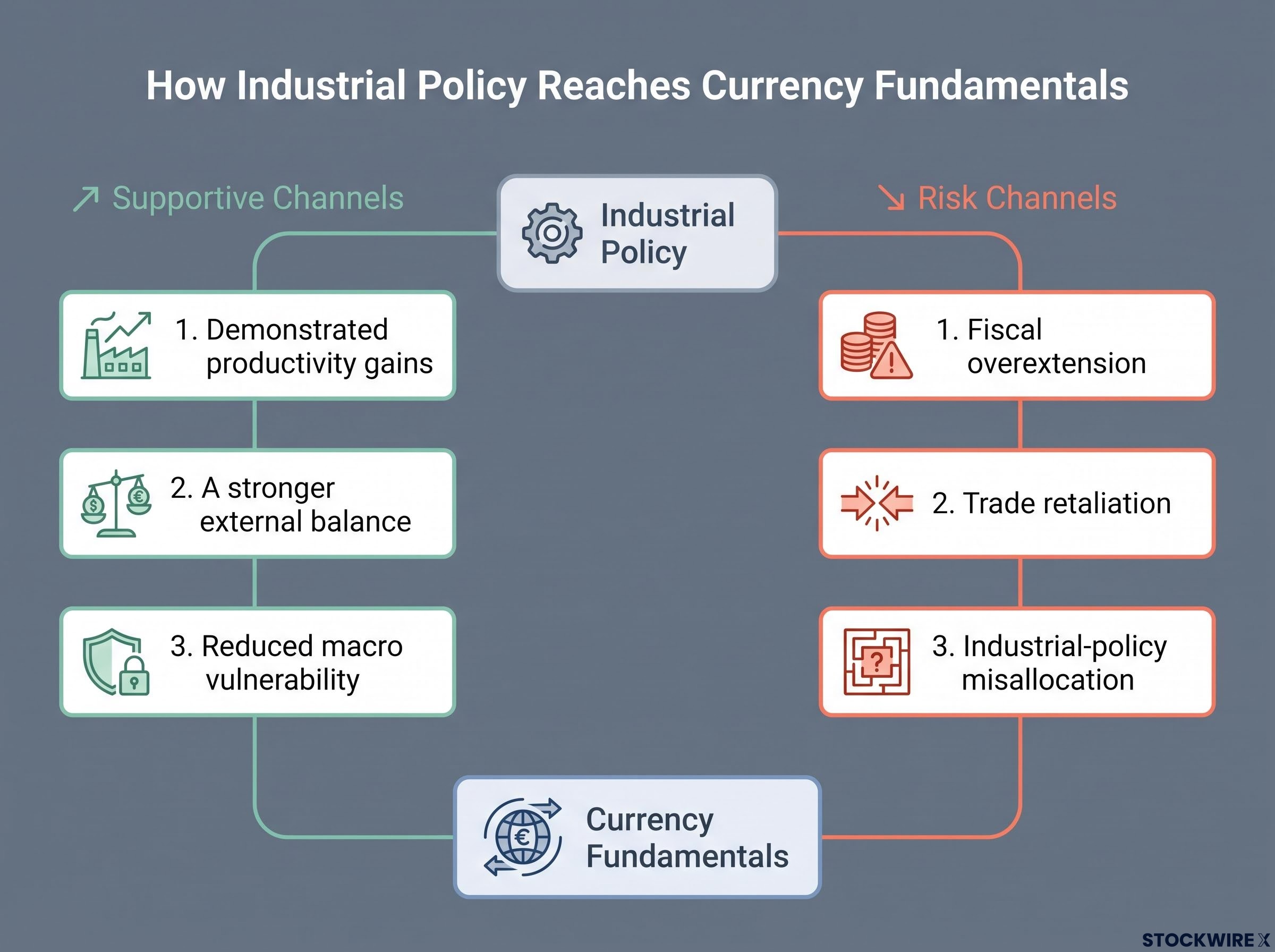
So the policy is real and funded. How does a tax credit or a sovereign fund ever reach the exchange rate? The pathway runs through fundamentals, and it cuts both ways.
On the supportive side, three channels could lift the currency over time:
- Demonstrated productivity gains. If sovereign AI capacity and minerals capability raise potential growth, that can justify higher real interest rates or a lower risk premium, both supportive of the currency.
- A stronger external balance. Higher-value exports relative to imports would improve the trade and current-account position, a durable currency positive.
- Reduced macro vulnerability. Diversifying away from dependence on a single trade partner or commodity can make the loonie a safer asset in global portfolios.
Three risk channels could short-circuit the same pathway:
Trade retaliation can move the loonie more sharply than most fundamental models predict: the US imposed 50% tariffs on roughly US$20 billion of Canadian goods in August 2026, triggering the largest single-session CAD drop of any major currency against the USD before a negotiation pause drove an equally sharp recovery.
- Fiscal overextension. A 30% refundable credit on capital costs plus multi-hundred-million-dollar AI spending is a significant fiscal commitment. If growth does not follow, markets can demand a higher risk premium, pressuring the currency downward.
- Trade retaliation. Partners who read sovereignty strategy as protectionism could respond with friction that offsets any competitiveness gains.
- Industrial-policy misallocation. Capital locked into politically favoured but economically weaker sectors could undermine, rather than support, the currency.
The trade-friction risk is not hypothetical. Reuters polls in October and December 2025 repeatedly flagged USMCA and broader U.S. trade relations as a constraint on appreciation, even when rate and commodity conditions looked supportive.
The trade-friction channel, made concrete Reuters reported in a survey on 4 December 2025 that Canadian Dollar forecasts had turned “less bullish” because delays in reaching a U.S. trade deal may require additional Bank of Canada rate cuts, reducing the currency’s carry appeal.
Corporate behaviour reflects the same worry. Ainvest noted in August 2025 that a deteriorating trade outlook was encouraging companies to hedge into the Euro and Yen.
The structural nature of this is worth stressing. The NBER working paper The Exchange Rate as an Industrial Policy argues that exchange-rate and industrial-policy interactions play out over long horizons, reshaping productivity, export composition and risk premia rather than producing sharp moves on announcement.
Here is the read for you. The very same policy that could diversify Canada’s export base and reduce its exposure to U.S. trade pressure could, if it provokes retaliation or fiscal strain, deliver the opposite currency outcome. Those two scenarios are not equally likely, but both are live.
The signals that would tell you the strategy is actually working
Rather than waiting for a verdict you cannot yet have, watch the indicators that would confirm which pathway is activating. The timeframe is years, not months, so the value is in knowing what to track.
Signs the positive pathway is taking hold:
- Rising high-value exports in AI-linked and critical-minerals sectors
- A narrowing current-account deficit
- Bank of Canada forward guidance shifting to reflect higher potential growth
- Institutional FX commentary beginning to cite structural diversification as a currency tailwind
Signs the negative pathway is activating:
- A widening fiscal deficit without a growth offset
- New U.S. trade measures targeting Canadian industrial policy
- Bank of Canada rate cuts driven by domestic weakness rather than easing inflation
For now, the market is waiting. A Reuters poll on 6 August 2026 put the loonie as rangebound near 1.40 per USD over the coming months, with only moderate gains expected over a year as domestic recovery signs balance global uncertainties. Earlier in the cycle, a Reuters poll on 6 May 2026 had turned modestly more bullish as geopolitical risk ebbed, with a three-month median near 1.3667, while the September 2025 consensus of 1.3415 on a twelve-month view rested on Fed cuts and resolved trade uncertainty.
The baseline to hold while you watch Reuters, 6 August 2026: the Canadian Dollar is expected to stay rangebound near 1.40 per USD, with moderate gains over a year.
Keep the CTM ITC phase-down in view too. With the credit stepping down through the early 2030s and ending after 2034, the policy horizon extends roughly a decade, which is the timeframe over which any structural currency effect would become visible.
The rangebound consensus is not a verdict on Carney’s strategy. It reflects a market waiting for realised evidence. That waiting period is structurally normal, and it does not tell you whether the strategy will succeed.
Reading Canada’s long-term bet through the lens of currency fundamentals
The gap between political ambition and market silence, which opened this piece, is not a disconnect to arbitrage. It is a structural feature of how policy and FX interact, and now you have the tools to read it.
Carney’s sovereignty agenda is more substantively funded than typical political rhetoric. The $2 billion Critical Minerals Sovereign Fund and the $925.6 million AI infrastructure commitment are the two clearest markers of execution intent, and the CTM ITC phase-down ending after 2034 signals a policy horizon stretching roughly a decade, consistent with the long timeframe over which structural currency effects emerge.
What remains unconfirmed are the conditions that turn ambition into a stronger currency: credible execution, macro discipline, and constructive trade relations. Until those show up in realised outcomes, the Reuters consensus of a loonie rangebound near 1.40 is the market doing exactly what it should.
The practical takeaway is a matter of framing. Canada’s sovereignty strategy gives you a structural thesis to monitor over years, not a short-term trade signal. Knowing the difference between those two things is the most useful output of this analysis. Future fiscal updates, shifts in export composition, Bank of Canada guidance and trade-negotiation outcomes are now data points you can weigh as evidence for or against the long-term thesis, rather than reactive noise.
For readers wanting to place Canada’s strategy within the broader global policy context, our full explainer on modern mercantilism covers how the US, EU, China, and India are simultaneously deploying industrial subsidies and export controls to compete for dominance in semiconductors, AI, and critical minerals.
This article is for informational purposes only and should not be considered financial advice. Investors should conduct their own research and consult with financial professionals before making investment decisions.
Past performance does not guarantee future results. Financial projections are subject to market conditions and various risk factors. Forward-looking statements are speculative and subject to change based on market developments.