
A multi-billion dollar mining project, fully funded, fully permitted, engineering locked in, stalls. Not because of geology. Not because of regulation. Because there are not enough beds within driving distance of the worksite for the people who need to build it.
That sounds absurd until you understand how remote Australia actually works. The Pilbara, Western Australia’s iron ore and LNG heartland, was built for extraction, not for permanently housing thousands of rotating workers. The gap between those two realities is measurable, current, and large enough to constrain project timelines right now.
Here is a clear explanation of how workforce accommodation actually functions in remote Australia, why the shortage is real, and what Fleetwood Limited’s recent acquisition of Red Dog Village tells you about where the constraint sits and what it means for ASX industrial stocks with exposure to the resource sector supply chain.
The three ways resource workers actually find a bed in the Pilbara
Workers on major mining, LNG, and infrastructure projects in remote Western Australia are housed through one of three pathways:
- Purpose-built workforce accommodation villages: Modular, prefabricated facilities designed specifically for fly-in fly-out (FIFO) and transient workforces, built near project sites
- Repurposed commercial buildings: Hotels or other commercial properties bought or converted by employers when standard housing is unavailable
- Local rental housing stock: Workers renting houses or rooms in nearby regional towns, where they exist
In practice, only the first option works reliably at the scale these projects demand.
The private rental market in Pilbara towns is extremely tight. Regional centres were never sized to absorb the worker volumes that large-scale resource and infrastructure developments generate. Even smaller WA towns outside the Pilbara struggle with the same problem. Some businesses have reported losing staff directly because adequate housing could not be secured, a consequence that turns accommodation from a logistics footnote into an operational risk with real cost.
Repurposed commercial stock is limited and inconsistent. There simply are not enough hotels or suitable buildings in towns like Karratha or Port Hedland to house thousands of rotating workers at the quality and proximity required.
The modular workforce village is not a corporate preference. It is the default because the other two options fail at scale in remote Western Australia. Understanding that makes it easier to see why companies that build and operate these villages at high occupancy in constrained regions hold a position that is harder to replicate than it looks.
When big ASX news breaks, our subscribers know first
What a workforce accommodation village actually contains
Your mental image is probably wrong. These are not rows of demountable huts in a paddock. A functioning workforce village at scale is a small, self-contained town with infrastructure designed to keep thousands of people fed, rested, healthy, and operationally ready across weeks of remote posting.
A typical modern village includes:
- Sleeping quarters (single rooms, often with ensuite bathrooms)
- Industrial-scale kitchens and mess halls capable of serving thousands of meals daily
- Laundry facilities sized for constant turnover
- Recreational spaces: gyms, common rooms, outdoor areas
- Medical and first-aid facilities
- Training and induction spaces
Managing a village running at 90-98% contracted occupancy is a fundamentally different operational challenge from running a hotel. Hotels target leisure-sector utilisation rates and tolerate vacancy. A workforce village operates under long-term contracts with resource companies that need near-full capacity, week in, week out. The margin for operational error is narrow.
The delivery model matters too. Villages are manufactured off-site as modular, prefabricated systems: sleeping units, kitchens, mess halls, and administration buildings are built in factories, transported to site, installed on cyclone-rated foundations (a specific Pilbara engineering requirement), then connected to services and commissioned.
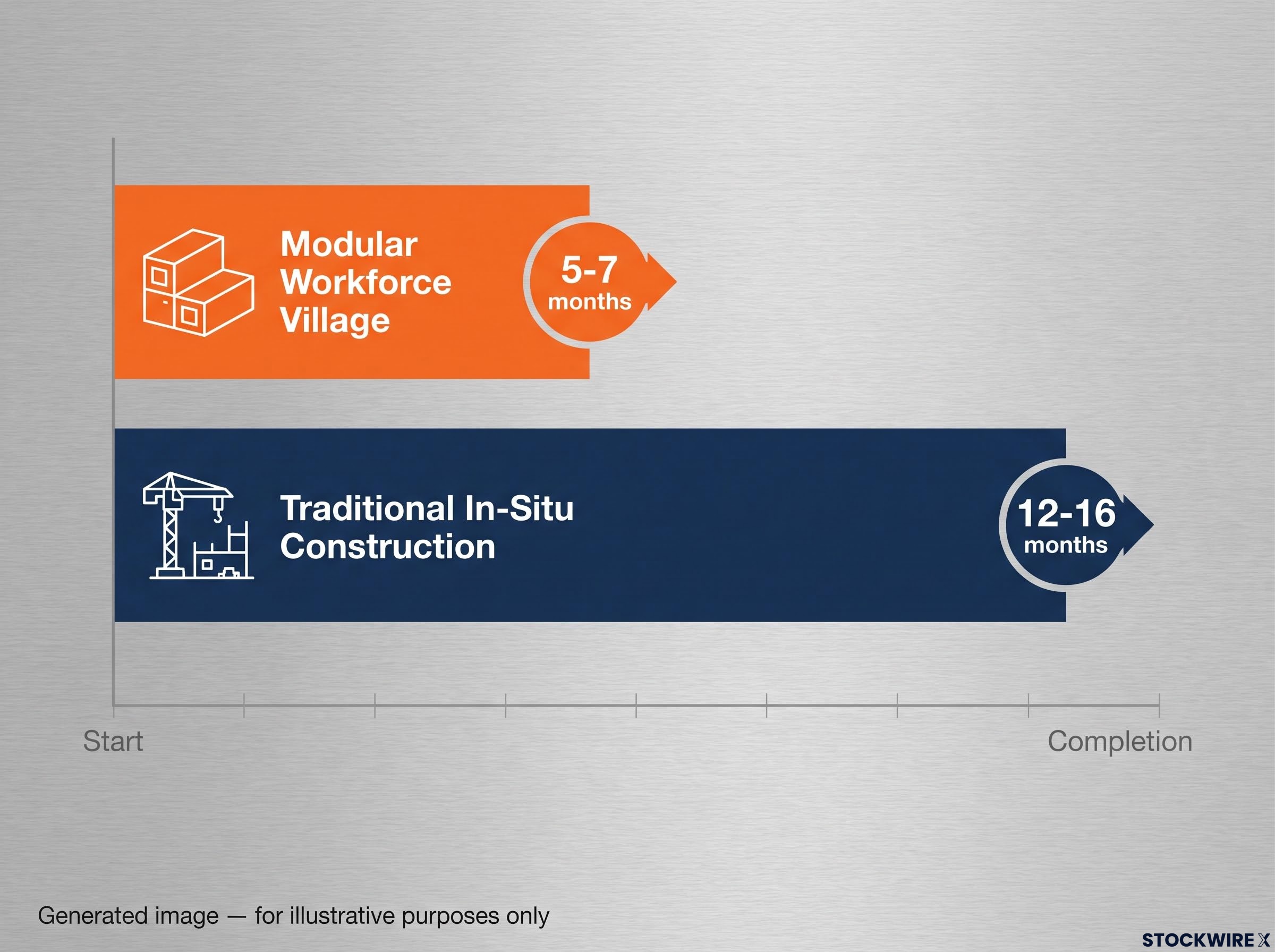
Delivery speed comparison: A modular workforce village can move from design lock to first occupancy in approximately 5-7 months. Traditional in-situ construction for equivalent facilities typically takes 12-16 months.
That speed gap is not a technical footnote. It is the reason modular operators hold a structural advantage when accommodation shortfalls appear. By the time a traditional build breaks ground, a modular village can already have workers sleeping in beds.
Why a missing bed can delay a billion-dollar project
When beds are scarce in a region like the Pilbara, the constraint does not sit quietly in the logistics column. It cascades through the entire project.
Here is the sequence:
- Accommodation capacity fills up. Available beds in existing villages and local housing are fully contracted.
- Workforce ramp-up slows. The project can hire workers, but it cannot deploy them because there is nowhere for them to sleep within a reasonable distance of the worksite.
- Commutes and costs stretch. Workers are pushed into more distant or lower-quality options, increasing commute times, transport budgets, and fatigue risk.
- Shift scheduling tightens. The number of available beds, not the number of available workers, determines how many people can be on-site at any given time.
- The project timeline extends. Construction and operational milestones slip, not because of engineering or capital, but because the workforce could not be housed at the rate the schedule demanded.
“You can’t extract anything if your people have nowhere to sleep.”
That line, common across industry commentary, captures the constraint with the bluntness it deserves. WA employers have documented cases of losing staff because adequate housing could not be secured, turning a logistics gap into a direct hit on project delivery and retention.
The accommodation bottleneck is logistically unglamorous. It receives less strategic attention than financing, approvals, or engineering. But it is equally capable of determining whether a project delivers on schedule.
The accommodation bottleneck compounds a risk that is already well documented across the sector: mining capex overruns are statistically the norm rather than the exception, with Wood Mackenzie estimating that cost blowouts of 40-50% are typical for critical minerals projects, meaning schedule slippage from any single constraint, including workforce housing, tends to arrive inside a project that is already carrying budget pressure.
For anyone evaluating resource sector equities or ASX industrial stocks tied to project delivery, accommodation capacity belongs in due diligence alongside the more visible risks of permitting, capex, and commodity price. The operators who control beds at scale in constrained markets control a real input to project output.
How tight is the Pilbara right now, in actual numbers
The data here comes with an important caveat: no independently audited comprehensive bed-count exists for the entire Pilbara transient workforce accommodation market. The figures below are drawn from Fleetwood Limited’s direct operating experience and ASX disclosures, and should be understood as the clearest available signal from an operator with real-time visibility into the market, not as independently verified market statistics.
| Data Point | Figure | Time Horizon | Attribution |
|---|---|---|---|
| Pilbara accommodation shortfall estimate | ~1,500 beds | Next 3-5 years | Fleetwood company estimate (not independently verified) |
| Searipple Village occupancy rate | 98% under contract | Through December 2026 | Verified, Fleetwood ASX disclosures |
| Searipple rooms committed | 800 rooms | To end-April 2027 | Verified, Fleetwood ASX disclosures |
| Shortfall persistence outlook | Potentially to 2030 | Medium-term | Fleetwood company estimate (not independently verified) |
The shortfall estimate and the persistence outlook are directional indicators, not settled data. But the Searipple occupancy figure is the most compelling piece of evidence in this table, because it is verified, current, and contracted.
The resource sector contract pipeline supporting Pilbara demand is active across multiple tiers of the supply chain: Monadelphous secured over $200 million in new contracts with Fortescue, Santos, and Synergy across construction and maintenance work in mid-2026, a contract volume consistent with the sustained project activity that keeps workforce accommodation villages at the saturation occupancy levels Fleetwood reports.
98% contracted occupancy at Searipple Village through December 2026, with 800 rooms committed to April 2027, is not a peak-season anomaly. It is a structural condition.
For you, the distinction matters. If you are assessing whether the accommodation shortage is real or promotional narrative, the Searipple occupancy figure answers the question with observable, contracted demand at the saturation point, before the broader shortfall estimate even needs to be accepted.
What the Red Dog acquisition tells you about the investment logic
In July 2026, Fleetwood announced the purchase of Red Dog Village in Karratha from Bechtel for A$20 million plus GST. Settlement is scheduled for December 2026, with Fleetwood assuming day-to-day operational management from January 2027.
The Red Dog Village acquisition also carries four conditions precedent that must be satisfied before settlement, including removal of Bechtel-specific use restrictions and five-year extensions to both the Development Approval and Crown Lease through October 2032, details that matter when assessing the certainty of the projected earnings uplift.
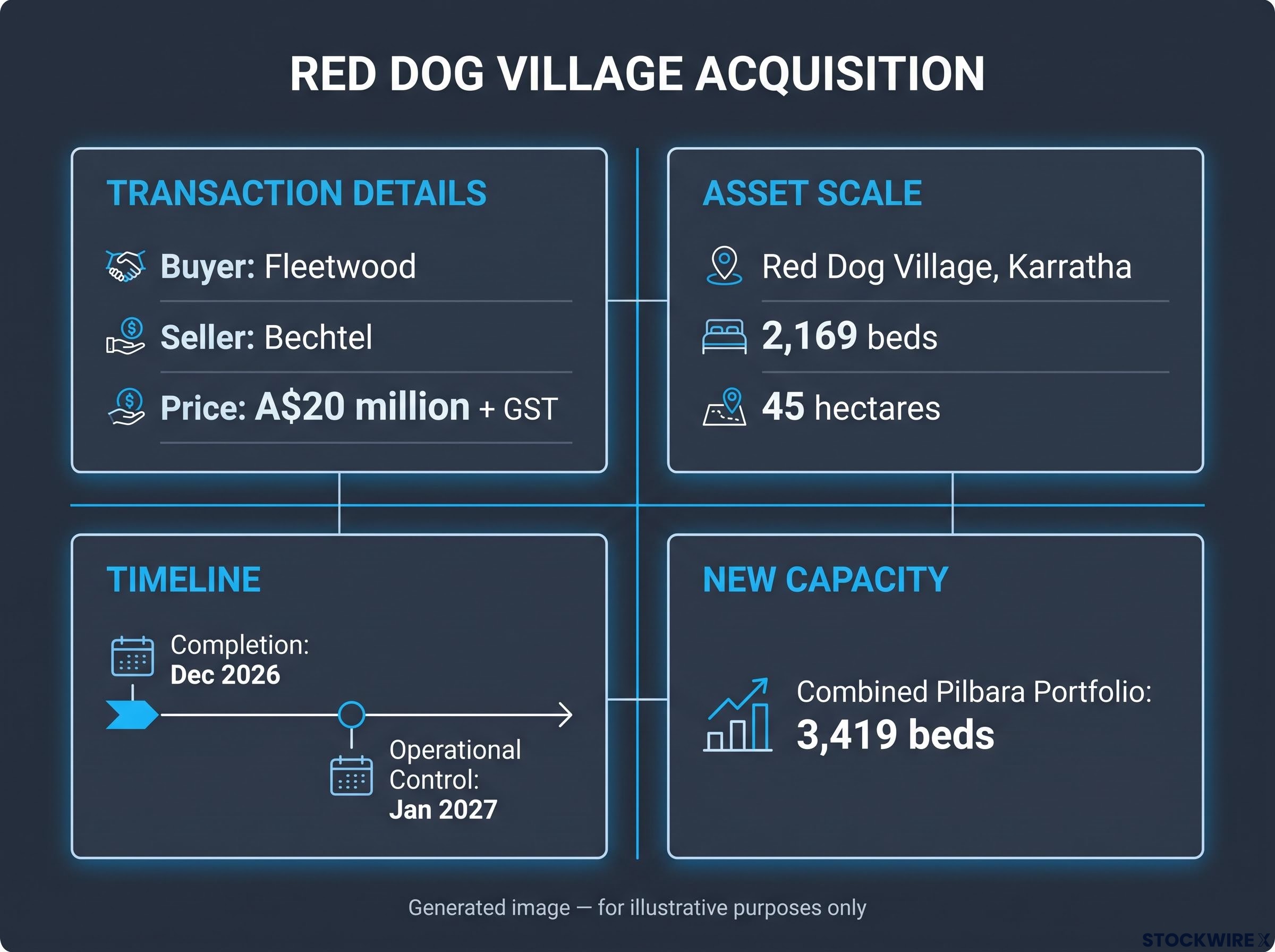
| Item | Detail | Status |
|---|---|---|
| Asset | Red Dog Village, Karratha | Verified |
| Beds | 2,169 | Verified |
| Site area | 45 hectares | Verified |
| Seller | Bechtel | Verified |
| Purchase price | A$20 million + GST | Verified |
| Completion date | December 2026 | Verified |
| Operational control transfer | January 2027 | Verified |
| Projected annual earnings uplift | A$10-20 million | Fleetwood / Euroz Hartleys estimate |
| Combined Pilbara portfolio | 3,419 beds | Calculated (1,250 + 2,169) |
Red Dog Village holds the distinction of being the Pilbara’s largest transient worker accommodation facility. Spread across a 45-hectare site, the asset includes a full suite of village services covering dining, training, medical, recreational, and laundry functions. This is not a collection of rooms. It is a self-contained operating asset.
From operational intelligence to capital decision
What makes this deal worth examining closely is not the price. It is the information advantage behind it.
Fleetwood already operated Searipple Village at 98% contracted occupancy in the same region. That gave the company direct, real-time visibility into how constrained the Pilbara accommodation market had become. It was not relying on external market reports or consultant projections. It was watching its own beds fill up, month after month, with contracted demand extending well into 2027.
The Building Solutions division adds another layer. Fleetwood is not buying a static asset. Its modular construction capability means it can design, manufacture, and manage village infrastructure end-to-end, extending a proven operating model built over more than 60 years in modular construction and accommodation.
Broker estimates from Euroz Hartleys suggest the acquisition could add A$10-20 million per year to Fleetwood’s Community Solutions earnings. That projection depends on occupancy levels and contract timing assumptions playing out as expected, and it is not a confirmed outcome. But the combined 3,419-bed Pilbara portfolio establishes Fleetwood as the region’s dominant private workforce accommodation operator, a position the company secured at the very point its own occupancy data was signalling the shortage had become most severe.
The investment logic only works if the shortage is real. The company’s own occupancy data is the clearest argument that it is.
What this means for Australia’s resource and infrastructure pipeline
The accommodation constraint is not specific to the Pilbara or to Fleetwood. It is a feature of every major remote resource and infrastructure project that depends on transient workforces. The gap between project ambition and available worker housing is described as widening rather than stabilising.
For the workers living in these villages during remote postings, the difference between adequate and inadequate accommodation affects rest, safety, mental health, and the practical quality of daily life during weeks away from family. An accommodation crunch typically means longer commutes, lower-quality living conditions, and more personal stress, all of which drive attrition and safety risk.
For you, as someone thinking about ASX industrial stocks, the structural thesis is clear. Operators who own and manage well-located, high-capacity accommodation villages in constrained regions control a scarce, strategic input to project delivery. The durability of that position depends on three variables:
Greenfield project cost overruns follow documented patterns that extend well beyond accommodation: approximately 80% of mining projects exceeding US$1 billion experience budget revisions, and the mechanism by which any single input constraint, whether housing, permitting, or logistics, cascades into broker target cuts and NPV repricing is consistent across commodities and jurisdictions.
- Pipeline durability: Whether the Pilbara’s resource project pipeline remains active over the medium term
- Shortfall persistence: Whether the accommodation deficit continues as Fleetwood estimates, potentially toward 2030
- Operator execution: Whether the company manages high occupancy under long-term contracts while handling the operational complexity that running a village at scale demands
The workforce accommodation gap is not a temporary inconvenience that market forces will solve in the short term. It is a structural supply constraint built from the combination of remote geography, limited existing housing stock, and the scale of Australia’s resource project pipeline. Understanding that gives you the right framework for evaluating any company in this space.
What the bed count tells you that the annual report does not
The accommodation shortfall is real, measurable, and current. Searipple Village running at 98% contracted occupancy through December 2026, with 800 rooms committed to April 2027, is not a projection or a marketing claim. It is observable demand at the saturation point. Fleetwood’s estimate of an approximately 1,500-bed shortfall persisting potentially toward 2030 is a company estimate, not independently verified, but it points in the same direction as the occupancy data.
The combined 3,419-bed Pilbara portfolio, built through a transaction that cost A$20 million for the region’s largest village, tells you something about how the company valued the opportunity relative to the constraint it was already tracking from inside Searipple.
The forward-looking question is whether the Pilbara project pipeline remains active, whether the accommodation shortfall persists as estimated, and whether Fleetwood executes well on contract management and village operations over a multi-year horizon. Those are the variables that determine whether the earnings projections materialise.
Beds in a constrained market are harder to substitute than processing technology. The company that controls them at scale controls a real input to project delivery.
When you evaluate ASX industrial stocks that sit at the intersection of modular construction, resource sector supply chains, and transient workforce accommodation, the question to ask is not just what the company builds or operates. It is whether the constraint the company serves is structural or cyclical, and whether its position in the market is defensible or replicable. In the Pilbara right now, the data suggests the constraint is structural, and the beds are harder to build than they look.
This article is for informational purposes only and should not be considered financial advice. Investors should conduct their own research and consult with financial professionals before making investment decisions.
Financial projections referenced in this article are forward-looking statements from company and analyst sources, subject to assumptions about occupancy, contract timing, and market conditions. Past performance does not guarantee future results.
—