The ASX lists more than 2,000 securities, and millions of Australians already own shares. Yet for most people considering their first investment, the actual mechanics of buying a share remain surprisingly unclear. The gap between wanting to invest and knowing exactly what to do is narrower than you think.
Buying shares in Australia is entirely online, can realistically be completed in a single afternoon, and requires far less capital than most beginners assume. The process sits within a structured regulatory environment, with ASIC-licensed brokers, ASX infrastructure, and clear protections designed for retail investors like you.
Here is the practical, step-by-step framework for opening a brokerage account, funding it, researching your first investment, and placing your first order on the ASX. Each step is sequenced so you can work through it at your own pace, starting today.
Understanding share ownership and what it means for investors
When you buy a share, you are not placing a bet on a number going up. You are acquiring a fractional ownership stake in a real business. That distinction matters, because it changes how you think about risk, time, and what you are actually paying for.
As a shareholder, you have three potential benefits:
- Dividends: Some companies distribute a portion of their profits to shareholders as cash payments. These are not guaranteed; the company’s board decides whether and how much to pay.
- Capital growth: If the share price rises, the value of your holding increases. If it falls, you can lose money. Capital growth is never assured.
- Voting rights: You may vote on certain company decisions at annual general meetings (AGMs). Your influence is limited to formal resolutions put to shareholders, not the company’s daily operations.
None of these outcomes are automatic. Understanding this before you commit capital reframes the mental model from gambling on prices to holding a stake in a business, and that shift changes how you evaluate risk and how long you are willing to hold.
What about ETFs and managed funds?
Exchange-traded funds (ETFs) trade on the ASX just like individual shares, but each ETF holds a basket of underlying assets rather than representing a single company. Managed funds work differently: units are priced once per day and you transact directly with the fund provider. The share-buying mechanics you will learn in this guide apply directly to ETFs listed on the ASX. The next section covers how to choose between these three options.
When big ASX news breaks, our subscribers know first
Shares, ETFs, or managed funds: how to choose your starting point
Before you open an account, you need to decide what type of investment you are actually buying. The three main options available to Australian investors differ in ways that affect your day-to-day experience, not just your returns.
| Investment Type | Risk Concentration | Fee Level (Relative) | Trading Flexibility |
|---|---|---|---|
| Individual Shares | High (single company) | Brokerage per trade | Buy/sell anytime during market hours |
| ETFs | Low (diversified basket) | Low ongoing fees + brokerage per trade | Buy/sell anytime during market hours |
| Managed Funds | Low to moderate (diversified) | Higher ongoing fees, often higher minimums | Once-daily pricing, no intraday trading |
Individual shares suit you if you want to back a specific company and are comfortable with concentrated risk. Managed funds suit investors who prefer fully delegated professional management. But for most beginners, the middle column is the logical starting point.
The ETF market in Australia has grown to 2.69 million investors and $330.6 billion in funds under management as of end-2025, with passive index ETFs charging management fees as low as 0.07%, making them significantly cheaper to hold than traditional actively managed funds over a long investment horizon.
Broad-market ETFs are often suggested as the first investment for beginners because they spread risk across many companies rather than relying on a single stock. An ETF tracking the ASX 200, for example, gives you diversified exposure to Australia’s 200 largest listed companies through a single purchase.
Getting this choice right before you open an account prevents the frustration of buying something that does not match your actual goals or risk tolerance.
How to choose and open a brokerage account in Australia
To buy shares on the ASX, you need a broker. Every broker offering share trading in Australia must hold an Australian Financial Services Licence (AFSL) issued by ASIC (the Australian Securities and Investments Commission). You can verify any broker’s licence by searching ASIC’s professional registers before you deposit a cent. This is the single most important protection you have, because unlicensed platforms have no obligation to protect your funds or follow ASIC’s dispute resolution requirements.
When comparing brokers, assess them in this order:
- Brokerage fees: The cost you pay per trade, either as a flat fee or a percentage of the trade value.
- Platform usability: How intuitive the app or website is for placing orders and monitoring your holdings.
- Research tools: Whether the platform provides company data, charts, news, and analyst research.
- Market access: Whether you can trade ASX-listed securities only, or also access US and other international markets.
- Ownership model: Whether the broker offers CHESS sponsorship or uses a custodian structure (explained below).
Once you have chosen a broker, the account opening process is straightforward. You will complete an online application and provide three things:
- A valid photo ID such as a driver’s licence or passport
- Your Tax File Number (TFN) or ABN if applying as a business
- An Australian bank account to link for deposits and withdrawals
Most beginners open an individual account, though joint, company, trust, and SMSF structures are also available. Approval can be near-instant or take a couple of business days, depending on identity verification.
CHESS sponsorship versus custodian accounts
CHESS (Clearing House Electronic Subregister System) is the ASX’s system for recording share ownership. Under a CHESS-sponsored arrangement, each investor receives a personal Holder Identification Number (HIN) and their shares are recorded directly against it. This means if your broker fails, your shares remain registered to you and can be transferred to another broker.
Under a custodian model, shares are legally registered in the broker’s or a nominee’s name and held on your behalf. This can be a legitimate structure, but it differs from having a personal HIN.
Many Australian investors prefer CHESS sponsorship for direct ownership and clearer protections. It is worth asking any broker about their ownership model before you open an account.
Funding your account and understanding brokerage costs
Once your account is approved, you need to deposit money before you can trade. The process is simple, but the cost calculation that follows it is where most beginners make their first mistake.
Three main funding methods are available at most Australian brokers:
- PayID / Osko / NPP: Funds arrive quickly, often within seconds, via Australia’s real-time payment network.
- Standard bank transfer (EFT): Settlement into your trading account generally takes 1-2 business days.
- Card or digital wallet: Some brokers accept debit card or digital wallet payments.
Once your funds appear in the account, you are ready to place your first order. But before you do, check the maths on brokerage.
A $10 flat brokerage fee on a $200 investment represents 5% of your total outlay before the market moves at all. You would need your investment to rise 5% just to break even on the cost of buying.
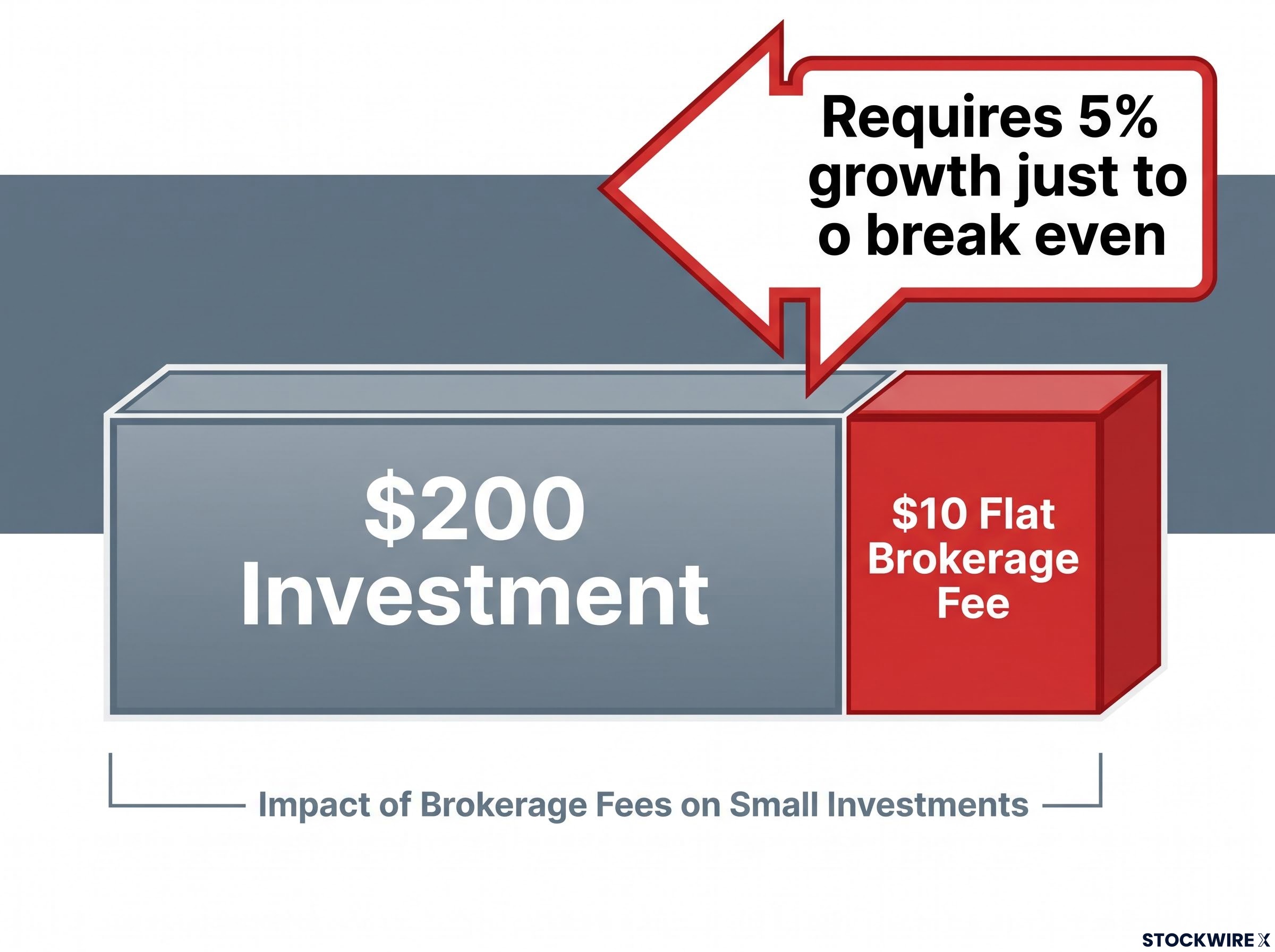
This is not a technicality. It is the first real test of whether your planned investment size makes financial sense. Make sure the amount you are investing is large enough that brokerage represents a small, rather than significant, portion of the total.
Total cost of ETF ownership extends well beyond the headline management fee and includes tracking difference, bid-ask spreads, and brokerage commissions, all of which compound silently; a fee difference of just 0.95 percentage points between two otherwise identical ETFs can cost an investor approximately $100,000 in forfeited returns on a $100,000 portfolio over 20 years.
Building a research checklist before you commit capital
Research does not need to take days. A structured checklist you can run through in under an hour is enough to ensure your first purchase is an informed decision rather than a hunch.
At a minimum, you should be able to answer three questions before you buy:
- What does the company or ETF do? Understand its business model or the index it tracks.
- How does it generate returns? Revenue sources for a company; underlying holdings for an ETF.
- What are the key risks? Sector-specific risk, broad market risk, and currency risk if the investment holds overseas assets.
If you cannot answer all three, you are not ready to buy yet, and that is fine. The information is freely available from these sources:
The ASIC Moneysmart shares guidance covers how shares work, how to choose a broker, and what rights you hold as a shareholder, making it a reliable reference point as you work through each stage of the buying process.
- ASX company announcements and financial reports, available free on the ASX website
- Broker-provided research tools, including company data, charts, and analyst commentary
- ASIC’s Moneysmart educational material on shares, ETFs, and investing basics
- Product disclosure statements (PDS) from ETF and managed fund providers
Investors who skip this step and buy on a tip or a headline are taking on risk they have not consciously chosen, which makes panic-selling far more likely when prices move against them.
Evaluating ASX shares requires looking beyond price charts: three financial metrics available in ASX filings, earnings per share, the price-to-earnings ratio, and debt levels, give you a structured way to assess whether a company is priced sensibly relative to its sector peers before you commit capital.
This article is for informational purposes only and should not be considered financial advice. For guidance tailored to your personal circumstances, ASIC’s Moneysmart website is a good starting point, and a licensed financial adviser can provide specific recommendations.
How to navigate the order screen and execute your first ASX trade
This is where every step in the guide converges into a single action. Knowing what you will see on the order screen before you get there removes the last friction point between research and execution.
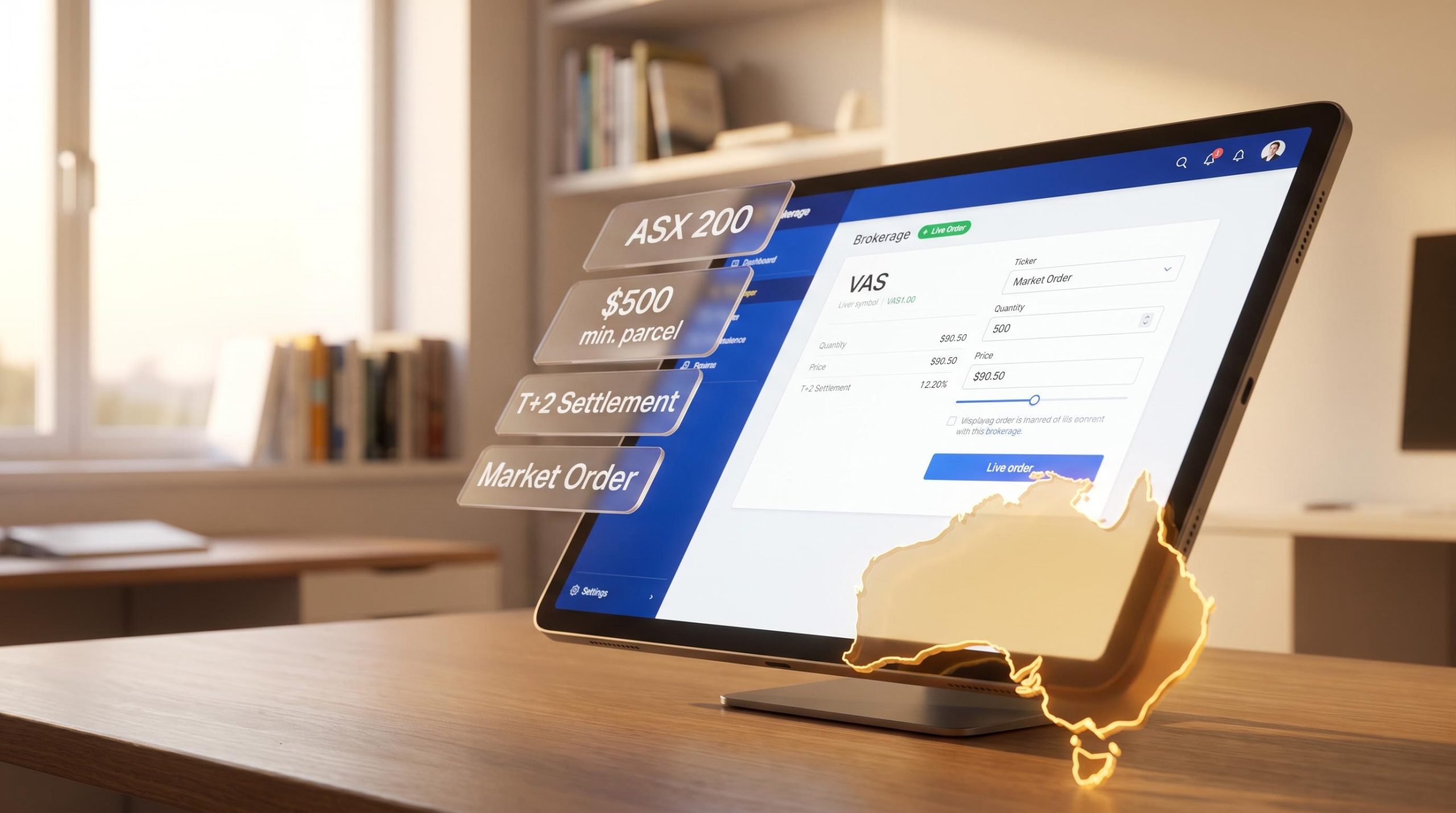
Start by searching for your chosen investment using its ASX ticker code. For example, BHP for BHP Group, or VAS for Vanguard Australian Shares Index ETF. Your broker’s platform will display the current price, recent performance, and basic company or fund information.
Market orders versus limit orders: which one for your first trade?
You will need to choose an order type. The two options that matter for beginners are:
- Market order: Executes immediately at the best available price. Fast and simple, especially for liquid ASX 200 shares and major ETFs. The exact execution price may differ slightly from the last traded price shown on screen.
- Limit order: Executes only at the price you specify, or better. Gives you price certainty but may not fill if the market never reaches your price.
For widely traded large-cap shares and major ETFs during normal market hours, a market order is the simpler and more reliable choice for a first trade. Limit orders become more useful for thinly traded stocks or during periods of high volatility where price certainty matters more than speed.
Note that the ASX requires a minimum marketable parcel of typically $500 for a first purchase in a listed security.
To place the order, follow this sequence:
- Enter the ticker code for your chosen investment.
- Choose your order type (market or limit).
- Enter the quantity (number of shares or units) or total dollar amount.
- Set the duration (day only, or good-till-cancelled).
- Review the estimated total cost, including brokerage.
- Confirm the order.
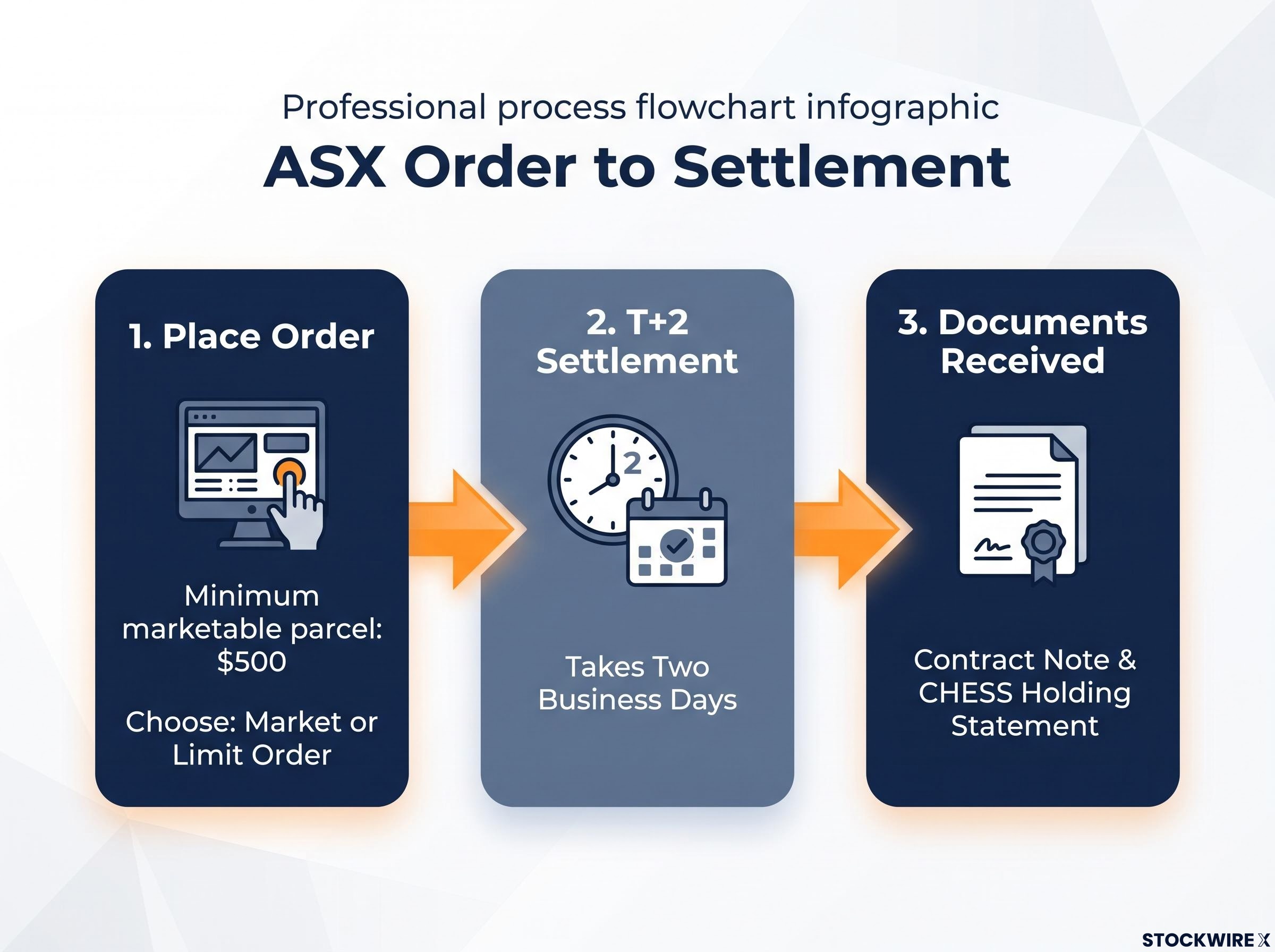
After execution, Australia’s T+2 settlement cycle applies. This means your money is debited and the shares are transferred to you two business days after the trade executes. Understanding this matters, because your cash balance will not move immediately; knowing that in advance prevents the confusion of thinking a trade has not been processed correctly.
You should expect to receive these documents after settlement:
- A contract note from your broker confirming the transaction details.
- A CHESS holding statement (if CHESS-sponsored) confirming the shares are registered under your personal HIN.
Tax, risk, and what comes after your first trade
Two topics consistently catch first-time investors off guard: tax obligations and investment risk. Neither needs to be intimidating if you understand the basics before your first dividend arrives or your first sale settles.
| Term | What It Means | Where to Get Specific Guidance |
|---|---|---|
| Dividend | A distribution of company profit to shareholders, taxable as income in the year received | ATO guidance or a qualified tax professional |
| Franking Credit | A tax credit attached to dividends from Australian companies that have already paid corporate tax, which can reduce your personal tax liability | ATO guidance or a qualified tax professional |
| Capital Gain | The profit made when you sell shares for more than you paid; subject to capital gains tax (CGT) | ATO guidance or a qualified tax professional |
| CGT Discount | Australian tax rules may provide a discount on capital gains for shares held longer than twelve months | ATO guidance or a qualified tax professional |
| W-8BEN | A US tax form required for non-US investors to manage withholding tax on US shares; relevant if you buy international shares | Your broker’s international trading section; ATO for Australian tax implications |
Knowing about franking credits before you receive your first dividend means you will understand your tax statement rather than being confused by a credit you did not anticipate. That small piece of knowledge builds confidence in managing your investment going forward.
The CGT discount that currently reduces taxable gains by 50% for assets held longer than 12 months is scheduled to be replaced from 1 July 2027 with a CPI-indexed real-gains model and a 30% minimum rate floor, making the planning window between now and that date relevant for any investor building a long-term share portfolio today.
On risk, prices can fall and you can lose money. That is a reality of share ownership, not a reason to avoid it. Three principles help you manage risk over time:
- Diversify across companies and sectors rather than concentrating in a single stock.
- Match your investment horizon to your risk level. Money you may need in six months should not be in equities.
- Use broad-market ETFs to spread concentration risk if building a diversified portfolio of individual shares feels overwhelming.
Historically, diversified portfolios have provided positive returns over long periods, though past performance does not guarantee future results. For tax matters specific to your situation, refer to ATO guidance or a qualified tax professional.
Past performance does not guarantee future results. Financial projections are subject to market conditions and various risk factors.
Your action plan for buying your first Australian share
Everything in this guide condenses into a single pre-trade checklist. Work through each step in order, and by the time you reach the final item, you will be ready to place your first ASX order with confidence.
- Decide your investment type: individual shares, ETFs, or managed funds.
- Select a licensed broker and verify their AFSL via ASIC’s professional registers.
- Open your account by completing the online application with valid ID, your tax file number, and a linked bank account.
- Deposit funds and confirm they appear in your trading account.
- Research your investment using ASX announcements, broker tools, PDS documents, or Moneysmart resources.
- Confirm CHESS sponsorship or understand your broker’s custody arrangements.
- Choose your order type (market or limit) and confirm the $500 minimum parcel requirement.
- Place your order, review the total cost including brokerage, and confirm.
ASIC’s Moneysmart (moneysmart.gov.au) is the authoritative free resource for Australian investors learning to navigate the market. Bookmark it as your ongoing reference point.
The first trade is always the hardest. The second is faster. By the third, the process feels routine. What matters most is that your first trade is an informed one, built on a clear understanding of what you own, what it costs, and what comes next.
This article is for informational purposes only and should not be considered financial advice. Investors should conduct their own research and consult with financial professionals before making investment decisions.