The safest industry on earth is also one of the slowest to adopt new safety technology. That is not a contradiction. It is a design feature.
Pharmaceutical manufacturing operates under a different set of commercial physics than any other sector. The regulatory architecture, the committee-based purchasing, the multi-year validation cycles: all of it exists because getting sterility wrong means contaminated drugs reach patients. Contamination and sterility failures have consistently ranked among the leading causes of Food and Drug Administration (FDA) drug recalls over the past decade, which is why every pharmaceutical quality team treats any process change as a formal regulatory event rather than a purchasing decision.
For any company trying to sell new laboratory technology into this market, that structural caution creates a commercialisation timeline that looks nothing like a typical sales cycle. Here is what the pattern looks like when the strategy is working, using Clever Culture Systems (ASX: CC5) and its APAS Independence platform as a specific and instructive case for understanding how ASX medtech stocks build durable traction in the world’s most sceptical market.
Why pharma says no by default
If you have evaluated technology companies in other sectors, the pharmaceutical purchasing process will feel foreign. The resistance is not about price sensitivity or lack of awareness. It is institutional design, and understanding that distinction matters when you are assessing whether a medtech company’s slow progress reflects a broken strategy or simply the reality of its market.
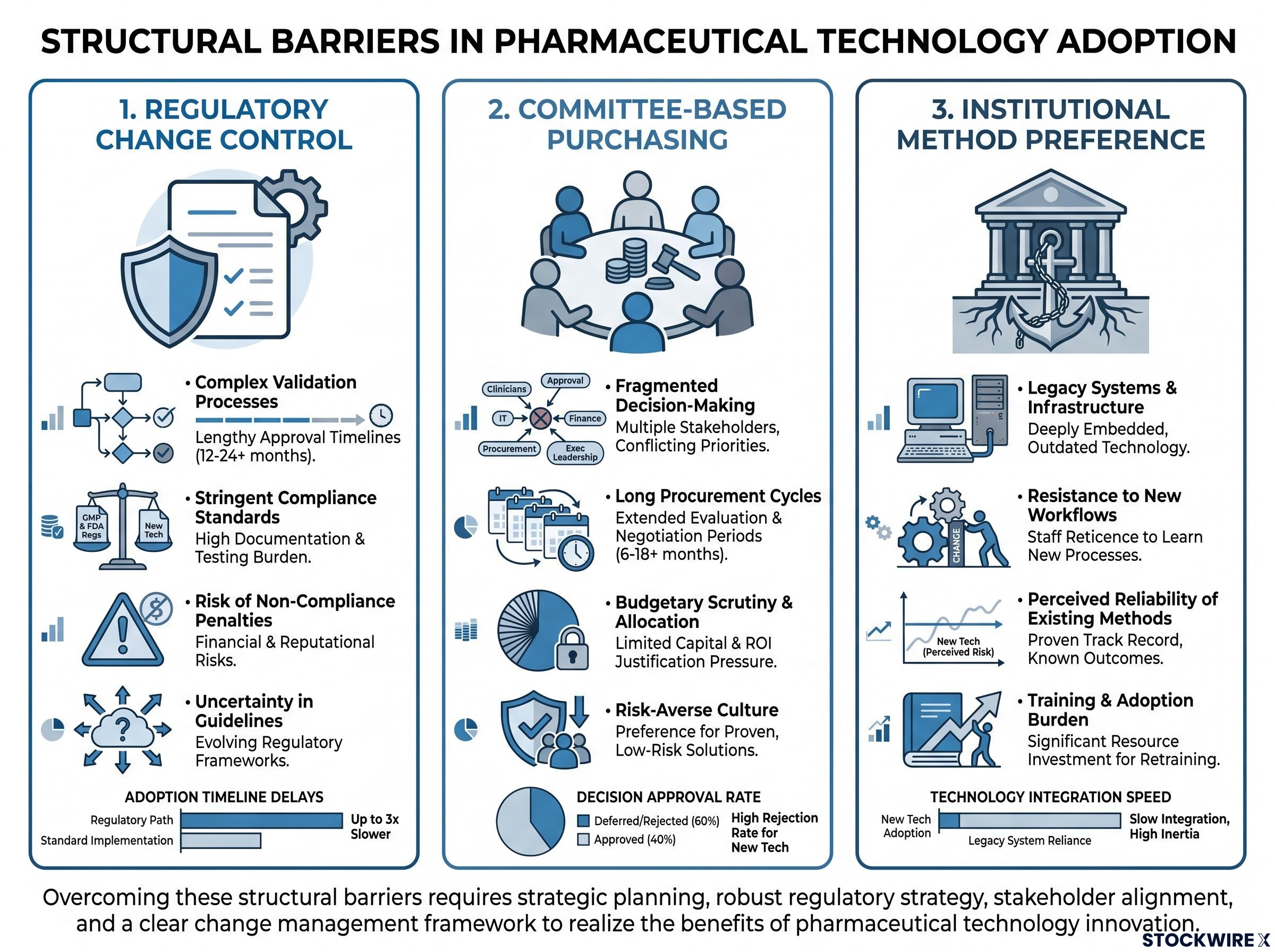
Three structural mechanisms make “yes” genuinely rare:
- Regulatory change control. Any modification to a validated manufacturing process requires formal documentation, parallel testing, and in many cases regulatory submission. Switching from a manual inspection method to an automated one is not a procurement decision; it is a multi-stage regulatory event.
- Committee-based purchasing. Quality assurance, regulatory affairs, operations, and finance each carry effective veto power. Consensus among them is sequential, not simultaneous, and a single department’s concern can stall a decision for months.
- Institutional method preference. In an industry where getting it wrong means a recall or patient harm, “we have always done it this way” is a rational risk-management position. Established methods carry decades of regulatory precedent; new ones carry none.
Every pharmaceutical company undertakes its own independent evaluation process from the ground up. Prior adoption by a peer organisation carries no formal weight with the next evaluator, who must reach its own validated conclusions regardless of what others have done. The multi-year validation cycle is a structural norm, not an exceptional circumstance. When you see an ASX medtech company reporting a two-year sales cycle in pharma, that is the market working as designed.
Regulatory submission timelines in medical device approval can extend across multiple years even after clinical data collection is complete, as the Imricor PMA process illustrates: three of four required modules are now under FDA review, with the clinical data module still to come before a final approval decision.
When big ASX news breaks, our subscribers know first
What sterility testing actually involves, and why the manual process has persisted
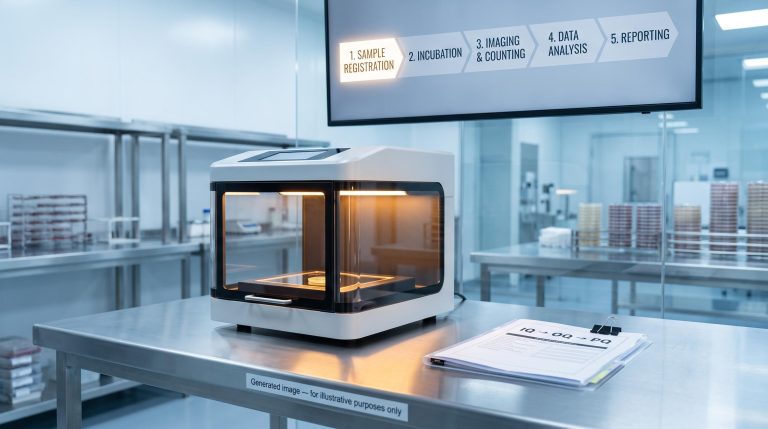
To understand what CC5 is automating, you need to understand what pharmaceutical environmental monitoring actually tests for. In sterile drug manufacturing, culture plates, small dishes containing growth media, are placed in cleanrooms to capture any microorganisms present in the manufacturing environment. The two primary formats are 90 mm settle plates, which are left open to collect airborne organisms, and 55 mm contact plates, which are pressed against surfaces to sample for contamination.
For decades, trained microbiologists have manually inspected these plates under controlled conditions, looking for microbial growth that would signal a contamination event. The process works, but it is labour-intensive, introduces human variability, and creates a substantial documentation burden. Every plate reading must be recorded, reviewed, and stored for regulatory audit.
The automation challenge in sterility assurance
Automating this process is technically difficult for a specific reason: the system must achieve an effective false negative rate of zero. A false negative, clearing a plate that is actually contaminated, is categorically more serious than a false positive. A false positive triggers an unnecessary investigation. A false negative allows a contaminated product to reach a patient.
The instrument must also perform consistently across variable sample types and plate conditions encountered in real manufacturing environments, not just in controlled test scenarios. That performance bar is why the manual method persisted for so long. It was not that no one tried to improve it; it was that the improvement bar was exceptionally high.
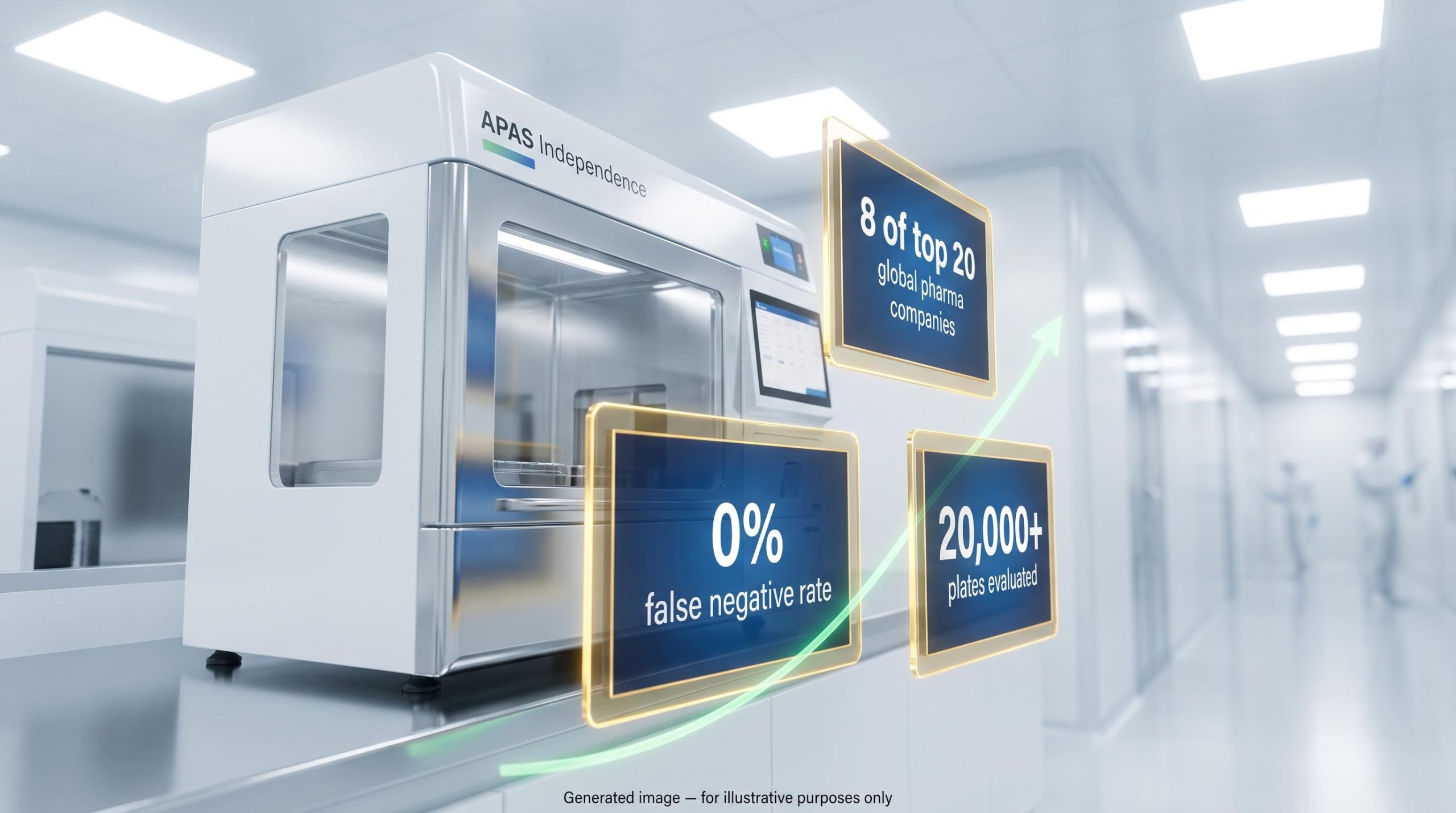
Validation result: In independent testing of CC5’s 55 mm contact plate module, the system was evaluated against a dataset exceeding 20,000 environmental monitoring plates and recorded a 0% false negative rate for microbial growth detection. (Source: CC5 technical disclosures.)
That result is the number a quality assurance director brings to a validation committee. It directly addresses the failure mode that would make adoption unacceptable, and it does so across a dataset large enough to withstand the scrutiny pharmaceutical quality teams apply before signing off on any process change.
The first FDA-cleared AI for culture plate reading
APAS Independence is the first and only US FDA-cleared artificial intelligence technology for automated culture plate reading.
That designation, confirmed in CC5’s annual reports and corporate presentations, carries a specific commercial function beyond its quality badge. FDA clearance for a laboratory instrument means the technology has been assessed by the same regulatory authority that pharmaceutical companies themselves answer to. When a quality assurance team evaluates APAS Independence, the FDA clearance does not eliminate their evaluation process, but it removes a category of regulatory risk assessment that would otherwise add months to the timeline.
The clearance applies to both clinical microbiology use and pharmaceutical manufacturing laboratories. That breadth matters because it widens the evidence base available to evaluators: pharmaceutical quality teams can point to clinical adoption data as additional validation, even when their own application is manufacturing-specific.
Thermo Fisher reinforces this credibility through a dual role. The company serves as both a pharma services customer, using APAS Independence in its own contract manufacturing operations, and as the exclusive clinical distributor in the US and selected European markets. When a distributor of Thermo Fisher’s scale adopts the technology in its own facilities, that is a different signal than a distribution agreement alone.
For you as an Australian investor evaluating ASX-listed medtech companies, FDA clearance in this specific segment functions as a commercial moat. No competitor can walk into a pharmaceutical quality team meeting and claim equivalent regulatory standing on this application.
First and only cleared positioning creates a structurally different commercial dynamic than being one of several cleared options, because the evaluation burden for competitors resets from zero each time, while the incumbent accumulates reference accounts and regulatory track record across successive customer cycles.
How peer adoption builds credibility in regulated markets
In most industries, marketing drives awareness and awareness drives sales. Pharmaceutical manufacturing does not work that way. In a sector built on validated evidence, what carries weight with the next evaluator is not an advertisement but the documented fact that an organisation with comparable regulatory obligations, comparable internal standards, and comparable technical resources completed the same scrutiny and reached a positive conclusion.
When a globally recognised manufacturer completes an independent evaluation and adopts a technology, the significance of that decision lies in what it took to reach it. The evaluating organisation operated under the same regulatory framework, committed equivalent internal resources, and applied equivalent quality standards to the assessment. Its adoption functions as a standing data point that subsequent evaluators can weigh.
AstraZeneca was the first major reference, and its subsequent second order confirmed the transition from initial evaluation to sustained operational use. Bristol Myers Squibb and Thermo Fisher Pharma Services completed their own independent evaluations and adopted the technology in turn. Pfizer and Novo Nordisk feature in management commentary and investor materials, with Novo Nordisk reported to have placed an order to assess the system at multiple sites within its European manufacturing network.
Per CC5’s own reporting, the company has now secured eight customers among the world’s twenty largest pharmaceutical companies. That figure comes from CC5’s disclosures rather than an external audit, and you should treat it as a company-stated claim rather than independently corroborated data.
| Company | Confirmation status | Relationship |
|---|---|---|
| AstraZeneca | Confirmed (formal ASX/company announcement) | Adopted; repeat order placed |
| Bristol Myers Squibb | Confirmed (formal ASX/company announcement) | Adopted |
| Thermo Fisher Pharma Services | Confirmed (formal ASX/company announcement) | Customer and exclusive clinical distributor (US, selected Europe) |
| Pfizer | Management-disclosed (investor commentary) | Adopted |
| Novo Nordisk | Management-disclosed (investor commentary) | Multi-site European evaluation |
| CSL Behring | Attributed to CC5 ASX announcement | Five-year lease; Broadmeadows, Melbourne |
Note: Confirmed names are referenced in formal ASX or company announcements. Management-disclosed names appear in investor commentary with less formal public confirmation. CSL Behring lease term and June 2026 date are attributed to CC5’s ASX announcement and have not been independently confirmed from external sources.
Eight of the world’s twenty largest pharmaceutical companies, per CC5’s own disclosures, tells you the company has crossed a threshold where its credibility is being built by its customers’ institutional weight rather than by its own sales effort alone. That distinction matters. Customer quality at this stage is a structurally different signal than customer quantity.
Why focused positioning outperforms broad ambition in regulated sectors
CC5’s strategic approach was to direct close to a decade of development resources at a single product serving a single purpose, automated culture plate reading in pharmaceutical environmental monitoring, rather than diversifying across wider diagnostic or lab-automation opportunities. According to the company’s Chief Scientific Officer, this concentration was a considered strategic choice, not a reflection of constrained resources.
The practical significance of that focus becomes apparent in the evaluation room. When pharmaceutical procurement committees and quality assurance directors assess a potential vendor, they are not shopping for a capable general-purpose instrument. They are looking for evidence that the vendor has internalised the specific regulatory, technical, and operational demands of sterile drug manufacturing. A narrowly specialised vendor with deep domain expertise reads very differently to a broad-market supplier that has adapted its platform to fit an adjacent application.
The most recent evidence of this strategy producing results is the CSL Behring placement at Broadmeadows, Melbourne. According to CC5’s ASX announcement, CSL Behring committed to a five-year lease for one APAS Independence unit at its Broadmeadows facility in June 2026, marking the company’s eighth placement with a top-20 global pharmaceutical manufacturer. Should the evaluation produce a satisfactory outcome, deployment could extend to CSL’s other manufacturing facilities in Australia, Europe, and the United States.
The CSL Behring lease placement at Broadmeadows is notable not just for the customer name but for the language CSL itself used, explicitly referencing broader standardisation across its global network, framing this evaluation as a platform-level strategic assessment rather than a single-site procurement decision.
Three reinforcing elements underpin CC5’s position:
- FDA clearance functioning as shared regulatory authority across the industry
- Top-tier reference accounts, each the outcome of a rigorous independent review by organisations with the standing and internal capability to evaluate thoroughly
- Large-scale validation datasets providing a specific and defensible evidentiary record, including the result from over 20,000 plates tested with no false negatives recorded
According to CC5’s management, the revenue potential associated with its existing and targeted relationships amounts to approximately A$100 million in prospective capital equipment sales and approximately A$10 million in prospective recurring software and algorithm revenue. These figures are CC5 management estimates, not independently validated projections, and you should treat them with appropriate scepticism before incorporating them into any investment thesis.
What the commercialisation pattern means for investors tracking ASX medtech
The distinction that matters most for you at this stage of CC5’s development is a specific one. The company has demonstrably crossed the threshold where adoptability is proven: eight of the world’s twenty largest pharmaceutical companies have evaluated or adopted the technology, per CC5’s disclosures. The remaining question is the rate at which deployment scales, and that is a different, more tractable risk question than whether the technology works or whether the sector will accept it at all.
There is a structural asymmetry here worth understanding. The institutional caution that once made winning initial sales so difficult has inverted into a protective mechanism. Any competing technology entering the market now faces the same exhaustive validation process from the beginning, with no existing reference accounts and no regulatory track record, while CC5 already occupies a validated position within the manufacturing processes of multiple tier-one operators.
ASX medtech valuation re-rating follows a pattern that is now well documented: a cluster of resolved risk events, regulatory clearance, reimbursement, and institutional capital, can compress years of risk premium into a short window, as the 4DMedical FY2026 case illustrates in detail.
The variables to monitor from here:
- Evaluation-to-adoption conversion: Are trial placements converting to full operational deployments at existing customer sites?
- Multi-site expansion: Are customers like Novo Nordisk and CSL Behring extending from single-site evaluations to broader manufacturing network rollouts?
- New top-20 relationship initiation: Is the pace of new tier-one pharmaceutical engagements accelerating as the reference base grows?
CC5 established its commercial pharma focus from approximately 2024 following a long development phase. The revenue generation period is still early relative to the market position that has been built. Long evaluation cycles and committee-based purchasing are permanent structural features of this market, not transitional obstacles, and your patience benchmarks should be calibrated accordingly.
This article is for informational purposes only and should not be considered financial advice. Investors should conduct their own research and consult with financial professionals before making investment decisions. All revenue opportunity figures cited are CC5 management estimates and have not been independently validated. Past performance does not guarantee future results.
Slow adoption, durable advantage
The characteristics that make pharmaceutical manufacturing so resistant to new technology are not weaknesses in how the sector is run. They reflect a deliberate architecture built around the principle that process changes carry real patient risk, and grasping that distinction changes how you interpret what commercial progress actually looks like in this environment.
CC5 has assembled something specific: eight relationships among the world’s twenty largest pharmaceutical companies, with each one the result of a rigorous and independent evaluation process. Taken together, those relationships form a credibility base that becomes more valuable as more names are added. The long and expensive work of building the first evaluations is done. The structural barriers that once slowed CC5 now slow anyone who would try to displace it.
When each successful evaluation lowers the perceived risk for the organisations that follow, because those organisations apply the same institutional standards and recognise the precedent that has been set, the adoption curve bends toward acceleration rather than running at a fixed pace, so long as technical performance is maintained and evaluations continue to reach positive conclusions. That mechanism, validated trust propagating through a sector that moves on evidence rather than marketing, is what CC5 is demonstrating in real time.