Nobody thinks about the cybersecurity protecting government systems until it breaks. That is not an accident. The layer of infrastructure standing between attackers and your tax records, welfare data, and national financial systems is engineered to be invisible, and its silence is precisely what tells you it is working.
Specialist cybersecurity vendors that most citizens have never encountered are the primary line of defence for the organisations managing the most sensitive public data in Australia and around the world, from revenue authorities to sovereign development banks. The technical frameworks used to assess these vendors are complex and seldom translated into accessible terms. Public scrutiny tends to arrive only after a failure has already occurred.
Here is a plain-language map of that hidden infrastructure and how to read the signals that tell you when it is in capable hands. You will understand what the invisible layer actually does, how institutions decide who to trust with it, and what that trust looks like in practice when applied to a real ASX-listed company.
The layer most citizens never see, and why that is the point
Effective cybersecurity for governments and national institutions is deliberately unobtrusive. It continuously inspects traffic, enforces access controls, and monitors systems without drawing attention unless something goes wrong. When it works, attacks are blocked, logs are collected, and incidents are contained without anyone outside the security team noticing.
That invisibility is a feature, not a flaw. If an attacker cannot see a network, they cannot probe it. If they cannot probe it, the attack surface (the total number of points where an unauthorised user could try to get in) shrinks structurally. Modern stealth architectures go further: they cloak IP addresses, hide ports, and ensure that unauthorised users see nothing of the protected environment, not even confirmation that a system exists.
The characteristics that define this invisible layer include:
- Deep operational integration: Security is built into the architecture of the system itself, not bolted on as a separate product
- Continuous 24/7 monitoring: Attacks often unfold as subtle anomalies over time, making round-the-clock surveillance a foundational requirement rather than an enhancement
- Stealth architecture: Cloaked IPs, hidden ports, and identity-first pathways mean unauthorised entities encounter nothing to scan or map
- Minimal external visibility: Security graphs and relationship-based analysis detect abnormal patterns across devices, users, and data flows, none of which is visible to the public or to non-technical institutional leaders
This creates what you might call the accountability paradox. Because success leaves no trace and failure becomes a headline, your understanding of who provides this protection and how good they are is almost entirely reactive. The invisibility that protects government systems from attackers is the same invisibility that makes it nearly impossible for you to understand who is protecting your data and whether those protections are adequate.
When big ASX news breaks, our subscribers know first
What “critical infrastructure cybersecurity” actually means in practice
Cybersecurity for government systems, energy grids, financial networks, and telecoms operates under fundamentally different rules than standard enterprise IT. The difference is consequence.
A breach of a government email system, a national bank, or a major telco does not just expose data. It undermines public confidence in institutions expected to be fundamentally stable. When things go wrong at this level, the consequences extend well beyond a remediation effort: they attract national media scrutiny, formal regulatory investigation, and in some cases physical outcomes that no helpdesk can resolve.
The cost of failure in critical infrastructure cybersecurity is measured in national headlines rather than support tickets.
Procurement reflects these stakes. The organisations selected to secure this infrastructure are evaluated through multi-year technical assessments, compliance audits, and red-teaming exercises rather than simple feature comparisons or price-based decisions. OT (operational technology) security, the discipline of protecting systems where digital controls govern physical processes like pumps, turbines, and traffic systems, covers sectors where a compromised system can cause physical harm, not just data loss.
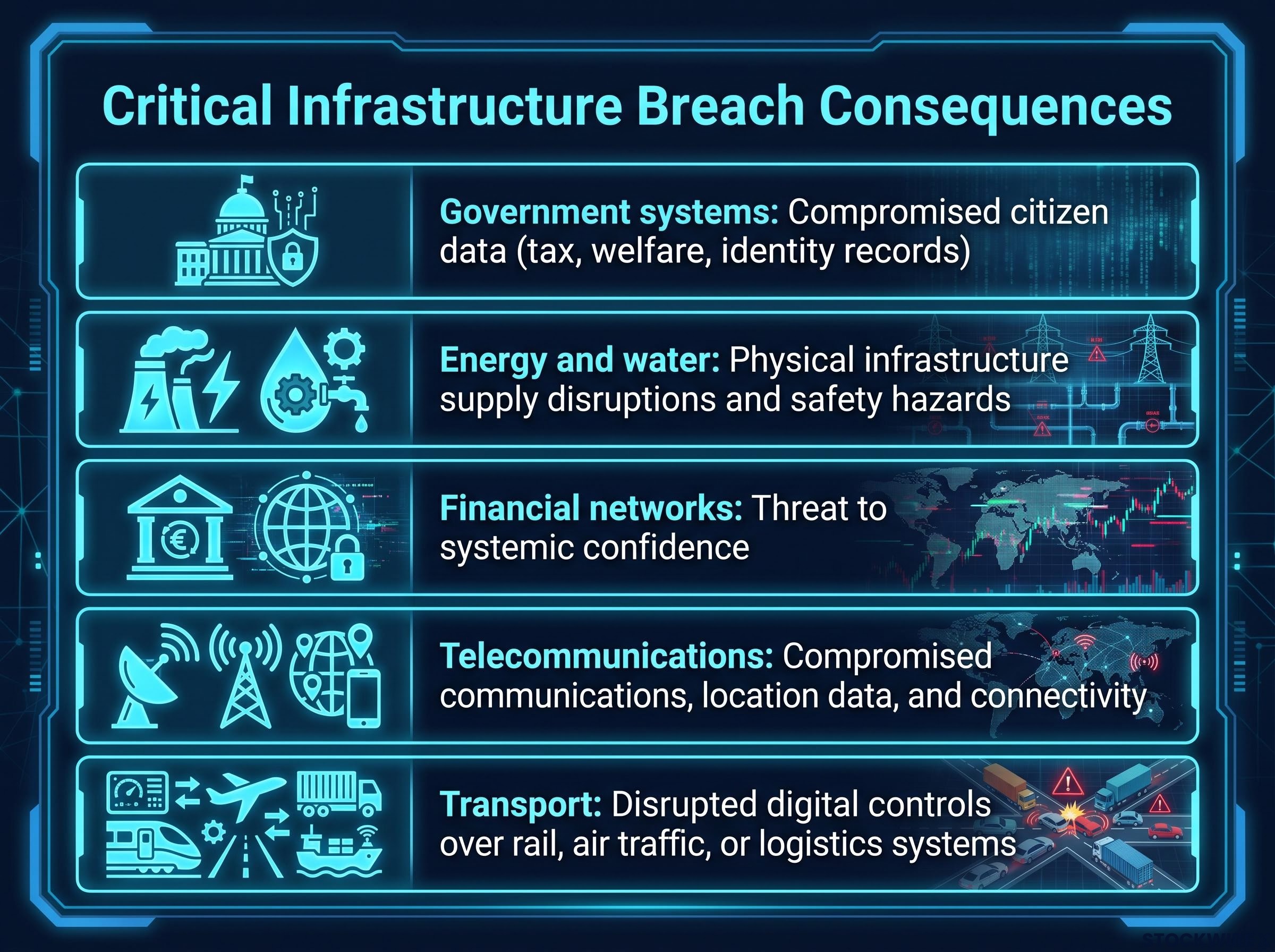
The categories of critical infrastructure and their consequence profiles look like this:
- Government systems: Compromised citizen data (tax, welfare, identity records) erodes institutional trust
- Energy and water: Breached controls over physical infrastructure can cause supply disruptions and safety hazards
- Financial networks: A breach of a sovereign bank or payment system threatens systemic confidence
- Telecommunications: Compromised networks expose communications, location data, and the connectivity that other infrastructure depends on
- Transport: Disrupted digital controls over rail, air traffic, or logistics systems carry direct public safety risk
Cyber risk in financial networks carries consequences that extend well beyond individual institutions, with Federal Reserve simulations finding that impairment of a single large bank can affect 31-38% of the broader banking network through liquidity hoarding and confidence-driven deposit outflows.
Within Australia, the Australian Signals Directorate (ASD) publishes the Information Security Manual (ISM), which functions as the binding technical benchmark that Commonwealth systems are required to meet for cybersecurity. There is also a hidden dependency problem: organisations increasingly rely on untracked SaaS tools, middleware connectors, and API gateways that bypass formal risk review, expanding the attack surface without corresponding oversight.
For you, evaluating the cybersecurity sector, this is the structural context that separates high-accountability vendors embedded in critical infrastructure from commodity software providers. The demand side has nowhere to go if it gets this wrong.
How Australia’s ISM sets the standard for government email security
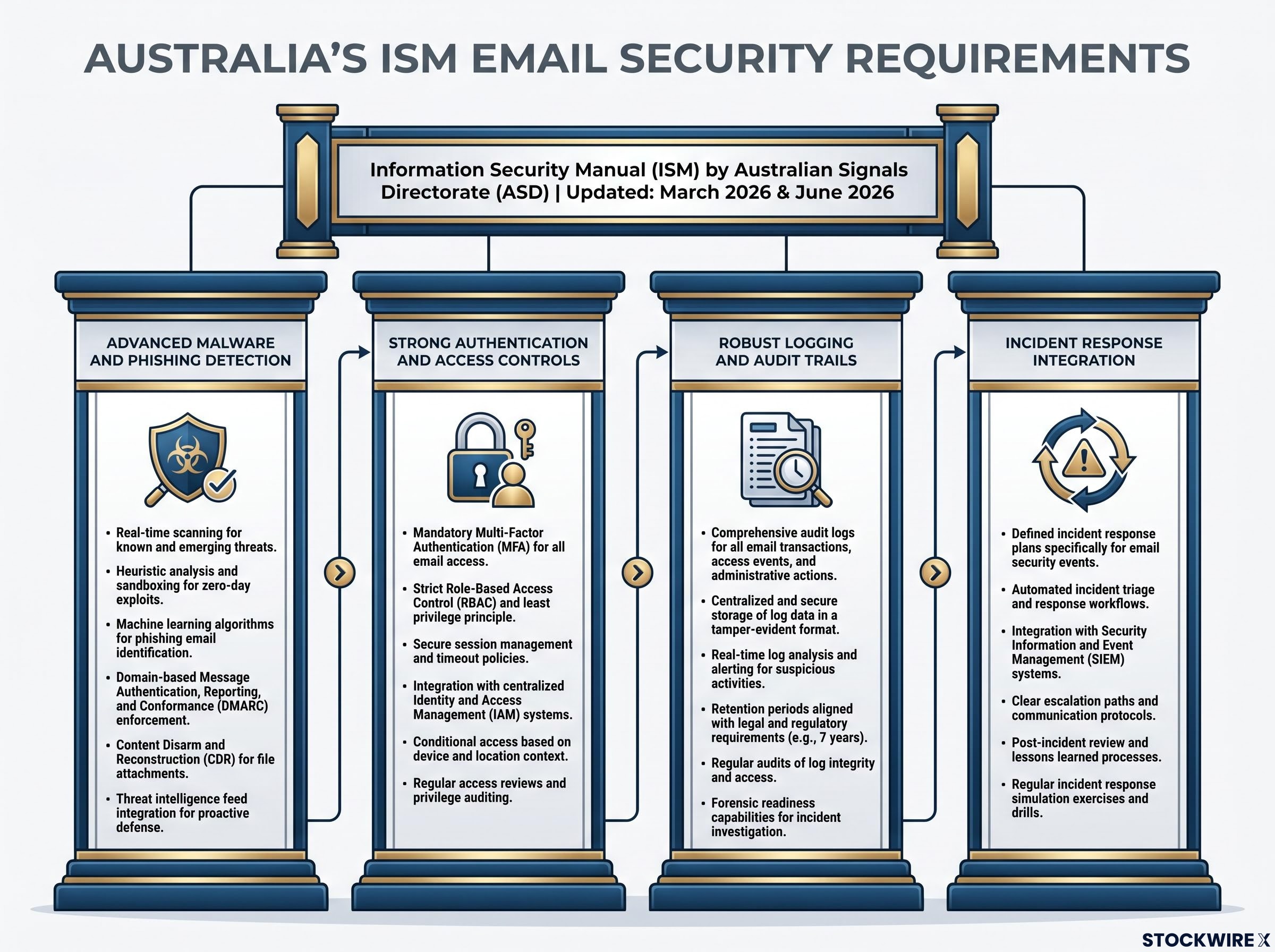
The ISM, which the ASD develops and maintains, sets out the specific technical controls that Commonwealth Government systems are obligated to implement across areas including email security, access control, monitoring, and incident response. Its requirements are rigorous and detailed, and because the standard is written for technical practitioners rather than general audiences, the gap between what it demands and what the public understands about it remains wide.
The Essential Eight maturity framework, developed by the same ASD that publishes the ISM, operates as a companion credential in the Australian market, with procurement teams and insurers now treating verified controls as a hard eligibility gate rather than a soft preference.
The ISM is not a static benchmark. It is a living standard, updated regularly. The March 2026 and June 2026 versions addressed evolving controls including cryptography and AI-related considerations. A vendor that holds ISM compliance does not earn a permanent certification. It must continue meeting the standard under active government scrutiny as the requirements evolve.
For email security specifically, the ISM requires:
- Advanced malware and phishing detection: Identifying and blocking malicious attachments, links, and social engineering attempts before they reach inboxes
- Strong authentication and access controls: Ensuring only authorised personnel can access email systems and the data within them
- Robust logging and audit trails: Maintaining detailed records of who accessed what, when, and from where, enabling forensic analysis after any incident
- Incident response integration: Email security cannot operate in isolation; it must feed into broader response processes so that a detected threat triggers coordinated action across the organisation
Why email remains the most targeted entry point
Email remains the preferred initial access vector because it reaches humans, not systems, and humans are harder to patch than software. A phishing email that lands in the right inbox does not just compromise that account. In a government context, a compromised inbox carries access to workflows, identity credentials, and inter-agency communications that extend well beyond the email itself. A single successful email-based compromise can act as a pivot point into more sensitive systems.
The ACSC email security guidance documents how business email compromise alone accounted for nearly 7% of all cybercrime reports in Australia, with self-reported losses exceeding $81 million in a single reporting year, a figure that illustrates why email remains the entry point attackers return to most reliably.
ISM compliance is not a marketing label. It is a technically verified, regularly updated standard that a vendor must continue meeting, and the fact that a vendor holds and renews this position with multiple Commonwealth agencies is a more meaningful signal than most public-facing credentials you will encounter when evaluating this sector.
What contract renewals actually signal about vendor trust
When you see a cybersecurity company announce a new contract, it tells you someone chose them. When you see a renewal, it tells you something different: someone experienced them and chose to stay.
Critical infrastructure operators rarely switch core cybersecurity platforms casually. Changing email security or OT monitoring tools in live environments requires recertification, re-integration, staff retraining, and controlled transition periods. In highly regulated environments such as government agencies and sovereign financial institutions, a vendor change also triggers compliance re-verification and a gap period during transition, which carries its own security risk.
The implication is straightforward. When a sophisticated institutional client renews a core cybersecurity relationship rather than re-tendering, that renewal reflects accumulated operational confidence that is costly to replicate elsewhere. A one-off contract win can be a procurement anomaly. An embedded, recurring relationship is evidence of sustained performance under real operational conditions.
When you are evaluating any cybersecurity company, the signals worth reading from client relationships include:
- Contract renewal history: Has the vendor been retained over multiple cycles, or is every announcement a new client?
- Client type: Government and sovereign institutional clients apply the most rigorous evaluation. Enterprise clients vary widely in their scrutiny.
- Compliance framework alignment: Does the vendor operate under mandatory, technically verified standards (like the ISM), or under self-reported certifications?
- Embedded engagement versus transactional sale: A multi-year embedded relationship where the vendor is integrated into live operations carries a fundamentally different signal than a one-off software licence
For anyone evaluating cybersecurity companies, a contract renewal by a sophisticated government or institutional client is a stronger signal of real-world performance than a new contract win, because renewals reflect what a client experienced rather than what a vendor promised.
Multi-year renewal patterns across government and institutional clients are increasingly visible across the ASX cybersecurity sector, with WhiteHawk (ASX: WHK) separately announcing A$685,000 in renewed and expanded engagements across financial services, education, and government in the same period.
Firstwave Cloud Technology as a worked example of embedded institutional trust
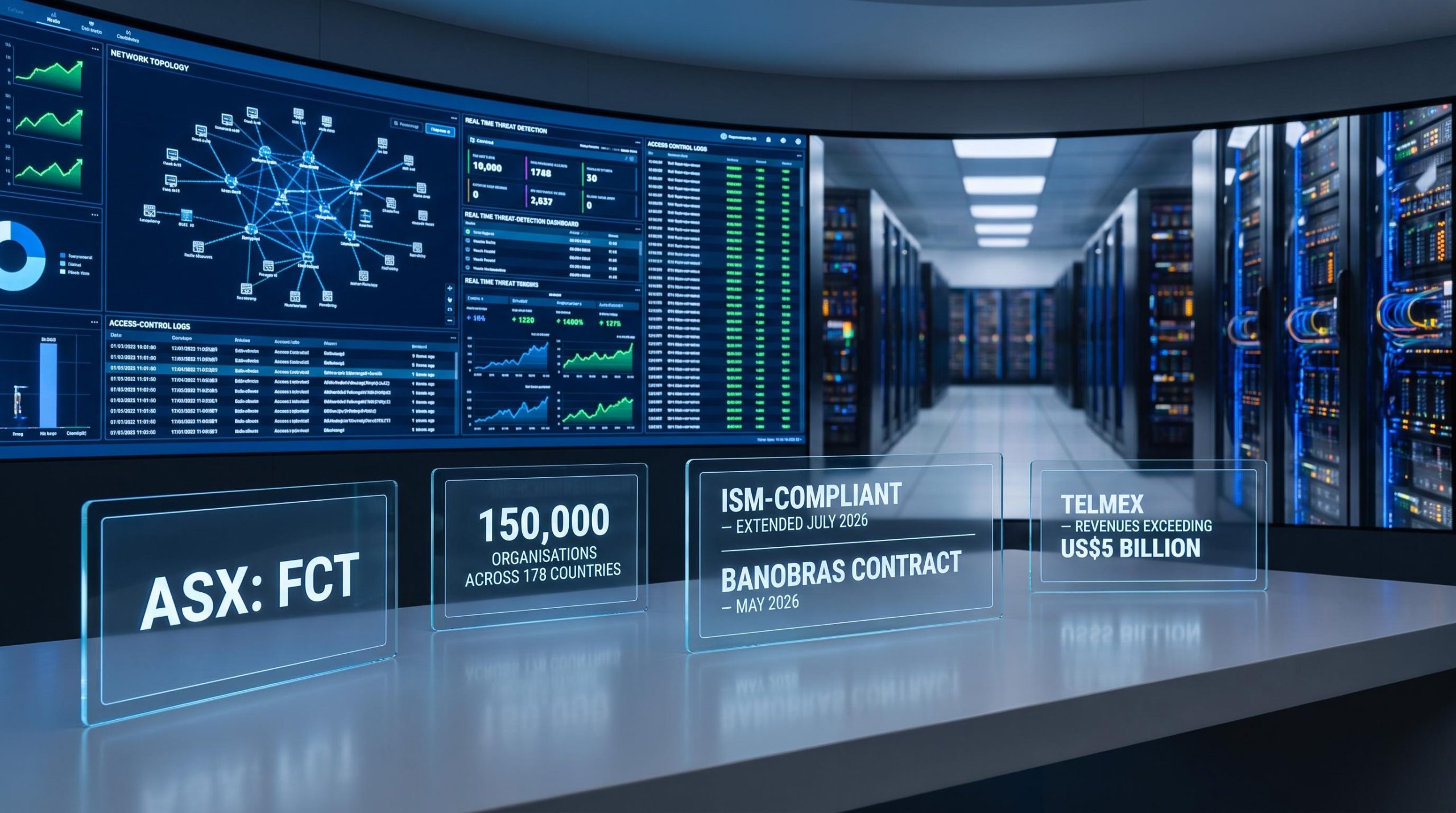
Firstwave Cloud Technology (ASX: FCT) is a Sydney-headquartered, ASX-listed company whose cybersecurity and network management products have been built out over roughly twenty years of operation. According to company disclosures, its platforms are deployed across more than 150,000 organisations in 178 countries worldwide.
Two core product lines define what the company delivers. CyberCision is its cybersecurity-as-a-service platform, while Opmantek, brought into the group through an acquisition in 2022, extends the offering into network discovery, monitoring, and security management, completing an end-to-end capability set.
The client roster is where the evaluative framework built earlier in this article finds its application.
| Client | Region | Relationship Type | Key Detail |
|---|---|---|---|
| Commonwealth Government Agencies (via Telstra) | Australia | Multi-year embedded, renewed repeatedly | ISM-compliant email security; latest extension 12 months from July 2026 |
| Banobras | Mexico | New institutional contract | Mexico’s state-owned national development bank; announced May 2026 |
| Telmex | Latin America | Multi-year embedded engagement | Latin America’s leading telco; annual revenues exceeding US$5 billion (per Firstwave disclosures) |
| Claro | Latin America | Existing client | Major telecommunications operator |
| NASA | United States | Existing client | High-security US federal agency context |
The relationship conducted through Telstra with Australian Commonwealth Government agencies is the most instructive case in the roster. Via that arrangement, CyberCision supplies ISM-compliant email security to several agencies, and the contract has been renewed on multiple occasions rather than put back out to tender. The current term runs for 12 months from July 2026, continuing a pattern of successive extensions.
Rather than being replaced, the Telstra arrangement has been extended through repeated renewal cycles. Given the operational disruption and compliance exposure that a vendor transition creates in this environment, consistent retention is a meaningful indicator of the performance Firstwave has delivered.
The Banobras engagement, announced in May 2026, marks Firstwave’s entry into the sovereign financial institution category beyond Australian borders. Banobras is the Mexican state’s national development bank, tasked with financing the country’s public infrastructure programme. The Telmex relationship is long-standing, having generated its own renewal cycles and upward revisions in contract value over time. NASA appears on the client list, placing Firstwave inside a US federal agency environment with its own demanding security requirements.
The pattern across these relationships is not a list of impressive names. It is evidence of a vendor that has been evaluated, embedded, and re-evaluated by institutions where the cost of a wrong choice is institutional credibility, and has been retained each time. The commercial specifics presented in this section draw entirely from Firstwave’s published disclosures, and readers are encouraged to cross-reference them against the company’s official ASX filings.
For investors wanting the full commercial detail behind the July 2026 renewal, our dedicated guide to the Telstra extension announcement covers the ARR figure, the dual-channel partnership structure, and the Q4 FY26 contract sequence that preceded it.
Reading the signals in a sector built on silence
The paradox that opened this article now has a different weight. Good cybersecurity for governments and institutions leaves no visible record of its own success. The most capable vendors in this space are structurally unlikely to generate the kind of public attention that drives casual investor awareness.
That means the evaluative posture this sector demands is different from most. Rather than looking for cybersecurity companies with the loudest marketing or the highest-profile breach response moments, you should look for quieter signals of embedded trust:
- Compliance framework alignment: Is the vendor operating under mandatory, technically verified standards like the ISM, or under self-reported certifications?
- Institutional client type: Sovereign agencies, national banks, and major telcos apply the most rigorous ongoing evaluation
- Renewal pattern: Multi-year, embedded, continued rather than replaced, across multiple cycles
- Embedded engagement depth: Is the vendor integrated into live operations, or selling a product at arm’s length?
- Multi-jurisdiction presence: Trust that translates across countries and institutional categories is harder to manufacture than a single domestic win
The ISM compliance point is worth revisiting here: it is mandatory, technically verified, regularly updated, and applied in live government environments. A vendor that holds and renews this position has cleared a bar that most cybersecurity companies never face.
The institutions examined in this piece, Commonwealth Government agencies, a national development bank, Latin America’s dominant telco, and a US federal agency, represent the hardest end of the demand spectrum. The companies trusted with this work are unlikely to make headlines for doing it well. For anyone building a position in the cybersecurity sector or simply trying to understand which companies carry genuine institutional credibility, the quietest vendors with the most demanding clients are often the ones worth understanding first.
This article is for informational purposes only and should not be considered financial advice. Investors should conduct their own research and consult with financial professionals before making investment decisions. Company-specific figures and contract details in this article are drawn from Firstwave’s own public disclosures and ASX announcements, and have not been independently verified. Readers should consult official filings directly to confirm all such information.