Most people only notice a streetlight when it fails. A dark stretch of road at night, a shadow where there should be light, a council complaint lodged and left unanswered for weeks. That absence of light is the only moment public lighting infrastructure becomes visible to the people it protects.
Across Australia, a national infrastructure replacement cycle is now accelerating. The driver is not aesthetics. It is safety liability, energy waste, and a widening gap between what is installed on Australian roads and what modern traffic management actually requires. Government spending on major arterial and freeway upgrades is increasing, and procurement decisions are shifting toward infrastructure that can communicate its own status, not just illuminate a road.
This piece lays out what that transition looks like in practice, who is building the replacement infrastructure, and why the domestic manufacturing question carries more weight than it first appears for anyone watching ASX industrial stocks or infrastructure procurement pipelines.
Why millions of Australian streetlights cannot tell anyone they have failed
The bulk of streetlights across Australian council roads were installed under an engineering standard that has not changed in decades: activate at dusk, deactivate at dawn, transmit nothing. There is no data channel, no self-monitoring, and no mechanism to alert anyone on the network when something stops working.
When one of these lights fails, the only detection mechanism is a member of the public calling the council. That means a dark stretch of road, sometimes on a busy arterial, can persist for weeks before a maintenance crew is dispatched. This is not a marginal edge case. It is the operating condition of most streetlight networks across Australian councils right now.
The failure modes are consistent:
- No fault reporting: The light cannot tell anyone it has failed. Detection depends entirely on public reports.
- No dimming or adaptation: Energy consumption is fixed regardless of traffic conditions or ambient light.
- No real-time data: Councils have no visibility into the operational status of their lighting assets until something visibly breaks.
Each of these gaps compounds over time. Unmonitored lighting on public roads carries a well-documented safety cost: research consistently shows higher rates of pedestrian and vehicle incidents during nighttime conditions where lighting is absent or degraded, and councils managing ageing networks face growing liability exposure as a result. Maintenance models that depend on public fault reports also carry a higher long-term cost burden than monitored systems, through unplanned labour, wasted energy, and emergency callouts that could have been avoided.
Nighttime road safety research quantifying the effect of street lighting improvements shows reductions of up to 52% in fatal crashes and 78% in fatal pedestrian crashes at lit versus unlit sites, figures that translate directly into the liability exposure councils carry when ageing, unmonitored fittings degrade without detection.
The absence of communication capability in these assets is not a minor inconvenience. It is a compounding cost and safety liability, and it is now the single biggest factor pushing procurement decisions toward infrastructure that can report its own status.
When big ASX news breaks, our subscribers know first
What smart infrastructure actually means for a council managing a road network
For a council managing hundreds or thousands of lighting assets across a road network, the shift to data-enabled infrastructure changes the operating model at every level.
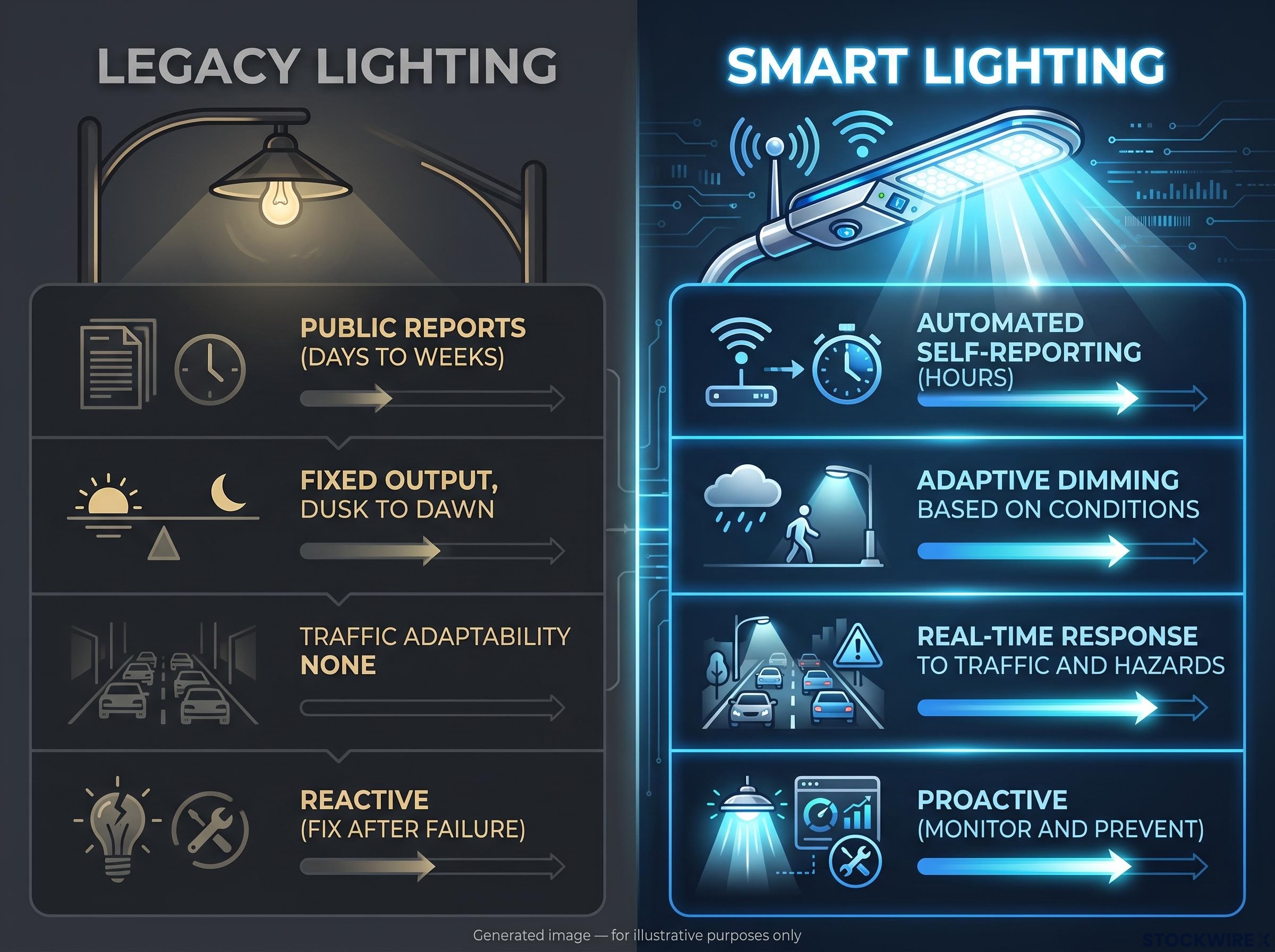
Smart lighting systems flag their own faults. Instead of waiting days or weeks for a public report, a council receives an automated alert the moment a fitting fails or degrades. That single capability, self-reported faults, collapses the response timeline from weeks to hours.
Beyond fault detection, fittings with traffic-adaptive capability can vary their output according to conditions as they change. On arterial roads and freeways where lighting quality has a direct bearing on trauma outcomes, that responsiveness is operationally significant. IoT-enabled (Internet of Things, meaning devices connected to a network that share data in real time) monitoring shifts safety equipment from a periodic inspection model to one of continuous, active oversight.
| Dimension | Legacy lighting | Smart lighting |
|---|---|---|
| Fault detection | Public reports (days to weeks) | Automated self-reporting (hours) |
| Energy management | Fixed output, dusk to dawn | Adaptive dimming based on conditions |
| Traffic adaptability | None | Real-time response to traffic and hazards |
| Maintenance model | Reactive (fix after failure) | Proactive (monitor and prevent) |
When smart public lighting is functioning as designed, the public has no reason to think about it. A fitting that operates correctly generates no complaints and no calls to the council. That unremarkable invisibility is precisely what the infrastructure is built to achieve.
What this means for councils is a shift in the liability and cost profile of their road infrastructure: from assets that silently degrade and expose the organisation to risk, to assets that communicate their own status and allow proactive management. For anyone without a technical background in infrastructure procurement, this is the conceptual framework that makes the commercial capability of companies in this space meaningful rather than abstract.
The supply chain problem sitting underneath Australia’s smart city ambitions
The acceleration of smart infrastructure spending in Australia is happening against the backdrop of a domestic manufacturing base that has been contracting for years.
Australian manufacturing accounts for a roughly mid-single-digit share of GDP. In lighting specifically, the overseas import reliance is substantial: China alone accounts for a large majority of Australia’s lighting imports. The practical consequence is that most smart infrastructure going into Australian cities today is designed, procured, and maintained through offshore supply chains.
For councils and transport agencies, this import dependency creates three practical procurement risks:
- Extended lead times: Imported components can take months to arrive, delaying upgrades and replacements on projects with fixed delivery timelines.
- Controller replacement delays: When a controller unit fails on an import-sourced system, replacement parts can add weeks to maintenance timelines, leaving infrastructure offline.
- Orphaned product lines: When an offshore manufacturer discontinues a product line, councils are left managing assets with no available spare parts and no local service capability.
These are not theoretical risks. They are documented outcomes that procurement teams in government and infrastructure agencies have encountered directly, and supply chain resilience has moved from a secondary consideration to a primary evaluation criterion in how contracts are now being structured.
For a council or transport agency specifying smart lighting today, the import dependency question determines whether replacement parts arrive in days or months, and whether the manufacturer will still support the product in a decade. That consideration is changing how contracts are awarded, and it favours onshore manufacturers in ways that were less pronounced even a few years ago.
Why FOS Capital entered the roadway lighting market by buying a working business
FOS Capital (ASX: FOS), a Melbourne-based, ASX-listed lighting manufacturer, did not develop its way into the roadway lighting and intelligent transport systems (ITS) market. It bought its way in.
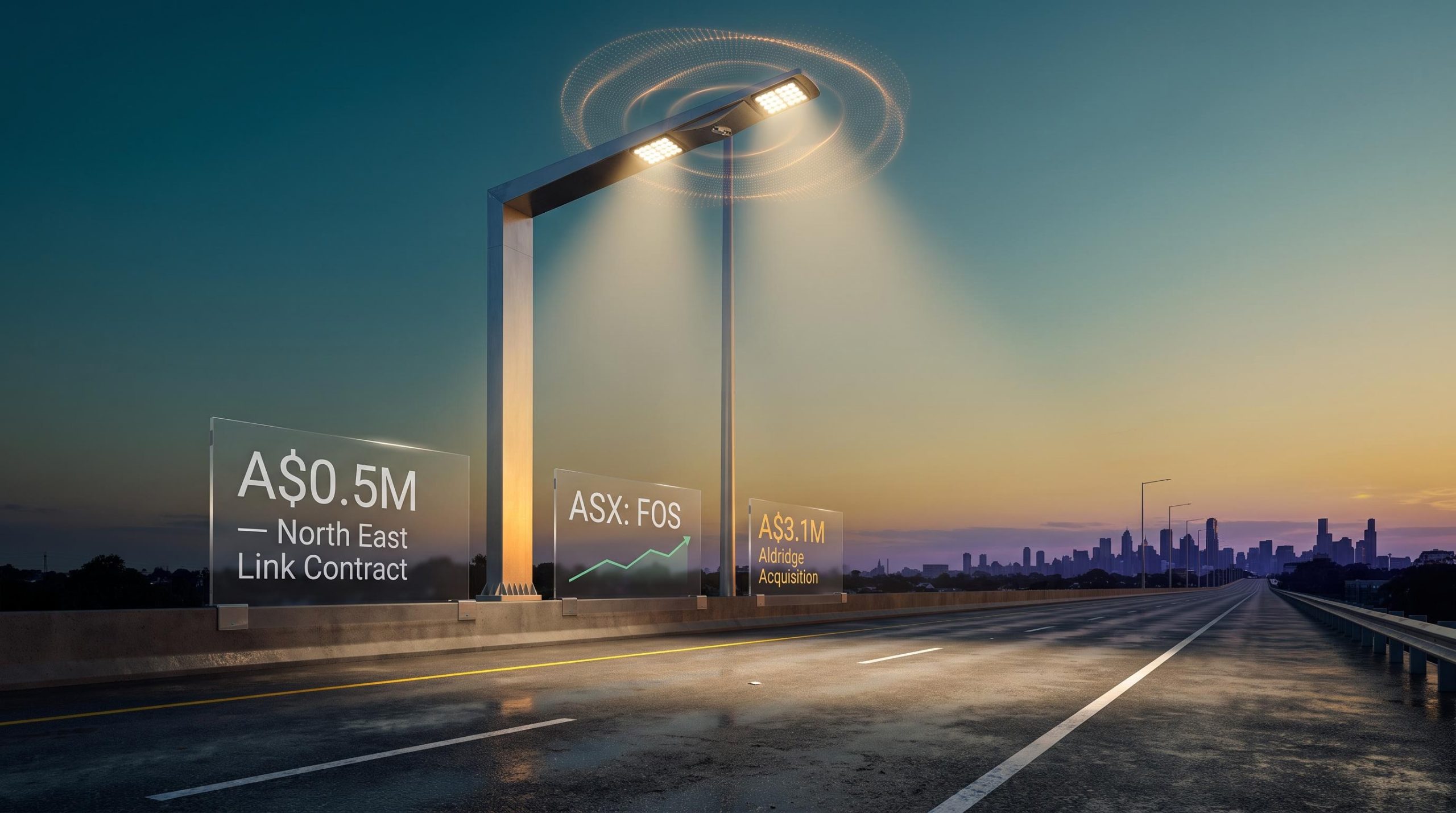
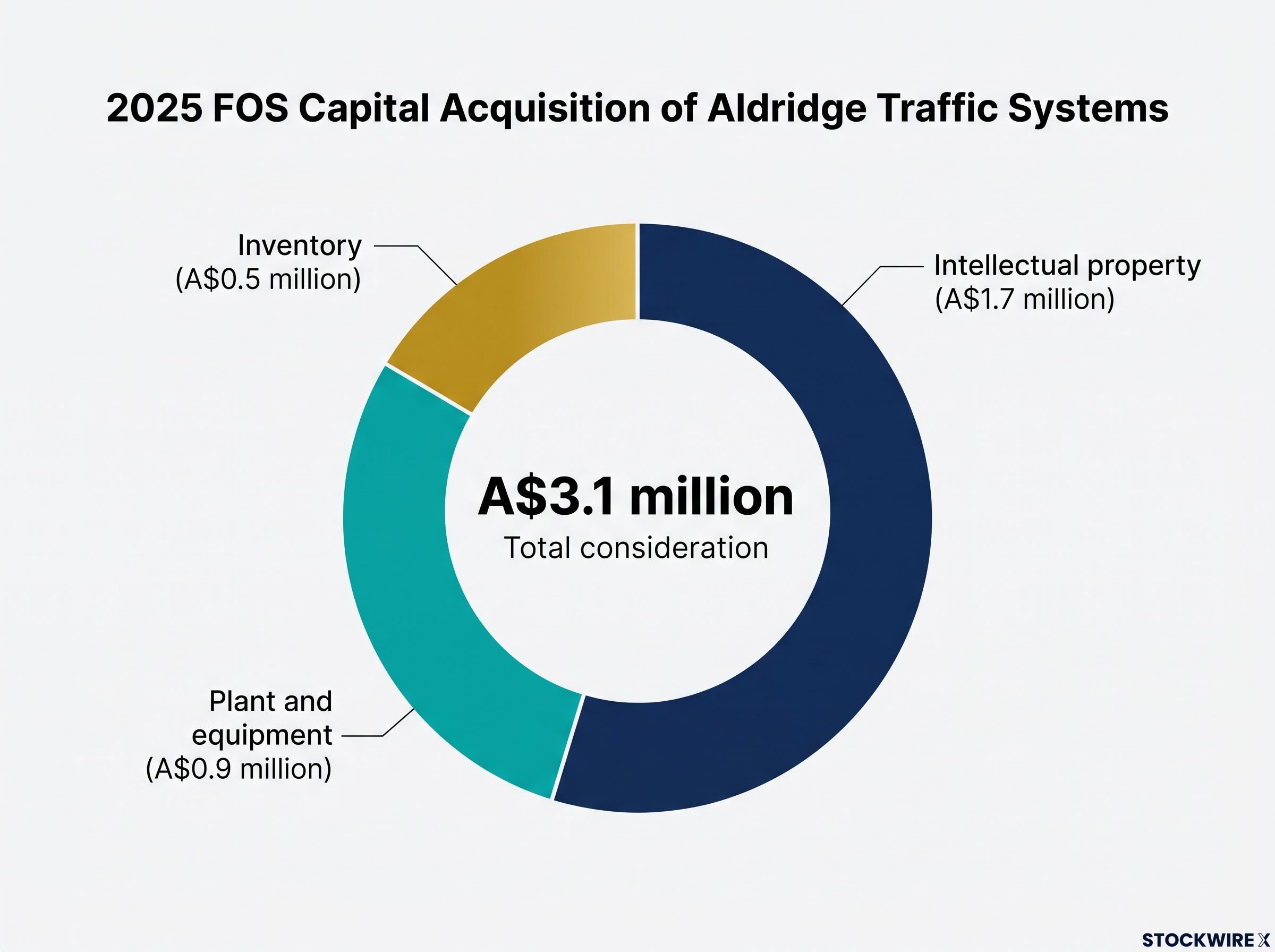
In 2025, FOS acquired the street lighting and ITS assets of Aldridge Traffic Systems from Traffic Technologies, which had entered administration. Total consideration was approximately A$3.1 million, funded by a A$3.7 million equity placement at A$0.30 per share.
The asset breakdown tells you what FOS was actually buying:
| Asset category | Approximate value |
|---|---|
| Plant and equipment | A$0.9 million |
| Inventory | A$0.5 million |
| Intellectual property | A$1.7 million |
More than half the consideration went to intellectual property. The IP acquired covers the product design, engineering specifications, and accumulated technical expertise underpinning a range of data-enabled LED road lighting, traffic signal hardware, pedestrian push buttons, and IoT-ready fittings. Prior to the acquisition, Aldridge had an established track record of delivering Smart City streetlight projects for government clients, with the City of Sydney among its confirmed reference customers.
The strategic logic was specific: acquire an operating business with established government credentials and a product range that is already in service, rather than betting years and capital on internal R&D with no guaranteed procurement pathway.
Acquisition-led market entry is a pattern appearing across multiple ASX industrial companies targeting government infrastructure pipelines: Symal Group’s A$51 million purchase of Queensland defence contractor Shamrock Civil follows comparable logic to the FOS/Aldridge deal, with both buyers prioritising established credentials and existing contract relationships over greenfield capability development.
Unlike most participants in the Australian lighting market, FOS has held onto substantive onshore manufacturing and engineering operations rather than moving entirely to an import-and-distribute model. That domestic capability compresses the timeline between a council identifying its smart lighting requirements and having a working, monitored system in the ground.
Near-term financial variable: FOS recorded approximately A$795,000 in restructuring costs in the half-year to 31 December 2025, reflecting the integration and turnaround work required after the Aldridge business exited administration. Integration is a real execution variable here, not a formality.
The acquisition logic tells you something specific about how to read FOS. This is not a concept-stage play. It is a company that bought a working business with existing government clients, an established product range, and a restructuring task that is still underway.
The Eastern Freeway contract and what a proof point looks like at this scale
When FOS Capital announced in May 2026 that Aldridge Traffic Systems had won a contract on Victoria’s North East Link Program, it marked the first substantial deployment of the acquired technology on one of the state’s most prominent transport infrastructure projects. The contract covers the supply of intelligent transport systems, roadway lighting, and control equipment for the Eastern Freeway upgrade corridor.
The contract, valued at approximately A$0.5 million, has been described as ATS’s largest project win since the FOS acquisition. It covers three elements:
FOS Capital’s group order book now stands at A$9 million following the ATS acquisition and restructure, and the company is actively tendering for additional contracts across the same North East Link programme, meaning the A$0.5 million headline figure may significantly understate the total Eastern Freeway opportunity.
- Intelligent transport systems supply, including traffic management hardware for the freeway upgrade corridor.
- Roadway lighting, featuring a newly designed ATS high-mast fitting.
- Control equipment with TST integration, incorporating FOS’s Traffic Smart City Technology system to improve traffic management and efficiency across the supplied products.
The ATS high-mast fitting operates at roughly half the weight of alternative market products, reducing structural load requirements on freeway gantries and support structures.
At A$0.5 million, this contract is a credentials signal rather than a revenue inflection. But in government infrastructure procurement, the significance lies in the reference customer and the programme, not the dollar value. The North East Link is among the most visible road projects in Victoria. Having FOS/ATS equipment specified and installed on that programme is the credential that opens subsequent tender conversations with other state and council buyers.
The contract is on the public record and the infrastructure is going into the ground. The product range assembled through the Aldridge acquisition is now operating on active government infrastructure, not waiting for a first deployment opportunity.
What the replacement cycle means for Australian infrastructure procurement going forward
The demand driving this transition is structural, not cyclical. Australia’s ageing installed base of public lighting across councils, combined with accelerating government investment in major arterial and freeway projects, means the procurement of smart lighting and ITS infrastructure is a decade-long replacement shift rather than a short-term programme.
Government procurement teams are now treating onshore manufacturing capability and supply chain continuity as active selection criteria, not incidental preferences. The majority of significant players in the Australian lighting market operate as importers and distributors without onshore production. FOS’s onshore manufacturing base, the Aldridge product range, and the North East Link installation record together place it among a small number of local alternatives at a moment when procurement specifications are actively moving against import dependency.
Victorian road maintenance contracts are growing in scale alongside the freeway upgrade programmes: Ventia Services Group secured two contracts worth a combined A$340 million over four years from July 2026, covering the Grampians and Eastern Metropolitan regions, reflecting the same government infrastructure investment cycle that is driving smart lighting and ITS procurement.
That structural tailwind is real. But so are the constraints.
The risks that stay on the table
- Integration execution: The Aldridge business came out of administration and required a turnaround. The A$795,000 in restructuring costs recorded in a single half-year period signals that integration work is material and ongoing.
- Unconfirmed revenue base: The reported FY24 annual sales figure of approximately A$6 million for the Aldridge business has not been independently confirmed in available public deal disclosures. Investors should treat this as unconfirmed until sourced directly from full investor presentations or management commentary.
- Early-stage contract pipeline: The Eastern Freeway win, at A$0.5 million, is a meaningful proof point but modest in absolute scale. The pipeline beyond this contract is not yet publicly detailed.
- Small-cap scale: FOS is a small-cap ASX company. Its competitive differentiation rests on domestic manufacturing capability and the Aldridge credentials platform, but scale relative to import-based competitors remains a constraint.
The twin data points that define where FOS sits right now are the A$795,000 restructuring cost and the A$0.5 million Eastern Freeway contract: integration still underway, first major proof point secured. The structural demand is not in question. The execution trajectory is still forming.
Safer roads and the manufacturers building the infrastructure behind them
A functioning streetlight produces no observable evidence of its own operation. That is the nature of the infrastructure. The benefit of smart lighting systems is expressed as an absence: fewer unlit stretches of road, shorter windows between fault and repair, lower nighttime risk on arterial corridors. When everything is working, there is nothing to see.
The manufacturing and procurement shift described throughout this piece is part of a broader, quiet rebuilding of urban safety infrastructure happening largely without public attention. The companies positioned in this replacement cycle are not making dramatic bets on speculative technology. They are supplying infrastructure that Australian councils and transport agencies are already budgeting to replace.
The most significant infrastructure shifts in Australian cities are often the least visible ones, and the manufacturers supplying them are worth understanding before the procurement volumes make them obvious.
Among the domestic manufacturers active in this procurement space, FOS Capital, operating through Aldridge Traffic Systems, stands out as one of very few with both onshore production capability and a verified deployment on major government infrastructure. The Eastern Freeway installation on the North East Link programme is the most current on-the-ground example. The underlying demand for replacement is driven by structural factors that will persist across the next decade. And the standard against which all of it is measured remains unchanged: the infrastructure only draws attention when it stops working.
This article is for informational purposes only and should not be considered financial advice. Investors should conduct their own research and consult with financial professionals before making investment decisions. Past performance does not guarantee future results. Financial projections are subject to market conditions and various risk factors.
—