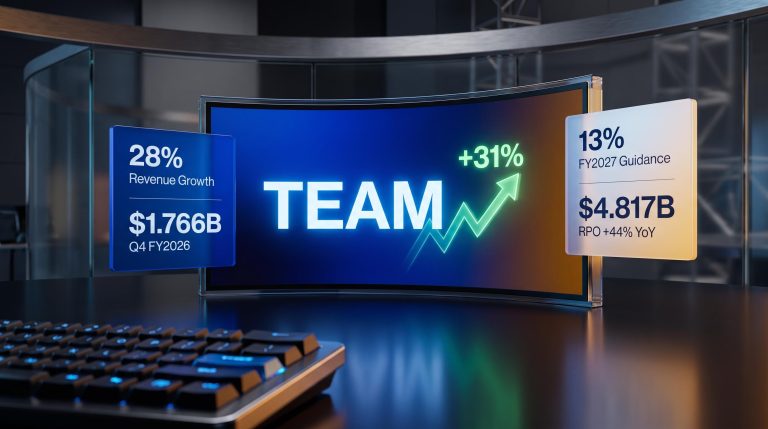
ResMed just posted solid FY26 results, and its stock fell 7%. That gap between earnings quality and share price performance is where the real story lives.
The decline is not a reaction to what ResMed earned this quarter. It is the market adjusting its implied probabilities across two long-cycle structural threats that have no resolution date: the anticipated return of Philips to the U.S. sleep device market, and the potential for GLP-1 weight-loss drugs to shrink the pool of future patients who need a CPAP device at all. These are not near-term earnings risks. They are steady-state economics risks, and they are beginning to weigh on how investors price the business.
Here is what the data actually tells you about each structural threat, what the MatrixCare sale and Noctrix acquisition signal about management’s own read of the landscape, and a scenario framework that maps where the stock goes if the threats materialise at different speeds and severities.
Why the market sold off on a quarter that did not disappoint
Near-term demand for PAP (positive airway pressure) devices and masks remains strong. ResMed is still absorbing the patient backlogs created by Philips’ withdrawal from the U.S. market. Margins held up. The quarter’s income statement did not deliver a reason to sell.
A field safety notification on the Astral ventilator triggered a halt to new Astral sales and a supercapacitor defect at its root. The financial footprint is contained: a $42 million charge taken in Q4 FY26 covers recall costs, with the resulting lost revenue carrying a $75 million headwind and a $0.15 per share drag into FY27. It consumes management bandwidth, but it is not what the market is reacting to either.
The sell-off is a repricing of uncertainty about future steady-state economics, not a verdict on current execution. A 7% decline on a non-disappointing quarter tells you the market is recalibrating the probability distribution of outcomes three to five years out, not anything visible in the current income statement.
Multiple compression driven by sentiment rather than earnings deterioration is a pattern that has persisted across ResMed’s share price history through 2025 and into 2026, with multiple compression accounting for the bulk of the decline even as non-GAAP EPS rose 21% in Q3 FY2026.
Three overlapping overhangs are shaping how analysts frame valuation:
- Philips re-entry: modelled as a scenario around the second half of this decade, with downside risk to ResMed’s temporarily elevated share and device pricing.
- GLP-1 and alternative therapies: structurally uncertain impact on obstructive sleep apnea (OSA) incidence and CPAP utilisation that caps multiple expansion even though it is not yet affecting the income statement.
- Reimbursement and policy risk: tighter competitive bidding and cost containment in the U.S. and abroad, which could amplify any competitive or volume shocks.
Correctly diagnosing the source of a sell-off is the first step in deciding whether it represents a buying opportunity, a fair valuation adjustment, or a warning. Misreading this as an earnings miss leads to the wrong conclusion.
When big ASX news breaks, our subscribers know first
How Philips went from market leader to consent-decree casualty
The timeline is a causal chain, and each step compounded the competitive windfall ResMed received.
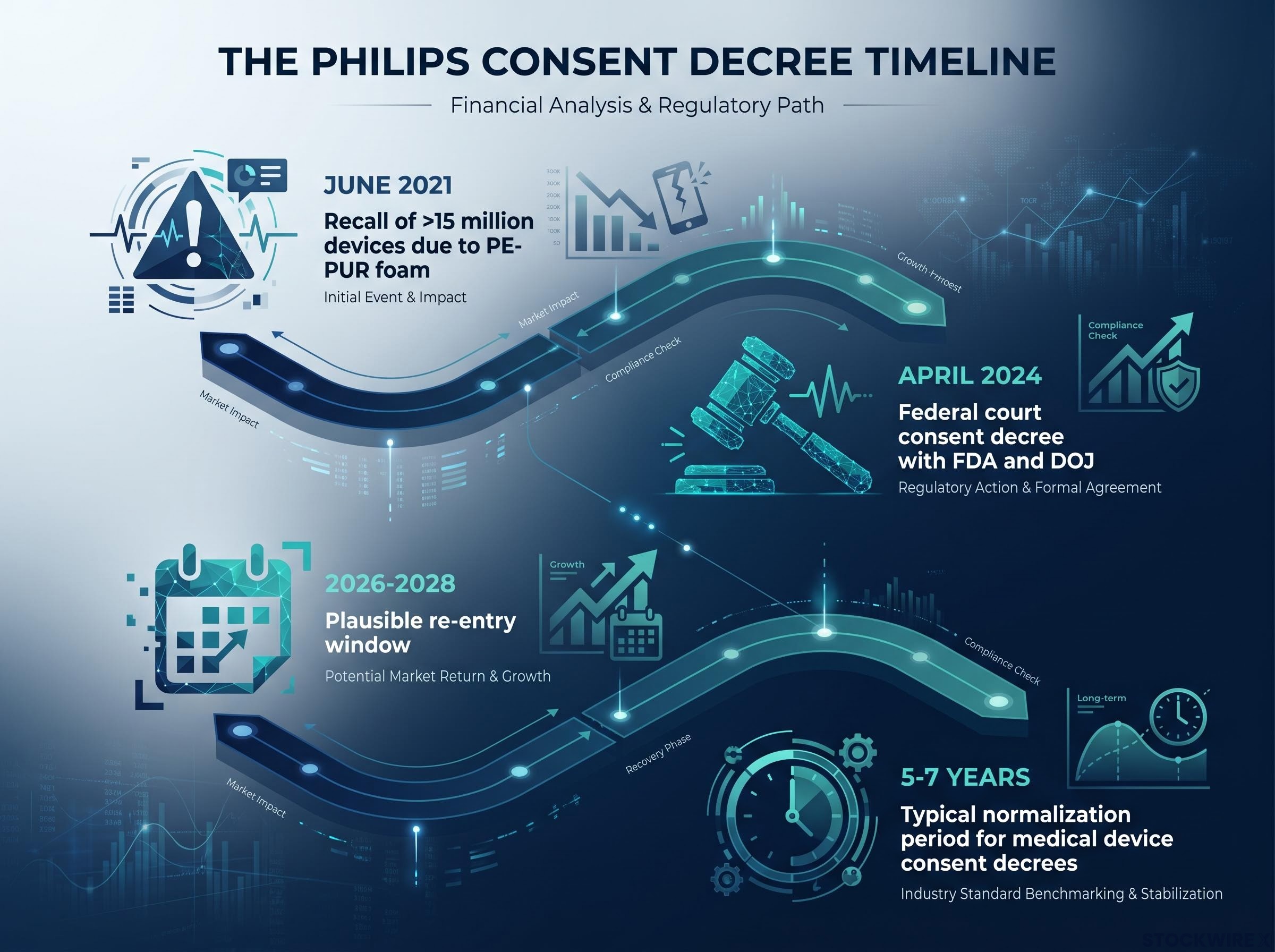
- June 2021: Philips Respironics initiated a recall affecting more than 15 million CPAP, BiPAP, and ventilator devices due to degradation of PE-PUR sound abatement foam, with potential inhalation of particles and chemicals by patients.
- Market withdrawal: Philips pulled back from the U.S. sleep device market, removing ResMed’s primary competitor from the field.
- April 2024: A federal court entered a consent decree with the FDA and DOJ, restricting production and sale of new CPAP and BiPAP machines in the United States until compliance milestones are met.
- Plausible re-entry window (2026-2028): Specialist commentary frames a gradual return as likely, but stresses it will not be a single step change. Industry precedents for medical device consent decrees suggest full normalisation typically requires 5-7 years from the start of remediation.
The consent decree is a U.S.-specific regulatory instrument. Competition in Europe and other international markets may normalise sooner, meaning the competitive dynamics deserve separate consideration depending on geography.
The FDA consent decree against Philips Respironics, entered April 2024, restricts the production and sale of new CPAP and BiPAP devices in the United States until specific compliance milestones are met, establishing the legal framework that defines the re-entry timeline investors are now pricing.
ResMed’s FY27 guidance contained no discussion of a Philips re-entry scenario, suggesting management is not treating this as a near-dated operational input. But the market is not waiting for management to bring it up.
What Philips’ return would actually do to ResMed’s numbers
Analyst and channel checks are directionally consistent: competitive impacts would be negative but not catastrophic. Device pricing pressure would return. Distributors and providers would resume dual-vendor contracting. Survey work cited by Jefferies suggests ResMed’s PAP market share, inflated during Philips’ absence, could normalise to the high-40s to low-50s percent range over one to three years after re-entry. That figure has not been independently confirmed, and should be treated as directional rather than precise.
The medium-term question is whether ResMed’s installed base, connected device ecosystem, and mask-attach advantages allow it to retain structurally higher share than pre-recall levels, even after normalisation. Investors pricing a 2027 re-entry scenario are not being pessimistic; they are correcting for a temporary market structure that was never permanent.
GLP-1 drugs and the long-cycle question about who needs a CPAP in 2035
The mechanism is straightforward. Obesity is a major modifiable risk factor for obstructive sleep apnea (OSA), a condition where the airway partially or fully collapses during sleep. Clinically meaningful weight loss reduces OSA risk in a subset of patients. GLP-1 receptor agonists, drugs such as Ozempic and Mounjaro that promote sustained weight loss, therefore have the potential to reduce the number of people who develop OSA in the first place.
That potential, however, operates on two very different time horizons.
| Dimension | Near-term GLP-1 effect | Long-term GLP-1 effect |
|---|---|---|
| P&L impact | Minimal; installed base drives revenue | Potential deceleration in consumables growth |
| Installed base | Unaffected; existing patients still need masks and supplies | Renewal cohorts may shrink if fewer new patients enter the system |
| New patient pipeline | May increase as GLP-1 use drives health engagement and OSA diagnosis | May decrease if sustained weight loss at population scale reduces obesity-driven OSA incidence |
| Multiple implications | Headline sensitivity creates volatility; fundamentals intact | Caps upside re-rating until long-term demand trajectory is clearer |
ResMed’s management maintains that GLP-1 drugs increase health engagement and ultimately funnel more patients toward sleep disorder diagnosis and treatment. Near-term, this view has supporting logic: obesity, diabetes, and sleep apnea are frequently co-managed, and a patient who starts a GLP-1 drug is more likely to be screened for related conditions.
The long-term concern is different. If successive cohorts of new middle-aged patients are less obese than today’s, the replacement cohort entering the sleep apnea system in 2030 or 2035 could be meaningfully smaller. High-margin recurring revenue from masks and supplies, which dominates ResMed’s P&L, would eventually decelerate.
OSA diagnosis rates remain substantially below estimated global prevalence, a structural underpinning that limits the near-term demand destruction from GLP-1 adoption; even meaningful weight-loss adoption at population scale would need to outpace ongoing improvements in diagnostic penetration before net new patient volumes actually declined.
GLP-1 risk is a multiple overhang, not a near-term earnings headwind. That is why the stock can sell off on drug headlines even when quarterly numbers are solid: investors are pricing the uncertainty around future steady-state economics, not current earnings power.
Understanding this distinction helps you separate sentiment-driven volatility from genuine structural deterioration. They require different responses.
What the MatrixCare sale and Noctrix deal signal about where management is steering the business
When a company simultaneously simplifies its portfolio and acquires an adjacent business insulated from its primary structural risk, that is management communicating its own threat assessment more clearly than any investor day presentation would.
MatrixCare: simplifying the story when complexity costs you
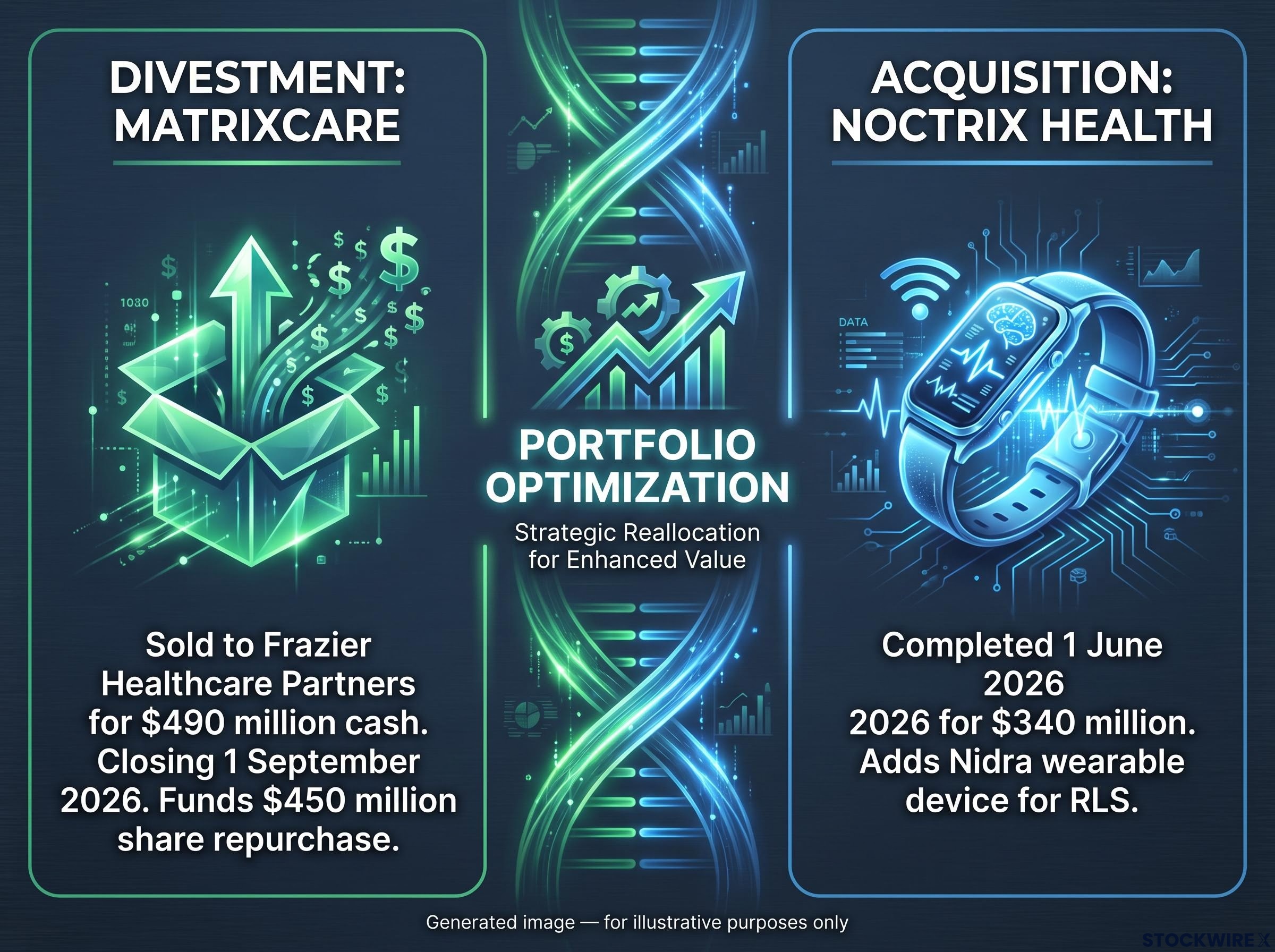
Frazier Healthcare Partners is acquiring MatrixCare, ResMed’s post-acute care software division, for $490 million in cash, with the deal expected to complete around 1 September 2026. ResMed plans to deploy the proceeds into an accelerated share repurchase programme of approximately $450 million.
The MatrixCare transaction terms include a revenue base of approximately US$220 million and non-GAAP operating profit of US$55 million in FY2026, giving investors a concrete measure of what ResMed is trading away in exchange for portfolio simplification and the accelerated buyback programme.
MatrixCare was non-core: a capital-consuming software platform that created narrative confusion for investors trying to value a medical device and consumables business. Shedding it sharpens the portfolio at a moment when structural fears are compressing the multiple.
The capital allocation signal matters too. Management is choosing buybacks over reinvestment at current prices, which implies a view that the stock is undervalued relative to their own assessment. That is not a guarantee they are right, but it is a data point worth noting.
Noctrix: buying a hedge that the obesity thesis cannot reach
ResMed completed the acquisition of Noctrix Health on 1 June 2026 for $340 million, adding the Nidra wearable neuromodulation device for Restless Legs Syndrome (RLS), an FDA-cleared wearable therapeutic for a sleep-disruptive condition.
The strategic logic sits in one sentence: RLS prevalence is not driven by obesity, making this revenue stream structurally insulated from the GLP-1 demand question. If the GLP-1 bear case materialises and obesity-driven OSA incidence falls, Noctrix revenue is unaffected.
The deal is near-term EPS dilutive, consistent with how early-commercial medtech acquisitions are typically received. Analysts are bundling Noctrix together with Philips and GLP-1 effects when discussing medium-term margin considerations. That bundling obscures the strategic purpose: this is diversification away from the single-pathway risk, not a margin management failure.
The contrast tells the story:
- MatrixCare sale: removes complexity and returns capital, signalling confidence in the core business valuation.
- Noctrix acquisition: adds an adjacent sleep therapy with a separate prevalence pathway, hedging the structural risk that concerns investors most.
The three structural scenarios and what each implies for the stock
The investment question is not which scenario is right today. It is which scenario the market is currently pricing, and whether your own probability assessment differs materially from that implied pricing.
| Scenario | Key assumptions | EPS growth trajectory | Multiple implication |
|---|---|---|---|
| Bull | Philips re-entry slower and shallower than feared; GLP-1s expand diagnosis more than they shrink prevalence; Noctrix, digital health, and ex-U.S. growth contribute | Mid-teens | Re-rating toward premium medtech multiples |
| Base | Gradual Philips re-entry from late this decade; modest GLP-1 drag; ResMed retains structural leadership | High-single-digit to low-double-digit | Current multiple holds; limited re-rating |
| Bear | Faster Philips normalisation plus meaningful GLP-1-driven reduction in obesity-related OSA and/or reimbursement tightening | Mid-single-digit | Structural de-rating toward lower-growth medtech peers |
All three scenarios are plausibly consistent with today’s share price. The approximately 7% decline reflects the market shifting its implied probabilities across these scenarios, not reacting to a single quarter’s P&L.
The two variables that separate the scenarios are the pace of Philips normalisation and the scale of sustained GLP-1 adoption at population level. If you can form a differentiated view on either variable, you have a basis for a position. If you cannot, the current price may be fairly reflecting the uncertainty.
What needs to resolve before the structural discount lifts
The structural discount will not lift until at least one of the two primary overhangs resolves or is credibly de-risked by observable evidence. For investors already holding ResMed, the question is not whether these risks are real but whether the current discount adequately compensates for the uncertainty.
That assessment depends entirely on where you place your own probability weights on Philips timing and GLP-1 penetration. Here are the specific catalysts that would shift those probabilities:
Philips-related catalysts
- FDA milestone disclosures signalling progress (or delays) in Philips’ compliance remediation.
- Philips manufacturing audit outcomes and any consent decree amendment filings.
- Any public communication from Philips regarding a U.S. re-entry timeline or product roadmap.
GLP-1-related catalysts
- Population-level adherence data on sustained weight loss, not drug approval headlines. The question is whether patients stay on GLP-1s long enough and in sufficient numbers to shift obesity prevalence at scale.
- Longitudinal studies linking sustained GLP-1 use to measurable reductions in OSA incidence.
ResMed corporate catalysts
- MatrixCare close, expected approximately 1 September 2026, as a near-term capital return catalyst.
- Noctrix commercial ramp trajectory as a signal of whether the RLS adjacency is gaining traction or remaining pre-revenue in character.
- Reimbursement and policy developments, including competitive bidding changes, that could amplify any competitive or volume shocks.
Knowing which catalysts to monitor converts an abstract risk discussion into an active watchlist. That is the practical output this analysis is designed to deliver.
For investors wanting to model the gap between current pricing and analyst consensus targets in more detail, our dedicated guide to ResMed’s valuation discount examines the 51% price-to-sales gap against the five-year average and maps it against the specific GLP-1 adoption scenarios that would need to materialise to justify the current discount.
This article is for informational purposes only and should not be considered financial advice. Investors should conduct their own research and consult with financial professionals before making investment decisions. These statements regarding future scenarios are speculative and subject to change based on market developments and company performance.