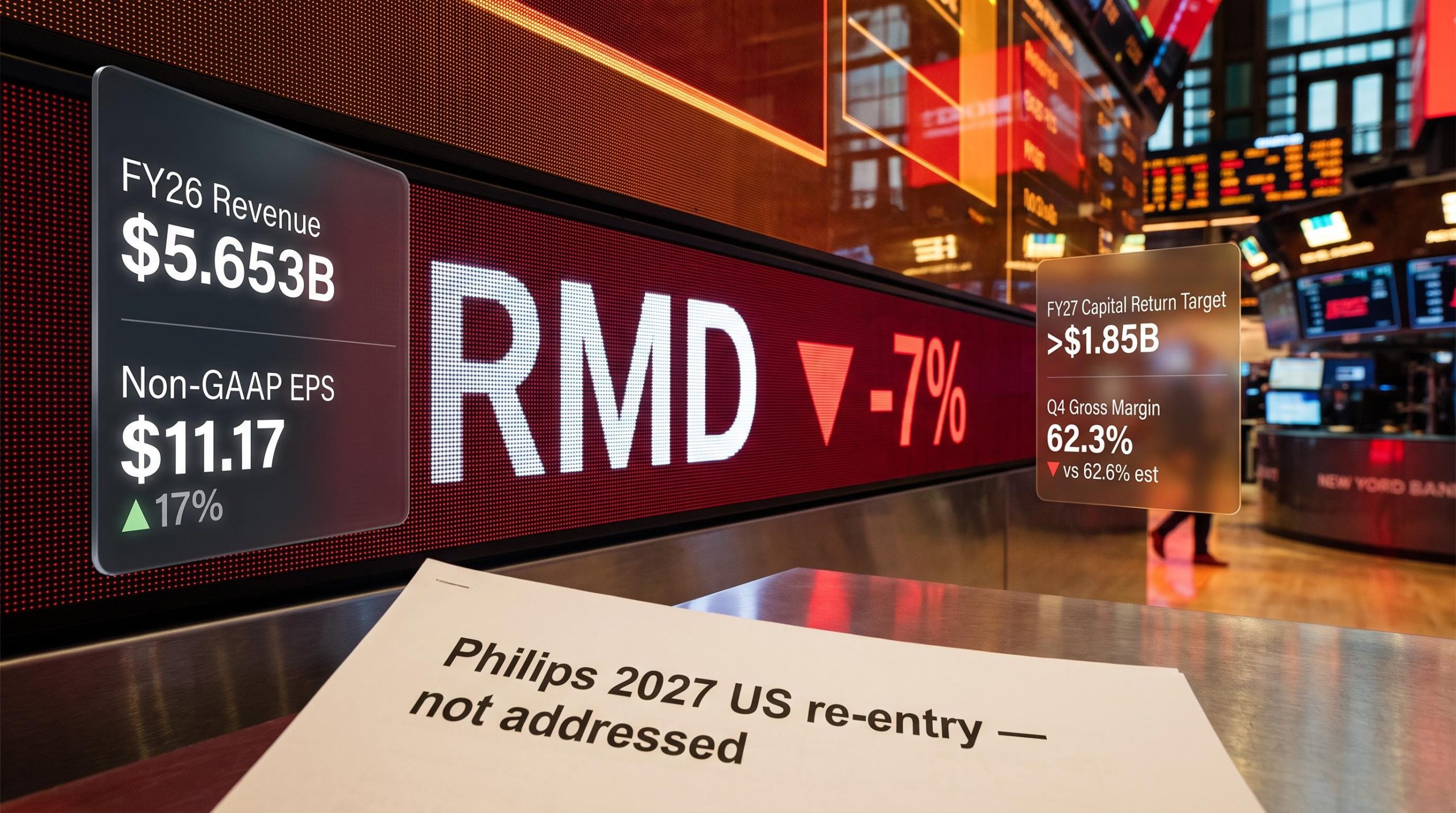
ResMed beat analyst forecasts on both revenue and earnings per share, raised its dividend 10%, and pledged more than $1.85 billion in shareholder returns for FY27. Its shares then fell 7%.
That gap between what the numbers showed and how the market responded is the story. For investors tracking the stock on the ASX or NYSE, understanding why a largely in-line result with a generous capital return plan triggered a sharp selloff requires looking past the headline figures to the margin detail, the guidance assumptions, and the competitive risk that management left unaddressed.
Here is a clear breakdown of the actual FY26 numbers, what management guided for in FY27, and the specific line items and silences that drove the after-hours reaction. If you hold ResMed or are following ASX reporting season, this is where the print landed and what it leaves unresolved.
What the FY26 numbers actually delivered
ResMed’s full-year FY26 result was, on its own terms, a solid print. Full-year revenue landed at $5.653 billion, representing reported growth of 10% (8% in constant currency), against a Morgans forecast of $5.64 billion — a margin of outperformance of around 1%. Non-GAAP diluted earnings per share reached $11.17, a 17% year-over-year improvement that cleared the Morgans estimate of $10.98 by close to 2%.
The fourth quarter reinforced the trajectory. Q4 brought in $1.46 billion in revenue, 9% higher than the prior year period, while the Q4 non-GAAP gross margin of 62.3% represented 90 basis points of expansion compared to the same quarter last year. Operating cash flow for the full year was $1.806 billion, and free cash flow reached $1.65 billion.
| Metric | FY26 / Q4 actual | Analyst estimate | Beat / miss |
|---|---|---|---|
| FY26 revenue | $5.653B | $5.64B (Morgans) | Beat (~1%) |
| FY26 non-GAAP diluted EPS | $11.17 | $10.98 (Morgans) | Beat (~2%) |
| Q4 non-GAAP gross margin | 62.3% | 62.6% | Miss (~30 bps) |
| Q4 operating income | $515M | $525.3M | Miss (~2%) |
The beat was real, but narrow. A 1-2% earnings surprise in a large-cap healthcare stock trading on a premium multiple is not the kind of upside that changes an investment thesis or forces a re-rating. It confirms the existing trajectory. It does not extend it.
When big ASX news breaks, our subscribers know first
Dividend lifted, capital returns doubled: the shareholder story
The capital returns programme told a more assertive story than the earnings line. The quarterly dividend was increased by 10%, moving to $0.66 per share from the previous $0.60. Total shareholder returns for FY26 reached $1.0 billion, a more than 70% increase year-over-year. The FY27 capital return target was set at more than $1.85 billion, a figure that sits more than 75% above what the prior guidance had anticipated.
- Quarterly dividend: $0.66 per share (up from $0.60)
- FY26 total shareholder returns: $1.0 billion (more than 70% year-over-year increase)
- FY27 capital return target: more than $1.85 billion (more than 75% above prior guidance)
FY27 capital return target: more than $1.85 billion, backed by $1.65 billion in FY26 free cash flow generation.
A capital return plan of this scale is a direct signal from management about how much cash the business generates and how confident they are in sustaining it. $1.65 billion in free cash flow comfortably funded the FY26 programme, and the FY27 target implies management sees that cash generation as durable. For income-oriented investors and those evaluating ResMed as a long-term compounding holding, this is material information that the headline selloff can easily obscure.
On the day of the result, the market priced other factors ahead of it.
The MatrixCare divestiture, announced in early July 2026 at US$490 million with proceeds earmarked for accelerated share repurchases, added further context to the FY27 capital returns narrative before the full-year result was published.
FY27 guidance: growth projected, drags embedded
For FY27, the company outlined underlying revenue growth in a 5-7% range and underlying EPS growth of 12-14%. On the surface, those are respectable numbers for a business of this scale. But two embedded headwinds change the complexion of the outlook once you account for them.
- FY27 underlying revenue growth guidance: 5-7%
- FY27 underlying EPS growth guidance: 12-14%
- Astral-related FY27 drags: $75 million revenue headwind and $0.15 per share EPS drag
The word “underlying” is doing heavy lifting. FY26 delivered 17% EPS growth, making the 12-14% FY27 guide a visible deceleration even before adjustments. Management also signalled confidence in sustaining margin expansion even as freight and component costs continue to rise, a commitment that sets a clearly measurable bar for execution.
The Astral adjustment: what the safety action costs FY27
In Q4 FY26, $41.885 million was recognised as a charge to address costs associated with the Astral field safety notification, which related to a supercapacitor component issue. Management characterised it as a one-time item. Yet with lost sales translating into a $75 million revenue impact in FY27 and a $0.15 reduction to earnings per share already embedded in guidance, the consequences extend well beyond a single accounting entry.
The FDA Class 1 Device Recall notice for the Astral 100/150 ventilators identifies supercapacitor electrolyte leakage as the root cause, a detail that contextualises why management’s characterisation of the charge as a one-time item carries ongoing regulatory scrutiny beyond the initial accounting entry.
Operational disruption and ongoing regulatory scrutiny extend beyond the initial charge. Investors who understand that the “underlying” guidance already carries a known $75 million revenue drag and a $0.15 EPS drag built in will be watching reported actuals against the adjusted baseline, not just the headline guidance range. The functional bar is lower than the headline percentages suggest.
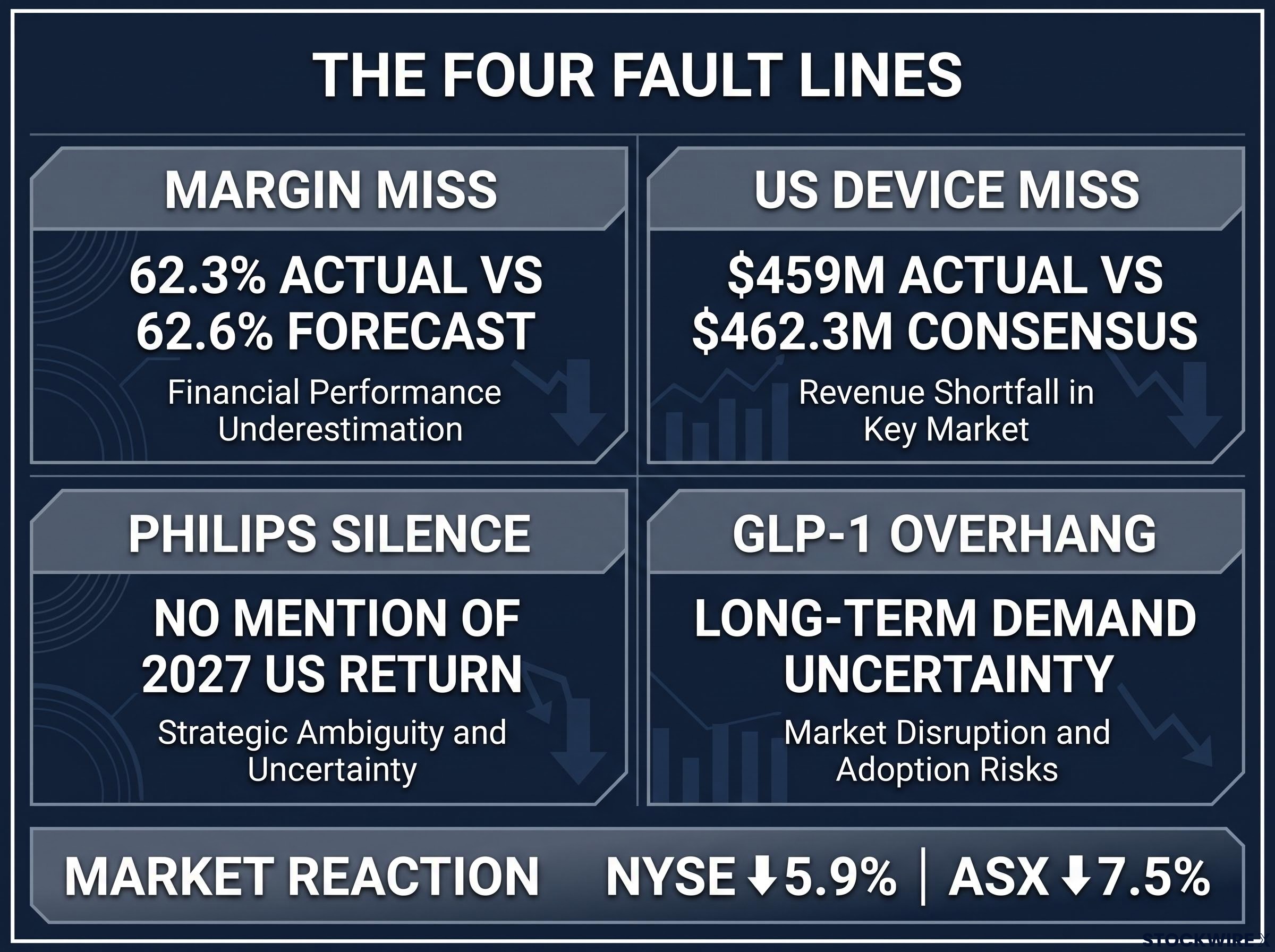
Why the beat was not enough: the four fault lines investors priced
The selloff was not a reaction to a bad result. It was a repricing of four specific pressure points that, taken together, undermined the margin expansion narrative that had been supporting ResMed’s premium multiple.
Multiple compression, rather than any deterioration in underlying earnings, had already been driving the share price lower through early 2026, setting the context for why a narrow beat was unlikely to trigger a re-rating even before the margin miss registered.
- Margin miss: The Q4 non-GAAP gross margin of 62.3% fell short of the 62.6% forecast by around 30 basis points, and Q4 operating income of $515 million missed the $525.3 million consensus by approximately 2%.
- US device revenue miss: Americas device revenue for Q4 came in at $459 million against a consensus of $462.3 million, a shortfall in the segment most exposed to upcoming competitive pressure.
- Philips silence: FY27 guidance commentary contained no reference to Philips’ anticipated 2027 return to the US sleep device market.
- GLP-1 overhang: Although the company maintained its position that GLP-1 weight-loss drugs support the patient pipeline, investors have not fully accepted that view, and uncertainty about long-term demand persists.
The key unquantified risk: Philips’ anticipated 2027 US market re-entry was not addressed in FY27 guidance commentary. When a material and imminent competitive threat goes unmentioned, investors typically interpret this as either limited management visibility or a reluctance to quantify expected pressure.
For a stock trading on a premium multiple built around a margin expansion narrative, the combination of a margin miss, a US device miss, and silence on the most significant near-term competitive threat was enough to prompt a repricing of uncertainty rather than a reward for the headline beat. NYSE shares dropped around 5.9% in after-hours trading, while ASX-listed CDIs fell by roughly 7.5%, a reaction that reflects how much the market recalibrated its expectations.
Market pricing good-news selloffs has become a recurring pattern across healthcare in 2026, with Novo Nordisk’s shares also declining on an August guidance upgrade as investors recalibrated their expectations against a valuation premium built on forward growth assumptions.
What ResMed’s business model means for reading results like this
ResMed is the dominant global player in continuous positive airway pressure (CPAP) devices and masks for obstructive sleep apnoea (OSA), a condition where the airway repeatedly collapses during sleep. The company is dual-listed on both the ASX and NYSE, making it relevant to both Australian and US investors.
Two structural dynamics sit behind the FY26 numbers and shape how you should interpret them:
- Philips absence: In 2021, Philips issued a major product recall covering its sleep devices due to foam degradation concerns, which saw the company withdraw from the US CPAP market. ResMed operated with significantly reduced competition for approximately six years. When Philips returns to the US market, as expected in 2027, it will bring competitive normalisation rather than a wholly new threat, though it does mark the conclusion of an extended period of unusually limited rivalry.
- GLP-1 debate: GLP-1 receptor agonist drugs reduce obesity, and because excess body weight is a significant contributor to OSA, some investors worry that broader uptake of these therapies could reduce the pool of patients requiring sleep devices over time. ResMed pushes back on this view, arguing that these drugs draw more people into health-related conversations and ultimately increase the number of patients diagnosed and treated. The market has not fully accepted that framing.
The FDA consent decree against Philips Respironics, entered in April 2024, restricts the production and sale of new CPAP and BiPAP machines in the US until specific regulatory requirements are met, establishing the legal framework that governs any timeline for Philips re-entry into the market.
If you understand that ResMed’s recent growth occurred against a uniquely low-competition backdrop, you are better positioned to assess whether FY27 guidance accurately prices in the return of normalised market conditions.
Where the FY27 investment case stands after the selloff
The selloff did not change the quality of the underlying business. It repriced the uncertainty around three active variables that will define the next twelve months:
The price-to-sales discount relative to ResMed’s five-year historical average had already reached approximately 52% before the FY26 result landed, meaning the selloff extended a derating that long-predated any single quarterly margin miss.
- Philips US re-entry: How quickly and at what scale does Philips return? The extent of any impact on market share, device pricing, and competitive intensity has not been quantified in management’s public commentary.
- Astral safety action containment: Management characterised it as a one-off. A $75 million FY27 revenue headwind and continued regulatory scrutiny will determine whether that assessment holds.
- Margin delivery: Management committed to continued margin improvement against rising freight and component costs. Any shortfall will be judged against a clearly stated bar.
The structural positives remain intact: aging population demographics, ongoing under-diagnosis of OSA globally, and a $1.65 billion free cash flow base supporting the $1.85 billion capital returns programme. FY27 EPS growth guidance of 12-14% is respectable, though it represents a deceleration from FY26’s 17%.
For investors with a longer-duration view, the quality of FY27 guidance delivery will matter more than the headline guidance range itself. The margin for error in management’s stated assumptions has narrowed, and the specific line items the market is watching, US device revenue, gross margin trajectory, and any commentary on Philips, will carry outsized weight in coming quarters.
This article is for informational purposes only and should not be considered financial advice. Investors should conduct their own research and consult with financial professionals before making investment decisions. Forward-looking statements, including FY27 guidance, are subject to market conditions and various risk factors disclosed in ResMed’s SEC filings.