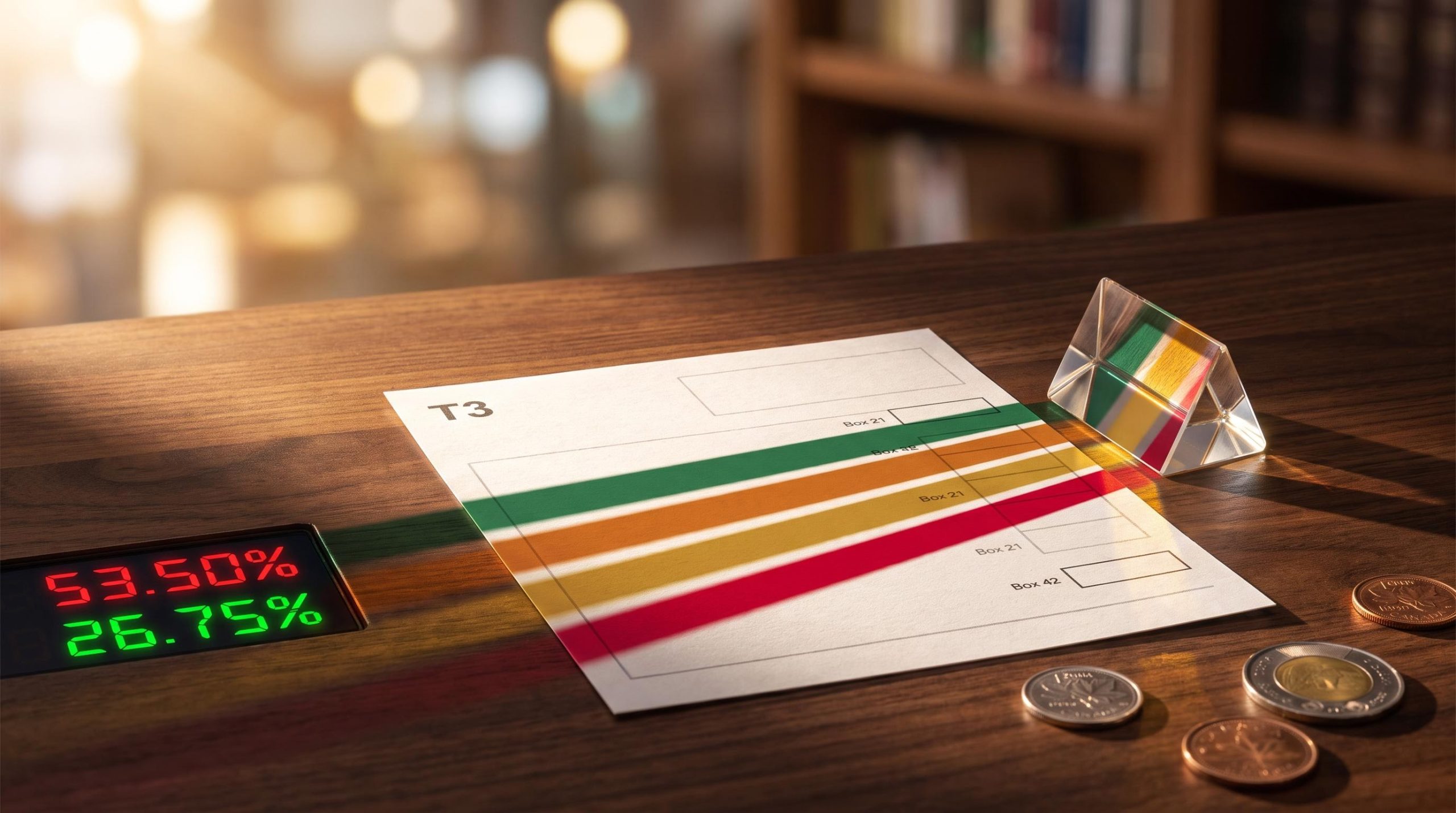
Every spring, a T3 slip lands in your inbox or your mailbox, and there is a strong pull to do the obvious thing: find the total distribution figure, treat it as income, and brace for a tax bill at your marginal rate. That instinct is wrong, and it can cost you real money.
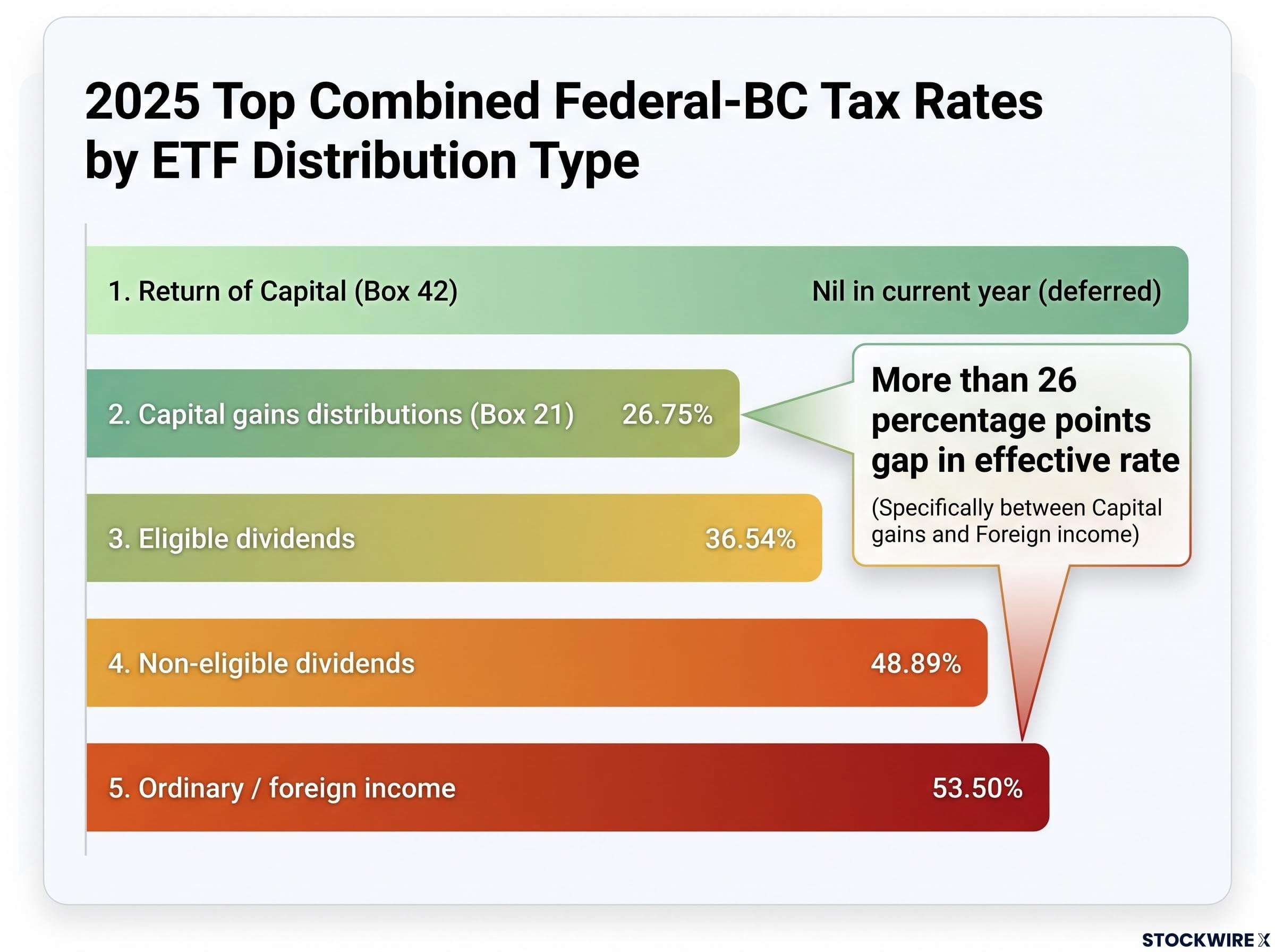
Canadian ETF distributions are not a single type of income. A single payout can be a bundle of up to four legally distinct categories, and each one is taxed on its own terms. For a British Columbia resident at the top bracket, the gap between the least and most tax-efficient category runs to more than 26 percentage points in effective rate. That is not a rounding error. It is the difference between keeping most of a distribution and handing back roughly half of it.
Understanding ETF distributions and tax in Canada starts with knowing which dollars are which. After working through this piece, you will know exactly how each of the four categories is taxed, what a realistic tax bill looks like when they arrive together, and which account decisions make the biggest practical difference to your after-tax returns.
The four buckets: how the CRA actually categorises ETF distributions
The Canada Revenue Agency does not see your ETF distribution as one lump of income. It sees up to four separate categories, and they are ranked by how gently or harshly they are taxed.
At the top for tax efficiency sits Return of Capital (ROC), which is not taxable in the year you receive it. Next comes capital gains distributions, where only half the gain is included in your taxable income. Then eligible dividends, paid by Canadian corporations and cushioned by a tax credit. At the bottom sits foreign or other income, including interest, which is taxed at your full marginal rate with no relief.
Here is what makes this genuinely tricky: you do not choose the category. The ETF’s underlying activity does. A bond fund throws off interest. A Canadian equity fund pays eligible dividends. A US-focused fund passes through foreign income. You only find out the exact breakdown when your T3 slip arrives, which is often the first time you learn that the “yield” you have been counting on is taxed four different ways.
ETF structure and portfolio construction choices interact with distribution tax outcomes in ways that are invisible at the point of purchase: a broad index ETF’s in-kind redemption mechanism tends to suppress capital gains distributions, while actively managed or high-turnover ETFs push more of their activity through as ordinary income on the T3 slip.
The number that anchors everything A BC resident at the top bracket pays a combined federal and provincial rate of 53.50% on ordinary income. That is the ceiling. Every other category is measured against it.
The spread below is the reason this matters. Two distributions of identical size can produce wildly different tax bills depending only on the category printed on your slip.
| Income type | CRA / T3 classification | Top combined federal-BC rate (2025) |
|---|---|---|
| Return of Capital | Box 42 (not taxable in year received) | Nil in current year (deferred) |
| Capital gains distributions | Box 21 (50% inclusion) | 26.75% |
| Eligible dividends | Grossed up, dividend tax credit applies | 36.54% |
| Non-eligible dividends | Grossed up, lower credit applies | 48.89% |
| Ordinary / foreign income | Interest, foreign income (full rate) | 53.50% |
Look at the two ends. A capital gain distribution taxed at 26.75% and foreign income taxed at 53.50% are separated by nearly half again. Two payouts of the same dollar size, one costing you double the tax of the other. The category is the only thing that decides which outcome you get, which is why treating all distributions the same is not a small oversight. It is a category error that flows straight through to your net return.
Reading your T3 slip without guessing
The two boxes that matter most for ETF investors are Box 21 and Box 42. Box 21 reports capital gains distributions, already taxed as gains and not to be double-counted when you eventually sell your units. Box 42 reports Return of Capital, which is not taxable now but quietly changes your cost base, a mechanism covered in the next section.
The catch is that many investors never see these boxes at all. Broker platforms often display a single aggregated distribution total, so the category breakdown is invisible until the official slip arrives. If you are relying on your brokerage statement to understand your tax position, you are reading a summary, not the source.
When big ASX news breaks, our subscribers know first
Why Return of Capital is the most misunderstood distribution type
On the surface, Return of Capital looks exactly like income. It shows up in your account as a distribution, your broker reports it as a cash payout, and the fund’s headline yield includes it. So most investors treat it as yield and move on.
Legally, it is nothing of the sort. ROC is a return of your own capital, money you already put in, handed back to you. Because it is not new income, the CRA does not tax it in the year you receive it.
That sounds like a gift, but there is a cost buried in the mechanics. Every dollar of ROC you receive reduces your Adjusted Cost Base (ACB), the total amount you are treated as having paid for your units. A lower cost base means a larger capital gain when you eventually sell. So ROC is not a tax exemption. It is a deferral, pushing the tax bill from today into the year you sell.
The three-step sequence looks like this:
- You receive a ROC distribution and pay no tax on it this year.
- Your ACB drops by exactly the amount you received.
- When you sell, the lower ACB produces a larger capital gain, and the deferred tax finally comes due.
For an investor holding a high-yield ETF that pays ROC, this means every distribution that feels like income is silently lowering your cost base. Your eventual sale will trigger a larger gain than you expect, unless you have tracked each adjustment along the way. That is the trap dressed up as a payout.
There is one more twist that most investors have never encountered.
The zero-ACB rule Once your Adjusted Cost Base reaches zero, any further ROC is no longer deferred. It becomes fully taxable as a capital gain in the year you receive it. The deferral benefit disappears entirely, and the payout you thought was tax-free becomes an immediate tax event.
This is why high-advertised-yield income ETFs and T-series funds deserve a closer look. These products often build their distributions heavily from ROC, which can make a yield look richer and more sustainable than the underlying return actually is. A 9% advertised yield made up substantially of your own returned capital is a very different proposition from a 9% yield of genuine income.
The yield-versus-total-return distinction matters here because a high-advertised yield made up largely of ROC is not new wealth arriving in your account; it is your own capital being redistributed, and the fund’s unit price adjusts downward to reflect each payout, leaving total return, not yield, as the only honest measure of what the investment is actually earning you.
The ACB tracking obligation most investors skip
ROC is the one distribution category that puts a recordkeeping job squarely on you. For every ROC payment, you need to record the date, the amount, and your updated cost base after the reduction. Miss this, and your capital gain at sale will be wrong, either overpaying tax or under-reporting a gain and inviting a CRA reassessment.
The complexity compounds when you reinvest. Distribution reinvestment plans (DRIPs) add units at varying prices, and buying in separate lots over time creates multiple cost bases to reconcile. If you have never tracked any of this, an eventual sale can surface years of untracked ROC as one large, unexpected gain.
A worked example: what a $10,000 ETF distribution actually costs in tax
Numbers make this real, so consider a specific investor. She lives in British Columbia, earns $80,000 in employment income, and receives $10,000 in ETF distributions spread across four funds at $2,500 each.
Start with her baseline. On the $80,000 salary alone, her estimated BC tax comes to roughly $18,843. The question is how much the $10,000 in distributions adds on top.
The distributions break down by category, and this is where the surprise lives. Roughly $5,000 of the total is Return of Capital. That figure adds nothing to her current-year tax bill, because ROC is not taxable in the year received. It simply reduces her cost base for later.
Next, around $1,600 arrives as eligible dividends. After the gross-up and dividend tax credit, the effective rate on this tranche works out to roughly 16.06%, generating only about $26 in additional tax. That is the tax credit system doing its work.
The remaining portion, approximately $3,700, is capital gains. With the 50% inclusion rate, only half of that is added to her taxable income and taxed at her marginal rate. The other half is not taxed at all.
| Distribution type | Amount (CAD) | Tax treatment | Estimated additional tax |
|---|---|---|---|
| Return of Capital | ~$5,000 | Not taxed this year; reduces ACB | Nil (deferred) |
| Eligible dividends | ~$1,600 | Grossed up; dividend tax credit (~16.06% effective) | ~$26 |
| Capital gains | ~$3,700 | 50% inclusion; half taxed at marginal rate | Taxed on half at marginal rate |
The lesson lands on its own. A $10,000 distribution that is half ROC, cushioned by eligible dividends, and rounded out with 50%-included capital gains generates a fraction of the tax that the same $10,000 of foreign income or interest would have produced at the full 53.50% ceiling. Composition matters far more than the headline size of the payout.
One more figure worth pinning down: the federal government proposed raising the capital gains inclusion rate to two-thirds, but that change was cancelled on 21 March 2025. The 50% inclusion rate stays in place for 2025 and 2026, which preserves the capital gains advantage in the numbers above.
How progressive brackets actually work (and why crossing one costs less than you think)
A persistent myth is that earning enough to enter a higher bracket suddenly taxes all your income at the higher rate. It does not. A bracket threshold is not a cliff.
Each rate applies only to the income that falls inside its band. When your income crosses into a higher bracket, only the dollars above the threshold are taxed at the new rate. Everything below stays taxed at the lower rates it always was.
| Income range | BC provincial rate (2025) |
|---|---|
| $0 to $49,279 | 5.06% |
| $49,279 to $98,560 | 7.70% |
| $98,560 to $113,158 | 10.50% |
| $113,158 to $137,407 | 12.29% |
| $137,407 to $186,306 | 14.70% |
| $186,306 to $259,829 | 16.80% |
| Over $259,829 | 20.50% |
For our BC investor on $80,000, her distributions push incremental income into her existing bracket, not into a punitive new one that reprices everything below it. That is why the incremental tax on her distributions is modest, and why the fear of “jumping a bracket” rarely justifies the decisions it drives.
Account type and source country: the two variables that change everything for foreign income
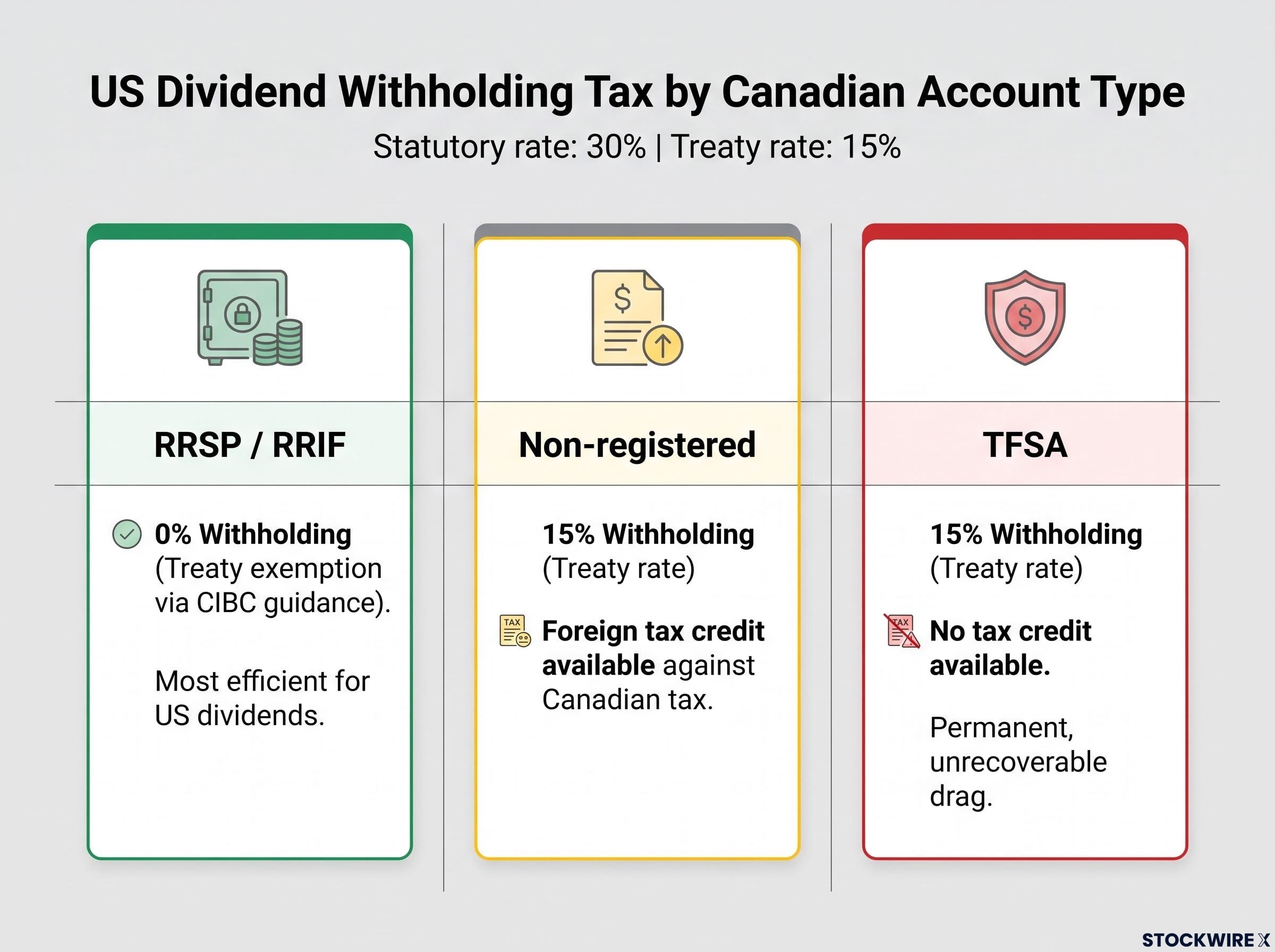
Where you hold a foreign-income ETF can matter as much as what you hold. This is clearest with US dividends, where three account types produce three completely different outcomes.
The United States levies a statutory 30% withholding tax on dividends paid to foreign investors. The Canada-US tax treaty reduces that to 15% for Canadian residents. What happens to that 15% next depends entirely on the account it sits in.
| Account type | US withholding | Foreign tax credit | Net outcome |
|---|---|---|---|
| RRSP / RRIF | 0% (treaty exemption) | N/A (nothing withheld) | Most efficient for US dividends |
| Non-registered | 15% (treaty rate) | Available; claim against Canadian tax | Withholding largely recoverable |
| TFSA | 15% (treaty rate) | None available | Permanent, unrecoverable drag |
The RRSP and RRIF sit at the efficient end. Under the treaty, US dividends paid into these retirement accounts face 0% withholding, according to guidance from CIBC. A US dividend ETF held here loses nothing at source.
In a non-registered account, the 15% is withheld, but you are not stuck with it. You report the gross dividend in Canadian dollars and claim a foreign tax credit against the Canadian tax payable on that income, largely recovering the withheld amount.
Then comes the counterintuitive trap.
The TFSA drag most investors never notice Holding a US dividend-paying ETF inside a TFSA means losing 15% of every distribution, permanently. The treaty exemption does not extend to TFSAs, so the withholding still applies, and because a TFSA shelters income from Canadian tax, there is no Canadian tax to credit the withholding against. The money is simply gone.
For an investor currently holding a US dividend ETF inside a TFSA, that account structure is costing 15% of every distribution with no way to recover it. Moving the holding into an RRSP, if contribution room exists, is one of the highest-certainty tax improvements available, and it requires no change to the underlying investment at all.
Asset location strategy formalises the account-matching logic described above into a portfolio-wide framework, placing interest-bearing and foreign-income assets in registered accounts while keeping tax-favoured capital-gains ETFs in taxable accounts, a separation that can meaningfully compound the after-tax return across a multi-decade holding period.
Global and international ETFs add another wrinkle. Withholding can stack in layers, from source country to fund domicile to Canada, and not all of the intermediate tax is creditable at your level. The headline yield on a global income ETF can therefore overstate what you actually keep.
If you do hold foreign-income ETFs in a non-registered account, the reporting obligations are specific:
- Convert all foreign income to Canadian dollars at the CRA-prescribed exchange rates.
- Report the gross dividend, before withholding, not the net amount that landed in your account.
- Claim the foreign tax credit against the Canadian tax payable on that income, noting that any withholding exceeding your Canadian tax on it is generally non-recoverable.
What this means before you buy your next ETF for a taxable account
You now have the mechanics. The practical question is what to do with them before your next purchase lands in a taxable account.
The hierarchy is straightforward. For taxable accounts, favour ETFs that distribute capital gains and eligible dividends over those that lean heavily on interest or foreign income. Treat ROC as a genuine deferral benefit, but only if you commit to tracking your Adjusted Cost Base with each payment.
The number that should drive the decision Capital gains are taxed at a top combined BC rate of 26.75%. Ordinary and foreign income tops out at 53.50%. For a high-bracket investor, that gap is the single most important reason to scrutinise what an ETF actually distributes before buying it in a taxable account.
Watch the high-yield products in particular. Covered-call and high-turnover ETFs often advertise generous yields built from ordinary income, other income, or ROC rather than tax-favoured capital gains. At higher marginal rates, that structure quietly inflates your annual tax drag.
Covered call ETF tax treatment follows the same four-bucket framework but with a critical wrinkle: the premium income generated by the options overlay typically flows through as foreign or other income rather than as capital gains, which pushes a large share of the distribution to the least tax-efficient category on the T3 slip.
One nuance on the capital-gains-versus-dividends question: capital gains are the more efficient choice at higher incomes, roughly above the $140,000 to $181,000 range, while eligible dividends can be more efficient below it. Your own income level decides which side of that line you sit on.
Before you buy, run this checklist:
- Identify the fund’s typical distribution composition from its fund facts or annual reports.
- Match the account type to the distribution type using the withholding table above.
- Confirm you have an ACB tracking process in place for any ROC component.
- Check whether the fund’s yield relies on ROC or covered-call premium rather than genuine underlying income.
This article is for informational purposes only and should not be considered financial advice. Investors should conduct their own research and consult with financial professionals before making investment decisions.
The rate tables and worked example here are tools for framing your decisions, not for filing your return. If you carry significant foreign income, large unrealised gains, or a complex mix of account structures, a tax professional should review your specific situation. Applying these principles before you buy, rather than discovering them from a T3 slip in spring, is how you keep more of what your ETFs pay you.