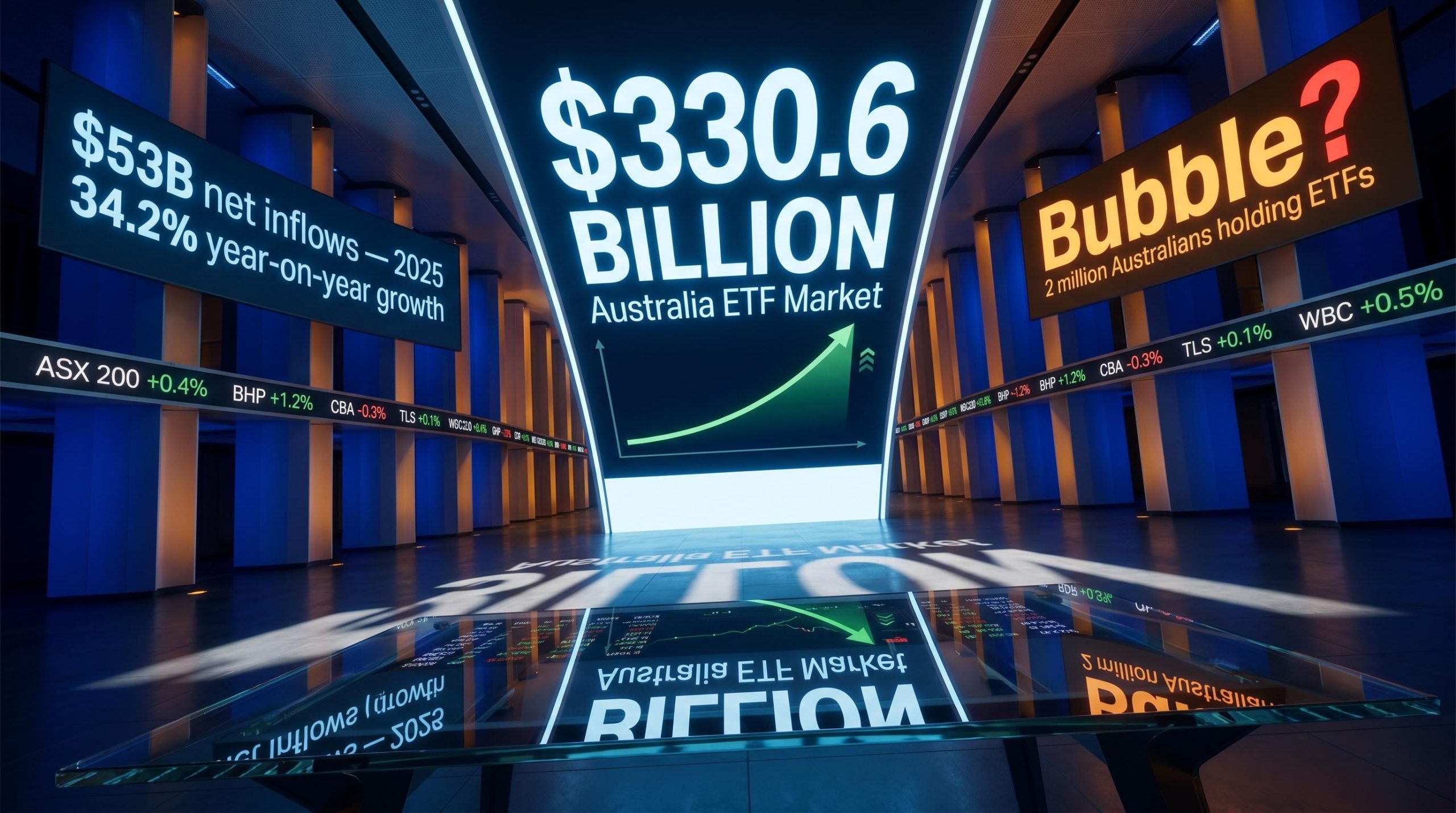
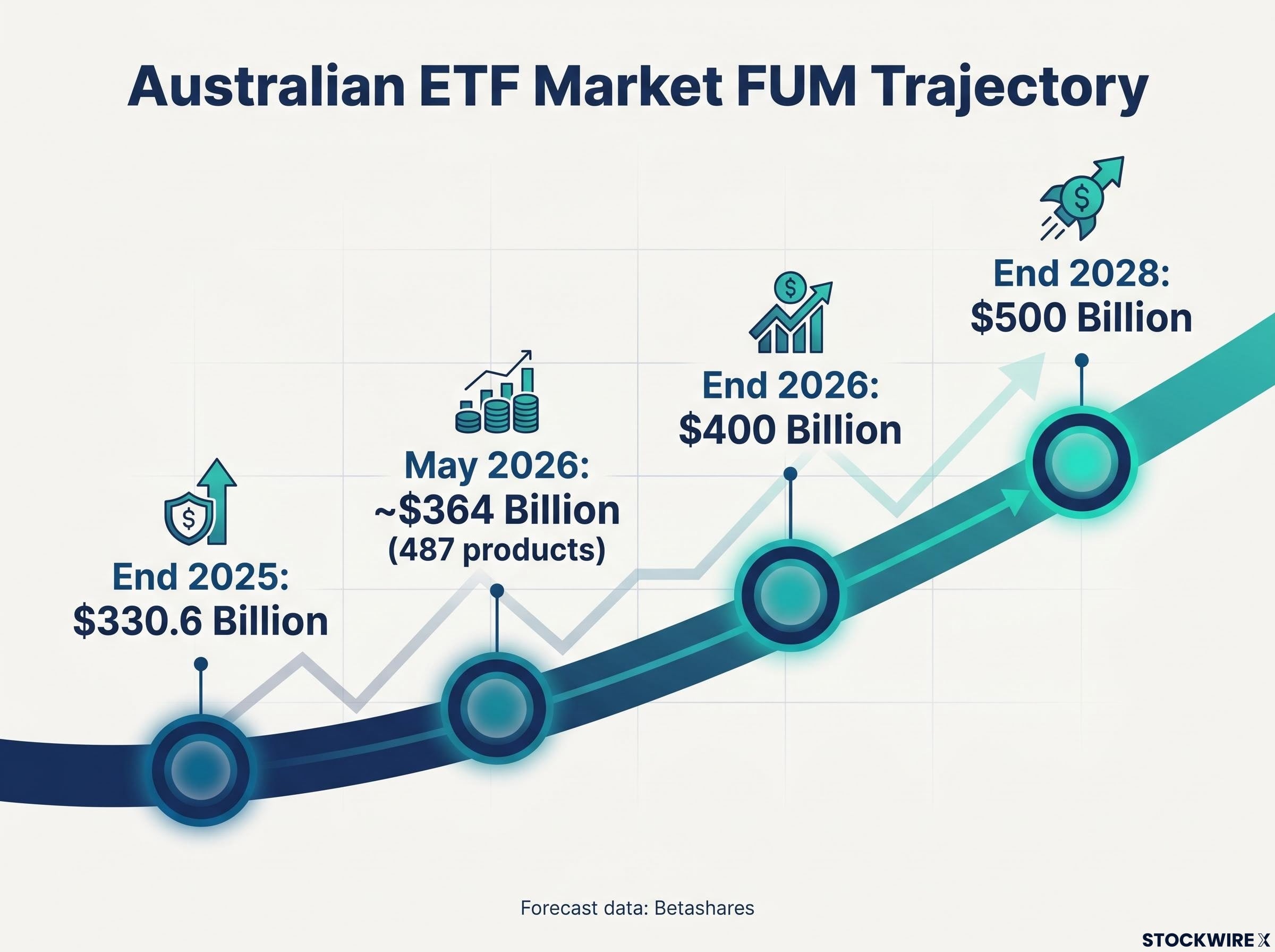
Australia’s ETF market has crossed $330.6 billion in funds under management and is tracking toward $400 billion before the end of 2026. The word “bubble” keeps surfacing in commentary about that trajectory. But a bubble describes an asset that has become detached from its underlying value, and an ETF is not an asset. It is a wrapper.
That distinction matters for roughly 2 million Australians who now hold ETFs as part of their wealth-building strategy. The growth is real: 34.2% year-on-year expansion, $53 billion in net inflows during 2025 alone, and a global industry that has reached US$21.9 trillion without a generalised structural collapse. This is not abstract finance news. It is the vehicle through which a growing share of ordinary Australian savings is being deployed.
Here is the distinction most bubble commentary misses, and what it means for your holdings specifically: the ETF structure itself has survived every major market crisis of the past two decades without breaking. The risks that do exist are concentrated in specific product types, and they are identifiable before they become problems.
What $330 billion in ETF assets actually tells you
The headline number is striking: $330.6 billion at the end of 2025, expanding to approximately $364 billion across 487 products by May 2026. Betashares forecasts the market will pass $400 billion during 2026 and reach $500 billion by the end of 2028. Globally, the ETF industry surpassed US$19.5 trillion by end-2025 and reached approximately US$21.9 trillion by April 2026.
The Australian ETF industry recorded net inflows of approximately $5.2 billion in April 2026 alone, making it the third-highest single month on record, with international equities capturing close to half of all new capital as home-bias among retail investors continued to decline.
But the composition of that growth matters more than the total.
$53 billion in net inflows during 2025, up 76% versus 2024 levels, drove the majority of the expansion.
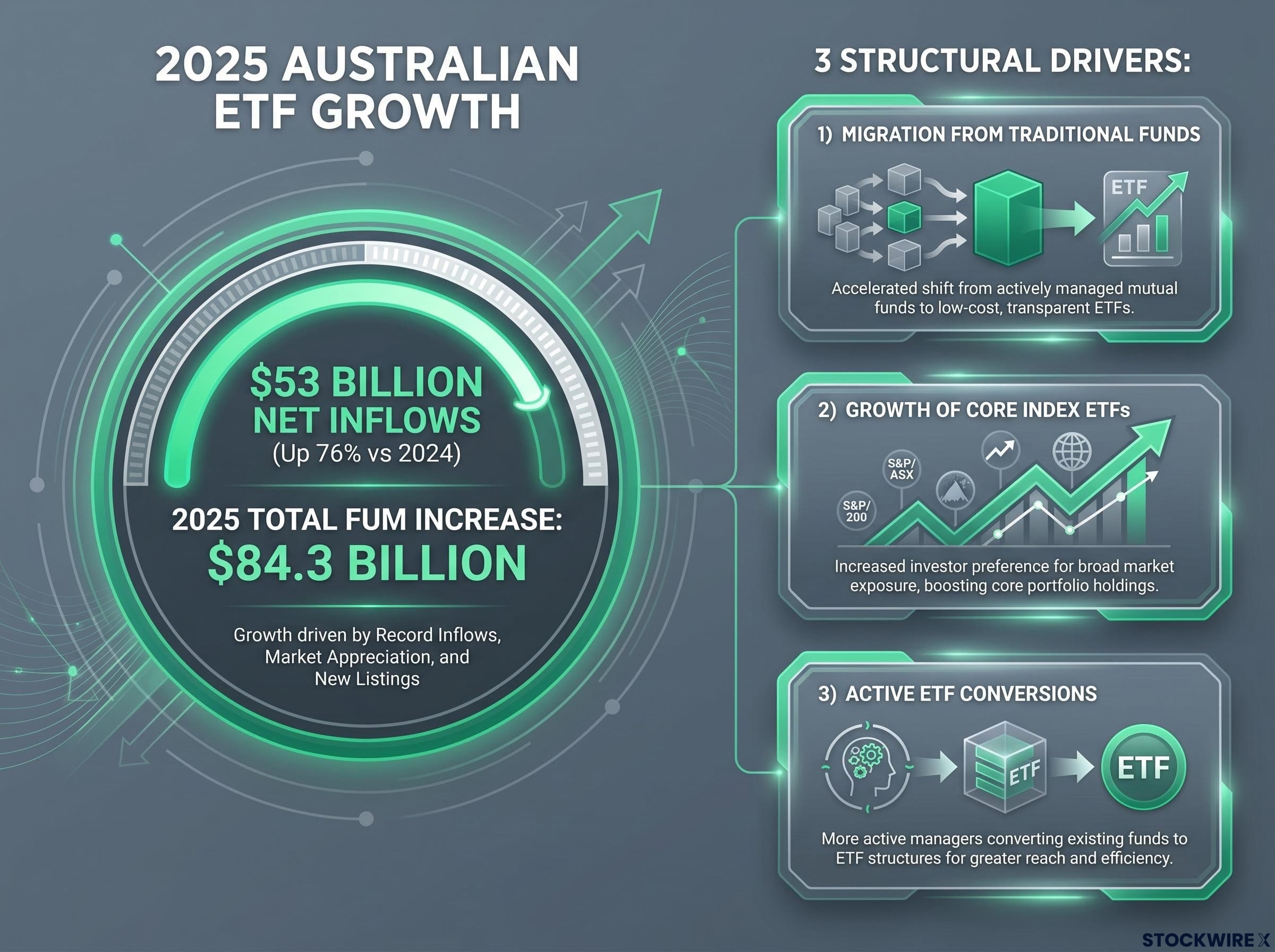
Of the $84.3 billion total FUM increase over 2025, net inflows accounted for the largest share. That tells you this expansion is being funded by deliberate savings decisions, not passive mark-to-market gains riding a bull market. Three structural drivers explain where the money is coming from:
- Migration from traditional managed funds and platforms, driven by fee pressure and transparency demands
- Growth of core index ETFs, broad Australian and global equity trackers used as long-term portfolio building blocks
- Active ETF conversions, where existing unlisted managed funds are being wrapped in ETF format to offer intraday liquidity
This is meaningfully different from what typically characterises speculative mania. A market inflated by momentum and leverage behaves very differently from one growing through structural savings migration.
When big ASX news breaks, our subscribers know first
Why calling an ETF a bubble misidentifies what an ETF actually is
Every major speculative bubble in modern history has shared three traits. The dot-com boom and the US housing crisis both exhibited prices that detached markedly from fundamental value, buying driven primarily by the expectation of further price rises rather than underlying income, and leverage that amplified the cycle until it collapsed.
An ETF does not exhibit these traits at the product level. A broad market ETF tracking the ASX 200 holds a basket of underlying securities. Its price is designed to stay close to the net asset value (NAV), the total value of the securities inside the basket, through a structural mechanism that actively corrects dislocations.
The ETF wrapper is the structural layer between an investor and the underlying securities; whether that layer is transparent, how closely its market price tracks the basket it holds, and how it behaves under stress are distinct questions from whether the assets inside that basket are fairly valued.
The reframe that most commentary misses is straightforward.
If Australian equities or global growth stocks are overvalued, ETF investors carry that risk. But no additional bubble premium is created simply because the exposure is held in ETF form rather than via an unlisted fund or direct shareholding.
How the pricing mechanism works
Authorised participants, typically large institutional firms, are responsible for keeping ETF prices aligned with NAV. When an ETF trades above its NAV, authorised participants create new ETF units by delivering the underlying securities to the fund, increasing supply and pushing the price back down. When it trades below NAV, they redeem units, reducing supply and pushing the price back up.
This arbitrage loop means the ETF itself cannot become structurally overpriced relative to what it holds. Small, temporary NAV dislocations can occur during extreme stress events, but the mechanism has held structurally across every major crisis of the past two decades. The implication for your portfolio is clear: redirect the bubble question toward your asset allocation, not your investment vehicle.
What the GFC and COVID-19 crash actually proved about ETF resilience
Theory is one thing. What matters is whether the structure holds when markets actually break.
During the Global Financial Crisis, broad equity ETFs fell roughly in line with the indices they tracked. The primary distress was located in credit markets and leveraged financial institutions, not in ETF plumbing. The ETF market navigated the crisis without notable structural failures.
Then came a faster, more violent test. During the COVID-19 correction in early 2020, broader equity markets shed more than 30% of their value across roughly 30 days of trading. That is the kind of speed and severity that exposes structural weakness if it exists. The creation/redemption mechanism continued to function. ETFs served as a key venue for price discovery and liquidity, particularly in fixed income markets where underlying bonds had become difficult to trade directly.
What both events demonstrated is consistent: investors in ETFs encountered broadly the same conditions as those who held the underlying assets through other structures. The ETF wrapper neither amplified the losses nor cushioned them. Your main protection against a crash is asset allocation and diversification, not a switch to a different investment vehicle.
| Factor | Global Financial Crisis | COVID-19 correction (2020) |
|---|---|---|
| Market severity | Prolonged bear market; major financial institution failures | More than 30% equity decline in approximately 30 days |
| ETF structural impact | No notable ETF-specific structural failures | Creation/redemption mechanism continued functioning; ETFs served as price discovery venue in fixed income |
| Key lesson for investors | Core risk resides in underlying assets, not the ETF wrapper | ETF structure held under rapid, severe stress across multiple asset classes |
Where the real risks in the Australian ETF market sit
The bubble question is largely misdirected at the structural level. That does not mean the Australian ETF market is free of risk. The risks that exist are specific, and they vary sharply by product type.
Three distinct risk categories deserve attention:
- Concentration and liquidity risk in large index ETFs. Increasing concentration of assets in a small number of very large ETFs means that simultaneous selling during a market shock could amplify short-term volatility for all ASX participants, not just ETF holders. Regulators and exchanges in Australia have been actively monitoring this dynamic. This is a liquidity and volatility concern, not a bubble trait; the same effect exists in large managed funds, but ETFs make the flow visible and tradable intraday.
The RBA financial stability assessment published in March 2026 addresses concentration and liquidity dynamics in Australia’s growing ETF market, providing the regulatory perspective on systemic considerations that individual investors cannot easily observe from product-level data alone.
- Thematic, illiquid, and synthetic exposures. ETFs holding illiquid credit, small-cap, or niche property assets face limited underlying market depth in a crisis. Narrow thematic strategies targeting specific sectors can become expensive when the theme is crowded, then correct sharply when sentiment shifts. Synthetic ETFs, those using derivatives or swaps rather than physical holdings, introduce counterparty risk that direct index ETFs do not carry.
- Leveraged and inverse ETFs, which represent a qualitatively different risk category.
A simultaneous rush to exit widely held large ETFs during a market shock is a systemic consideration worth factoring into your liquidity planning, even if the probability remains low.
Leveraged and inverse ETFs: a different risk category entirely
Leveraged ETFs aim to deliver a multiple (such as 2x or 3x) of the daily return of an index. Inverse ETFs aim to deliver the opposite of the daily return. Both are constructed using derivatives and rely on daily rebalancing.
The mathematics of daily compounding means their longer-term performance can diverge sharply from a simple “2x the index” expectation over weeks or months, even if the index finishes a period exactly where it started. The derivatives underpinning these products are subject to ongoing time-value decay, which acts as a persistent cost that erodes the ETF’s value regardless of how the underlying index moves.
These are short-term tactical instruments for sophisticated users, not long-term wealth-building tools. Familiarity with broad index ETFs does not transfer to these products. If you hold any leveraged or inverse ETFs, the risk profile is fundamentally different from what you encounter in a standard ASX 200 tracker.
For investors holding any leveraged or inverse ETFs who want to model the specific compounding effects in detail, our full explainer on leveraged ETF volatility drag covers the daily reset mechanism, path dependency, and worked examples showing how alternating market moves erode returns even when the underlying index ends flat.
Four questions every Australian ETF investor should now be asking
Given the evidence above, the bubble question is the wrong one. These four questions are the right ones for the roughly 2 million Australians currently holding ETFs:
- Are my underlying asset classes appropriately valued for my time horizon? The ETF wrapper does not protect you from a correction in overvalued equities, bonds, or property. The structural argument applies to the vehicle, not to what is inside it.
- Is my ETF portfolio genuinely diversified, or am I effectively concentrated in correlated equity indices? Product proliferation has made it easy to hold five ETFs that carry substantially the same exposure under different names.
- Do I hold any leveraged, inverse, or highly niche thematic ETFs? If so, the compounding effects, derivatives exposure, and liquidity risks are structurally different from a broad index tracker and require active monitoring.
- Am I using ETFs as a low-cost core for long-term wealth building, or as short-term trading vehicles without a clear risk framework? The structural migration thesis applies to the former use case, not the latter.
Owning several ETFs does not automatically mean your portfolio is well diversified. When multiple products track closely related indices or operate within the same sector, the underlying holdings can overlap substantially, leaving you with far less genuine spread than the number of funds might suggest. Identifying that kind of overlap takes deliberate analysis.
ETF portfolio concentration is a subtler risk than it appears: the top 10 ASX 200 companies hold approximately 48.6% of a cap-weighted domestic ETF, meaning investors who hold multiple broad Australian equity ETFs may carry far more exposure to banks and miners than they realise before adding a single active decision.
Each of these questions tracks directly to a specific risk identified in this analysis. Together, they form a practical framework for reviewing your own holdings.
Structural shift, not bubble, but the underlying asset question still stands
The $330.6 billion boom reflects a durable structural migration of Australian savings into a more transparent, lower-cost vehicle. It is not speculative mania in the wrapper itself. The trajectory toward $400 billion and then $500 billion by 2028 is being powered by persistent inflows, fee compression, product conversion, and managed fund migration. These are structural forces that do not reverse easily.
Both industry participants and regulators have given sustained attention to the systemic dimensions of ETF growth, including questions around concentration, liquidity, and the risks carried by specialised products. Oversight of this market is active and ongoing.
But the ETF wrapper argument does not provide immunity from a correction in overvalued underlying assets. If Australian equities, global growth stocks, or other asset classes inside popular ETFs are overvalued for your time horizon, that risk is real and is not neutralised by the efficiency of the ETF structure.
The risk in your ETF portfolio resides in what those funds hold, not in the fund structure itself. That is a question every investor can answer for themselves with the right information.
The more useful ongoing concern is not whether ETFs as a category should be avoided, but whether your specific holdings reflect sound asset allocation. That question will remain relevant at $400 billion, at $500 billion, and beyond.
This article is for informational purposes only and should not be considered financial advice. Investors should conduct their own research and consult with financial professionals before making investment decisions.
—