Most investors who hold a covered call ETF accept a simple bargain: you collect premium income in exchange for giving up some upside when markets rally. That trade-off feels reasonable during slow, sideways stretches. It feels far less reasonable when markets snap back sharply after a correction, and your fund’s structure prevents you from participating in exactly the recovery you waited for.
Two funds, QDAY and HPYE, are built specifically to break that bargain. Both use leverage, options mechanics, and distinct structural choices to preserve income generation while keeping recovery upside open. But they solve the problem in fundamentally different ways, one through hard-coded rules and the other through active management discretion.
Here is the framework for understanding how each fund’s architecture handles recovery participation differently, and for deciding which approach fits your own risk tolerance, sector preference, and comfort with manager dependency.
The covered call recovery problem that most income ETFs never solve
If you have ever held a covered call ETF through a sharp pullback and then watched markets surge back, you already know the frustration. The same call options that cushioned your losses on the way down are the exact mechanism that prevents you from participating on the way back up. This is not bad timing. It is the structure working as designed.
Here is how the trap works. A conventional covered call ETF writes calls on most or all of its equity exposure. Those calls establish a ceiling, a price above which any further appreciation is sold away to the call buyer. When markets rip higher through that strike, the fund collects its premium but misses the move. The premium income does not come close to offsetting the lost appreciation during a sharp rally.
The call coverage protecting you on the way down is the same mechanism capping your upside on the way back up.
The timing dimension makes this worse. Traditional structures use monthly options. If calls are written days or weeks before a recovery begins, they remain in force for the rest of their life, locking in the ceiling even after the market thesis has completely changed. The fund cannot simply “undo” the sold calls when conditions shift.
This problem is most acute under three specific conditions:
- Sharp post-correction recoveries, where the fastest gains arrive as gap-ups and early surges
- Monthly-option structures written before the recovery began, anchoring strikes to pre-recovery levels
- High call coverage ratios on total portfolio exposure, leaving little or no capital free to participate in upside
Understanding this structural limitation is the prerequisite for evaluating whether QDAY or HPYE actually solve it, or merely soften it.
Most investors shopping this space still rely on headline yield as their primary filter, but covered call ETF evaluation frameworks built around distribution streak length, lifetime payout growth, and total return context reveal structural differences that raw yield figures obscure entirely.
This article is for informational purposes only and should not be considered financial advice. Investors should conduct their own research and consult with financial professionals before making investment decisions.
When big ASX news breaks, our subscribers know first
How QDAY hard-codes recovery participation into its architecture
QDAY, part of Hamilton’s DayMAX suite, is built in two distinct layers designed to keep the majority of your capital free from any call ceiling.
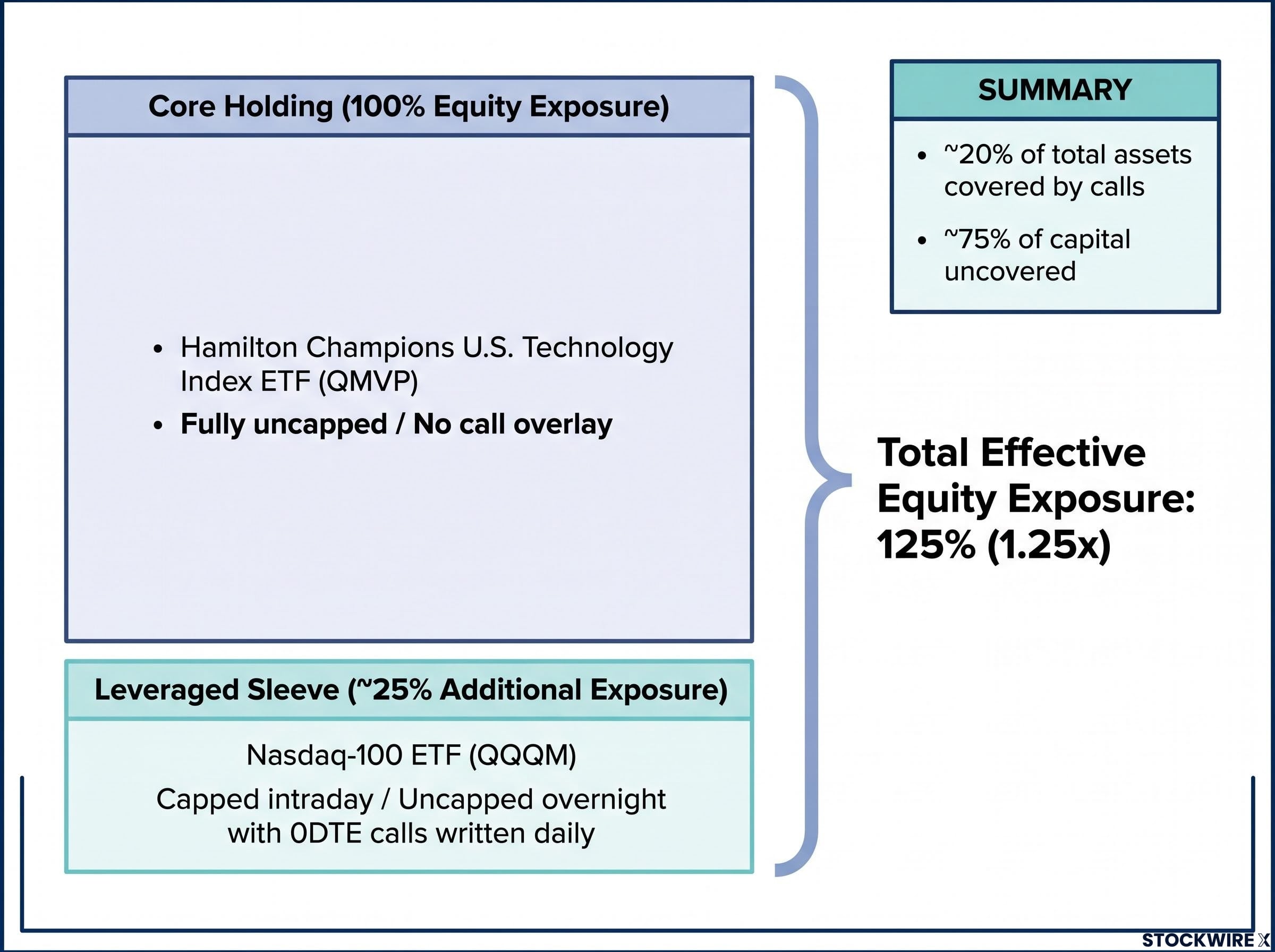
The first layer is the core holding: 100% equity exposure through the Hamilton Champions U.S. Technology Index ETF (QMVP), providing broad U.S. technology exposure. This entire slice carries no permanent call overlay. It participates fully in upside moves, all the time.
The second layer is a leveraged sleeve of approximately 25% additional exposure through a Nasdaq-100 ETF (QQQM), bringing total effective equity exposure to roughly 125% (or 1.25x). Only this leveraged sleeve has calls written against it, and those calls are zero days to expiration (0DTE), meaning they are opened each morning and expire by the close of the same trading day.
| Layer | Underlying Instrument | Coverage Status | Upside Participation |
|---|---|---|---|
| Core (100%) | Hamilton QMVP | No call overlay | Fully uncapped |
| Leveraged sleeve (~25%) | Nasdaq-100 ETF (QQQM) | 0DTE calls written daily | Capped intraday only; uncapped overnight |
The numbers tell the story clearly. Only approximately 20% of total assets are covered by at-the-money daily calls (approximately 25% of NAV, given the 1.25x exposure). That leaves roughly three-quarters of your capital uncovered and fully participating in any move higher.
What zero days to expiration means for overnight gap recovery
0DTE calls, or zero days to expiration calls (options that expire on the same day they are written), are the mechanism that makes QDAY’s recovery behaviour structurally different from a conventional covered call fund.
The Cboe analysis of 0DTE options growth documents how same-day expiry contracts now account for a substantial share of total index options volume, a structural shift in market mechanics that underpins why QDAY’s daily-expiry design carries real liquidity depth rather than relying on a niche or illiquid instrument.
Each trading day, calls are opened in the morning on the leveraged sleeve and expire by the close. At that point, QDAY holds no outstanding call obligations. The entire 1.25x portfolio sits overnight without any ceiling on appreciation.
Recoveries frequently take shape during hours when markets are closed: a central bank announcement after the bell, a geopolitical development over the weekend, a corporate result released before the open. Because the 0DTE calls have already expired by that point, the full 125% exposure is free to capture any resulting gap-up when trading resumes. Fresh 0DTE calls are then written at the new, higher price level, so premium collection resumes from the elevated base rather than being anchored to pre-recovery strikes.
The result is that QDAY’s recovery participation is largely automatic and structural. If markets gap up overnight, the full portfolio benefits before any new option is sold. You do not need a manager to read the environment correctly. The architecture handles it.
How HPYE uses active put-and-call rotation to shift toward recovery positioning
Harvest’s Premium Yield Enhanced ETF (HPYE) takes a fundamentally different approach. Where QDAY bakes recovery participation into its rules, HPYE gives its investment team the discretion to actively shift the fund’s options posture based on market conditions.
HPYE holds a curated portfolio of approximately 20 large-cap North American equities, primarily dominant U.S. mega-cap names. Like QDAY, it employs modest leverage of approximately 25% of net asset value, producing roughly 1.25x effective equity exposure. The fund distributes income semi-monthly (twice per month), combining three streams: underlying equity returns, covered call premiums, and put-selling premiums.
The ability to rotate between call-writing and put-writing is where HPYE’s recovery mechanism lives. When the team writes covered calls, upside is capped above the strike in the familiar covered call structure. Shifting the overlay toward put-writing is a structurally different proposition: the fund sells puts on holdings it would accept owning at the strike price, generating premium income while imposing no ceiling whatsoever on equity appreciation. Income continues to flow from the options book, yet every point of upside the underlying stocks deliver is retained by the portfolio.
Cash-secured puts work on a structurally similar logic: the fund sells an obligation to buy shares at a set strike price and collects premium income upfront, imposing no ceiling on equity appreciation above that strike, which is precisely why HPYE can rotate toward put-writing to preserve income while removing the call cap.
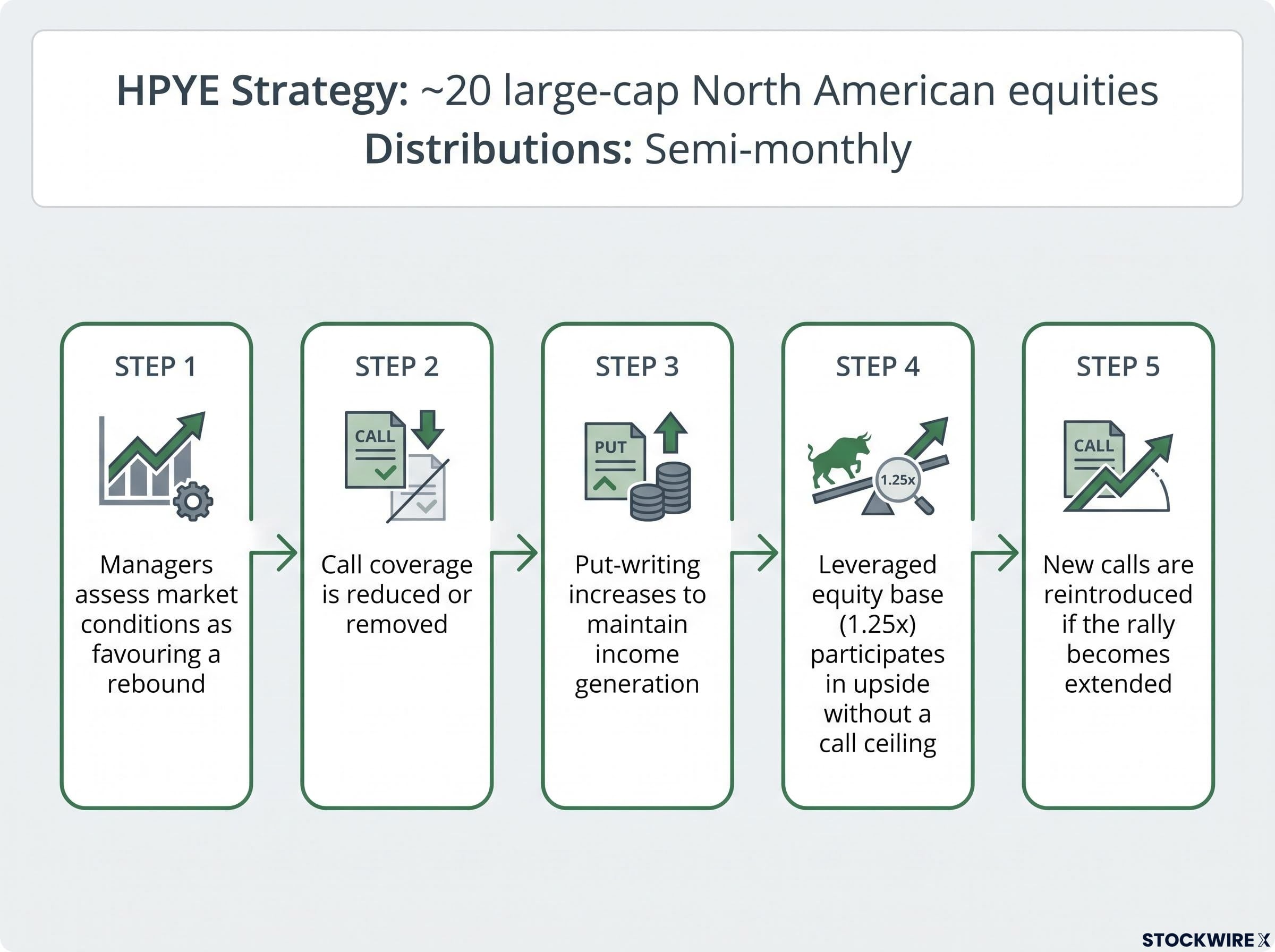
Here is how that rotation looks in practice during a recovery scenario:
- Managers assess market conditions as favouring a rebound
- Call coverage is reduced or removed on relevant holdings
- Put-writing increases to maintain income generation
- The leveraged equity base participates in upside without a call ceiling
- New calls are reintroduced if the rally becomes extended
The power of this flexibility is real. In a correctly anticipated recovery, removing the call cap and letting a 1.25x equity base run while collecting put premiums is a compelling combination.
But the risk is equally real.
If the recovery thesis is wrong and markets continue to fall, put-writing can force the fund to purchase stocks at above-market prices, adding downside exposure at precisely the wrong moment. Manager timing is HPYE’s primary structural risk.
Unlike QDAY’s rules-based architecture, HPYE’s recovery participation is discretionary. The outcome depends entirely on whether the investment team correctly anticipates the rebound and rotates toward put-writing before the recovery materialises. If they read it right, you benefit from uncapped upside on a leveraged base. If they misread the environment, the same mechanism compounds your losses.
For income investors comfortable with active management discretion and who want a fund that can dynamically shift between income-maximising and upside-participation modes, HPYE’s rotation mechanism is directly relevant to your evaluation framework.
Structural vs. discretionary recovery capture: choosing between them
The core decision between these two funds maps to two investor characteristics: your conviction in a specific sector, and your comfort level with manager dependency.
| Dimension | QDAY | HPYE | Investor Best Fit |
|---|---|---|---|
| Recovery upside mechanism | Structural: no overnight calls; ~75% of capital uncovered | Discretionary: managers rotate from calls to puts to remove upside cap | QDAY if you want certainty; HPYE if you trust active timing |
| Sector exposure | U.S. technology concentrated (QMVP + QQQM) | Diversified large-cap (~20 U.S. mega-cap names) | QDAY if bullish on tech; HPYE if you want broader exposure |
| Options instruments used | Primarily 0DTE covered calls on leveraged sleeve | Both covered calls and cash-secured puts, actively managed | QDAY for rules-based simplicity; HPYE for flexible overlay |
| Manager discretion required | Low: rules and structure drive behaviour | High: allocation between calls and puts is a judgment call | QDAY if you prefer mechanical certainty; HPYE if comfortable with active decisions |
| Primary structural risk | Leverage amplifies drawdowns; U.S. tech concentration; 0DTE volatility | Manager timing on call-vs-put allocation; forced stock purchases via puts in declines | Both carry leverage risk; sector risk in QDAY, timing risk in HPYE |
Both funds share a common characteristic: approximately 1.25x effective equity exposure through approximately 25% leverage on NAV. Both target regular, high-income distributions. The leverage amplifies gains and losses equally in both structures, so neither offers a free lunch on the downside.
Where they diverge is in the source of conviction required from you as the investor. QDAY asks you to accept U.S. technology concentration in exchange for recovery participation that is mechanically guaranteed. HPYE asks you to accept manager dependency in exchange for broader sector diversification and a flexible overlay that can adapt to conditions.
Past performance does not guarantee future results. Financial projections are subject to market conditions and various risk factors.
Both funds as long-term holdings, not just correction plays
It is worth noting that both funds are designed as viable long-term core holdings rather than purely tactical instruments deployed only after corrections. Their ongoing income-generating characteristics, daily premiums from 0DTE writing in QDAY’s case and semi-monthly distributions combining three income streams in HPYE’s, mean the decision is not really about when to deploy them. It is about which recovery participation mechanism fits your ongoing risk tolerance.
The framework above applies not just to the next post-correction environment but to how you want income generation and upside participation to coexist in your portfolio over a full market cycle.
For investors who hold conventional covered call ETFs alongside either of these funds, reclaiming capped upside through a sized leveraged ETF companion is an alternative structural approach worth understanding, particularly for portfolios where selling the income position is not practical.
Evaluating covered call ETF design when income and recovery both matter
The covered call recovery problem is not inherent to the strategy category. It is a function of specific design choices: coverage ratio, option tenor, and whether call obligations persist across the moments when recoveries typically begin.
The recovery problem is not baked into covered call ETFs as a category. It is a product of design choices, specifically coverage ratio, option duration, and overnight persistence, that vary meaningfully across funds.
QDAY and HPYE represent two valid engineering answers to the same design problem. QDAY covers only approximately 20% of total assets, uses daily-expiring options, and carries no overnight cap. HPYE can rotate its entire overlay between calls and puts, removing the upside ceiling entirely when managers choose to do so. Most conventional covered call ETFs sit at the opposite end of the spectrum: fully covered, passively written, monthly-option structures that the opening section identified as the problem case.
That spectrum gives you a portable framework. The next time you evaluate any covered call ETF, whether these two or any other, ask three questions:
Applying rigorous ETF due diligence to either fund means looking beyond the options overlay mechanics to mandate alignment, holdings concentration, distribution quality, and provider track record, all variables that determine whether a structurally sound design translates into a suitable portfolio holding.
- What percentage of total assets are covered by calls at any given time?
- How long do those calls persist, and do they carry over overnight or across sessions?
- Does the fund have a mechanism, structural or discretionary, to reduce coverage or shift to put-writing during recovery phases?
If you apply those three questions to your existing or prospective covered call ETF holdings, you will be able to identify, before the next correction arrives, whether your fund is structurally positioned to participate in the rebound or whether it will systematically sell away the recovery upside you need.
—