A 50% tariff on a targeted basket of Canadian goods has been announced by the United States government, with the Canadian Dollar posting the largest single-session drop of any major currency against the USD on the day the news broke. The announcement came through Truth Social and carries an implementation date of August 2026, landing with enough force to move USD/CAD by 0.47% in a single session, nearly four times the move against the next-closest major currency.
What happened next matters just as much. A three-day pause, announced after negotiations, produced an immediate and comparably sized CAD recovery. That two-sided pattern, sharp sell-off followed by sharp reversal, is the FX market making an argument about where this ends, not just where it started.
The data across this sequence tells you something specific about how to read the next tariff headline. Here is what the Canadian Dollar’s behaviour across the announcement, the approach to implementation, and the pause-reversal actually signals about the market’s probability-weighted view of the outcome, and how to use that signal going forward.
What the 50% tariffs actually cover, and who gets a pass
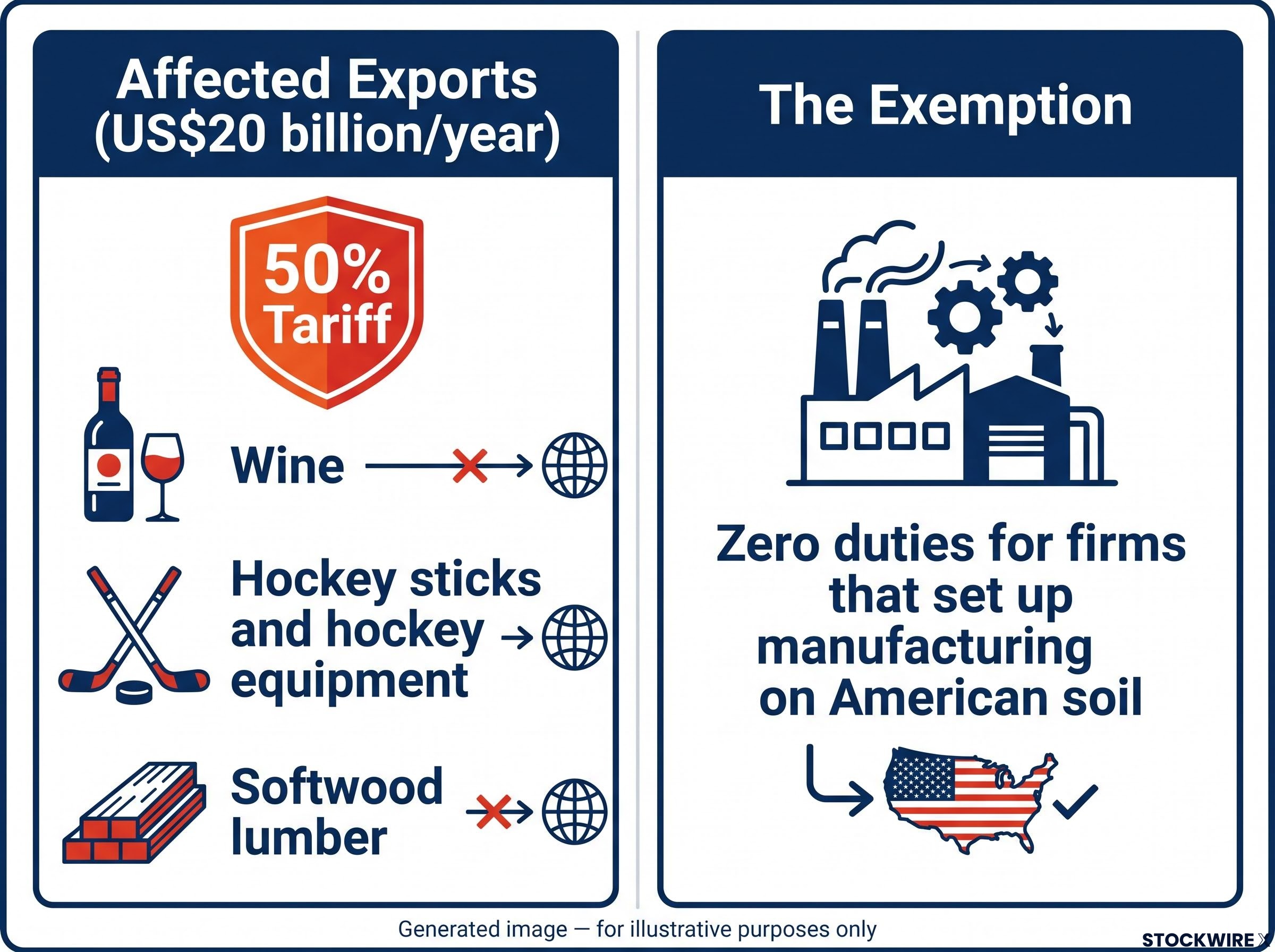
The tariff applies a 50% duty to a targeted basket of Canadian exports worth approximately US$20 billion per year. The affected categories include:
- Wine
- Hockey sticks and hockey equipment
- Softwood lumber
- Other manufactured and industrial products
That list matters, but the exemption structure matters more. Firms that set up manufacturing on American soil qualify for zero duties under the policy. This exemption is central to the policy’s design rather than incidental to it, functioning as a mechanism to encourage supply-chain relocation rather than acting purely as a penalty on Canadian producers. For investors, the distinction is material: companies with production flexibility are in a fundamentally different position from those locked into Canadian-based manufacturing.
Section 338 authority permits escalation to a full import ban without additional procedural steps, and its scope can be modified by presidential proclamation at any time, leaving the ceiling on this dispute genuinely open-ended in a way that conventional trade-remedy frameworks do not.
Trump’s stated justification: Trump pointed to longstanding Canadian trade barriers targeting US agricultural goods, dairy, autos, and alcohol as the basis for the move, arguing these had rendered the commercial relationship deeply one-sided. He cast Canada as conducting the overwhelming bulk of its trade with the US while that dependence was not reciprocated, and on that basis concluded Canada would no longer be accorded the standing of a partner nation in the bilateral relationship.
The implementation date is August 2026. A three-day pause was announced following negotiations, with Trump describing a deal as reached “subject to documents.”
When big ASX news breaks, our subscribers know first
How the Canadian Dollar moved, and what made the pattern unusual
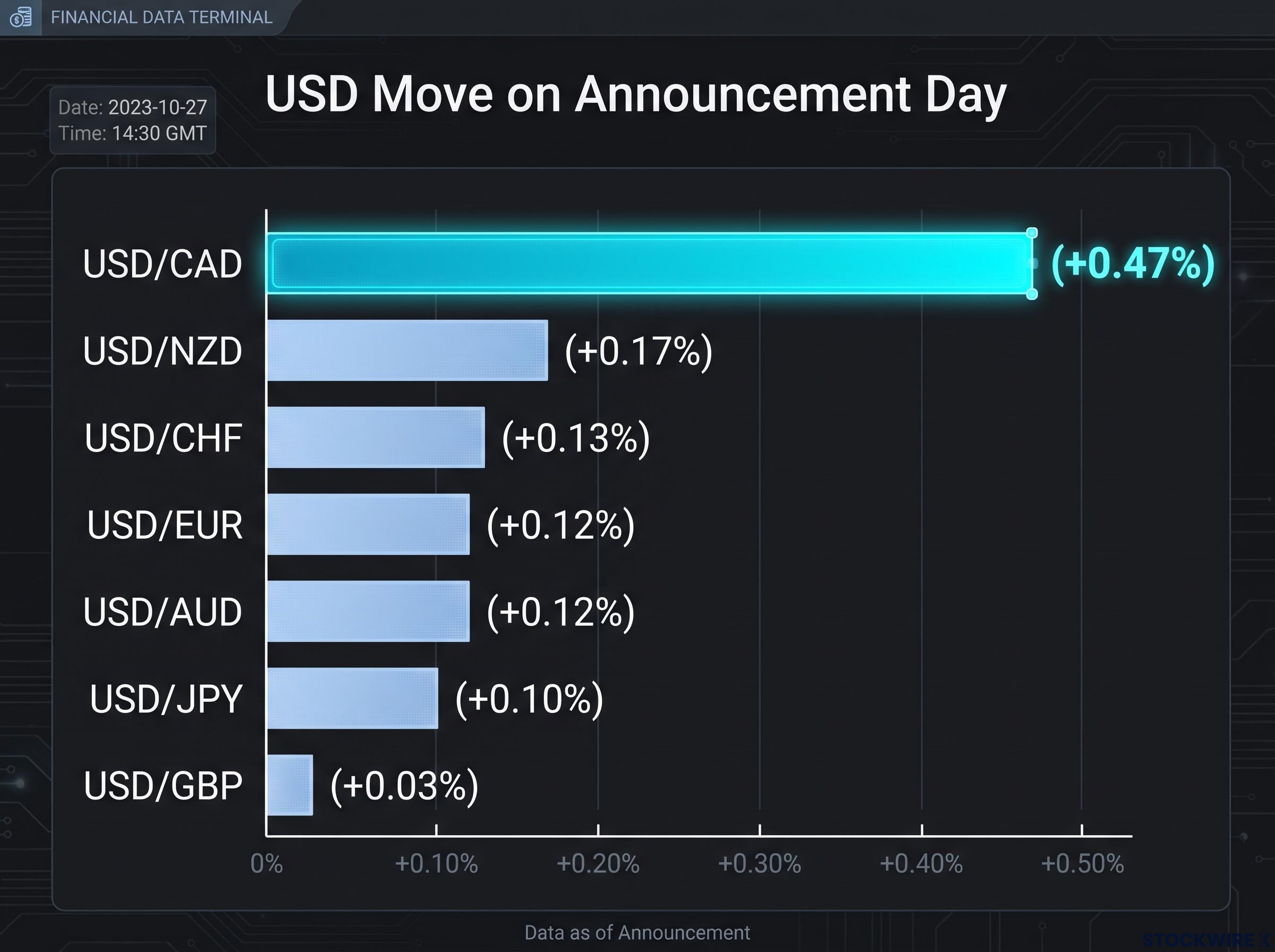
On announcement day, the USD gained approximately 0.47% against the CAD, according to FXStreet data. That was the largest USD advance against any major currency in that session.
The size of the move alone does not tell the full story. The cross-currency comparison does.
Why the CAD move was Canada-specific, not dollar-driven
| Currency Pair | USD Move on Announcement Day |
|---|---|
| USD/CAD | +0.47% |
| USD/NZD | +0.17% |
| USD/CHF | +0.13% |
| USD/EUR | +0.12% |
| USD/AUD | +0.12% |
| USD/JPY | +0.10% |
| USD/GBP | +0.03% |
The CAD did not just weaken against the dollar. It weakened against every major currency simultaneously: -0.35% against the Euro, -0.44% against the Pound, and -0.41% against the Yen. That confirms the move was a Canada-specific repricing event. If this had been general dollar strength, every other currency would have sold off in comparable magnitude. They did not. The market had a view on Canada as an individual growth and trade-risk story.
The reversal is equally part of the signal. When the three-day pause was announced, reports indicated USD/CAD fell roughly 0.5-0.6% intraday (this figure has not been independently confirmed), with the CAD reportedly reaching a 2.5-month high against the greenback. The speed of that recovery tells you how much negotiation optionality the market is pricing in.
What the FX reaction pattern tells investors about where markets think this ends
The two-sided, reversible nature of the CAD’s moves is itself a market verdict on policy durability. Investors who read only the 50% headline rate miss that argument entirely.
The data supports two interpretations. Either markets see the tariffs as manageable and negotiable, which is the pattern currently being priced, or they are deferring a more severe repricing until implementation is confirmed and prolonged. The speed and size of the CAD recovery on pause news implies traders are attaching meaningful probability to compromise, dilution, or reversal. That caps how far the pair can move on tariff fear alone.
TD Securities research on asymmetric CAD downside risk indicates a successful deal delivers only a 1.5 percentage point tariff reduction and a 0.1-0.2 percentage point GDP boost by end 2027, with much of that upside already priced into current positioning, while a breakdown would produce a sharp move higher in USD/CAD that current market levels have not adequately reflected.
BMO has characterised the loonie as having “taken the news in stride,” noting it traded stronger than pre-announcement levels after the initial dip (sourced via Perplexity; not independently confirmed). That framing aligns with the negotiation-optionality thesis the cross-currency data supports.
Even if the macro footprint is bounded, approximately 5% of Canada’s goods exports to the US are affected, representing roughly 0.8% of Canadian GDP (contextual estimates via Perplexity), the concentration of impact within specific industries means equity investors should look for intra-sector differentiation rather than a uniform Canadian market discount. Three practical implications follow:
- Growth risk is real but sector-concentrated, not economy-wide
- Negotiation optionality is being actively priced into the pair, capping unilateral moves
- Event risk around implementation deadlines, retaliation dates, and negotiation milestones is now structurally elevated
If subsequent tariff headlines consistently push USD/CAD higher without full reversals, that would signal the market is revising toward a persistent-damage thesis. The current two-sided pattern means that revision has not happened yet, and that is the variable worth monitoring.
How to use USD/CAD as a monitoring tool going forward
USD/CAD now functions as a real-time barometer for US-Canada trade policy sentiment. Given that Canada sends the great majority of its export volume to the American market while US dependence on Canadian trade runs in the opposite direction, the pair is exceptionally responsive to policy developments between the two countries. That sensitivity is what makes it useful.
Three monitoring anchors give the signal its structure:
- Track moves around key dates. Implementation deadlines, retaliation announcements, negotiation milestones, and any extensions or pauses are the moments where the pair reveals the market’s updated probability assessment. The three-day pause producing an immediate CAD recovery is a worked example of how monitoring the pair around event dates creates actionable information.
- Compare USD/CAD to peer currency pairs on the same day. When CAD moves more than its peers, as it did on announcement day (registering 0.47% against the USD while GBP registered only 0.03%), the signal is Canada-specific repricing, not general dollar noise. That comparison is the diagnostic test.
- Watch how tariff headlines interact with oil prices and Bank of Canada rate expectations. These remain the primary macro drivers of CAD and can amplify or dampen tariff-driven moves.
Oil-to-CAD transmission has weakened materially over the past decade according to Scotiabank research, meaning the commodity channel that would normally offset tariff-driven CAD weakness is running at reduced efficiency, compressing the natural stabiliser that historically cushioned bilateral trade shocks.
Two scenarios define the interpretive framework going forward:
- Persistent upward drift in USD/CAD without full reversals signals the market is revising toward a lasting-damage thesis, where implementation is expected to endure and retaliatory escalation is priced in
- Continued two-sided, reversible reactions signal the negotiable-policy thesis remains intact, meaning traders still see meaningful odds of compromise or partial relief
The reader who tracks USD/CAD against its peers on tariff announcement days will have a faster and more accurate read on whether markets are treating each new development as a negotiating move or a structural deterioration.
Whether the tariff regime holds will show up in the pair before it shows up in the data
The 50% headline rate matters less to current market pricing than the probability-weighted path of negotiations, exemptions, and escalation or de-escalation. USD/CAD has been encoding that probability distribution in real time across every stage of this episode.
What would change the picture is specific: a prolonged implementation without reversal, retaliatory Canadian measures that escalate the bilateral dynamic, or corporate relocation decisions that confirm supply-chain restructuring is underway. Each of those developments would shift the signal from two-sided to directional. The US-based manufacturer exemption is the structural feature most likely to influence long-run supply-chain and equity positioning if the tariff regime endures, because it converts a trade barrier into a relocation incentive with measurable economics.
Executive tariff authority raised the hurdle rate for long-term capital investment regardless of the tariff rate itself, a dynamic the US steel industry demonstrated across five decades of inconsistent protection, and the same structural uncertainty now applies to any cross-border supply chain exposed to US-Canada bilateral policy shifts.
As of August 2026, the FX market’s verdict is that the tariff regime is real but negotiable, and that verdict is subject to revision with each subsequent policy headline. The pair is already doing the analytical work. Watching USD/CAD in the context of tariff news offers a faster and more nuanced read on bilateral trade risk than waiting for GDP prints or trade balance revisions, and for investors with Canadian exposure, that speed matters.
This article is for informational purposes only and should not be considered financial advice. Investors should conduct their own research and consult with financial professionals before making investment decisions. These statements are speculative and subject to change based on market developments and policy decisions.