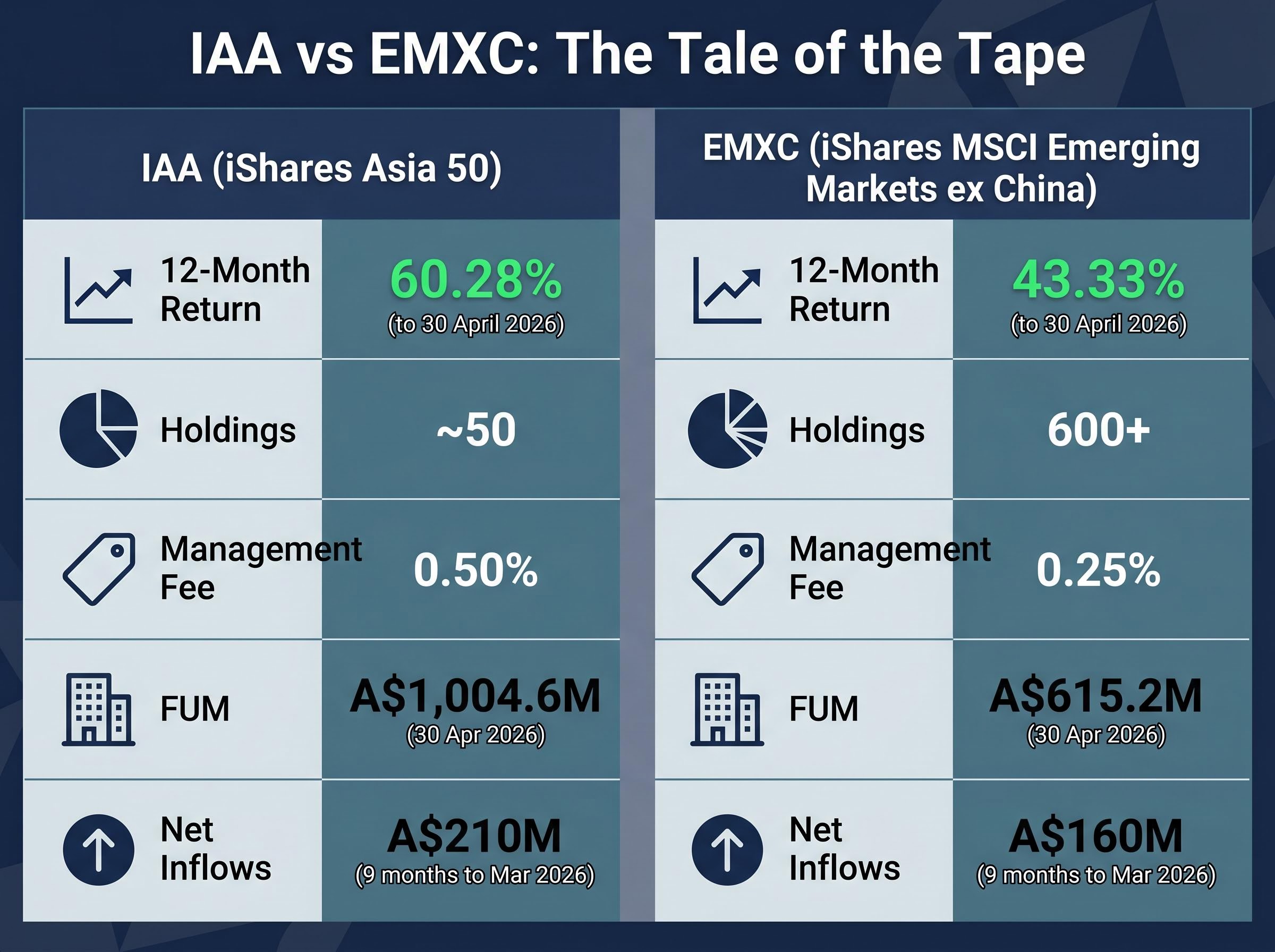
Two iShares ETFs listed on the ASX have posted returns that would make most Australian equity funds blush. IAA (iShares Asia 50 ETF) returned 60.28% and EMXC (iShares MSCI Emerging Markets ex China ETF) returned 43.33% over the 12 months to 30 April 2026, net of fees, in AUD.
Australian investors looking beyond the ASX 200 and the familiar US tech giants are increasingly turning to Asia-focused ETFs to access growth stories in India, Taiwan, South Korea, and Singapore. The timing matters: these gains arrived as flows into international equity ETFs surged, with IAA attracting approximately A$210 million in net inflows and EMXC pulling in approximately A$160 million over the nine months to March 2026, according to Morningstar Australia.
What follows breaks down exactly what drove those returns, what each fund holds, why one of them deliberately cuts out China, and what Australian investors should weigh before adding either to a portfolio.
Asia-focused ETFs in Australia: what you are actually buying
Both IAA and EMXC are passive, index-replicating ETFs listed on the ASX, managed by BlackRock’s iShares division, and traded in AUD with no foreign-exchange brokerage required. They track different indices, and that distinction explains nearly everything about how their returns diverge.
The broader ASX Asia ETF comparison across IAA, ASIA, and VAE reveals that management fees, index concentration, and sector tilt produce materially different risk profiles even among funds marketed to the same investor audience; IAA’s 0.50% fee sits between BetaShares ASIA at 0.67% and VAE at a confirmed 0.29%, a gap that compounds meaningfully over a multi-year holding period.
The ASX disclosure requirements for ETPs mandate that issuers publish the Net Asset Value per unit and portfolio composition daily, giving Australian investors the transparency needed to verify what each fund actually holds before committing capital.
| Feature | IAA | EMXC |
|---|---|---|
| Index tracked | S&P Asia 50 | MSCI Emerging Markets ex China |
| Approx. holdings | 50 | 600+ |
| Key countries | Taiwan, South Korea, Hong Kong, Singapore | India, Taiwan, South Korea, Brazil |
| FUM (30 Apr 2026) | A$1,004.6M | A$615.2M |
| Management fee | 0.50% | 0.25% |
Returns are total returns inclusive of distributions, calculated in AUD, net of fees. Currency movements between Asian markets and the Australian dollar are already embedded in the numbers. iShares manages approximately A$57.79 billion in Australian funds under management as of April 2026, placing it alongside Vanguard and BetaShares as one of the three dominant ETF providers on the ASX.
What IAA holds
The S&P Asia 50 Index comprises the 50 largest companies across Taiwan, South Korea, Hong Kong, and Singapore. The result is a concentrated, large-cap portfolio skewed heavily toward technology and financials. That concentration amplifies returns in a tech-led bull run and creates meaningful downside risk when the cycle turns.
What EMXC holds
The MSCI Emerging Markets ex China Index is far broader, spanning 600+ holdings across emerging markets with China deliberately removed. That exclusion shifts the country weight profile substantially toward India, Taiwan, and South Korea, all faster-growing markets that have benefited from structural tailwinds over the past year.
When big ASX news breaks, our subscribers know first
Breaking Down IAA: What Drove the 60.28% Gain
12-month NAV total return: 60.28% (after fees, AUD, to 30 April 2026)
The return was not a single-quarter spike. IAA’s FY-to-date return of 15.86% (from 1 July 2025 to 30 April 2026) confirms that performance was distributed across the financial year, with the bulk of gains arriving in the second half of calendar 2025 as the semiconductor and AI infrastructure cycle accelerated.
Three country-level forces combined to make a 60% return achievable from just 50 stocks:
- Taiwan semiconductors: TSMC and the broader Taiwanese chip supply chain captured surging demand from AI and high-performance computing buildouts. TSMC’s weighting in the index made it the single largest contributor to IAA’s result.
- South Korea memory rebound: A recovery in DRAM and NAND pricing and exports lifted Samsung Electronics, SK Hynix, and the broader Korean tech sector. The memory cycle turned positive through mid-2025 and sustained momentum into 2026.
- Singapore financials and REITs: Singaporean banks and REITs recovered as interest-rate expectations stabilised, providing a supplementary tailwind to a fund where Singapore carries a mid-sized weighting.
IAA’s concentrated structure is the amplifier. Fifty stocks, heavy in tech and financials, means that when those sectors move, the fund moves with them, in both directions. For Australian investors seeking a higher-beta tilt to Asian tech, this 12-month result illustrates the upside case. The same concentration that produced 60% creates real downside risk if the semiconductor cycle turns. According to Morningstar Australia, IAA attracted approximately A$210 million in net inflows over the nine months to 31 March 2026.
The semiconductor bubble narrative has gained traction as valuations have expanded, but Bank of America’s analysis shows that active long-only overweight in semiconductors sits at approximately 20%, roughly half the 40% peak seen in the 2017 cycle, suggesting the positioning that drove IAA’s Taiwan and South Korea weightings to outsized returns is elevated but not yet at the extremes associated with speculative excess.
The Ex-China Edge: EMXC’s 43.33% Return Explained
EMXC’s 43.33% NAV total return (after fees, AUD, to 30 April 2026) is the product of a deliberate structural tilt, not just a market tailwind. The FY-to-date return of 14.29% shows sustained momentum across the financial year.
The outperformance relative to standard emerging-market indices rests on two pillars: what the fund excludes and where the resulting weight concentrates. Chinese equities have been a drag on traditional EM benchmarks, and removing them has shifted capital toward markets with stronger earnings growth.
EMXC’s key country contributors, each with a distinct growth driver:
- India: GDP growth above 7%, strong corporate earnings in banking, IT, and industrials, and the “China+1” manufacturing shift drawing global capital
- Taiwan: AI and semiconductor demand centred on TSMC, with a stable Taiwan dollar and high free-cash-flow yields attracting foreign inflows
- South Korea: Memory chip price recovery and the “value-up” programme encouraging higher dividends and buybacks, drawing foreign investor re-engagement with the Kospi
- Brazil: Commodity tailwinds and domestic consumption recovery supporting broader EM diversification within the index
EMXC attracted approximately A$160 million in net inflows over the nine months to 31 March 2026, with the bulk arriving since January 2026 as ex-China EM outperformance gained attention among Australian investors, according to Morningstar Australia.
The result shows that deliberate index construction choices, specifically what a fund excludes, can matter as much as what it includes. That distinction is worth understanding for Australian investors building portfolios rather than simply chasing recent winners.
S&P Emerging Ex-China index research published in September 2024 quantified how China’s historical dominance in standard EM benchmarks produces a materially different risk and return profile compared to an ex-China construction, providing independent support for the case that index design choices, not just market conditions, shape long-run outcomes.
Why so many Australian investors are choosing to go ex-China
The shift toward ex-China emerging-market ETFs is not a single concern. It is four distinct concerns, each sufficient on its own to prompt a portfolio adjustment:
- Regulatory unpredictability: Abrupt crackdowns on tech, education, and property sectors since 2020 have demonstrated that shareholder interests can be subordinated to political objectives in China. Australian fund managers, including those at Platinum Asset Management and Fidelity International, have cited this as a primary reason to separate China exposure.
- Geopolitical and sanctions risk: Escalating US-China tensions, semiconductor export controls, and the possibility of conflict over Taiwan create scenarios where foreign ownership rights in Chinese equities could be impaired.
- Corporate governance concerns: Variable interest entity (VIE) structures, state-owned enterprise priorities, and accounting and disclosure quality leave minority shareholders with weaker legal recourse compared to other major markets.
- Concentration risk in traditional EM indices: Standard MSCI Emerging Markets indices have historically allocated 25-30%+ to China. An ex-China ETF allows investors to control that weight separately, either through a dedicated China vehicle or by avoiding it entirely.
The Stockspot ETF Report 2025 positions EMXC as a “core building block” for investors who want to manage China exposure separately. ASX Investor Update publications compare EMXC directly against IEM (iShares MSCI Emerging Markets, which includes China) and VGE (Vanguard FTSE Emerging Markets, which also includes China) as the standard alternatives.
The risk of being ex-China if China bounces
Morningstar analysts explicitly caution that EMXC’s recent outperformance is partly a function of China underperforming. If Chinese equities re-rate, a standard EM ETF with China exposure would likely outperform EMXC. This is a structural trade-off, not a prediction. Australian investors choosing EMXC are making an active choice about China exposure, not simply selecting a “safer” product.
The regional growth engines behind both funds: India, Taiwan, South Korea, and Singapore
| Country | Primary growth driver | Key risk | Presence in IAA / EMXC |
|---|---|---|---|
| India | GDP above 7%, manufacturing shift | Valuation stretch, INR volatility | EMXC only |
| Taiwan | AI/semiconductor super-cycle | Geopolitical risk, cycle peak | Both |
| South Korea | Memory chip rebound, value-up reforms | Export cycle sensitivity | Both |
| Singapore | Financials/REITs recovery, capital re-routing | Small market size, rate sensitivity | IAA only |
India
India’s GDP growth above 7% has been accompanied by corporate earnings strength across banking, IT, and industrials. Indian equities hit repeated record highs through late 2025 and early 2026. Production-linked incentive schemes and infrastructure improvements are supporting the “China+1” manufacturing shift, drawing global capital that feeds directly into EMXC’s returns.
Taiwan
The semiconductor super-cycle, centred on TSMC and AI/high-performance computing demand, has been the single largest performance driver for both ETFs. A relatively stable Taiwan dollar combined with high free-cash-flow yields in Taiwanese tech has attracted foreign inflows captured via ASX-listed Asia ETFs.
The AI capex cycle underpinning TSMC’s dominance in both IAA and EMXC is supported by combined 2026 capex guidance of approximately $725 billion from Microsoft, Google, Amazon, and Meta, but Morningstar analyst Dennis Li has identified an 18-24 month capex-to-revenue lag as the central structural risk, meaning the earnings that justify current semiconductor valuations are partially still ahead rather than fully recognised.
South Korea
A rebound in DRAM and NAND pricing has lifted South Korean exporters, while the government’s “value-up” programme, encouraging higher dividends and buybacks, has improved the governance case for Korean equities and drawn foreign investors back to the Kospi.
Singapore
Singaporean banks and REITs have recovered as rate expectations stabilised. Singapore is also attracting listings and asset-management inflows as capital shifts away from Hong Kong and mainland China, positioning the city-state as a growing beneficiary of regional capital re-routing.
What to weigh before adding IAA or EMXC to an Australian portfolio
The returns are the headline. The portfolio construction question is whether the conditions that produced them suit a given investor’s risk tolerance and time horizon.
The Stockspot ETF Report 2025 draws a clear distinction between the two:
Portfolio role: Stockspot classifies IAA as a “regional satellite” ETF, recommended tactically rather than as a core holding. EMXC is positioned as a potential “core building block” for investors managing China exposure separately.
Morningstar describes EMXC as a “sensible option” alongside a broad global ex-Australia ETF, rather than as a standalone global allocation. IAA is profiled as a “highly concentrated, large-cap Asia ex-Japan play” with a risk/return profile closer to a sector or factor allocation than a complete Asia allocation.
Before adding either fund, Australian investors should consider:
- What China exposure already exists in the portfolio (through IEM, VGE, or other vehicles)?
- Is the high sector concentration in IAA (tech and financials) acceptable given existing holdings?
- Is this intended as a core or satellite position, and for what time horizon?
- What is the outlook for the AUD against Asian currencies? Both funds hold assets in multiple currencies; AUD strength would reduce returns in Australian-dollar terms even if underlying Asian assets perform well.
One practical advantage of the ASX-listed versions: AUD trading and simpler tax reporting for Australian investors compared to US-listed equivalents, as noted by Livewire Markets.
For investors new to international equity ETFs who want to understand the index classification mechanics, currency risk, and tax obligations before making an allocation decision, our dedicated guide to emerging market investing on the ASX covers how MSCI and FTSE Russell classify countries differently, why South Korea appears in some EM indices but not others, and what Australian investors must report to the ATO on foreign income from these funds.
This article is for informational purposes only and should not be considered financial advice. Investors should conduct their own research and consult with financial professionals before making investment decisions. Past performance does not guarantee future results.
Double-digit returns are the story; understanding what produced them is the edge
IAA at 60.28% and EMXC at 43.33% over 12 months are among the strongest results on the ASX for the period, driven by identifiable forces: an AI-fuelled semiconductor super-cycle, Indian economic momentum, South Korean governance reforms, and the structural benefits of excluding China from an emerging-market allocation.
The ex-China thesis embedded in EMXC carries a genuine rationale, but it also carries its own trade-off. If Chinese equities re-rate, a standard EM ETF with China exposure would likely outperform. That is a structural choice, not a momentum trade.
The regional growth stories in India, Taiwan, South Korea, and Singapore have foundations that extend beyond the past 12 months: AI infrastructure demand, demographic tailwinds, and governance reforms. Concentration and currency risk, however, mean these funds reward investors who understand what they own.
Current holdings, fees, and performance data for both IAA and EMXC are available on the iShares Australia product pages. For investors evaluating whether the ex-China decision is appropriate for their portfolio, a direct comparison of EMXC against IEM and VGE is a practical starting point.